12 Year-Old Pak Girl Helps Promote MOOCs at Davos
Khadija Niazi, a 12-year old from Lahore, Pakistan, is taking online courses offered by a new wave of cyber-based educational platforms like Coursera and Udacity. She was recently interviewed by New York Times columnist Tom Friedman at World Economic Forum 2013 at Davos, Switzerland.
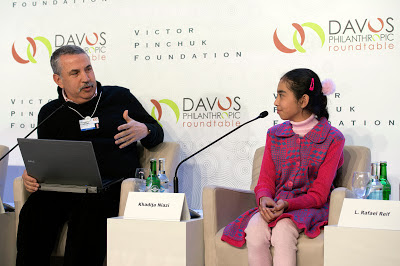 Khadija was the featured guest in a session on online education sponsored by Victor Pinchuk Foundation. She was joined on stage at WEF by Bill Gates, Larry Summer, Daphne Koller (Coursera co-founder), Rafael Reif (President of MIT), Jimmy Wales (Wikipedia founder), Peter Thiel and other dignitaries.
Coursera and Udacity offer massive open online courses (MOOCs) in a variety of subjects to large numbers of students from around the world. MOOC courses are often taught by professors who have been teaching for years at elite universities in the United States. Top academic institutions are in the forefront of online learning. For example, Harvard and M.I.T. have joined hands to introduce EdX, which offers free online courses from each university. About 753,000 students have enrolled, with India, Brazil, Pakistan and Russia among the top 10 countries from which people are participating, according to NY Times.
Khadija attends a local school in Lahore. She was only 10 years old when she first took the Artificial Intelligence online course on Udacity. She managed to finish the course and, the following year, Khadijah completed Udacity’s Physics course with highest distinction. She now plans to take courses in Astrobiology.
Enabling virtual education is the high-speed broadband expansion led by PTCL which has propelled Pakistan to become the fourth fastest growing broadband market in the world and the second fastest in Asia, according to a recent industry report.
The quickest and the most cost-effective way to broaden access to education at all levels is through online schools, colleges and universities. Sitting at home in Pakistan, self-motivated learners can watch classroom lectures at world's top universities including UC Berkeley, MIT and Stanford. More Pakistanis can pursue advanced degrees by enrolling and attending the country's Virtual University that offers instructions to thousands of enrolled students via its website, video streaming and Youtube and television channels.
The concept of virtual instruction is finding its way to K-12 education as well. Increasing number of Pakistanis are drawn to the Khan Academy channel on YouTube making Pakistanis among its top users. Virtual Education for All is a local Pakistani initiative extending the concept to primary level.
All of these technological developments and open courseware initiatives are good news for making education available and accessible to satisfy the growing needs in Pakistan and other emerging countries around the world seeking to develop knowledge-based economies of the 21st century.
Here's a video of Khadija's interview with Tom Friedman at Davos:
Related Links:
Haq's Musings
Pakistan's Youngest Computer Prodigy
Khan Academy Draws Pakistanis
Pakistan Virtual University Wins Top OCW Award
Pakistan Rolls Out 50Mbps Broadband Service
More Pakistan Students Studying Abroad
Inquiry Based Learning in Pakistan
Mobile Internet in South Asia
Allama Iqbal Open University
Online Courses at Top International Universities
Pakistan Virtual University
Pasi Sahlberg on why Finland leads the world in education
Intellectual Wealth of Nations

Coursera and Udacity offer massive open online courses (MOOCs) in a variety of subjects to large numbers of students from around the world. MOOC courses are often taught by professors who have been teaching for years at elite universities in the United States. Top academic institutions are in the forefront of online learning. For example, Harvard and M.I.T. have joined hands to introduce EdX, which offers free online courses from each university. About 753,000 students have enrolled, with India, Brazil, Pakistan and Russia among the top 10 countries from which people are participating, according to NY Times.
Khadija attends a local school in Lahore. She was only 10 years old when she first took the Artificial Intelligence online course on Udacity. She managed to finish the course and, the following year, Khadijah completed Udacity’s Physics course with highest distinction. She now plans to take courses in Astrobiology.
Enabling virtual education is the high-speed broadband expansion led by PTCL which has propelled Pakistan to become the fourth fastest growing broadband market in the world and the second fastest in Asia, according to a recent industry report.
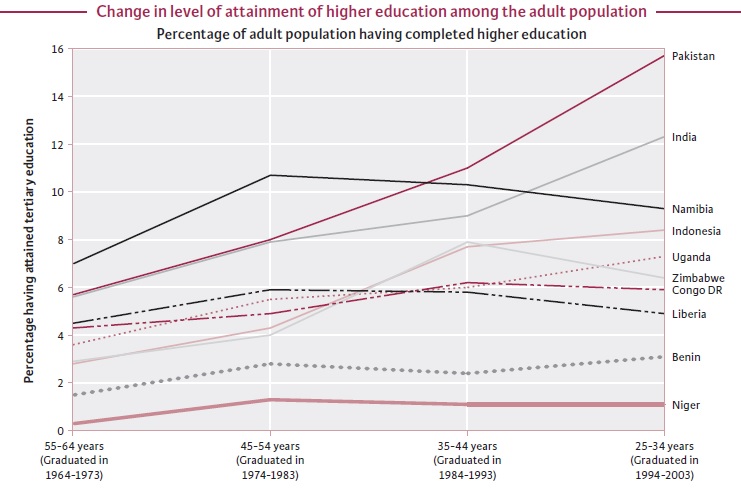 |
| Source: OECD Global Education Digest 2009 |
The quickest and the most cost-effective way to broaden access to education at all levels is through online schools, colleges and universities. Sitting at home in Pakistan, self-motivated learners can watch classroom lectures at world's top universities including UC Berkeley, MIT and Stanford. More Pakistanis can pursue advanced degrees by enrolling and attending the country's Virtual University that offers instructions to thousands of enrolled students via its website, video streaming and Youtube and television channels.
The concept of virtual instruction is finding its way to K-12 education as well. Increasing number of Pakistanis are drawn to the Khan Academy channel on YouTube making Pakistanis among its top users. Virtual Education for All is a local Pakistani initiative extending the concept to primary level.
All of these technological developments and open courseware initiatives are good news for making education available and accessible to satisfy the growing needs in Pakistan and other emerging countries around the world seeking to develop knowledge-based economies of the 21st century.
Here's a video of Khadija's interview with Tom Friedman at Davos:
Related Links:
Haq's Musings
Pakistan's Youngest Computer Prodigy
Khan Academy Draws Pakistanis
Pakistan Virtual University Wins Top OCW Award
Pakistan Rolls Out 50Mbps Broadband Service
More Pakistan Students Studying Abroad
Inquiry Based Learning in Pakistan
Mobile Internet in South Asia
Allama Iqbal Open University
Online Courses at Top International Universities
Pakistan Virtual University
Pasi Sahlberg on why Finland leads the world in education
Intellectual Wealth of Nations


Comments
They work by masking IP addresses.
Here's an example:
http://en.softonic.com/s/youtube-proxy-list
ISLAMABAD: Robotics as a discipline of science and technology is being taught at the graduate and post-graduate levels by more than 60 universities of Engineering Science and Technology in Pakistan, official sources told Daily Times here on Saturday.
The research and development (R&D) in advanced fields of Robotics and Artificial Intelligence has also been undertaken by some of laboratories established in the R&D institutes and universities in Pakistan. The official in the Ministry of Science and Technology claimed that there is a technical group engaged in development of automation of industrial processes at the National Institute of Electronics (NIE), Islamabad. The group has developed Programmable Logic Controllers (PLCs), which are used in automatic industrial controls.
The Centre for Intelligent Machines and Robotics (IMR) at the COMSATS Institute of Information Technology has a Research Group, which is undertaking research related to robotics, computer vision and machine learning. The IMR Research Group is conducting basic and applied research in robotics technologies relevant to industrial and societal tasks; the robotics technology in Pakistan has the potential role in boosting the productivity and competitiveness. The researchers at CIIT are working for projects on visual guided robotic systems for use in surgery, navigation control, mapping and geometric representation of environmental parameters.
National Engineering Robotics Contest (NERC) is an inter universities robotics competition held annually since 2005 at the NUST. The contest is organised by HEC, the Science, Technology, Engineering and Mathematics (STEM) Careers Project with more than 60 Pakistani universities participating in the event, and aims to train individuals for engineering services in Pakistan, and cash prizes are awarded to the winners.
NERC 2011 held at the College of Electrical and Mechanical Engineering (EME), Rawalpindi from June 28 to July 2. Many universities like FAST, GIKI, LUMS, CASE and UET Lahore participated in the event, where students were encouraged to design, develop and programme their respective robots.
R&D projects on Tele-Surgical Training Robot and Simulators and Development of Intelligent Robotic Wheelchairs are being undertaken by NUST funded by ICT R&D Fund.
International workshops and seminars for knowledge sharing and events at national level for talent hunt among youth in the fields of robotics have been organised regularly at NUST. Specialisation in robotics is a popular choice for students going abroad to study under various scholarships schemes for research and PhD. This field offers job opportunities, and robotics engineers can apply their mastery in diverse fields like modern warfare, surgery, nano-technology and space-exploration.
The official claimed that developing a robot comes with the goal of finding a solution to the problem. Along with the technical know-how, interest in research is essential. This field has promising opportunities, with no boundaries and will continue to grow with the advancement of science and technology in the near future.
http://www.dailytimes.com.pk/default.asp?page=2013\02\10\story_10-2-2013_pg5_12
Wednesday, February 13, 2013 - Peshawar—Dell is proud to be doing its part in developing literacy and promoting education in Pakistan. Dell was recently selected to provide the provincial government of Khyber-Pakhtunkhwa (KPK) 25,000 Inspiron3420 computers, the first round of distribution was conducted on Feb 10 at Peshawar University.
Speaking about the initiative, Project Director KPK, Adeel Khan, said “This project is a great leap in terms of equipping our youth to meet the challenges of the modern world and to keep Pakistan a competitor in the global knowledge economy. Dell’s involvement goes a long way in guaranteeing the success of this initiative.”
The initiative is the largest of its kind ever in the province and is designed to help enable students and people of KPK to become productive and contributing members of society and to give back to the province.
Shahzad Aslam Khan, Country Manager Dell Pakistan & Afghanistan, said “We look forward to working with KPK as they increase technology access and the learning potential for students. Mobile computing devices have become essential to daily life — at work, at home and increasingly, in academic institutions. Students are leveraging devices of all kinds to access information, collaborate with their peers and teachers, and produce dynamic content inside and outside of the classroom.
At Dell, we believe these devices can help support teaching and learning – and have the potential to personalize the learning experience for each student.Dell is delighted to work with KPK in this important program and is committed to providing these devices by meeting aggressive time lines and ensuring highest product quality”.
http://pakobserver.net/detailnews.asp?id=195707
The national focal point of this distance learning initiative selected by the HEC is the Latif Ebrahim Jamal Science Information Centre located at the University of Karachi. Over 2,000 lectures from professors based in the US, UK, Europe and Australia have been delivered through this mechanism during the last three years.
A major advance in distance learning was the availability of MIT OpenCourseWare free of charge to the world. This provided over two thousand excellent undergraduate and postgraduate courses in various disciplines delivered by the MIT faculty. There are about 20 million website visits by students from 215 countries to benefit from these courses annually and an astonishing 100 million users have benefited from them so far.
We set up a mirror website of the MITCourseWare in Pakistan to facilitate downloading when I was chairman of the HEC. These Massive Open Online Courses (MOOCs) are also being introduced by Stanford and other universities. One such initiative, ‘Udacity’, was initiated by a Stanford professor last year and attracted 160,000 students to register for the course on artificial intelligence.
The fastest growing distance learning initiative, ‘Coursera’, was started by two Stanford professors of computer science and has already enrolled more than two million students worldwide. Harvard University has also followed the same path, teaming up with MIT to start online courses under a programme termed ‘edX’. These will be available free for developing countries.
Apple-iTunesU also offers access to websites of the leading universities in the world including Cambridge, Oxford, Yale etc, where free video lectures are available. The Khan Academy based in California has been providing school and college level materials for many years, many of which are dubbed in Urdu by a group based in NED University, Karachi.
Recently a meta search engine has been developed at the International Centre for Chemical and Biological Sciences at Karachi University to quickly search through all these materials, and arrangements have been made to make these materials available to students and academics in Pakistan free of charge through internet and television.
The Latif Ebrahim Jamal Science Information Centre is the HEC designated national focal point for the video conferencing and distance learning programmes. The formal inauguration of educational TV is expected to occur within a couple of months. This will be a huge leap forward for education in Pakistan, and I am thrilled to be a part of this exciting initiative to help bring quality education to the doorsteps of some 100 million youngsters of Pakistan who are below the age of 19.
http://www.thenews.com.pk/Todays-News-9-161624-Education-at-the-doorstep
The world’s media recently reported how a new approach to online learning – called massive, open, online courses (MOOCs) – allowed a 12-year-old girl from Pakistan to study subjects like astrobiology from the worlds’ top universities. The story captured our attention, hinting at how education might open doors in ways unimaginable just a few years ago.
While the potential for change is dramatic in developing countries, new learning technologies have the power to revolutionize life for Canadians, as well.
A recent Statistics Canada survey suggests that as many as one third of Canadians have unmet learning needs. That is, because of family responsibilities, demands of work, or the challenges of location and time, many Canadians are unable to pursue the educational path they imagine for themselves.
---
MOOCs are certainly opening our eyes to the possibility of addressing these needs. They may also be the tail that wags the dog. The technology is evidence of dynamic forces at work to dramatically change higher learning.
Four factors are rapidly taking us beyond the tipping point for major change in postsecondary education: advances in understanding how people learn; transformative technologies; a shift in demand for new learning options; and rising costs for the current bricks and mortar model.
What is at play here is similar to the upheaval we’ve seen in the book, music and video industries. Technologies are driving dramatic new ways of enjoying these creative materials. The winners are almost everyone: There is massive access now to the very best works of art. But with the new forms of access come new forces of change, and pressure for the creators of these materials to rapidly adapt to new forms of content created in different ways and by almost anyone.
The analogy is imperfect, however. Education is not a product to be passively consumed. Just as people still want to attend a concert, go to a high-quality bookstore, or prefer to see a hockey game in person rather than on TV, there will still be a place for physical classrooms and the exciting face-to-face experiences of learning.
However, the factors mentioned above are pushing us to adopt more effective teaching methods like “flipped” classrooms, where students review material online, and spend valuable class time in discussion and analysis. They are pushing us to make more use of blended learning, which involves a varied mix of technologies outside and inside class time. And they are pushing us to offer more high quality fully online programs. All together these represent an approach often called flexible learning.
The challenge will be managing this profound change. Professors are not dispensers of information. They are guides through the growing vastness of information – provokers of critical thought and analysis, facilitators and mentors who can effectively channel discussion so that the learning becomes a personal and a shared effort.
For those who are passionate about education, the possibilities of change outweigh the anxieties. After leading UBC’s first MOOC on game theory, a course that attracted 130,000 learners, Prof. Kevin Leyton-Brown, an associate professor of computer science, enthused that he had four times as many Canadians in his course than he had taught in 10 years as professor.
--
We don’t know yet what the future holds, but I invite universities across our country to join with us to embrace the challenge to develop innovative learning opportunities. Together we can open worlds to 12-year-old Pakistani girls and boys. But we can also unleash a new level of creativity and potential for Canadians.
http://m.theglobeandmail.com/news/national/education/technology-will-change-universities-as-it-changed-the-music-industry/article11310170/?service=mobile
DOTCOM mania was slow in coming to higher education, but now it has the venerable industry firmly in its grip. Since the launch early last year of Udacity and Coursera, two Silicon Valley start-ups offering free education through MOOCs, massive open online courses, the ivory towers of academia have been shaken to their foundations. University brands built in some cases over centuries have been forced to contemplate the possibility that information technology will rapidly make their existing business model obsolete. Meanwhile, the MOOCs have multiplied in number, resources and student recruitment—without yet having figured out a business model of their own.
Besides providing online courses to their own (generally fee-paying) students, universities have felt obliged to join the MOOC revolution to avoid being guillotined by it. Coursera has formed partnerships with 83 universities and colleges around the world, including many of America’s top-tier institutions.
EdX, a non-profit MOOC provider founded in May 2012 by Harvard University and the Massachusetts Institute of Technology and backed with $60m of their money, is now a consortium of 28 institutions, the most recent joiner being the Indian Institute of Technology in Mumbai. Led by the Open University, which pioneered distance-learning in the 1970s, FutureLearn, a consortium of 21 British, one Irish and one Australian university, plus other educational bodies, will start offering MOOCs later this year. But Oxford and Cambridge remain aloof, refusing to join what a senior Oxford figure fears may be a “lemming-like rush” into MOOCs.
On July 10th Coursera said it had raised another $43m in venture capital, on top of the $22m it banked last year. Although its enrolments have soared, and now exceed 4m students, this is a huge leap of faith by investors that the firm can develop a viable business model. The new money should allow Coursera to build on any advantage it has from being a first mover among a rapidly growing number of MOOC providers. “It is somewhat entertaining to watch the number of people jumping on board,” says Daphne Koller, a Stanford professor and co-founder of Coursera. She expects it to become one of a “very small number of dominant players”.
The industry has similar network economics to Amazon, eBay and Google, says Ms Koller, in that “content producers go to where most consumers are, and consumers go to where the most content is.” Simon Nelson, the chief executive of FutureLearn, disagrees. “Anyone who thinks the rules of engagement have already been written by the existing players is massively underestimating the potential of the technology,” he says.
Certainly, there is plenty of experimentation with business models taking place. The MOOCs themselves may be free, but those behind them think there will be plenty of revenue opportunities. Coursera has started charging to provide certificates for those who complete its courses and want proof, perhaps for a future employer. It is also starting to license course materials to universities that want to beef up their existing offering. However, it has abandoned for now attempts to help firms recruit employees from among Coursera’s students, because catering to the different needs of each employer was “not a scalable model”, says Ms Koller......
http://www.economist.com/news/business/21582001-army-new-online-courses-scaring-wits-out-traditional-universities-can-they?fsrc=scn/tw_ec/the_attack_of_the_moocs
On Sept. 17, the Pakistani government shut down access to YouTube. The purported reason was to block the anti-Muslim film trailer that was inciting protests around the world.
One little-noticed consequence of this decision was that 215 people in Pakistan suddenly lost their seats in a massive, open online physics course. The free college-level class, created by a Silicon Valley start-up called Udacity, included hundreds of short YouTube videos embedded on its website. Some 23,000 students worldwide had enrolled, including Khadijah Niazi, a pigtailed 11-year-old in Lahore. She was on question six of the final exam when she encountered a curt message saying “this site is unavailable.”
Niazi was devastated. She’d worked hard to master this physics class before her 12th birthday, just one week away. Now what? Niazi posted a lament on the class discussion board: “I am very angry, but I will not quit.”
In every country, education changes so slowly that it can be hard to detect progress. But what happened next was truly different. Within an hour, Maziar Kosarifar, a young man taking the class in Malaysia, began posting detailed descriptions for Niazi of the test questions in each video. Rosa Brigída, a novice physics professor taking the class from Portugal, tried to create a workaround so Niazi could bypass YouTube; it didn’t work. From England, William, 12, promised to help and warned Niazi not to write anything too negative about her government online.
None of these students had met one another in person. The class directory included people from 125 countries. But after weeks in the class, helping one another with Newton’s laws, friction and simple harmonic motion, they’d started to feel as if they shared the same carrel in the library. Together, they’d found a passageway into a rigorous, free, college-level class, and they weren’t about to let anyone lock it up.
By late that night, the Portuguese professor had successfully downloaded all the videos and then uploaded them to an uncensored photo-sharing site. It took her four hours, but it worked. The next day, Niazi passed the final exam with the highest distinction. “Yayyyyyyy,” she wrote in a new post. (Actually, she used 43 y’s, but you get the idea.) She was the youngest girl ever to complete Udacity’s Physics 100 class, a challenging course for the average college freshman.
That same day, Niazi signed up for Computer Science 101 along with her twin brother Muhammad. In England, William began downloading the videos for them.
Read more: http://nation.time.com/2012/10/18/college-is-dead-long-live-college/
YouTube has been banned in Pakistan for a year now, underscoring the rising influence of Islamist hardliners and intolerance for free speech in the country.
The ban came after YouTube refused Pakistan's demand that it remove “the Innocence of Muslims” clips, outtakes from an attempt at making an anti-Islamic film that enraged many Muslims, from its website.
Islamists, backed by different religious parties came out to protest in the thousands, and started riots across Pakistan, leaving at least 20 people dead. Protestors also attempted to attack the US Embassy in Islamabad. The government eventually blocked access to YouTube last September, appeasing the protestors. A year later, despite calls to end the ban from free speech activists and business interests, the ban remains.
“The Pakistani government has been blocking Internet content under the pretext of national interest, religion, and morality,” says Hassan Belal Zaidi at the independent Internet rights advocacy group Bytes For All, based in Islamabad. “But it is actually trying to block any parallel discourse on the Internet and curtail freedom of expression of minorities... both political and religious, which speak against their persecution that happens quite often in Pakistan, and are not covered by mainstream media."
----------
Youtube hasn’t been the only case of social media censorship in Pakistan. Facebook and Twitter have been banned for hosting what the government deemed blasphemous material. And websites promoting separatism in the restive province of Balochistan and those criticizing the powerful Pakistani Army are also regularly blocked.
It’s not a complete crackdown: Internet rights activists say many Pakistanis are getting around the ban in new and creative ways.The digital block can easily be circumvented, they say, by using proxies and virtual private networks.
“Software such as Hotspot Shield, Spotflux, or TOR Browser as well as a host of online proxy servers are being used to access YouTube in the country. Many Pakistan-specific mirror sites have also been set up to allow people here to access content on Youtube, directly and indirectly,” says Mr. Zaidi.
Though university students who cannot access proxies while on university servers are losing out, everyone from Internet experts to the former president’s son provide advice online on how to circumvent the ban.
“Anyone using iOS and looking to get around the YouTube ban I suggest downloading VPN One Click,” tweeted the former president's son Bilawal Bhutto Zardari, chairman of the Pakistan People's Party, the party that was in power when the YouTube ban was enforced last year.
One possible silver lining, say some observers, is that the ban and problems associated with using proxies has prompted a rise in alternative local websites. One example is www.tune.pk, which now has more than 25,000 registered users. “We cannot beg someone to erase the videos we do not like, instead we made our own space,” reads a statement on the website run as a private enterprise out of Lahore, the cultural capital of Pakistan. The website says the site regularly monitors content and removes any material that it feels is not suitable for a Pakistani audience.
That self-censorship is not satisfying to activists. Bytes For All, the advocacy group, has filed a lawsuit against the government's YouTube ban in the Pakistani courts, saying it curtails the fundamental rights of Pakistanis. The group's lawyer says the case is slow going because the government is terrified of inflaming religious sentiments and the possibility of more violence.
http://www.csmonitor.com/World/2013/0919/Pakistan-s-YouTube-ban-1-year-later
The idea of attending academies became popular a decade ago and even parents are also of the view that there was no concept of after-school tuition in their student life.
But now, a general perception has developed that a student, without attending academies, cannot get good marks.
Probably, this has been the reason for parents to blindly spend on their children's academies whether tutors are clearing the concepts or not that is usually not the concern but parents simply get satisfied from the fact that their child is getting "extra assistance for studies."
The other fact is that owing to mushrooming of academies, standards of teaching at schools have dropped with no efforts to fix them.
"All this has given rise to academy mafia which has plagued our society. We see tuition centres opening in every other street," Muhammad Iqbal, father of a student, said on Sunday.
He said such centres exploit both parents and students in the name of `quality education' while in reality, all this is a result of lack of `quality education' in schools and colleges.
Rahim Khan, guardian of a 9th class student, informed that the fast growing academy industry is a living proof that teachers are unable to deliver their concepts effectively.
What is even more painful is that many a time teachers deliberately do not clear concepts of their students so that they are left with no choice but to join their academies in the evening.
He termed this situation "very sad" and supported the trend of online education, which, he said, would be a viable alternative to throwing money to support a broken system.
"Our education sector is already bickering in pain. There is a dire need for institutes to come up with solutions to stop this exploitation," he opined.
The first alternative is Sabaq Foundation's website www.sabaq.pk which is an online video tutorial website with free video lectures for Pakistani students. The website provides tutorials for four main science subjects -- Mathematics, Physics, Chemistry and Biology for SSC, FSc and O Level students. The best thing about this website is that all tutorials have been prepared and sequenced following the exact syllabus of respective boards Cambridge, Federal, Punjab, Sindh, Khyber Pakhtunkhwa (KPK) and Balochistan.
Another example is that of Maktab.pk which is quite similar to Sabaq and provides lecture videos for four science subjects for FSc students.
So clearly, there are people who recognize the deficiencies of the current state of affairs and are working to resolve them.
When contacted, an education expert was of the view that non-profit initiatives
like these can be a game changer in society and once enough awareness is created about such free educational resources, students can
surely get rid of hassle and cost of after-school academies.
http://www.thenews.com.pk/Todays-News-6-296927-Online-help-for-studies-a-viable-alternative-to-academies
https://www.thenews.com.pk/print/413797-online-education-programme-launched-in-14-kp-districts
Online education programme - tele-education - has been launched in 14 districts of the province under which the students of grades-4 and 5 would be taught English, mathematics and science subjects online.
For the purpose, 150 schools have been selected where 16,000 students would be imparted education. “Sixty percent of the students taking benefit of the programme are girls,” said Zulfiqar Ahmad, managing director of the Elementary and Secondary Education Foundation (ESEF).
The programme has been jointly launched by ESEF, DFID, Pakistan Poverty Alleviation Fund (PPAF) and Tele-education Organisation. It is being launched in Peshawar, Charsadda, Swabi, Nowshera, Mardan, Mansehra, Abbottabad, Swat, Dir, Chitral, Bannu, Dera Ismail Khan and Lakki Marwat.
The official said the computer labs would be established in the schools where the online classes would be arranged. Teachers sitting in Islamabad would deliver online lectures at the schools.
He said the programme had already been launched in some areas of Chitral, Dir and other districts and within a short span of time the interest of the students had increased.
The official said monthly monitoring of the programme is done and the students have shown enough improvement in the subjects they are taught online. He said the curriculum of government schools is taught in the online classes.
The official said in some schools of Chitral and Dir Lower, the project has already been completed and due to the successful results, it has been extended for another two years. The project continued for nine months in different schools in Chitral.
More elite business schools try virtual degrees to lure graduate students
https://www.wsj.com/articles/online-mba-wharton-berkeley-nyu-georgetown-11667343552
Starting next year, executive M.B.A. students at the Wharton School of the University of Pennsylvania can earn the $223,500 degree from their living rooms.
After years of resistance, some of the country’s top business schools are starting virtual M.B.A. programs that require only a few days of in-person instruction. Wharton and Georgetown University’s McDonough School of Business said they would include options for executive and part-time M.B.A. students to take most coursework online in 2023.
This fall, part-time M.B.A. students at New York University’s Stern School of Business and the University of California, Berkeley’s Haas School of Business were given an online option for most of their classes. All of the programs will charge online students the same tuition as those who attend in person, and those online students will get the same degree and credential as on-campus counterparts.
The move to give students flexible location options comes as demand for two-year, full-time traditional M.B.A. programs has been dropping amid a competitive job market and growing concern about the cost of college.
“The pandemic definitely accelerated this in every industry,” said Brian Bushee, who leads teaching and learning at Wharton and also teaches accounting. “I would be surprised in 10 or 20 years if there were schools that only did in-person and did nothing online.”
Between 2009 and 2020 the number of online M.B.A.s at accredited business schools in the U.S. more than doubled, and schools added more fully online M.B.A. degrees over the past two years during the pandemic, according to the Association to Advance Collegiate Schools of Business. Recent announcements by Wharton and others mark a turning point for adoption of the degrees even at highly ranked campuses, school leaders say.
-------
At Stern, even the students who choose online courses are required to take nine in-person credits, which can be completed on nights or weekends, or by doing an intensive weeklong session.
Boston University’s Questrom School of Business, which announced its online M.B.A. in 2019, graduated its first online M.B.A. students in August. The degree, which costs $24,000, follows a completely separate curriculum and costs far less than the traditional M.B.A. program. Online M.B.A students watch live broadcasts of professors and talk in small groups or on a virtual online forum. A 2021 survey of students found that 35% received a promotion since enrolling.
Many schools are still reluctant to make a reduced-price online degree because they fear such a product might eat up demand for their traditional M.B.A. programs, said Paul Carlile, who leads online learning at Questrom.
Halley Kamerkar, 36 years old, finished her online Questrom coursework in August and said hearing from fellow M.B.A. candidates in South Africa, Ireland and Miami was valuable.
Ms. Kamerkar, of Salem, Mass., said she thought about graduate school for a long time, but a study guide she bought for the Graduate Management Admission Test gathered dust until she learned about Questrom’s program with its $24,000 price tag. Ms. Kamerkar works in the nonprofit sector and only recently paid back her undergraduate loans.
“I did not want to give up my full-time career to take a step back and pursue education,” she said.