Social Media Revolution Exposes Corruption in Pakistan
Social media revolution is well underway in Pakistan. The new media are coming of age, and trumping the traditional commercial media. Many of the top journalists in the mainstream media knew about Arsalan's Iftikhar's massive corruption but it was through Youtube that the world first learned about it. The same pattern repeated itself when Duniya TV's incriminating off-air video footage found its way on Youtube.
Familygate or Arslangate:
It has now been established that Malik Riaz Husain of Bahria Town approached a number of top TV talk show hosts in Pakistan and shared detailed information, videos and documentation about $3.7 million in illegal payments made to Arsalan Iftikhar, the son of Chief Justice Iftikhar Mohammad Chaudhry, over several years. Others, including Chaudhry Aitazaz Ahsan, knew about it and shared it with Justice Chaudhry a while ago. While rumors swirled among the Capital insiders, the public at large was kept in the dark until recently when a video of Shaheen Sehbai talking about it surfaced on Youtube and forced the mainstream media to finally discuss it on air.
Here's Shaheen Sehbai breaking the scandal on Youtube:
Mediagate:
Several behind-the-scenes video clips of a Dunya TV talk show leaked on Youtube reveal the television hosts appearing to be helping Malik Riaz Husain prepare his answers, and in certain cases even spoon-feeding him the answers.
The leaked video also shows a son of Prime Minister Yousaf Raza Gilani and a daughter of Pakistan Muslim League (Nawaz) chief Nawaz Sharif calling in to try and influence the on-air contents. “Why don’t you start talking about it yourself, otherwise [if we ask] it will seem planted, which it is, but I don’t know if it should look planted,” says Ms Mehr Bukhari to Malik Riaz while Mr Lucman say that “I’ll say it on air that I’ve been "pressurised" by Mian Amir Mehmood (Dunya TV's owner) and Malik Riaz to do this program.”
Here's two-part Duniya TV's leaked video on Youtube:
Questions:
The fact that mainstream media sat on these stories raises serious questions about whose interests are its journalists serving? Why are they afraid to expose the top judges? What kind of illegal payments and other favors are they accepting from the rich and the powerful? How are the commercial interests of the media owners influencing the editorial opinions and news coverage? Are they trying to hide their own guilt? And to what end?
What's Next:
Free and independent media are often seen as an effective watchdog in a democracy. But the question being asked now is who's watching the watchdogs? One possible answer is that the new super watchdogs are the ordinary citizen journalists and bloggers who are active in the new cybermedia and not beholden to any special interests.
High-speed broadband expansion led by PTCL has propelled Pakistan to become the fourth fastest growing broadband market in the world and the second fastest in Asia, according to a recent industry report. Serbia leads all countries surveyed with a 68% annual growth rate from Q1 2010 to Q1 2011. Thailand (67%), Belarus (50%), Pakistan (46%), and Jordan (44%) follow Serbia. India is in 14th place worldwide with a 35% annual growth rate.
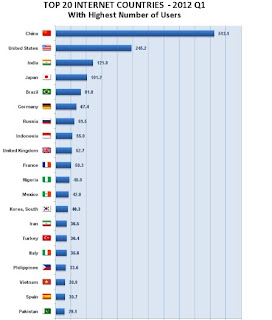
In spite of rapid growth, the level of Internet penetration is Pakistan is still low. In a population of 180 million, only 30 million ( about 16 percent) are connected to the Internet, according to Internet World Stats. It's enough Pakistan among the top 20 nations in terms of Internet subscribers. And Internet use in Pakistan is growing at a rapid rate, particularly in urban centers where 40% of the population lives, which are also home to the middle class which often forms the backbone of mass-scale uprisings. Mobile Internet use shot up 161 percent in 2010 alone.
Summary:
I believe Pakistan is entering a new era of the Internet media. And I hope that the new social media will continue to enjoy sufficient freedom and growth to provide wide enough access in Pakistan for the citizen journalists to play their role as a watchdog where the mainstream commercial media fails. Sunlight is indeed the best disinfectant for the rot that characterizes Pakistan's power centers today.
Related Links:
Haq's Musings
Imran Khan's Social Media Campaign
Culture of Corruption in Pakistan
Pak Judges' Jihad Against Corruption
Pakistan Rolls Out 50Mbps Broadband Service
Mobile Internet in South Asia
Media and Telecom Sectors Growing in Pakistan
Internet Service Providers of Pakistan
Chaudhry is No Angel
Justice Chaudhry's Address to New York Bar
Incompetence and Corruption in Pakistan
Zardari Corruption Probe
NRO Amnesty Order Overturned
Transparency International Rankings 2011
Familygate or Arslangate:
It has now been established that Malik Riaz Husain of Bahria Town approached a number of top TV talk show hosts in Pakistan and shared detailed information, videos and documentation about $3.7 million in illegal payments made to Arsalan Iftikhar, the son of Chief Justice Iftikhar Mohammad Chaudhry, over several years. Others, including Chaudhry Aitazaz Ahsan, knew about it and shared it with Justice Chaudhry a while ago. While rumors swirled among the Capital insiders, the public at large was kept in the dark until recently when a video of Shaheen Sehbai talking about it surfaced on Youtube and forced the mainstream media to finally discuss it on air.
Here's Shaheen Sehbai breaking the scandal on Youtube:
Mediagate:
Several behind-the-scenes video clips of a Dunya TV talk show leaked on Youtube reveal the television hosts appearing to be helping Malik Riaz Husain prepare his answers, and in certain cases even spoon-feeding him the answers.
The leaked video also shows a son of Prime Minister Yousaf Raza Gilani and a daughter of Pakistan Muslim League (Nawaz) chief Nawaz Sharif calling in to try and influence the on-air contents. “Why don’t you start talking about it yourself, otherwise [if we ask] it will seem planted, which it is, but I don’t know if it should look planted,” says Ms Mehr Bukhari to Malik Riaz while Mr Lucman say that “I’ll say it on air that I’ve been "pressurised" by Mian Amir Mehmood (Dunya TV's owner) and Malik Riaz to do this program.”
Here's two-part Duniya TV's leaked video on Youtube:
Questions:
The fact that mainstream media sat on these stories raises serious questions about whose interests are its journalists serving? Why are they afraid to expose the top judges? What kind of illegal payments and other favors are they accepting from the rich and the powerful? How are the commercial interests of the media owners influencing the editorial opinions and news coverage? Are they trying to hide their own guilt? And to what end?
What's Next:
Free and independent media are often seen as an effective watchdog in a democracy. But the question being asked now is who's watching the watchdogs? One possible answer is that the new super watchdogs are the ordinary citizen journalists and bloggers who are active in the new cybermedia and not beholden to any special interests.
High-speed broadband expansion led by PTCL has propelled Pakistan to become the fourth fastest growing broadband market in the world and the second fastest in Asia, according to a recent industry report. Serbia leads all countries surveyed with a 68% annual growth rate from Q1 2010 to Q1 2011. Thailand (67%), Belarus (50%), Pakistan (46%), and Jordan (44%) follow Serbia. India is in 14th place worldwide with a 35% annual growth rate.
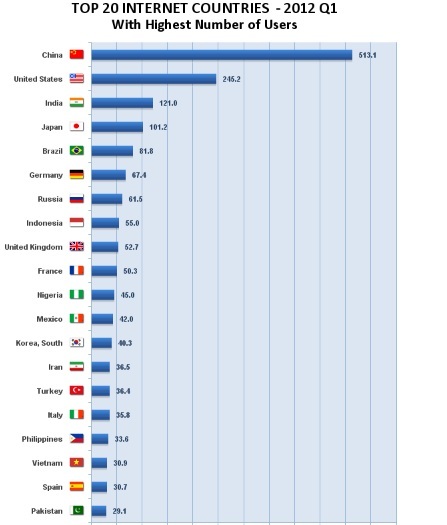
In spite of rapid growth, the level of Internet penetration is Pakistan is still low. In a population of 180 million, only 30 million ( about 16 percent) are connected to the Internet, according to Internet World Stats. It's enough Pakistan among the top 20 nations in terms of Internet subscribers. And Internet use in Pakistan is growing at a rapid rate, particularly in urban centers where 40% of the population lives, which are also home to the middle class which often forms the backbone of mass-scale uprisings. Mobile Internet use shot up 161 percent in 2010 alone.
Summary:
I believe Pakistan is entering a new era of the Internet media. And I hope that the new social media will continue to enjoy sufficient freedom and growth to provide wide enough access in Pakistan for the citizen journalists to play their role as a watchdog where the mainstream commercial media fails. Sunlight is indeed the best disinfectant for the rot that characterizes Pakistan's power centers today.
Related Links:
Haq's Musings
Imran Khan's Social Media Campaign
Culture of Corruption in Pakistan
Pak Judges' Jihad Against Corruption
Pakistan Rolls Out 50Mbps Broadband Service
Mobile Internet in South Asia
Media and Telecom Sectors Growing in Pakistan
Internet Service Providers of Pakistan
Chaudhry is No Angel
Justice Chaudhry's Address to New York Bar
Incompetence and Corruption in Pakistan
Zardari Corruption Probe
NRO Amnesty Order Overturned
Transparency International Rankings 2011
Comments
Users of social networking website Facebook in Pakistan have crossed the eight million mark, revealed statistics provided by Social Bakers. The number of Pakistani Facebook users stands at 8,008,720.
The steady increase in users has put Pakistan at 28th place in the ranking of countries that use Facebook.
The highest number of Facebook users (more than 160 million) is in the United States, followed by Brazil with more than 63 million and India with more than 62 million users.
According to the statistics, the total number of Facebook users in Pakistan grew by more than 1,383,900 in the last six months.
The statistics revealed that the age group with the highest number of Facebook users in Pakistan (3,990,800) lies in the age bracket of 18-24 and the second largest group in the age of 25-35.
According to the data, more men use Facebook in Pakistan than women.
Around 70% Facebook users are male, while 30% are female.
LinkedIn
The number of LinkedIn users in Pakistan has reached 1,472,143 (more than one million), as revealed by Social Bakers.
Pakistan stands at rank 10 among all countries that use LinkedIn.
http://tribune.com.pk/story/486676/pakistan-crosses-8-million-facebook-users/
Much of the communication and organization of civil society members in support of the lawyers' movement used social media platforms like facebook and twitter.
Pakistan saw the beginnings of online civil and political activism in 2008-2009 when the lawyers, according to Woodrow Wilson Center's scholar Huma Yusuf, "used chat forums, YouTube videos, Twitter feeds, and blogs to organize the Long March, publicize its various events and routes, and ensure that citizen reporting live from the march itself can be widely circulated to counter the government-influenced coverage of the protest on mainstream media outlets (such as state-owned radio and private news channels relying on government-issue licenses".
http://www.riazhaq.com/2011/05/can-bin-laden-raid-ignite-twitter.html
New media have broken stories where traditional media has failed, like Chief Justice Iftikhar Chaudhry's son Arsalan's corruption scandal.
http://www.riazhaq.com/2012/06/pakistans-familygate-mediagate-scandals.html
Politicians and their supporters are active on facebook and twitters to organize and get their messages out and influence public opinion and get votes.
http://www.riazhaq.com/2011/11/imran-khans-social-media-campaign.html
http://www.riazhaq.com/2013/05/election-ads-money-buys-favorable-media.html
New young talent is getting attention by posting its protest music videos online.
http://www.riazhaq.com/2011/11/pakistans-protest-music-in-social-media.html
Young men in Lahore have organized through facebook to clean city streets.
http://www.riazhaq.com/2009/05/young-pakistanis-inspire-with-public.html
Young men and women are defying old customs of arranged marriages based on parents' choices and going for civil marriages outside their families and biraderies. Some of it is resulting in violence by the old guard as evidenced in more honor killings.
In 1992, the applications for court marriages in Karachi amounted to about 10 or 15, mainly applications from couples who were seeking the protection of the court for wedlock without familial consent, according to Arif Hasan. By 2006, it increased to more than 250 applications for court marriages per day in Karachi. Significantly, more than half of the couples seeking court recognition of their betrothal came from rural areas of Sindh. This is yet another indication of how the entire feudal system and its values are in rapid collapse.
http://www.riazhaq.com/2012/12/violent-conflict-is-part-of-pakistans.html
Flashmobs are becoming more common.
Gays are finding each other through social media and organizing underground gay parties in Karachi and elsewhere.
http://www.bbc.co.uk/news/23811826
...The vituperative exchanges have exposed troubling aspects of Pakistan’s oft-lauded media revolution: Along with the military’s concerted campaign to muzzle the press is the heavy hand of querulous media barons who, driven by commercial concerns and personal grudges, may be endangering the sector they helped create.
“The way this has played out is extremely disturbing,” said Zaffar Abbas, editor of Dawn newspaper, one of the few media outlets that have stayed out of the dispute. “I’ve never seen the media like this, really going after one other. If better sense doesn’t prevail, whatever we have earned in press freedom will be lost.”
The stakes are high on all sides. Since 2007, when television coverage played a key role in fanning the street protests that led to the ouster of General Musharraf, the news media has grown into a powerful factor in Pakistani society. Television news has widened public debate and exposed abuses, but it has faced sharp criticism for shoddy reporting and for giving a platform to Islamist extremists.
The exploding market has also turned prime-time talk show hosts like Mr. Mir into powerful figures, and made fortunes for a handful of newly minted media tycoons.
------
“It is supremely dangerous to be a reporter in Pakistan,” he said.
The military, in particular, has squirmed under the media’s relentless scrutiny. Tensions have been bubbling for some time between the Jang Group, the country’s largest media conglomerate, and the ISI. Jang is owned by Mir Shakil ur-Rehman, a reclusive editor who lives with his two wives in Dubai, where he keeps a tight grip on a media empire that includes Geo News, several sports and entertainment channels, and a stable of newspapers in Urdu and English.
Last fall, Mr. Rehman came to believe that the ISI was sponsoring a new television station, Bol, to dilute his commercial and political clout. His newspapers ran hostile reports about Bol, prompting competing media organizations to hit back with stories that painted Geo as sympathetic to Pakistan’s old rival, India.
---------
Unlike in the Musharraf era, when journalists united against military attempts to muzzle them, virulent rivalries between the businessmen who own the major stations have pulled the news media apart.
Mr. Rehman of the Jang group has a rancorous relationship with Sultan Lakhani, who owns the smaller Express media group, which includes a television station and several newspapers. (One of those papers, the English-language Express Tribune, prints The International New York Times in Pakistan.) A third station, ARY, is owned by a family of gold dealers that has little love for Mr. Rehman.
“The control of the owners and their say in what happens has increased tremendously,” said one editor, speaking on the condition of anonymity. “No editor or journalist can take a stand against them.”
The turmoil has partly obscured the plight of Mr. Mir, who has an ambiguous history with the ISI. He shot to prominence after interviewing Osama bin Laden in 1998, and was initially seen as sympathetic to the pro-jihadi agenda of the Pakistani military and the ISI. But in recent years he has championed the cause of Baluch nationalists, angering the army, and highlighted human rights abuses during military operations.
He is now under close protection at a Karachi hospital, where flowers are piled outside his door and doctors report a steady recovery. In a statement issued through his brother, Mr. Mir vowed to “continue the fight for the rights of people till my last breath and last drop of blood.”....
http://www.nytimes.com/2014/04/27/world/asia/attack-on-journalist-starts-battle-in-pakistani-press.html
A respite for Pakistanis, Google introduced on Tuesday the local version of YouTube for Pakistan which will deliver country specific content.
If you’re in Nepal, Pakistan or Sri Lanka, you’ll see a new YouTube homepage that’s customised in your local language and domain, a post on Google Asia Pacific blog read.
Pakistan’s IT sector more robust than before
YouTube is already available in Nepali, Sinhalese and Urdu, and now having country-specific homepages means we can bring you the most relevant videos in a YouTube experience tailored for you, said the post written by Gautam Anand, Director of Operations and Content, YouTube Asia Pacific.
“With these launches, we hope to pave the way for the work of more local creators, personalities and musicians to shine on the world’s largest and most vibrant video community. To all our YouTube viewers and creators from South Asia and around the world, we can’t wait to see what you share,” he added.
YouTube has officially been banned in Pakistan since September 2012 after a low-budget movie containing sacrilegious content sparked furious protests around the world. At the time, the country’s top court ruled the site should be banned until a way is found to block all blasphemous material. Google had removed the blasphemous movie following a US court order but its shorter versions are still available online.
YouTube’s local version will present popular country-specific content on its home page. While announcing the launch, Google also presented some of their favourite examples of the South Asian content that’s already available on YouTube.
“Pakistanis love YouTube’s diverse music offerings. One of the country’s most popular YouTube channels is Coke Studio, a series of live studio-recorded music performances by artists from across Pakistan. Atif Aslam’s tribute to the magnum opus of the Sabri brothers, Tajdar-e-Haram is one their most-watched videos, clocking over 11 million views to date,” the post read.
National Assembly session: ‘Ban to stay till YouTube localised’
However, it is not yet known whether this localised version will lead to the removal of the government ban on YouTube. IT Minister Anusha Rahman could not be reached for comment.
In March last year, the state minister for information technology (IT) said YouTube will only be accessible in Pakistan after Google allows the country to manage the video-sharing website locally for proper monitoring. Anusha Rehman had said that the legislation to localise YouTube in Pakistan was under way.
3-8-2
John Swinton: Yes, he said it, but...
http://www.rense.com/general20/yes.htm
One night, probably in 1880, John Swinton, then the preeminent New York journalist, was the guest of honour at a banquet given him by the leaders of his craft. Someone who knew neither the press nor Swinton offered a toast to the independent press. Swinton outraged his colleagues by replying:
"There is no such thing, at this date of the world's history, in America, as an independent press. You know it and I know it.
"There is not one of you who dares to write your honest opinions, and if you did, you know beforehand that it would never appear in print. I am paid weekly for keeping my honest opinion out of the paper I am connected with. Others of you are paid similar salaries for similar things, and any of you who would be so foolish as to write honest opinions would be out on the streets looking for another job. If I allowed my honest opinions to appear in one issue of my paper, before twenty_four hours my occupation would be gone.
"The business of the journalists is to destroy the truth, to lie outright, to pervert, to vilify, to fawn at the feet of mammon, and to sell his country and his race for his daily bread. You know it and I know it, and what folly is this toasting an independent press?
"We are the tools and vassals of rich men behind the scenes. We are the jumping jacks, they pull the strings and we dance. Our talents, our possibilities and our lives are all the property of other men. We are intellectual prostitutes."
(Source: Labor's Untold Story, by Richard O. Boyer and Herbert M. Morais, published by United Electrical, Radio & Machine Workers of America, NY, 1955/1979.)