Pakistan Needs National Energy Policy
Since the middle of the 18th century, the Industrial Revolution has transformed the world. Energy-hungry machines are now doing more and more of the work at much higher levels of productivity than humans and animals who did it in pre-industrial era. In recent years, the rapid growth in computers and mobile phones spawned by the Information and Communications Technology (ICT) revolution has further increased demand for energy. Currently somewhere between 5-10% of
electrical consumption is for ICT and it's likely to continue to grow rapidly.
Energy Consumption:
Energy consumption in this day and age generally indicates a nation's level of industrialization, productivity and standards of living. Going by this yardstick, Pakistan's 14 million BTUs per capita consumption in 2009 indicates that the country has a long way to go to achieve levels comparable with the world average productivity signified by 71 million BTUs per capita as estimated by US Energy Information Administration for 2009.
Regional Comparison:
Although Pakistan's 14 million BTUs per capita energy use is ahead of Bangladesh's 6 million BTUs and Sri Lanka's 10 million BTUs, it is less than India's 18 million BTUs, and far behind China's 68 million BTUs and Malaysia's 97 million BTUs.
Energy Costs:
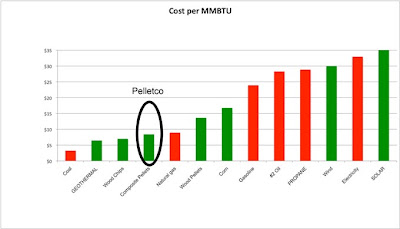
Fossil fuels are currently the primary source of the bulk of energy used. Cost of producing energy from various fossil fuels ranges from $2-4 per million BTUs for coal to $19-20 per million BTUs from oil. Costs of energy from natural gas vary widely depending on the source. Cost of shale gas in the United States has plummeted to about $2 per million BTU recently, while Pakistan has signed agreements to purchase gas from Iran and Turkmenistan in the range of $10 to $12 per million BTUs. Cost of production of domestic natural gas is in the range of $2 to $4 per million BTU.
Impact on Economy:
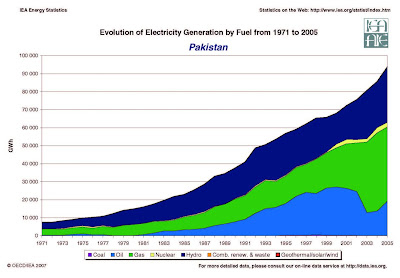
Energy costs have had a huge impact on Pakistan's economy. Its heavy dependence on imported oil has been a big contributor to balance of payments crises in the past. In 2008, for example, the oil prices jumped from less than $50 a barrel to $150 a barrel and forced the country to seek IMF bailout. Pakistan oil import bill has increased from about $7 billion in 2007 to over $12 billion in 2011. Energy shortages have also put a significant dent in Pakistan's GDP growth.
 Pakistan's Fuel Options:
If Pakistan could generate all of the 14 million BTUs of energy per capita from coal, the cost would be $28 to $56 for each person. Alternatively, the cost of using oil for the entire production would add up to about $280 per person, a significant chunk of Pakistan's per capita income of $1372 in 2011-12. The costs therefore range from a low of $28 to a high of $280 per Pakistani.
Energy Policy Suggestions:
As the nation develops and the energy demand increases, the policy makers have to try and produce as much of the needed energy at costs closer to the low-end of the range from $2 to $20 per million BTUs. Here are some policy suggestions for Pakistan's energy policy going forward:
1. Develop Pakistan's shale gas reserves estimated at 51 trillion cubic feet near Karachi in southern Sindh province. The US experience has shown that investment in shale gas can increase production quite rapidly and prices brought down from about $12 per mmBTU in 2008 to under $2 per mmBTU recently. Pursuing this option requires US technical expertise and significant foreign investment on an accelerated schedule.
2. Increase production of gas from nearly 30 trillion cubic feet of remaining conventional gas reserves. This, too, requires significant investment on an accelerated schedule.
3. Convert some of the idle power generation capacity from oil and gas to imported coal to make electricity more available and affordable.
4. Utilize Pakistan's vast coal reserves in Sindh's Thar desert. The problem here is that the World Bank, Asian Development Bank and other international financial institutions (IFIs) are not lending for coal development because of environmental concerns.And the Chinese who were showing interest in the project have since pulled out.
5. Invest in hydroelectric and other renewables including wind and solar. Several of these projects are funded and underway but it'll take a while to bring them online to make a difference.
6. Curb widespread power theft, improve collection of electricity dues from consumers, and resolve spiraling circular debt to make Pakistan's energy sector attractive to domestic and foreign investors.
Energy Conservation:
In addition to significantly increasing energy production, Pakistan needs to take prudent steps to conserve by promoting the use of energy-saving electric bulbs and machines. Concerns about the environment have propelled many developed nations to cut energy consumption in recent years. For example, serious conservation efforts have reduced Japan's 172 million BTUs per capita in 2009 down from 178 in 2005, Germany is at 163 million BTUs in 2009 down from 175 in 2005, and the United States is down to 308 million BTUs in 2009 from 340 million BTUs per person per year in 2005.
Summary:
Instead of addressing different pieces of the energy puzzle in an ad hoc fashion under multiple ministries and bureaucracies fighting turf battles, Pakistani policy makers need to look at the big picture for the sake of the nation's future. Nothing short of a holistic approach with a comprehensive energy policy formulated and implemented under a competent and powerful energy czar will do.
Related Links:
Haq's Musings
US EIA International Data on Per Capita Energy Consumption
Affordable Fuel for Pakistan's Electricity
Pakistan Needs Shale Gas Revolution
US Census Bureau's International Stats
Pakistan's Vast Shale Gas Reserves
US AID Overview of Pakistan's Power Sector
US Can Help Pakistan Overcome Energy Crisis
Abundant and Cheap Coal Electricity
US Dept of Energy Report on Shale Gas
Pakistan's Twin Energy Crises
Pakistan's Electricity Crisis
Pakistan's Gas Pipeline and Distribution Network
Pakistan's Energy Statistics
US Department of Energy Data
Electrification Rates By Country
CO2 Emissions, Birth, Death Rates By Country
China Signs Power Plant Deals in Pakistan
Pakistan Pursues Hydroelectric Projects
Pakistan Energy Industry Overview
Energy from Thorium
Comparing US and Pakistani Tax Evasion
Pakistan's Oil and Gas Report 2010
Circular Electricity Debt Problem
International CNG Vehicles Association
Rare Earths at Reko Diq?
Lessons From IPP Experience in Pakistan
Correlation Between Human Development and Energy Consumption
Energy Consumption:
Energy consumption in this day and age generally indicates a nation's level of industrialization, productivity and standards of living. Going by this yardstick, Pakistan's 14 million BTUs per capita consumption in 2009 indicates that the country has a long way to go to achieve levels comparable with the world average productivity signified by 71 million BTUs per capita as estimated by US Energy Information Administration for 2009.
Regional Comparison:
Although Pakistan's 14 million BTUs per capita energy use is ahead of Bangladesh's 6 million BTUs and Sri Lanka's 10 million BTUs, it is less than India's 18 million BTUs, and far behind China's 68 million BTUs and Malaysia's 97 million BTUs.
Energy Costs:
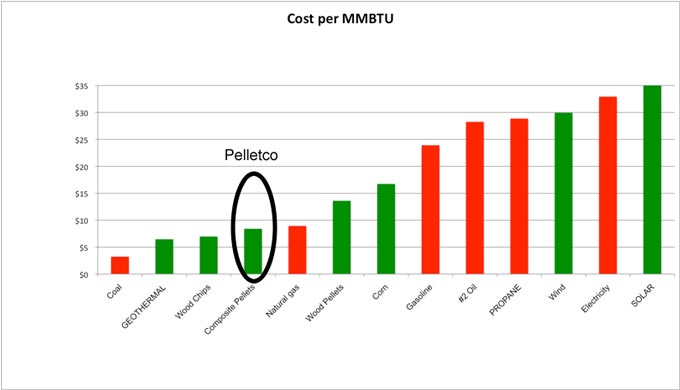
Fossil fuels are currently the primary source of the bulk of energy used. Cost of producing energy from various fossil fuels ranges from $2-4 per million BTUs for coal to $19-20 per million BTUs from oil. Costs of energy from natural gas vary widely depending on the source. Cost of shale gas in the United States has plummeted to about $2 per million BTU recently, while Pakistan has signed agreements to purchase gas from Iran and Turkmenistan in the range of $10 to $12 per million BTUs. Cost of production of domestic natural gas is in the range of $2 to $4 per million BTU.
Impact on Economy:
Energy costs have had a huge impact on Pakistan's economy. Its heavy dependence on imported oil has been a big contributor to balance of payments crises in the past. In 2008, for example, the oil prices jumped from less than $50 a barrel to $150 a barrel and forced the country to seek IMF bailout. Pakistan oil import bill has increased from about $7 billion in 2007 to over $12 billion in 2011. Energy shortages have also put a significant dent in Pakistan's GDP growth.

If Pakistan could generate all of the 14 million BTUs of energy per capita from coal, the cost would be $28 to $56 for each person. Alternatively, the cost of using oil for the entire production would add up to about $280 per person, a significant chunk of Pakistan's per capita income of $1372 in 2011-12. The costs therefore range from a low of $28 to a high of $280 per Pakistani.
Energy Policy Suggestions:
As the nation develops and the energy demand increases, the policy makers have to try and produce as much of the needed energy at costs closer to the low-end of the range from $2 to $20 per million BTUs. Here are some policy suggestions for Pakistan's energy policy going forward:
1. Develop Pakistan's shale gas reserves estimated at 51 trillion cubic feet near Karachi in southern Sindh province. The US experience has shown that investment in shale gas can increase production quite rapidly and prices brought down from about $12 per mmBTU in 2008 to under $2 per mmBTU recently. Pursuing this option requires US technical expertise and significant foreign investment on an accelerated schedule.
2. Increase production of gas from nearly 30 trillion cubic feet of remaining conventional gas reserves. This, too, requires significant investment on an accelerated schedule.
3. Convert some of the idle power generation capacity from oil and gas to imported coal to make electricity more available and affordable.
4. Utilize Pakistan's vast coal reserves in Sindh's Thar desert. The problem here is that the World Bank, Asian Development Bank and other international financial institutions (IFIs) are not lending for coal development because of environmental concerns.And the Chinese who were showing interest in the project have since pulled out.
5. Invest in hydroelectric and other renewables including wind and solar. Several of these projects are funded and underway but it'll take a while to bring them online to make a difference.
6. Curb widespread power theft, improve collection of electricity dues from consumers, and resolve spiraling circular debt to make Pakistan's energy sector attractive to domestic and foreign investors.
Energy Conservation:
In addition to significantly increasing energy production, Pakistan needs to take prudent steps to conserve by promoting the use of energy-saving electric bulbs and machines. Concerns about the environment have propelled many developed nations to cut energy consumption in recent years. For example, serious conservation efforts have reduced Japan's 172 million BTUs per capita in 2009 down from 178 in 2005, Germany is at 163 million BTUs in 2009 down from 175 in 2005, and the United States is down to 308 million BTUs in 2009 from 340 million BTUs per person per year in 2005.
Summary:
Instead of addressing different pieces of the energy puzzle in an ad hoc fashion under multiple ministries and bureaucracies fighting turf battles, Pakistani policy makers need to look at the big picture for the sake of the nation's future. Nothing short of a holistic approach with a comprehensive energy policy formulated and implemented under a competent and powerful energy czar will do.
Related Links:
Haq's Musings
US EIA International Data on Per Capita Energy Consumption
Affordable Fuel for Pakistan's Electricity
Pakistan Needs Shale Gas Revolution
US Census Bureau's International Stats
Pakistan's Vast Shale Gas Reserves
US AID Overview of Pakistan's Power Sector
US Can Help Pakistan Overcome Energy Crisis
Abundant and Cheap Coal Electricity
US Dept of Energy Report on Shale Gas
Pakistan's Twin Energy Crises
Pakistan's Electricity Crisis
Pakistan's Gas Pipeline and Distribution Network
Pakistan's Energy Statistics
US Department of Energy Data
Electrification Rates By Country
CO2 Emissions, Birth, Death Rates By Country
China Signs Power Plant Deals in Pakistan
Pakistan Pursues Hydroelectric Projects
Pakistan Energy Industry Overview
Energy from Thorium
Comparing US and Pakistani Tax Evasion
Pakistan's Oil and Gas Report 2010
Circular Electricity Debt Problem
International CNG Vehicles Association
Rare Earths at Reko Diq?
Lessons From IPP Experience in Pakistan
Correlation Between Human Development and Energy Consumption



Comments
A stunning chart that shows the entire economic history of the world's most powerful countries over the past 2,000 years has been released by investment bank JP Morgan.
Viewed as a whole, the graph shows the creeping restoration of Asian economic supremacy as the rest-of-the-world catches up to the West and its levels of industrialisation.
Charting the globe's 10 major powers since the time of Jesus, the graph can be broken down by simply applying a cut off point at around the 1800 AD mark.
That was the birth of the Industrial Revolution in the U.K. and when taken into account, everything to the left of that mark can bee seen as economic power through sheer size of population and to the right is the effect of mass production on a country's economic output.
One feature of the simple graph is to show that up until around 1500 AD India and China accounted for between 50 and 60 percent of the world's economy until the late 18th century when the Industrial Revolution rendered countries with large populations, just countries with the largest populations.
In 1 AD, China had a population of almost 60 million people, while the United States had a population of 680,000.
It took the United States 1800 years to overtake China's economic output.
But by 1950, even though the U.S had a population three times less than China, it's economic output was three times as great.
Additionally, in 1913, China had a population of 437 million and the U.K. had a population of 45 million, but their economic output was almost identical.
Indeed, when the graph is broken down into its constituent parts, the analysis of what happened in Europe and later the United States shows that the Western lead was taken even before 1800.
For the majority of human history the most important factor in economic growth was the relationship between births and deaths.
If there were too many births then there was not enough food to go around and without mass production techniques people went without until there was starvation or disease.
After a higher death rate, a stable supply of food was re-established, goods were shared among a smaller group of people and everyone felt and became richer until the cycle occurred again.
However, between 1000 AD and 1500 AD, wages, or GDP per capita had started to slowly rise as small economies of scale were made in agrarian organisation and moderate technological advances were made which improved the quality and length of life.
If a similar graph is opened up to show the world from Jesus to Napoleon, the slow building growth especially of Europe is clear to see, even without factoring in the Industrial Revolution.
However, if the graph is expanded to show the world from 1500 to World War I then the effect of mechanisation on the planets economic growth is clear.
Theories about why the Industrial Revolution occurred in the U.K. and then Northern Europe include the dense, localised population, easy availability of natural resources and the mild climate that exists around the North Sea and the U.K. for cotton spinning.
----------
As the world escaped the trap foreseen by Thomas Malthus of a rising population never matched by food production, population and GDP exploded.
The industrial revolution changed the Malthusian Trap leading to a situation today where the U.S. accounts for five percent of the world population and 21 percent of its GDP whereas Asia (minus Japan) has 60 percent of the world's population and only 30 percent of its GDP.
http://www.dailymail.co.uk/news/article-2163610/Fascinating-new-graph-shows-economic-history-world-Jesus.html
...Munir, born and educated in Lahore, makes his case in the latest issue of the Economic & Political Weekly of India, to be published on Saturday.
“The 1994 privatisation of the energy sector offered investors generous returns and created pricey overcapacity,” he told beyondbrics. “This created an expensive legacy which is the real problem of today’s energy crisis.”
Unless that problem is dealt with, he sees no light at the end of the energy tunnel.
He says Pakistan’s government, helped by the World Bank, “sweetened” its energy privatisation with attractive conditions, fearing it wouldn’t be able to attract investors otherwise. It guaranteed a 12 to 15 per cent annual return (indexed in dollars, not rupees), gave tax breaks and paid interest on private funding – more expensive for the government than providing the funding itself. ”The deal was too good to be true for investors,” Munir says.
The government gave those guarantees during an economic boom it assumed would continue. That turned out not to be the case.
Munir says the model turned out to be badly constructed in terms of creating value for the government and people of Pakistan. Even in an environment of economic growth and efficient energy generation, it would have been hard for the government to finance the plan. But since both have been absent, it became nearly impossible to pay for privatised energy.
What else went wrong?
Most private investors chose to build oil-powered plants because of their low construction costs and short lead times. This backfired as the oil price has trebled since the 1990s. Variable costs, and therefore prices to consumers, are at unsustainable levels. “No wonder many consumers can’t afford to pay their bills,” Munir says.
To make things worse, the government neglected to step on the brakes when its generous conditions attracked too many investors. Assuming economic growth would continue, it allowed too much capacity to be built and guaranteed the same return on that extra capacity, whether it was used or not.
But as growth stalled, the government could no longer meet its commitments. So operators have begun shutting down power plants, killing the lights across Pakistan – which is now enduring daily power outages in spite of having excess generating capacity of almost 35 per cent.
Munir says the government should develop new power plants using cheaper fuels, and that this shouldn’t be a problem in a country with an abundance of coal, waterways and sun.
But Pakistan must first escape its vicious payment cycle. The Economist magazine reports that Pakistan’s so-called circular debt to energy producers stands at $880m. It is only getting worse because of rising interest costs and dollar-rupee appreciation.
“We need to get out of the the current deals,” says Munir. But at what cost, and does this imply default? “Your guess is as good as mine,” the academic admits.
Still, he felt it was time to make his point. “I’m not defending people who don’t pay bills and I’m not promoting government subsidies to keep prices low,” Munir says. “But why isn’t anyone talking about the policy that led to this situation to begin with?”
http://blogs.ft.com/beyond-brics/2012/06/22/pakistans-real-power-problem-a-failed-privatisation/
Till the introduction of Power Policy 2002, there were 13 IPPs operating in the country with an installed capacity of 4,340 MW. These include Hub Power 1,292 MW, AES Lalpir (now Pakgen Power) 362 MW, AES Pak-Gen (now Pakgen Power) 365 MW, Altern Energy 29 MW, Fauji Kabirwala 157 MW, Gul Ahmed 136 MW, Habibullah Coastal 140 MW, Japan Power 120 MW, Kohinoor Energy 131 MW, Liberty Power 235 MW, Rousch Pakistan 412 MW, Saba Power 114 MW, SEPCO 135 MW, Tapal Energy 126 MW and Uch Power 586 MW. In subsequent years, another 12 IPPs of total installed capacity of 2,468 MW were commissioned, whereas WAPDA-owned KAPCO of 1,638 MW also emerged as an IPP. Power plants commissioned after implementation of the Power Policy 2002 are Attock Gen 165 MW, Atlas Power 225 MW, Engro Energy 227 MW, Foundation Power (Daharki) 110 MW, Halmore Power 225 MW, Hub Power Narowal 225 MW, Liberty Power Tech 202 MW, Nishat Power 202 MW, Nishat Chunian 202 MW, Orient Power 225 MW, Saif Power 225 MW and Sapphire Electric 235 MW. A number of small IPPs, or SPPs, generate electricity with a total capacity of over 700 MW, of which mostly are in-house or captive power plants.
The long list includes ICI Pakistan 26 MW, Sapphire Power 26 MW, Crescent Power 11 MW, Ellicott Spinning 22 MW, Gulistan Power 40 MW, Kohinoor Mills 25 MW, Monno Energy 5 MW, Mahmood Textile 40 MW, DS Power 2 MW, Sitara Energy 78 MW, Bhanero Energy 17 MW, Quetta Textile 31 MW, Ideal Energy 12 MW, Ghazi Power 21 MW, Genertech 28 MW, Nimir Industries 18 MW, Zeeshan Energy 7 MW, Ibrahim Fibers 32 MW, Crescent Bahuman Energy 23 MW and Kohinoor Power 15 MW. In addition, DHA CoGen of 94 MW and Pakistan Steel Mills power plant of 110 MW have in-house power generation facilities. The role of the captive power plants is, nonetheless, significant as these have eased-out the demand on national grid. The SPPs and many captive power units provide their surplus electricity to the network--up to 182 MW to PEPCO-NTDC and 40 MW to the KESC. Textile sector, having an installed captive power plants to achieving dependable and uninterrupted power supply for hi-tech machinery, is the main contributor to NTDC system.
In the power system, a balance between electricity generation and consumption has to be continuously maintained. It was planned to make available a committed net power generation to the level of 23,726 MW (compared to existing 18,580 MW) by June 2012 but the target could not be achieved. A total of 3,400 MW installed generation capacity has been added to the national grid instead since 2008. To overcome power shortages in short term, an investment of RS 32.5 billion was envisaged through the 2011-12 national budget, whereas 14 on-going power projects of cumulative capacity of about 3,000 MW were scheduled for completion during October 2011-June 2012.
http://www.brecorder.com/articles-a-letters/187/1206239/
Power outages in India, now enduring the peak demand of hot summer months, are running to as long as eight to 10 hours in northern cities, including the capital, and while large parts of the country continue to be off grid rural areas with access to electricity can be without power for over 20 hours at a stretch.
The Uttar Pradesh government this week ordered that electricity be cut off at malls and shopping centers in the evenings, before apparently backtracking in the face of angry traders who put up defiant protests, clashing with police.
Billions of dollars have been invested by power producers to create new capacity over the past few years, but numerous factors linked to populist politics, over-zealous implementation of
environment norms, transmission losses, pilferage, free power to agriculture and bureaucratic tardiness have resulted in under utilization of existing capacity. In short, India can produce more power if it wants to, but is unable to.
One bottleneck is coal, the majority of which is mined by state-owned Coal India Ltd (CIL). The bulk of Indian power is produced at coal-fired thermal plants, but CIL has not been able to increase output to meet the country's needs.
The environment ministry has declared many of the company's mines to be in "no go" zones, while the bulk of CIL's coal supply comes from areas in eastern India where Maoist rebels are active.
It also has to rely on another government institution, the slip-shod Indian Railways, to move the coal. Coupled with in-built delays and indecision within the government, CIL's output growth has been near stagnant over the past three years, with the result that more than one-third of India's coal-based thermal power plants are running on critically low levels of fuel stocks this season.
Estimates suggest that if CIL continues to falter in supplying coal, India's target for adding new power capacity for the 2012-17 period will need to be slashed to 45,000 megawatts from the proposed 76,000 MW. New Delhi has already scaled down its capacity addition target for the next five years by 25,000 MW to 75,000MW from conventional sources.
The coal ministry, meanwhile, has projected that India's annual coal demand could rise over 40% by March 2017 to nearly 1 billion tonnes while domestic coal output may increase by less than 30%, leaving a gap of around 300 million tonnes that will have to be met by imports.
India's power woes do not stop there. Electricity generators such as NTPC, Tata Power and Adani have the option of buying coal from the likes of Indonesia, Africa and Australia, but overseas prices are too steep compared with the artificially depressed domestic prices set by the government.----------
As India does not produce enough of its own oil, the bulk of the diesel is imported, draining foreign exchange, creating balance of payments problems and weakening the rupee - which drives up the cost of imported products such as oil and coal.
The government continues to subsidize diesel to protect among others the transport sector - which adds to the ever-rising fiscal deficit, which again helps to fuel inflation. It is no surprise that rating companies such as Standard & Poor's have cautioned that India's investment climate could be pegged at "junk'' levels.
Meanwhile, in the sweltering streets and fields of India, the poor die of heatstroke, a savage reminder that the structural infirmities built into power generation ostensibly to protect the poor are actually harming the impoverished the most. While India pushes to increase its use of renewable and nuclear power, it is the thermal power energy chain that needs some serious attention and reform.
http://www.atimes.com/atimes/South_Asia/NF28Df03.html
Pakistan has agreed to award contracts without bidding for multi-billion-dollar Iran-Pakistan (IP) and Turkmenistan-Afghanistan-Pakistan-India (TAPI) gas pipeline projects to Russia, which will also extend financial assistance.
However, in an understanding reached with Russia, Pakistan made it clear that it would award the contracts on government-to-government basis only. Private Russian firms will not be entertained.
“Pakistan’s government will ask the cabinet to waive public procurement rules for award of pipeline contracts to Russia,” a participant of the meeting of Pak-Russia Joint Working Group on Energy told The Express Tribune.
A 15-strong delegation of Russia, led by the deputy minister for energy, participated in the meeting held in Islamabad on Wednesday.
The two sides would sign a memorandum of understanding (MoU) in next two to three months to move ahead with the projects, he said. Third meeting of the joint working group will be held in Moscow in 2013.
The government has already floated tenders, inviting bids for giving contracts for construction and pipeline procurement for the IP project, costing $1.5 billion.
“Russian energy giant Gazprom may also participate in bidding for the engineering, procurement and construction (EPC) contract, which gives an edge to the company that will pledge financing as well,” a government official said, adding Moscow also agreed to finance the rehabilitation of Guddu and Muzaffargarh power plants.
According to sources, Pakistan will submit a draft of agreement for financial and technical assistance for the IP pipeline in 15 days. Though the Russian side assured financial assistance for the pipelines, they did not indicate the amount.
In a preliminary meeting held in Islamabad on Tuesday, the Russian authorities offered cooperation in gas import through pipelines and the Central Asia South Asia (CASA) electricity import project, which would bring electricity from Central Asian states.
Besides Russia, Iran is also willing to provide $250 million on government-to-government basis for constructing the IP pipeline. Pakistan wants $500 million for the pipeline.
Iran has also come up with a plan to lay Pakistan’s portion of the pipeline based on a mechanism called ‘supplier’s credit’, which Pakistan will repay after two years.
Pakistan is also seeking China’s help for the IP pipeline. In a recent visit to Beijing, President Asif Ali Zardari and Adviser to Prime Minister on Petroleum Dr Asim Hussain succeeded in convincing the Chinese leadership to take part in bidding for the construction of the pipeline.
Electricity import
In addition to supporting the gas pipelines, Russia has also expressed its willingness to cooperate in import of 1,000 megawatts of electricity from Central Asia. Leading financial institutions including the World Bank and Islamic Development Bank have committed financial support for the power import project.
Construction of a cross-border transmission line is being considered for creating a dedicated link aimed at supplying surplus hydropower during summer months from Kyrgyzstan and Tajikistan to Pakistan.
http://tribune.com.pk/story/400262/breakthrough-pakistan-to-award-gas-pipeline-contracts-to-russia/
India is facing an energy crisis that is slowing economic growth in the world's largest democracy.
At stake is India's ability to bring electricity to 400 million rural residents—a third of the population—as well as keep the lights on at corporate office towers and provide enough fuel for 1.5 million new vehicles added to the roads each month.
-----------
Vast tracts of rural India lack electricity. Even in such business hubs as Delhi's suburb of Gurgaon, companies employ backup generators because of regular outages. Factories are forced to curtail production. And vaccines that require refrigeration go bad because of spotty service.
----------
Energy imports will be costly for India's already shaky public finances, economists say, and the government will have to pass on higher costs to consumers and businesses. That won't be easy. Residents depend on government subsidies to lower prices for electricity, auto fuels and cooking gas.
Last month, Standard & Poor's cited India's yawning 5.8% budget deficit and inability to reform fuel subsidies as reasons it was considering downgrading the country's debt from investment-grade to junk status. Fitch, another ratings firm, later joined S&P in cutting its outlook on India's sovereign debt from "stable" to "negative."
"India has a very distorted system of subsidies," Jaipal Reddy, minister for petroleum and natural gas, said. "But how, in a vibrant democracy like in India, do you change the system suddenly?"
The country's energy crunch can be overcome, he said: "We'll have to pay for more, that's about all. It does not weaken the long-term growth story."
-----------
India's efforts in April to strike a long-term gas supply deal with Qatar faltered over price, about $20 per million British thermal units, or more than triple the cost of Indian domestic gas.
Exploration for gas and oil discoveries isn't going well. Since 1998, the government has issued 87 exploration blocks to companies through competitive bidding. Only three blocks have gone into production.
Interest in India is waning among the global oil companies that dominate exploration: Eight of the 37 companies that bid in the last round of auctions were foreign companies, down from 21 in 2008.
Mr. Reddy, the oil and gas minister, said he was considering allowing firms to sell what they produce at higher prices to attract more investment. Companies complain that government price caps are too low.
Policy makers are resigned to costly imports for now. "In all probability the import dependence in primary energy is going to increase," said Mr. Ahluwalia of the Planning Commission. "The real issue is, 'Can we pay for that energy?' "
http://online.wsj.com/article/SB10001424052702304331204577352232515290226.html?mod=WSJINDIA_hps_MIDDLELSMini
The Karachi Electric Supply Company (KESC) has denied allegations that the power utility has “ulterior motives”, and it is resorting to 12 to 14 hours of loadshedding, saying only three to 7½ hours of loadshedding is being carried out for the last six months in high-loss areas.
“Low-loss areas in Karachi are still exempted from loadshedding while loadshedding is only being resorted up to 7½ hours only in high-loss areas despite the fact that electricity demand has soared to 2,500 megawatts,” a KESC spokesman said on Thursday.
Commenting on the allegations levelled by an MQM MPA in the Sindh Assembly on Thursday, he insisted that the KESC was a public utility and acting as a utility service provider, otherwise it could have disconnected power to several defaulters who were not ready to pay their electricity dues.
“The KWSB is the biggest defaulter, but the KESC is still providing power to it as any action against the water utility can create an extreme water shortage in the city. Corporate organisations do not give such relaxations to their clients,” he claimed.
Commenting on the provision of 50 billion rupees in subsidy to the KESC, the spokesman said public representatives should know that subsidies were provided to consumers, not to the power producing companies.
“Subsidy is being given to the consumers so that the entire cost of power production is not passed on to the consumers, otherwise each unit of electricity would be costlier than the rates applicable now,” he maintained.
On the occasion, the KESC spokesman urged the public representatives to assist the power utility in curbing electricity theft and recovering dues from the defaulting consumers, and said that by doing this, the KESC would be able to minimise loadshedding and breakdowns and provide quality service to its consumers.
Meanwhile, the KESC strongly condemned the rising streak of violence at its area offices by defaulting consumers, trying to pressure the company into restoring the power supply without wanting to clear their dues.
A KESC’s Garden area office came under attack recently by agitating defaulters, who get electricity from Malbari Lines and Ambajivilljee PMTs, where power theft is in the region of 60 percent and outstanding bills are close to Rs10 million.
Often in such cases, the PMTs are rendered faulty due to the unauthorised connected load put by illegal power users.
In the case of the Garden area’s PMTs, the KESC issued the defaulting consumers with several notices for th clearance of bills, warning them to refrain from illegally using electricity and asking if they wanted the utility to replace the non-functioning PMTs.
They, however, refused to cooperate and instead shifted their illegal load through unauthorised hook connections onto another PMT, eventually overloading it to the point of breaking down.
Consequently, the KESC officials held several meetings with the local MPA and area notables and sought their support for the clearance of dues and curbing the menace of power theft....
http://www.thenews.com.pk/Todays-News-4-114462-KESC-denies-allegations,says-outages-only-in-high-loss-areas
The Pakistan Economy Watch (PEW) on Friday said the government is planning to buy Liquefied Natural Gas (LNG) on inflated rates under the garb of resolving energy crisis.
All rules and regulations have been relaxed for the import of 500 million cubic feet of LNG per day under a long-term contract with Qatar, said Abdullah Tariq, SVP of PEW in a statement.
Current price of LNG is hovering around $12.5 per million British thermal units (MMbtu). A 15-year agreement should bring down the cost to $7/MMbtu. However, the government is planning to buy the same for around $15/MMbtu which will cost slightly over $18/MMbtu when transportation cost is included. Pakistan will have to pay some $5 million daily for 15 years while politicians will get some Rs400 billion in kickbacks if the deal to import LNG from Qatar on hefty rates is finalised, Tariq warned.
Secretary Petroleum Muhammad Ejaz Chaudhry has been fired for resisting the deal while efforts are under way to tame Ogra, which has also opposed the deal, he claimed.
http://tribune.com.pk/story/408182/whistleblower-pew-smells-scam-in-lng-deal/
Pakistan may receive the most overseas investment in four years as companies set up wind and coal generation plants, helping curb the nation’s record energy shortage, a government agency official said.
“Pakistan serves as the gateway to Iran, central Asia and even India so we have a lot of potential to attract foreign investment,” Mohammad Zubair Motiwala, chairman, Sindh Board of Investment, said in an interview in Karachi today. “Energy is a field where an investor can come and really make money.”
Pakistan needs to increase overseas investment to help meet an economic growth target of 4.3 percent in the year that began July 1. Power outages lasting as long as 18 hours a day have led to factory shutdowns and riots across the nation.
Foreign direct investment may rise to $2.5 billion in the year that began July 1, mostly in energy, said Motiwala, 56. That would be the highest since the 12 months ended June 30, 2009, when overseas companies invested $3.7 billion. Overseas investment declined 50 percent to $813 million in the year ended June 30, according to the central bank.
Norway’s NBT AS and Malaysia’s Malakoff Corp. Bhd signed an agreement with Pakistan yesterday to build a $600 million wind power plant in the southern province of Sindh that will generate 500 megawatts a day within 18 months, Motiwala said.
South Korea, China and India are among the countries “most interested” to invest in Pakistan, he said.
Pakistan’s $200 billion economy faces the fastest inflation in Asia, an insurgency on the Afghan border and reduced aid flows. Political tension has increased after a dispute between civilian leaders and the judiciary led to Yousuf Raza Gilani’s ouster as prime minister last month.
http://www.bloomberg.com/news/2012-07-18/pakistan-targets-2-5-billion-of-overseas-investment-in-energy.html
1. PSO hits trillion rupees in sales, according to Dawn:
Board of Management of Pakistan State Oil (PSO) meeting Thursday at Karachi reviewed performance for year ended June 30, 2012, in which it achieved a major milestone by becoming Pakistan’s first company with revenues exceeding a trillion rupees.
For the year ended June 30, 2012, PSO’s revenue exceeded Rs1,199 billion as compared to Rs 975 billion in FY11, representing 23 per cent growth.
It announced after tax earnings of Rs9.06 billion in FY12 as compared to Rs14.78 billion in last year.
Profitability was severely impacted by rapid devaluation of Pak rupee along with reduction in inventory gains. These losses absorbed improvement in margins of Furnace Oil and HSD along with recovery of financial income from power sector.
Earnings in FY12 are lower as compared to FY11 due to a deferred tax adjustment made in previous year amounting to Rs2.29 billion which had resulted from reinstatement of rate of turnover tax by tax authorities.
Further, financial cost resulting from accumulation of highest ever receivables continue to constrain both profitability and liquidity of PSO.
In period under review, industry’s volumes for Black Oil reduced by 8 per cent, whereas, White Oil grew by 4 per cent reflecting increase in PMG consumption of 22 per cent while a decline of 1 per cent was recorded in HSD demand.
In spite of reduction in market size of HSD, PSO has been able to increase its market share from 54.9 per cent to 56 per cent. It also continued its overall domination of market with its share in Black Oil and White Oil segments standing at 78.1 per cent and 55.1 per cent respectively, thereby contributing to an overall market share of 65.4 per cent.
Based on this performance, the company’s Board declared a final cash dividend of Rs2.5 per share in addition to already paid interim dividend of Rs3 per share.
2. OGDC profits rise 53%, reports Platts:
Pakistan's largest exploration and production company, Oil and Gas Development Company Ltd's, net profit rose 53% to Pakistani Rupees 96.9 billion ($1.03 billion) in its 2011-12 fiscal year (July-June) from 63.5 billion in 2010-11, OGDCL announced Thursday.
OGDCL's sales revenues in 2011-12 rose 27.7% to Rupees 197.8 billion from Rupees 155.6 billion, the company said in a statement to the Karachi Stock Exchange.
The company's exploration expenses fell 39% to Rupees 4.047 billion from Rupees 6.621 billion the previous fiscal year. Financing costs rose 15.7% year-on-year to Rupees 1.718 billion in 2011-12 from Rupees 1.484 billion.
"Non-payment of gas bills from state-run companies forced OGDCL to borrow more to pay its debt, creating financial difficulties," said Nauman Khan, research analyst at Karachi-based brokerage Topline Securities Ltd.
Royalty payments in 2011-12 rose 30.6% and operating expenses were up 4.2% to Rupees 23.12 billion and Rupees 34.37 billion respectively, the statement said.
Pakistan's oil and gas sector has been caught in a spiral of circular debt since mid-2008, with state-held utilities defaulting on payments to oil marketing companies, which in turn are unable to pay refiners their dues, which then have trouble financing crude oil purchases and running plants.
The total value of outstanding dues currently amounts to around Pakistan Rupees 425 billion, and has also affected the liquidity of local exploration and production companies, restricting drilling activity.
http://www.platts.com/RSSFeedDetailedNews/RSSFeed/Oil/8615494
Of course, it was not an easy decision in the context of country’s squeezed financial resources as elaborated by Prime Minister Raja Pervaiz Ashraf himself while presiding over a recent meeting of Thar Coal and Energy Board at PM Secretariat the other day in which the request of Sindh government for modelling of two Jamshoro plants on coal source was not only accepted but also made the basis of switching the entire thermal generation industry to coal.
During this meeting, the prime minister admitted that, given the financial constraints, it was very difficult to give sovereign guarantees nevertheless he directed the Ministry of Finance to arrange sovereign guarantee for Sindh Engro Coal Mining Company (SECMC), a joint venture of Sindh government and Engro Power Generation, with the sole objective of starting work, without further delay, on coal-based generation. The first two projects include one existing 800MW unit and another new 600MW unit, both located in Jamshoro, Sindh. These two plants would be redesigned and designed, respectively, as per Thar coal specifications and this conversion would be financed by ADB.
---------
the SECMC and Engro Corporation are working on $1.3 billon integrated coal mining and power project in Thar area. The project covers mining of 6.5 million tonnes of coal and generation of1200 MW power. It is a matter of national pride to note that the Thar lignite (coal) resources of 175 billion tonnes constitute the sixth largest reserve in the world (however, total national coal reserves amount to 185.5 billion tonnes). For sure, these resources present an opportunity for development into a sustainable fossil fuel reserve that has the capability of meeting a large portion of Pakistan’s energy needs.
---------
Here's an ET report on ADB supporting Thar coal-fired plants development:
KARACHI:
The Asian Development Bank (ADB) has dispelled the impression that the bank has some reservations about the viability of Thar coal consumption in power plants, but at the same time it lays stress on the importance of environmental standards and project timelines.
ADB Country Director Werner Liepach highlighted the issues in a meeting between Sindh Chief Minister Syed Qaim Ali Shah and ADB board of directors at Chief Minister House on Wednesday.
Speaking about the potential of Thar coal, the chief minister said coal was the most feasible fuel for power plants, which were being switched to coal. A new 600-megawatt coal-based power plant is also being set up at Jamshoro with the aim of diversifying the fuel mix and moving away from expensive imported furnace oil...
---------
Officials of the provincial government told the meeting that international environmental standards would be followed in Thar coal mining. They also said any timing mismatch between conversion of existing power plants into coal and readiness of coalmine at Thar block-II would be covered by Sindh Engro Coal Mining Company through imported coal of Thar specification.
It was agreed that the ADB and Sindh government would work for a better understanding and push ahead with different projects. An amount of $105 million will be extended for such projects.
http://tribune.com.pk/story/456539/adb-says-has-no-reservations-about-thar-coal/
ISLAMABAD, Nov. 3 -- Japan has offered to support Thar Coal power projects and construct transmission line to inter link the project with national grid.
Japanese Ambassador to Pakistan, Hiroshi OE stated this during a meeting with the Federal Minister for Water and Power, Ch. Ahmed Mukhtar here on Thursday.
During the meeting, the Ambassador discussed various matters of mutual interest, energy situation and current political situation.
The Ambassador expressed his views on investment opportunities in Pakistan and observed that the investment environment is better here in Pakistan so that Japanese companies are interested to put their capital in Pakistan in various projects. He also offered to invest in the Mangla Dam power extension project. He assured that Japan would continue its financial and technical support for social sector development. The Ambassador also appreciated the current recovery drive of the Ministry of Water and Power and said that it would help to increase the cash flow for power generation.
The Minister while welcoming the envoy appreciated the Japanese offers and said that the government is taking all possible measures for generation of cheap electricity. He said that the indigenous resources are being utilized for future projects to generate affordable energy. He said that a wind power project would start generation next couple of month while the other wind projects would be completed next year. Mr. Mukhtar also asked the Ambassador to invest in the wind, solar and other hydel power projects.
http://www.power-eng.com/news/2012/11/04/pakistan-japan-offers-to-construct-transmission-line-for-thar-coal-project.html
Karachi Electric Supply Company has reaffirmed its commitment towards Pakistan by announcing an ambitious investment plan in excess of Rs40 billion. According to the statement, KESC has already invested around USD one billion over the last four years in various large scale projects in generation, transmission and distribution. The new Rs40 billion investment plan is aimed at enhancing KESC’s generation capacity, improving its generation fleet efficiency, reducing the cost of power generation and building the requisite transmission capacity to meet growing power demand across its service territory. These projects will be completed over the next 18-36 months and KESC will be arranging required funding from local and foreign institutions in shape of both debt and equity.CEO KESC, in a related statement said, “We believe in the potential that Pakistan offers and despite the difficult operating environment we have demonstrated this through unprecedented investments in the past. The new investment plan is just a reiteration of this belief and comes at a time when Pakistan is witnessing dampening of investors’ sentiments, both local and foreign”.Under the new investment plan, KESC is undertaking combined cycle projects at its three power plants at Korangi and SITE that will significantly enhance the efficiency of these plants and add additional 47 MW of generation capacity. A specially designed ‘Transmission Package’ will see the installation of new transformer bays, addition of 3 new grid stations at strategic locations and extension of 6 existing grid stations. In line with the strategic intent to bring down the cost of generation, the new investment plan will allow KESC to convert two of its oil-fired units of 210 MW each at its Bin Qasim-I to coal. KESC is also undertaking to develop a bio-waste to energy project which will convert cattle manure from Landhi Cattle Colony and organic food waste to produce 22MW of electricity. The new investment plan will help KESC accomplish many strategic objectives, including creation of social and environmental values.
http://www.nation.com.pk/pakistan-news-newspaper-daily-english-online/karachi/08-Nov-2012/kesc-to-funnel-rs40b-for-power
The US Special Envoy and Coordinator for International Energy Affairs Ambassador Carlos Pascual was in Islamabad on Friday as head of the US delegation at the fourth US-Pakistan Energy Working Group meeting.
Secretary of Water and Power Nargis Sethi and Secretary of Petroleum and Natural Resources Dr Waqar Masood Khan co-chaired the annual Energy Working Group meeting.
The meeting is part of an ongoing bilateral dialogue to help address Pakistan’s energy sector challenges, including power generation, fuel, gas, and reform priorities.
At the conclusion of the meeting, the three officials announced that the United States government will fund an international consultancy to assist Pakistan in acquiring liquefied natural gas (LNG).
Secretary of Water and Power Sethi highlighted the need for an improved and sustained governance structure as a key element for a sustainable power sector and the steps taken so far.
Special Envoy Pascual welcomed the Pakistani government’s commitment to the reform process, improving governance, improving the financial viability and efficiency of the power sector and energy sector in general, and attracting private sector investment in energy production and distribution. The Secretary of Water and Power expressed her appreciation for U.S. assistance under the power distribution improvement project and the energy efficiency programmes.
Special Envoy Pascual also welcomed Pakistan’s adoption of the 2012 Petroleum Exploration & Production Policy, noting that it that has the potential to spur investment in exploration throughout Pakistan. Secretary Khan pointed out the imminent Pakistani oil and gas delegation meetings in Houston and London to promote the auction of licenses for 60 blocks (or exploration zones). “Today, the United States government and the Government of Pakistan launched a new initiative to help Pakistan acquire liquefied natural gas more efficiently,” said Ambassador Pascual at the the working group, “This initiative shows the United States and Pakistan working together on concrete actions to relieve Pakistan’s chronic shortage of electricity. It will accelerate the liquefied natural gas procurement process and offer a cheaper alternative to Pakistan’s current fuel oil imports.” The LNG consultancy, which will commence work before the end of the year, will assist the Government of Pakistan in the terms and assessment of liquefied natural gas supply and delivery from international suppliers.
The effort will speed the procurement process, saving the government the expense of fuel oil imports that are currently used to generate much of the nation’s electricity. The consultancy will also provide market analysis and technical assistance to the government’s implementer of LNG imports. Beyond today’s agreement, the United States and Pakistan together are carrying out large-scale energy projects, that will add 900 megawatts of capacity to the power grid by the end of next year — enough to supply electricity to an estimated 2 million households.
These projects include renovating the power plant at the Tarbela Dam; modernizing the generators at the Mangla Dam; upgrading the Guddu, Jamshoro and Muzafaragarh power plants; and building the Satpara and Gomal Zam dams. US technical assistance is also supporting crucial policy and management reforms underway in the Ministry of Water and Power. These reforms are focused both on reducing the power grid’s technical losses and on increasing collections.
http://www.pakistantoday.com.pk/2012/12/08/news/profit/pakistan-and-us-discuss-energy-sector-reforms/
MILAN: Italy’s Eni has strengthened its hand in Pakistan by agreeing to buy offshore gas acreage as the oil and gas major continues to channel cash into more profitable upstream activity.
In a statement on Thursday Eni said it had signed a deal with Pakistan and state oil company OGDCL to acquire 25 per cent and operatorship of the offshore Indus Block G licence, located in Pakistan’s Indus Basin.
Eni is the leading foreign producer in Pakistan with an equity output of 58,000 barrels of oil equivalent per day (boed).
In September it announced a significant onshore gas discovery in a country which it is counting on as part of its strategy to develop assets and bring them to market rapidly.
Huge cost overruns and delays at Kashagan, the world’s largest oil development, have raised questions about its ability to deliver large-scale projects on budget and on time.
Eni, the world’s No. 7 oil company in terms of production, is selling non-core assets like gas transport group Snam and Portuguese energy group Galp Energia to focus on oil and gas exploration.
The company, which produced 1.7 million boed in 2011, has said it is looking to add more than 1.3 million boed of new production by 2022.
Over the past year, Eni has dispelled some of the scepticism about its profitability and growth potential by clinching a deal with Russia’s Rosneft and scoring exploration successes in Norway and Mozambique.
The 7,500-square-kilometre block in Pakistan is “in ultra deep water of an underexplored and promising area offshore Pakistan”, Eni said.
The consortium managing the block is composed of the two state companies OGDCL and Pakistan Petroleum, Eni and United Energy Pakistan Limited – each holding a 25 per cent stake.
http://dawn.com/2012/12/13/eni-to-buy-new-exploration-block-in-pakistan/
Karachi-based Byco Oil said it had completed Pakistan's largest oil refinery at Balouchistan with a capacity of 120,000 barrels per day, which is expected to reduce the country's imports of oil products.
The new refinery, manufactured in the UK and assembled in Pakistan, is currently in the pre-commissioning stage, with tests being done on various equipment, the company said on its website. Byco Oil is the parent company of listed Byco Petroleum .
"It will enhance overall crude oil refining capacity in the country from an existing 12.25 to 18 million tonnes per year and will significantly contribute in reducing a shortage of refined petroleum products in the country," the statement read.
Byco officials could not be reached for comment.
The new plant will more than triple Byco's current capacity of 35,000 bpd at its existing refinery.
The refinery can be further expanded up to 180,000 bpd, the company said.
An isomerisation plant to produce higher volumes and cleaner motor gasoline is also being commissioned with the refinery.
Pakistan operates five other refineries, the largest of which is Pak-Arab Refinery's 100,000 bpd plant.
Pakistan State Oil, a major oil importer in the country, imports about 250,000 tonnes of diesel every month through term volumes, they added.
http://www.reuters.com/article/2012/12/21/pakistan-refinery-idUSL4N09V3ND20121221
The current wave of load-shedding will end soon, as water flow in canals will come to normal levels in coming days and production of electricity will increase. The government is making all-out efforts to cope with the current situation and eliminate load-shedding.
The energy mix of the country consists of around 34% electricity generation from hydel resources and 66% from oil and gas. Reports show that hydropower production has dropped from 6,500 megawatts to 1,500MW these days.
Every year, canals are closed in winter for de-silting and the Indus River System Authority (Irsa) curtails water releases from major reservoirs of Mangla and Tarbela during December and January, leading to a sharp decline in hydropower production.
On the other hand, gas companies also cut supply in winter to those power producers, which have nine-month gas supply agreements, disrupting electricity production. Thus, the shortfall increases and the Ministry of Water and Power is left with no choice but to opt for power outages.
However, considering the scale of gas and water curtailment, the power supply has been managed very well. The ministry is mindful of providing maximum relief to people by resorting to load-shedding mostly during night and very less power cuts in day time so that routine life of people is not disturbed.
The canals are expected to be opened in the second week of January and production of hydropower will increase and outages will come down.
The ministry is also making alternative plans to cope with the power crisis as it is working to increase the generation capacity of existing power plants.
It is very important that the people should also come forward and help the government in conserving electricity, which could be done by saving power through all possible ways. This way, they will not only be helping the government, but will also reduce their electricity bills....
http://paktribune.com/business/news/Prolonged-power-outages-to-end-soon-10726.html
KARACHI - Pakistan’s gas requirements are growing hastily, while the domestic gas production is not growing at the same pace. Primary energy consumption in Pakistan has grown by almost 80pc over the past 15 years, from 34 million tons oil equivalent (TOEs) in 1994/95 to 60 million TOEs in 2010/11 and has supported an average GDP growth rate in the country of about 4.5pc per annum.
Consumer Rights Commission of Pakistan (CRCP) in collaboration with Citizens’ Voice Project hold policy dialogues on “Role of Government and Regulators in the Gas Sector of Pakistan” with parliamentarians, policy makers, regulators and civil society organisations here on Wednesday.
CRCP recommended Effective Governance & Regulation for development of Gas Policy in dialogue.
The present natural Gas crisis clearly indicates that overall governance of the gas sector needs improvement. The growing energy shortages have made life difficult for Pakistanis across the board. The quality of life of citizens has deteriorated.
Dialogue reported that economic growth rates have been stunted, and industry and agriculture have suffered. The Government of Pakistan has not yet recognising magnitude of crisis and its effect on the people and the economy. Government has to take emergency measures to address, manage and reduce the impact of crisis. The reasons for present crisis in gas sector have both technical and governance aspects.
The dialogues have given comprehensive insight into the current situation of transparency, public participation and accountability processes in gas sector of Pakistan. The intervention is likely to result in enhanced understanding of the sect oral issues for the stakeholders.
Most important of all, it is expected to inform the policy makers and especially the public representatives about the governance situation of the sector and shall persuade them to take positive actions for sectoral improvement. In Pakistan, industrial and fertilizer sectors are getting gas on subsidised rates, while the CNG stations were being subjected to an exorbitantly high tariff regime, neglecting the general public’s interest. The gas consumers’ woes could not be resolved unless Pakistan had an autonomous regulator free of political interference. Besides, the problems could not be resolved without improving people’s access to information, putting in place a system of strict penalties on consumers involved in gas pilferage and non-payment of gas bills
http://www.nation.com.pk/pakistan-news-newspaper-daily-english-online/business/31-Jan-2013/primary-energy-consumption-grows-by-almost-80pc-in-15-years
Following a lacklustre period of several years, when things remained quite on the oil and gas exploration sector, in the face of heightened security situation and circular debt issues, the oil and gas fields have started to buzz with activity.
In the current financial year-to-date (July 1, 2012 to March 11, 2013) the country’s oil and gas sector has spudded as many as 56 wells. It represents a big leap over the 31 wells drilled in the same period last year. The sector has drilled 20 new exploratory wells as against 12 wells same time last year, depicting a significant increase of 67 per cent.
On the discovery side, the picture was a lot brighter than the earlier years as a total of 10 discoveries have been made by the sector in FY13 so far.
The sector’s drilling of a total of 56 exploratory and development (E&D) wells during the period also represents achieving 61 per cent of the full year target set at 91 wells. Even in that sphere, the sector fared better than the comparable period last year when only 41 per cent of the target 76 wells could be drilled.
“O&G sector’s focus continues to remain on the development wells”, says Nauman Khan, analyst at Topline Securities. Of the total wells drilled, 36 were development wells (representing 64 per cent of total activity). It reflected improvement over 19 wells or 61pc of total wells drilled in the comparable period last year.
Apart from the development wells, the activity on the exploration side also represented encouraging growth. Although, contribution of the exploratory wells had slightly declined to 36pc as against 39pc in the same period last year, the overall trend was heartwarming.
The sector spudded 20 exploratory wells, which was significantly more than 12 wells drilled in the comparable period last year while it represented 45pc of full year target of 44 wells.
Analyst said that amongst the listed companies, Pakistan’s largest oil and gas explorer, the Oil and Gas Development Company (OGDC) had drilled 13 wells which were 63 per cent higher than eight wells drilled last year. Included in those 13 wells, were two exploratory wells and 11 development wells.
Pakistan Petroleum Limited drilled five wells (one exploratory and four development), up from two development wells in the comparable period last year. However, with full year target of 16 wells (six exploratory and 10 development), sector watchers expect the drilling activity of the company to significantly intensify in the remaining of the year.
The third major oil and gas E&P company, the Pakistan Oilfields Limited drilled only one exploratory. In the comparable period last year, POL had drilled two exploratory wells.
Though much of the success eluded the E&P companies on the listed sector, the revival and discovery would benefit the country. The darkest hour for the sector came possibly in late 2010 and early 2011, when exploration and development work had started to limp.
According to the data compiled by Pakistan Petroleum Information Services (PPIS), 28 E&P companies in the country, that hold operator licences, together had drilled only 19 wells in first half of the year 2011, compared to 80 wells targeted for all of the FY11.Besides the poor security situation, the two major reasons for the underperformance of E&P companies were the nagging circular debt, which had affected the drillers’ liquidity thereby restricting their drilling portfolio and secondly, the continuation of the carry over wells of the earlier year that stalled companies from launching into new wells, keeping them focused on already drilled ground.
http://dawn.com/2013/03/24/oil-gas-sector-makes-10-discoveries/
Cutting energy waste is first and foremost a data challenge. You can’t cut waste until you know what you’re wasting, and most of us have only the slightest idea. Standard electricity meters take one reading for an entire month. Imagine trying to diet if all you knew was the total amount of food you ate every four weeks. Says Bennett Fisher, CEO of the building-efficiency start-up Retroficiency: “You need data to make energy saving work.”
We’ve got the data, thanks to the growth of smart, Internet-enabled sensors that can read and relay energy use almost in real time. A host of new big-data companies are figuring out how to crunch that information so energy users from huge factories to individual households can track and reduce waste. This combination of energy technology with the Internet–the industry calls it the Enernet–is the hottest sector in clean tech, in part because it relies on relatively cheap, easily scalable software rather than on the expensive factories needed for, say, making solar panels. “It’s much more capital-efficient,” says Roy Johnson, CEO of EcoFactor, an energy-management start-up.
And efficiency is what the Enernet is all about. Take Virginia-based Opower, one of the oldest and most successful Enernet companies. Opower began by offering homeowners the chance to compare their power use with their neighbors’. Just knowing whether they were energy hogs or energy saints–along with following Opower’s energy-efficiency tips–was enough to reduce waste among homeowners. But as smarter meters taking dozens of readings per day have begun to gather more-granular data, Opower has been able to offer much more. The company sorts through the data collected by smart meters to help customers identify exactly where the waste is occurring and how it can be reduced. “These are things we could never do without big-data analytics,” says Dan Yates, CEO of Opower.
For utilities, big data can be even more powerful and valuable for the bottom line. Smarter energy management can keep overloaded grids running and prevent the need for new, expensive plants. Energy use isn’t constant throughout the day or the year, but because utilities keep power running 24/7, they need to have spare capacity to accommodate spikes. Even if it isn’t needed all the time, that extra power has to be generated, usually by polluting and costly coal or gas plants. Companies like AutoGrid help utilities spread out the demand for energy, smoothing the spikes and reducing the need for unused excess power. AutoGrid’s algorithms sort through the petabytes of data from smart meters–adjusting for variables like weather–and spit out solutions that let utilities and their customers automatically shift nonessential electricity use to nonpeak times. The Enernet can also help utilities make better use of wind and solar power, compensating when the wind isn’t blowing or the sun isn’t shining. Amit Narayan, AutoGrid’s CEO, estimates that his company’s algorithms can help utilities get about 30% more power out of existing resources.
If we’re ever going to truly clean up our electrical grid, we’ll need to replace coal and natural gas with zero-carbon sources like solar or nuclear while improving efficiency. It won’t be easy or cheap. But a smarter, more efficient grid–enabled by the same intelligence that brought us the Internet–can help smooth that transition.
http://business.time.com/2013/03/28/smart-power/
Pakistan's federal government released a new energy policy that promises new investments in the power generation sector to address power outages.
According to the new policy, Pakistan will increase its power generation capacity to a total of 26,800 MW over the next 3 years. The country currently can generate about 21,100 MW, mostly from fossil fuels and hydropower.
At the same time, Pakistani policymakers are looking to reduce the production costs of electricity.
Pakistan's rolling blackouts can last nearly a 24-hour period and affect as many as 180 million people at a time, according to reports.
Nawaz Sharif, the prime minister of Pakistan, will formally announce the implementation details of the energy policy at a joint session scheduled July 29.
The policy will consist of four key points, including reducing demand and supply differences, keeping consumer prices low, investing in the energy sector and preventing electricity theft.
http://www.utilityproducts.com/articles/elp-archives/2013/06/new-pakistan-energy-policy-vows-new-power-generation.html
Pakistan Petroleum Limited (PPL) and Orion Energy have signed an agreement for undertaking a joint study on the prospects of offshore exploration and will invest millions of dollars in drilling and set up a power plant that will receive gas from Kandhkot gas field.
PPL Managing Director and Chief Executive Officer Asim Murtaza and Orion Energy CEO and Director David M Thomas signed documents here on Friday.
British High Commissioner to Pakistan Adam Thomson and Pakistan Britain Trade and Investment Forum Executive Director Nadim Khan were also present on the occasion.
PPL and Orion Energy, headquartered in Singapore with a representative office in the UK, have planned to conduct the study in Indus and Makran offshore areas to determine the hydrocarbon potential there.
They will constitute different teams and earmark resources for the study, which is expected to take around four months. Following the identification of prospective areas, further exploration may get under way.
Later, technological partners may be brought in for state-of-the-art data acquisition, processing and identification of potential structures and reservoirs. Subsequent to the study, further exploration and production may require investments of around $100 million.
According to a statement, they will also form a special purpose company for establishing a 20 to 25-megawatt power plant and the capacity will be enhanced to 250MW.
In his welcome address, British High Commissioner Adam Thomson said, “Today’s signing is another step towards the UK and Pakistan’s ambitious, joint trade and investment targets. This is a clear signal from UK companies of their wish to do business in Pakistan with Pakistani partners in the energy sector.”
He said investment by any UK company in Pakistan’s energy sector had great importance to the British government. “Two years ago, the prime minister of Pakistan and the British premier mutually agreed to bring the volume of investment and trade to around $2.5 billion by 2015,” he said.
Thomson was of the view that both the countries were following the right track of cooperation and they could do and should exceed the set investment target because both were natural business partners and were already working together in almost every sector of the economy.
In Europe, he said, British companies were leading in supplying energy technology, both in traditional and alternative energy.
Talking briefly about his company, PPL MD Asim Murtaza said PPL was a frontline player in Pakistan’s energy sector with 71% government shareholding in the company. It produces 186,000 barrels of oil per day and covers 24% of energy needs of the country.
According to Murtaza, so far 17 offshore exploration attempts have failed, discouraging exploration companies, but the PPL-Orion initiative has revived hopes.
About exploration work in Makran region, he said geology of the region was very complex, requiring the use of state-of-the-art technology, which Orion Energy has. At a later stage, exploration activities in Makran will be extended to Indus Delta.
Murtaza said Kandhkot gas field could supply 200 million cubic feet per day (mmcfd) of gas, but Guddu power plant was receiving only 100 mmcfd.
http://tribune.com.pk/story/569800/joint-venture-ppl-orion-energy-to-invest-100m-in-offshore-drilling/
Pakistan's Cabinet Executive Committee approved Thursday setting up two 1,100 megawatt nuclear power plants at the Karachi coast, Finance Minister Ishaq Dar said.
He told a press conference the two power plants would be set up by Pakistan Atomic Energy Commission, which is already operating a 137 megawatt nuclear power plant at Karachi known as K-1.
Budget documents had revealed the setting up of only one 1,100 megawatt coastal power plant at Karachi, with Chinese assistance.
The decision to build two plants was taken while Prime Minister Nawaz Sharif is visiting China to seek Chinese help in a number of development projects, including an energy corridor from Pakistan's Gwadar Port in Baluchistan to the border city Kasghar in China.
http://www.globalpost.com/dispatch/news/kyodo-news-international/130704/pakistan-approves-2-nuclear-power-plants
KARACHI: Pakistan’s energy deficit is likely to reach 110.8 million Tonnes of Oil Equivalent (TOEs) in the next 15 years if average gross domestic product remains around 4.5 per cent, according to a document issued by the Petroleum Institute of Pakistan (PIP) on Friday.
The document, Pakistan Energy Outlook (PEO) 2013-2028, predicts that country’s energy demand would grow to 147.78m TOEs by 2027-28 against the domestic resources of 36.90m TOEs in the same year.
Addressing a media briefing at the launch of PEO, PIP’s chairman and former adviser to the prime minister on petroleum and natural resources Asim Hussain said that Pakistan Energy Outlook is a flagship document of the institute, and has been prepared with the help of independent consultants taking into account energy demand-supply models based on the economic realities of the country.
“Recommendations identified in this document provide long-term energy solutions for Pakistan to secure higher GDP growth and economic development on sustainable basis,” Mr Hussain said. He maintained that mobilising and generating affordable and environment-friendly energy resources are one of the key challenges.
He urged the government to work together with the petroleum industry in framing the policies.To a question why there is so much stress on import of LNG these days when Pakistan itself has vast gas reserves and other indigenous options, Mr Asim Hussain said, “Expensive fire is better than no fire at all.”
He said that even gas producing countries, like Qatar, are now diversifying their energy mix by considering other possibilities.
He said that besides utilising indigenous resources, Pakistan should also look for import options, too.
Presenting the outline of the PEO, Mr Akhtar Raza of Enar Petrotech said that the energy deficit will have to be met through the import if coal, oil and gas as domestic production is likely to be insufficient.
Recommendations
The document recommends the government and other stakeholders to efficiently utilise natural gas; strengthen regulatory institutions to facilitate partnership between public and private sectors; make policy for aggressive exploration and production (E&P) to incentivise exploration of on-shore and on-shore oil, gas, tight gas and shale gas; fast-track indigenous coal projects, import of LNG and cross-border gas pipeline projects to improve the country’s energy mix, exploit renewable energy resources; cut transmission and distribution losses in the power sector; and develop a competitive market to root out pricing distortions in the energy sector.
The PIP is a non-government body established in 1963 by the oil and gas industry with a vision to establish itself as an energy advisory body.
http://www.dawn.com/news/1080973/steps-urged-to-overcome-energy-shortage
China's State Nuclear Power Technology Company (SNPTC) has installed the containment dome atop of the containment building of the unit 4 of the Chashma Nuclear Power Complex (CHASNUPP), located near Chashma city, Punjab, Pakistan.
The installation of dome, which weighs 185t, and measures 36m in diameter, and 9m in height, 72 days ahead of schedule, represents a significant milestone in the construction of the second of two reactors being constructed by Chinese companies in the country, World Nuclear News reports.
The general contractor for the third and fourth 340MWe pressurized water reactors (PWRs) is China Zhongyuan Engineering, while the reactor design was provided by the Shanghai Nuclear Engineering and Research Design Institute.
CHASNUPP's first and second 300MWe PWRs were also supplied by China.
Construction of units 3 and 4 commenced in May and December 2011, respectively, and the units are scheduled to start commercial operation in December 2016 and October 2017.
http://www.energy-business-review.com/news/chashma-nuclear-power-complex-unit4s-construction-moves-ahead-100114-4158128
ISLAMABAD, Pakistan—Pakistan is in talks with China to acquire three large nuclear power plants for some $13 billion, Pakistani officials said, in a further blow to international efforts to restrict the trade in nuclear technology.
The deal is in addition to last year's agreement to build two Chinese reactors in Pakistan's southern port of Karachi.
The agreement, if reached, would help plug the crippling gap in Pakistan's electricity supply and cement its strategic regional alliance with China, which is aimed against mutual rival India. Alarming Washington, the China-Pakistan nuclear trade bypasses international rules against nuclear exports to countries—like Pakistan—that have not signed the Non-Proliferation Treaty.
Negotiations are going on currently with China "for three more plants," Prime Minister Nawaz Sharif told his cabinet's meeting this month, according to those present.
The three Chinese reactors would likely be located in the center of the country, in Punjab province, at a site now being prepared, officials said. Two advanced 1,100-megawatt reactors from China are already due to be built near the southern port of Karachi, under a $9 billion agreement completed last year. Mr. Sharif led the groundbreaking ceremony for the Karachi reactors in November but the discussions about the additional plants have not been made public until now.
-------------
Mark Hibbs, an expert on nuclear issues at the Carnegie Endowment for International Peace, an independent research organization based in Washington, said that the Nuclear Suppliers Group was "clearly in a crisis that has continued to escalate" as a result of the trade taking place with India and Pakistan. The rules of the group had no binding force, as it is a voluntary arrangement, he said.
--------
Pakistan produces between 12,000 MW and 14,000 MW of electricity, while demand is at least 18,000 MW, according to the ministry of power, causing hours of power outages every day across the country. Demand is set to rise sharply with the ballooning population.
Nuclear energy provides just 750 MW of power currently, through two Chinese-built 330 MW plants at Chashma, in Punjab province, and a tiny, aged, plant outside Karachi. China is currently building two more plants of the same size at Chashma, boosting nuclear output to 1,400 MW by 2016. The plan for the future is to acquire much larger 1,100 MW plants from China, including the two new reactors for Karachi.
-------------
Ansar Parvez, chairman of the Pakistan Atomic Energy Commission, which builds and runs the country's nuclear power plants, said that the country's aim is to generate 8,800 MW of nuclear power by 2030.
------------
That target requires Pakistan to build six to seven large nuclear power plants, including the two already scheduled for Karachi. Each such plant costs $4 billion to $4.5 billion, said Mr. Parvez.
----
A spokeswoman for China's Foreign Ministry, Hua Chunying, defended the countries' nuclear cooperation in December, which she said was in accordance with the countries' international obligations.
"In the future, the Chinese side wishes to continue offering help to the best of its ability to resolve the electricity-shortage issue," Ms. Hua had said.
http://online.wsj.com/news/articles/SB10001424052702304757004579332460821261146?mg=reno64-wsj&url=http%3A%2F%2Fonline.wsj.com%2Farticle%2FSB10001424052702304757004579332460821261146.html
ISLAMABAD—Pakistan is close to striking a long-term deal worth potentially $22.5 billion or more to import liquefied natural gas to help fuel the country’s power stations and ease its crippling electricity crisis, Pakistan’s top energy official said.
“We are negotiating with Qatar and a few other sources,” said Pakistani Petroleum Minister Shahid Khaqan Abbasi in an interview with The Wall Street Journal. “The deal will be very competitive and very beneficial for Pakistan.”
An agreement with Qatar is expected by early March, Pakistani officials say.
---
The deal with Qatar would provide supplies over 15 years, Pakistani officials say. Pakistan is looking to import 3 million tons of LNG a year, beginning this year, with much or all of that coming from Qatar.
The country’s overall LNG imports are expected to rise to around 7 million tons annually within three years. It isn’t clear as yet how much of that higher total would be provided by Qatar.
Importing 3 million tons of LNG would cost around $1.5 billion annually, or some $22.5 billion over 15 years, given current global oil and gas prices, analysts say. That cost will fluctuate with the price of oil, which is also used to price LNG.
The Pakistani conglomerate Engro has built a terminal to import LNG at Port Qasim, on the edge of the southern city of Karachi, set to become operational at the end of March, officials say. Bidding is now under way to construct a second LNG terminal at Port Qasim.
Pakistani officials have been negotiating for months with state-owned Qatar Gas. The government of Qatar and Qatar Gas didn’t respond to requests for comment.
Pakistan’s electricity crisis has been caused partly by its reliance on importing furnace oil and diesel to fire its power stations, both relatively expensive fuels that will be replaced by the LNG. “LNG is more efficient and cleaner for the environment than the alternatives,” Mr. Abbasi said. “This is a major shift in our energy mix.”
According to Mr. Abbasi, LNG imports of 3 million tons would yield cost savings worth an annual $300 million. By using LNG, Pakistan will be able to between 7% and 9% more power, as a result of its greater efficiency and by bringing currently dormant gas-fired power stations back to work, Mr. Abbasi said.
Pakistan’s electricity shortage results from a failure to build power stations to keep pace with demand, a dependence on burning relatively expensive fuels and the swelling of debt in the sector that has led to some plants being shut down.
The deal would mark the first time that Pakistan will import natural gas. It would be the biggest financial commitment made by Pakistan to date, analysts say.
----
“This would be a positive development for Pakistan’s energy security. Qatar is a reliable and credible supplier,” said Anthony Livanios, head of oil and gas consultancy Energy Stream CMG. “For Qatar, this will help it diversify its customer base. So it’s a win-win situation for both countries.”
Qatar is the world’s biggest producer and exporter of LNG.
Pakistan is also considering shorter-term deals and open-market transactions to source some of its LNG needs from other countries, including Brunei, Malaysia and China, which isn’t a producer but may have excess imports that it can resell.
Nicholas Browne, a senior manager at Wood Mackenzie, an oil and gas consultancy, said typical pricing for Qatari LNG would be 14% to 15% of the price of oil. At 14%, Pakistan would be acquiring the fuel at $7 per million BTU, an attractive price, said Mr. Browne.
“From a buyer’s perspective, it is a great time to be in the market for LNG, in terms of both price and availability,” said Mr. Browne, because the price of oil has fallen and there is a substantial increase in supply expected in the next couple of years, as Australia and the U.S. bring new output onto the market.
http://www.wsj.com/articles/pakistan-close-to-deal-for-lng-supplies-from-qatar-for-power-plants-1424197572
Pakistan’s electricity shortage results from a failure to build power stations to keep pace with demand, a dependence on burning relatively expensive fuels and the swelling of debt in the sector that has led to some plants being shut down.
The deal would mark the first time that Pakistan will import natural gas. It would be the biggest financial commitment made by Pakistan to date, analysts say.
Pakistan has depended on its own natural gas fields, which have started being depleted in recent years. Longer-term plans are in the works to build pipelines to import gas from Iran and Turkmenistan.
Qatar is the world’s biggest producer and exporter of LNG.
Pakistan is also considering shorter-term deals and open-market transactions to source some of its LNG needs from other countries, including Brunei, Malaysia and China, which isn’t a producer but may have excess imports that it can resell.
Nicholas Browne, a senior manager at Wood Mackenzie, an oil and gas consultancy, said typical pricing for Qatari LNG would be 14% to 15% of the price of oil. At 14%, Pakistan would be acquiring the fuel at $7 per million BTU, an attractive price, said Mr. Browne.
“From a buyer’s perspective, it is a great time to be in the market for LNG, in terms of both price and availability,” said Mr. Browne, because the price of oil has fallen and there is a substantial increase in supply expected in the next couple of years, as Australia and the U.S. bring new output onto the market.
Mr. Browne said Qatar may also have strategic reasons for supplying Pakistan. The tiny Gulf state has run a highly ambitious foreign policy in recent years, seeking influence across the Muslim world.
Under Pakistan’s plans for the LNG, the fuel would eventually fire generation of 3,600 megawatts of power, equivalent to around a quarter of the country’s current electricity output. Pakistan also plans to build coal-fired power stations.
Michael Stoppard, head of gas at consultancy IHS, said that LNG offered environmental advantages, but “coal is hard to beat on the economics.”
http://www.wsj.com/articles/pakistan-close-to-deal-for-lng-supplies-from-qatar-for-power-plants-1424197572
Pakistan is the sixth most populous country in the world. Due to a variety of factors there is a major gulf between Pakistan’s energy potential and its ability to achieve that potential. And that is clearly illustrated in the country’s natural gas sector.
While Pakistan’s conventional natural gas reserves – 24 trillion cubic feet – are declining, the country is sitting on an estimated 105 trillion cubic feet of shale gas. For now, there are too many obstacles to expect much development in Pakistan’s unconventional sector, but there are still opportunities for gas drillers in the country.
One of the largest gas producers is OMV (VIE: OMV). And OMV just announced a major new natural gas discovery on October 12 from its Latif South-1 well, located in the Latif block of Sindh Province. The test well posted some promising figures, with flows of 2,500 barrels of oil equivalent per day (boe/d). OMV believes that the discovery opens up new opportunities in the region. The Austrian company will continue to appraise the well and assess its holdings to confirm the size of the gas discovery. The well drilled by OMV is located just 25 kilometers south of the Latif gas field, and as such, it is well positioned to tie into existing infrastructure, such as gas processing facilities.
OMV holds a 33.4 percent stake in the project, along with its joint venture partners Pakistan Petroleum Limited (OTCMKTS: PKKKY) with a 33.3 percent stake, and a subsidiary of Italian oil giant Eni (NYSE: ENI), controlling the remaining 33.3 percent position.
OMV is also processing 2D and 3D seismic surveys in the Kalat block this year.
OMV is one of the larger operators in Pakistan, producing from several gas fields, including Sawan, Miano, Latif, Tajjal, and Mehar. The company produces around 400 million cubic feet per day (mmcf/d) (or 65,000 boe/d) from its processing plants in Sawan, Kadanwari and Rehmat, which OMV says is about equal to 10 percent of Pakistan’s total gas supply.
OMV also has a stake in eight exploration licenses (five of which it is the operator) and six licenses in the development and production phase.
One of the other most important gas operators in Pakistan is Eni. Eni’s holdings are mostly south of OMV, also in Sindh Province. Eni produced 248 million cubic feet of natural gas per day in Pakistan at the end of 2014.
Eni made several key natural gas discoveries in recent years, including the Lundali in the Sukhpur Block, about 270 miles north of Karachi. In 2013, Eni’s Lundali-1 well had an impressive flow rate of 33 million cubic feet per day (mmcf/d). That followed a previous discovery made a year earlier in the Badhra Block. That discovery held an estimated 300 to 400 billion cubic feet of natural gas. The bulk of Eni’s focus is on the Bhit/Bhadra block (40 percent stake), Sawan (23.68 percent stake), and Zamzama (17.75 percent stake). Eni is also partnered with Pakistan’s state-owned oil company, as well as a subsidiary of Kuwait’s state-owned oil company. Premier Oil (LON: PMO) holds small stakes in these fields as well.
Problems and Opportunities
For companies like OMV and Eni, Pakistan offers an interesting opportunity. The demand for natural gas is huge. In fact, the country is starved for new sources of gas, creating a captive market for operators.
But Pakistan is riddled with problems and is a tough place to do business. Energy is one area where the country faces a serious crisis. Pakistan is woefully deficient in reliable electricity, and power outages shave 2 percent off of GDP. It pays a dear price for imported energy. Millions of Pakistanis resort to wood for heat and fuel, plaguing the country with a massive deforestation problem.
The Pakistani government has implemented some measures to incentivize shale development. However there are several problems holding back investment. First, the geography is complex and infrastructure is inadequate. That raises the cost of development. Second, Pakistan regulates the price of natural gas in order to insulate the public, but that discourages investment as producers can’t realize adequate compensation.
To make up for the shortfall in natural gas, Pakistan constructed an LNG import terminal in Karachi, and the country signed a deal with Qatar to import 200 mmcf/d of LNG.
Outside Interests
Pakistan is desperately trying to solve its energy shortfall, which creates opportunities for drillers. But it is also looking abroad with the help of some outside entities, not all of which are primarily concerned with Pakistan’s wellbeing.
Pakistan is at the crossroads of some geopolitical jockeying. Two competing pipeline projects have been on the drawing board for years but are inching forward. The U.S. backed Turkmenistan-Afghanistan-Pakistan-India (TAPI) pipeline would connect Caspian Sea natural gas through Southeast Asia. There is also the Iran-Pakistan pipeline, which, following the nuclear deal with Iran and the pending removal of sanctions, is also in the works. The U.S. opposes the Iran-Pakistan project, but China is helping push it forward. Both projects would help ease the natural gas deficit in Pakistan, but the country will have to navigate competing pressure from China, the U.S., and Iran.
The government of Pakistan appears to prefer the Iranian route, due to its lower cost. The project could provide enough gas to erase the country’s electricity generation deficit. Also, Pakistan has a close alliance with China, making the project the obvious choice. China is planning an array of infrastructure projects, including roads, rail networks, deepwater ports, and pipelines.
The Asian Development Bank (ADB) is supporting infrastructure development in Pakistan, providing the country with $1.2 billion in financial assistance each year between 2015 and 2019. The investment will focus on energy, transport, agriculture, natural resources, water, and urban infrastructure.
Outlook
Pakistan has large natural gas reserves, albeit reserves that are in decline. The pent up demand in the country is massive. With millions of people without access to modern forms of energy, natural gas is sorely needed. Pakistan is also the second largest market in the world for natural gas vehicles, so demand for gas is not just for electricity and industrial purposes. Right now, blackouts are a regular occurrence, and shortfalls are made up from imports of LNG. But if the country can help E&P companies to develop domestic gas resources, the demand is a certainty.
Still, infrastructure constraints are real, and will hold back development. So will the high cost of production, coupled with regulated prices that cap returns on investment. This report did not even touch on the security concerns facing Pakistan, which throw up yet more red flags.
But a lot is about to change. New pipelines are in the works. Pakistan has no choice but to move rapidly to try to expand access to energy, as the security of the country depends on it.
With a slump in demand on account of Covid-19, Pakistan’s installed capacity of electricity would jump to 41,335 Megawatt (MW), adding more woes on account of power tariff increase due to higher capacity payments and lower plant utilisation factors.
According to energy experts, most of the power plants would remain idle due to low demand of electricity in Pakistan following coronavirus-fuelled economic recession. This situation would lead to additional burden of capacity payments in the form of hike in electricity rates.
According to Covid-19 Responsive Annual Plan 2020-21, Pakistan’s power sector may face an unusual situation because of decreased demand of electric power consumption due to the outbreak. The energy demand could be suppressed for all primary energy sources like electricity, natural gas, LNG and petroleum products during the next financial year 2020-21.
In the power sector, plant utilisation factors for power generation stations will be low, increasing the cost of electricity, reveals the Annual Plan. According to it the power sector reforms would be accelerated to improve the energy transmission and distribution performance and overall management of the power sector. Special attention would be given to reduce the power losses to bring down the cost of electricity, it added.
During fiscal year 2020-21, the power generation capacity of 3,933 Megawatt (MW) including 447MW from renewable energy will be added, which will increase the existing installed capacity from 37,402MW to 41,335MW.
An amount of Rs204.54 billion has been proposed in the PSDP 2020-21 for power sector projects of generation, transmission and distribution including government budgeted, self-finance of power sector corporations excluding IPPs.
In year 2019-20, 1,441MW power will be added to the national grid. As a result, the installed capacity would be enhanced from 35,961MW to 37,402MW. As on June 2020, overall generation mix will consist of 49.1% indigenous resources and 50.9% imported fuels.
Regional connectivity
With a commitment to continue work, Pakistan has allocated Rs3 billion funds to execute Central Asia South Asia (CASA) power import project to import electricity from Central Asian States.
According to the budget document, an amount of Rs3 billion has been proposed in the Public Sector Development Programme (PSDP) 2020-21 for the project. The implementation of CASA will continue in 2020-21. The transmission capacity will be enhanced by 4,445MVA on 660Kv network to June 2021. Furthermore, about 94 kilometres and 880km transmission lines would be constructed on 500kv and 600kv, respectively.
An amount of Rs7.8 billion was allocated in PSDP 2019-20 for Central Asia South Asia (CASA) transmission project. Significant progress has been made on the transmission project envisaging laying 1,200km transmission lines for import of 1,300MW from hydel power generation from Tajikistan and Kyrgyz Republic through Afghanistan to Pakistan. The parties have signed core power agreements, including power purchase agreements (PPAs). Meanwhile, land possession has also been taken and security clearance at site is in progress.
Losses of power distribution companies are still higher than the global average of around 8%. Higher losses will be curtailed through power distribution companies’ enhancement projects. The government has given targets to distribution companies to reduce losses in the next financial year.
https://financialpost.com/pmn/business-pmn/china-push-sees-coal-fired-generation-rise-to-record-in-pakistan
Coal’s surge in the South Asian nation is symbolic of the difficult choice that the region’s developing countries face as they seek affordable energy to support economic growth while trying to limit chronic air pollution. Asian demand is expected to support the commodity as its usage drops in most of the developed world in a transition to cleaner or renewable energy sources.
Is Canada's real estate forecast too optimistic?
Pakistan’s coal-fired power generation jumped 57% to a record in the fiscal year through June, according to data from the government’s National Electric Power Regulatory Authority. Coal accounted for about a fifth of total output, backed by supplies from the country’s first coal mine in its Thar region, developed as part of China’s Belt and Road plan.
Coal is set to expand further as China pushes funds into building more power plants in the country and mines to feed them. Pakistan is one of the flagship markets for China’s Belt and Road initiative, with more than $70 billion of projects including coal and liquefied natural gas fired power plants helping the nation end decades of electricity shortfalls.
“China has been cutting back on coal at home but it has no compunction about using coal in things that it funds outside of China,” said James Dorsey, a senior fellow at the S. Rajaratnam School of International Studies in Singapore. “Chinese can be willing but they need a partner to go along with them. In this case it’s the Pakistani government.”
Belt and Road progress has slowed recently with overseas energy spending last year dropping to the lowest in a decade, dogged by accusations that China is luring poor countries into debt traps for its own political and strategic gain. China’s President Xi Jinping has publicly urged more clean energy as part of the program, and the plan found new life in Pakistan recently with an agreement to build two hydro-power generation projects.
Until 2016, Pakistan had just one coal-burning power plant. It now has at least nine and more are in the making. The first target of these plants has been to replace expensive fuel oil-based generation facilities that burdened the nation’s economy with heavy costs and pollution.
The rise in coal power has come because of supplies from the Thar coal mine, Power Ministry spokesman Zafar Yab Khan said. The country will balance rising coal use with more renewable energy and its coal plants will use low-emissions technology, he said.
Read: A Hole in Pakistan’s Desert Shows Why Coal Won’t Go Away
With the shift to coal, average generation costs dropped 11% during the fiscal year, according to data from Karachi-based brokerage Arif Habib.
“Pakistan has increased coal-based generation to make it its new base to replace its previous expensive fuel oil-powered power plants,” said Tahir Abbas, head of research at Arif Habib. “This has also helped bring down the power prices, energy import bill and increase the share of an indigenous energy source.”
https://propakistani.pk/2020/07/28/pakistan-is-buying-its-cheapest-lng-cargo-ever-at-a-record-low-price/
PLL received an offer for an Aug 27-28 delivery cargo at about $2.20/mmbtu. It is worth mentioning that Pakistan has been out of the spot market in 2020, and this is their first tender since November 2019.
A.A.H Soomro, managing director at Khadim Ali Shah Bukhari Securities told ProPakistani,
This is a game-changer! It’s time for Pakistan to relook at long term LNG contracts and move towards Spot purchase. Let’s assess the possibility of cancellation of the contracts. Bargain in your favor. This solves half of Pakistan’s problems if we speedify the LNG terminals. The economy would grow in leaps and bounds if we reduce energy costs now.
This is lower than the Asian LNG spot price LNG-AS for August which on Friday was estimated to be about $2.35 per mmBtu. The prices are expressed in the document as a “slope” of crude oil prices, a percentage of the Brent crude price, and are typically a pointer for the opaque spot LNG market.
Pakistan LNG has a separate tender to buy two LNG cargoes for delivery in September which closes on August 4.
Fitch Solutions stated that Asian spot LNG prices continue to hover at historical lows as COVID-19 continues to drag economic activity and demand.
The spot prices in Asia have remained depressed accordingly, falling by more than 50% since the start of the year to hit USD 2.5/mmBTU at the time of writing in July, from USD 4.0/mmBTU in January. YTD prices are shown to have averaged USD 2.7/mmBTU, halved from USD 5.4/ mmBTU in 2019 and less than a third of the USD 9.7/mmBTU averaged in 2018.
LNG imports into key importing markets in Asia – apart from China – have registered large y-o-y declines across the board as gas consumption across industry and commercial sectors slowed to a crawl as strict COVID-19 containment measures were observed.
The outlook for LNG prices was hardly rosy coming into the year even before the onset of the coronavirus pandemic, amid a negative backdrop of slowing coal-to-gas switching in China and a milder winter, although it looks to have deteriorated further as energy demand sinks across the region.