Education in India & Pakistan
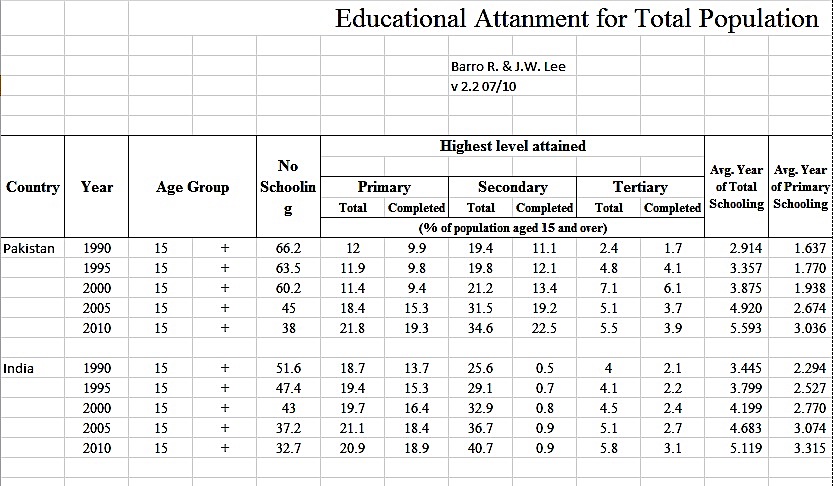
As of 2010, there are 380 out of every 1000 Pakistanis age 15 and above who have never had any formal schooling. Of the remaining 620 who enrolled in school, 22 dropped out before finishing primary school, and the remaining 598 completed it. There are 401 out of every 1000 Pakistanis who made it to secondary school. 290 completed secondary school while 111 dropped out. Only 55 made it to college out of which 39 graduated with a degree.
The preceding assessment is based on an interpretation offered by Indian blogger Siddarth Vij of Barro-Lee data in response to my earlier blog post titled Pakistan Ahead of India in Graduation at All Levels. Robert Barro and Jong-Wha Lee are Harvard University researchers whose data on educational attainment is used by UNDP and the World Bank. Here's how Vij read Barro-Lee dataset for India:
"327 out of every 1000 Indians above the age of 15 have never had any formal schooling. Of the remaining 673, only 20 dropped out during primary school. Once we got kids into primary school, we managed to make sure that they completed it. In secondary school, however, the situation is markedly different. 465 out of every 1000 Indians made it to secondary school but 394 dropped out without completing. Only 58 made it to college out of which a little more than half graduated with a degree"
Putting the two together, here's how the two South Asian neighbors compare:
As of 2010, there are 380 (vs 327 Indians) out of every 1000 Pakistanis age 15 and above who have never had any formal schooling. Of the remaining 620 (vs 673 Indians) who enrolled in school, 22 (vs 20 Indians) dropped out before finishing primary school, and the remaining 598 (vs 653 Indians) completed it. There are 401 (vs 465 Indians) out of every 1000 Pakistanis who made it to secondary school. 290 (vs 69 Indians) completed secondary school while 111 (vs. 394 Indians) dropped out. Only 55 (vs 58 Indians) made it to college out of which 39 (vs 31 Indians) graduated with a degree.
While Vij's explanation of Barro-Lee data-set sounds quite plausible, I still stand by my conclusion made in the earlier post that the percentage of population that completed secondary and tertiary education in Pakistan is higher than that in India.
Another important point to note in Barro-Lee dataset is that Pakistan has been increasing enrollment of students in schools at a faster rate since 1990 than India. In 1990, there were 66.2% of Pakistanis vs 51.6% of Indians who had no schooling. In 2000, there were 60.2% Pakistanis vs 43% Indians with no schooling. In 2010, Pakistan reduced it to 38% vs India's 32.7%.
Clearly, both India and Pakistan have made significant progress on the education front in the last few decades. However, the Barro-Lee dataset confirms that the two South Asian nations still have a long way to go to catch up with the rapidly developing nations of East Asia as well as the industrialized world.
Related Links:
Haq's Musings
India & Pakistan Comparison Update 2011
India and Pakistan Contrasted in 2010
Educational Attainment Dataset By Robert Barro and Jong-Wha Lee
Quality of Higher Education in India and Pakistan
Developing Pakistan's Intellectual Capital
Intellectual Wealth of Nations
Pakistan's Story After 64 Years of Independence
Pakistan Ahead of India on Key Human Development Indices
 |
| Source: Barro & Lee |
The preceding assessment is based on an interpretation offered by Indian blogger Siddarth Vij of Barro-Lee data in response to my earlier blog post titled Pakistan Ahead of India in Graduation at All Levels. Robert Barro and Jong-Wha Lee are Harvard University researchers whose data on educational attainment is used by UNDP and the World Bank. Here's how Vij read Barro-Lee dataset for India:
"327 out of every 1000 Indians above the age of 15 have never had any formal schooling. Of the remaining 673, only 20 dropped out during primary school. Once we got kids into primary school, we managed to make sure that they completed it. In secondary school, however, the situation is markedly different. 465 out of every 1000 Indians made it to secondary school but 394 dropped out without completing. Only 58 made it to college out of which a little more than half graduated with a degree"
Putting the two together, here's how the two South Asian neighbors compare:
As of 2010, there are 380 (vs 327 Indians) out of every 1000 Pakistanis age 15 and above who have never had any formal schooling. Of the remaining 620 (vs 673 Indians) who enrolled in school, 22 (vs 20 Indians) dropped out before finishing primary school, and the remaining 598 (vs 653 Indians) completed it. There are 401 (vs 465 Indians) out of every 1000 Pakistanis who made it to secondary school. 290 (vs 69 Indians) completed secondary school while 111 (vs. 394 Indians) dropped out. Only 55 (vs 58 Indians) made it to college out of which 39 (vs 31 Indians) graduated with a degree.
While Vij's explanation of Barro-Lee data-set sounds quite plausible, I still stand by my conclusion made in the earlier post that the percentage of population that completed secondary and tertiary education in Pakistan is higher than that in India.
 |
| Source: OECD Global Education Digest 2009 |

Another important point to note in Barro-Lee dataset is that Pakistan has been increasing enrollment of students in schools at a faster rate since 1990 than India. In 1990, there were 66.2% of Pakistanis vs 51.6% of Indians who had no schooling. In 2000, there were 60.2% Pakistanis vs 43% Indians with no schooling. In 2010, Pakistan reduced it to 38% vs India's 32.7%.
Clearly, both India and Pakistan have made significant progress on the education front in the last few decades. However, the Barro-Lee dataset confirms that the two South Asian nations still have a long way to go to catch up with the rapidly developing nations of East Asia as well as the industrialized world.
Year 2020 Update Pakistan:
 |
| Source: Pakistan Bureau of Statistics |
 |
| Source: Pakistan Bureau of Statistics |
Haq's Musings
India & Pakistan Comparison Update 2011
India and Pakistan Contrasted in 2010
Educational Attainment Dataset By Robert Barro and Jong-Wha Lee
Quality of Higher Education in India and Pakistan
Developing Pakistan's Intellectual Capital
Intellectual Wealth of Nations
Pakistan's Story After 64 Years of Independence
Pakistan Ahead of India on Key Human Development Indices
Comments
Investments in higher education seem to have reaped dividends as six universities of Pakistan, including the University of Karachi (KU), have won a place among the top 300 Asian universities.
The QS Asian University Rankings 2012 list shows National University of Science and Technology (#108), KU (#191-200), Aga Khan University (#201-250), Lahore University of Management Sciences (#251-300) and The University of Lahore (#251-300) in the top 300 universities of the continent.
Quacquarelli Symonds (QS) is the world’s most renowned and prestigious ranking agency.
A statement issued on Wednesday by the Higher Education Commission (HEC) claimed that the rankings speak volumes about the hard work put in by the management and faculty of these universities.
The HEC has consistently supported the varsities in terms of infrastructure, digital libraries, opportunities for innovative research, collaborative research projects with leading international institutions and participating in international exchange programmes, it was said.
Pakistani universities have produced more PhDs in the past nine years (3,280) – since the establishment of the HEC – than in the first 55 years (3,000) of the country’s establishment.
Research output has grown eight-fold since 2002 (from 815 in 2002 to 6,200 in 2011) which is a remarkable achievement by any world standard. Eighty per cent of these research publications are coming from higher education institutes. The output has more than doubled in the last three years and is expected to double again in the next three.
Around 5,000 scholars from Pakistan have presented their research work at leading conferences of the world and have established academic linkages with their counterparts in every leading university of the world in the US, UK, China, Germany, France, Australia, Korea, etc.
According to the HEC, Pakistani scientists, engineers and technologists are the country’s biggest strategic asset. Till five years ago, they were concentrated in a few strategic organisations, but the higher education revolution brought about by the HEC has ensured that every engineering and science and technology university has started to blossom into a centre of research and innovation.
The HEC declared that it has been able to break the elitist myth of availability of talent only in large cities by providing scholarships to talented students belonging to the middle class and poor segments of the society.
Currently, the education commission is focusing on expansion of facilities for biotechnology and genetics, immunology, robotics and automation, nanotechnology, superconductivity, photo-optics and lasers, electromagnetics and nuclear fusion for energy, it was stated.
http://tribune.com.pk/story/386574/ku-lands-in-bottom-half-of-top-300-asian-universities/
http://www.topuniversities.com/university-rankings/asian-university-rankings/2012
Apart from providing education, primary schools have an added incentive for children in upper Swat. They get free food rations for attending classes under the United Nations World Food Safety Net Feeding Programme. This has subsequently upped the enrolment rate in the schools by 60 per cent, it has been learnt.
Students have been provided energy biscuits and cooking oil under the World Food Program-sponsored programme since 2009. Teachers said that the project is achieving more than their expectations.
“Apart from increasing enrolment in primary schools, the programme aims to eliminate child labour and improve attendance,” Programme Manager Amjad Ali told The Express Tribune. He said that around 130,000 children and teachers in 610 primary schools of the upper Swat have benefited from the programme.
Balancing an oil canister in his hands, Muhammad Ali, a second grader who was returning home on Wednesday, said joyously: “We get parathas (oiled flatbread) with tea at school daily in the morning, which we did not get before.”
Another schoolboy, also holding an oil canister he got from school, seemed even more jubilant than his classmates. “We are getting double advantage: study and food. We love our school,” they said in unison.
“This is an effective way of attracting children towards schools,” said Kalam Education Department Centre In-charge Shah Nazar. “We don’t need to launch new campaigns to attract students; we are already short of space to accommodate them,” he said. Nazar added the programme has also motivated parents who were initially sceptical about sending their children to school and were more inclined towards sending them to work instead.
Abdul Ghafar Khan, a teacher in Kalam, concurred. He said that with the incentive of food, even street children have been admitted to schools.
http://tribune.com.pk/story/386965/food-for-education-in-swat-a-delectable-reason-to-be-in-primary-school/
India's growth prospects have been fading for some time. Multinationals are walking away from the country, withdrawing some $10.7 billion worth of investments in 2011 alone, according to Nomura. Manufacturing contracted by 0.3% for the year that ended March 31. Agriculture and services faltered as well.
-------------
Delhi managed to keep the party going after the 2008 financial crisis with more government spending and easier credit. But that only postponed the reckoning—while sending the inflation rate north of 8% for the better part of the last two years.
After growth dipped below 7% late last year, Prime Minister Manmohan Singh turned to gimmicks, like having state-owned Coal India boost coal supply to power producers in a one-off manner or proposing to set up special manufacturing zones where factories would get tax breaks. But businesses want less red tape permanently, especially when it comes to energy investments, as well as labor reform to make hiring and firing easier. On both fronts, the Prime Minister has done nothing.
Then there was his one serious attempt at reform. In late November he announced plans to allow foreign investment in big-box retail stores. The reform would have been a boon for consumers, and would have helped import some crucial supply-chain know how. But the reform met the usual combination of populist and special-interest resistance, and the government folded in 10 short days.
Indians are increasingly disenchanted with Congress's failure to push for pro-market reforms, and have voted accordingly in recent state elections. That's the good news. There's been a lot of talk about India's emergence as a new economic superpower. An India with the ambition to rise in the world will not treat a high-growth economy as a national birthright.
http://online.wsj.com/article/SB10001424052702303640104577440103460087194.html
“With the initiatives taken by the HEC, Pakistan was poised to make a major breakthrough and evolve into a knowledge economy from an agricultural economy,” he said. He lamented that an official notification was issued on November 30, 2010 to fragment the HEC and break it into pieces.
Rehman, however, being the Pakistan Academy of Science president intervened and approached the apex court to receive an order which declared the fragmentation of the HEC to be unconstitutional. “The government, however, slashed the commission’s budget by 50 per cent and a number of development programmes in universities have come to a halt,” he said.
Making a reference to an article in The Hindustan Times, he said, “The rapid developments posed a threat to India, but we ourselves are our own worst enemy.” He added we had this aim that Pakistan should not equal India but outdo it in terms of research outpost.
He also highlighted the fact that during his term as minister, he successfully convinced the former president, Pervez Musharraf, to increase the education budget by 2,400 per cent and that of science and technology by 1,600 per cent.
According to Dr Rehman, around 11,000 scholarships were awarded to students to study abroad at mostly European universities.
He said that the world’s largest Fulbright scholarship programme was initiated, with a research grant worth $100,000 dollars and a job arranged for the recipient a year prior of returning to Pakistan.
The HEC also developed the Pakistan Education and Research Network (PERN) through which 60,000 textbooks and 25,000 research journals were made accessible to students at their educational institutions. The students’ enrolment at the universities climbed up to 850,000 from 270,000 in just nine years while the universities produced 3,685 PhDs in such a short span which earlier were 3,200 in total from 1947 till 2000.
As for technological development, Dr Rehman said that fiber-optics lines which were laid in 40 cities in the year 2000, expanded to 400 cities allowing access to internet in nearly 1,000 cities and villages from just 29 cities previously.
http://tribune.com.pk/story/410711/we-are-converting-to-a-knowledge-based-economy-from-an-agriculture-based-economy/
Saturday, November 24, 2012 - Islamabad—The Pakistani universities are now able to produce more PhDs in the next 3 years as compared to last 10 years. The total number of PhDs in Pakistan has reached the figure of 8,142. According to the available statistics, the number of PhDs has increased from 348 (1947 to 2002) to 679 in 2012 in agriculture and veterinary sciences, from 586 to 1,096 in biological sciences, from 14 to 123 in business education, from merely 21 to 262 in engineering and technology and from 709 to 1,071 in physical sciences, Technology Times Reported.
In social sciences, the number increased to 887 from 108 during last ten years. The figures also indicate that during the last decade, special emphasis has been paid to the disciplines of agriculture and veterinary science, biological, physical and social sciences, business education, engineering and technology. “HEC has so far introduced various indigenous scholarship schemes to create a critical mass of highly qualified human resources in all fields of studies who conduct research on issues of importance to Pakistan.
http://pakobserver.net/detailnews.asp?id=183938
There's a recent book titled "Eating Grass: The Making of the Pakistani Bomb" by Feroz Khan to understand the basic fact that Pak nuclear weapons program has been a great catalyst for building national human capital and industrial base in the country.
Since 1990s, Pak has built two indigenous nuclear reactors at Khushab entirely on its own. Two more are under construction now.
As to nuclear power plants, Pakistan will find a way to generate more energy from various sources...the current PAEC plan is to build 8,800 MW nuclear power plants capacity by 2030.
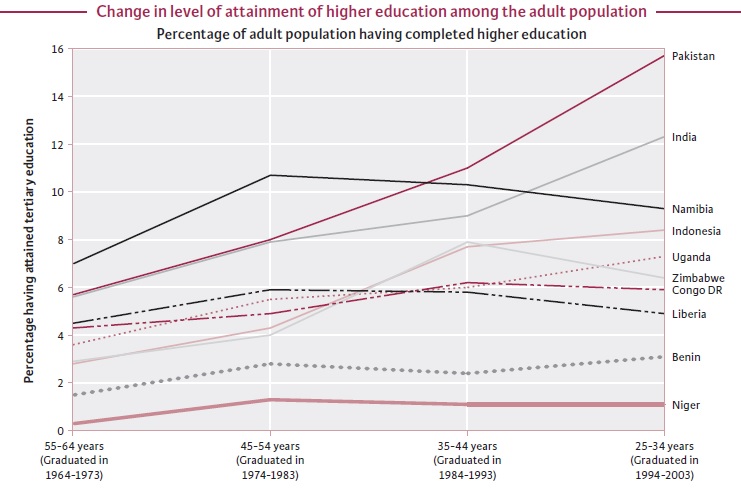
According to the OECD’s 2009 Global Education Digest, 6.3 per cent of Pakistanis were university graduates as of 2007. The government plans to increase this rate to 10 per cent by 2015 and 15 per cent by 2020. But the key challenges are readiness for growth of the educational infrastructure and support from public and private sector.
----------
According to 2008 statistics, Pakistan produces about 445,000 university graduates and 10,000 computer science graduates per year. Pakistan Telecom Authority indicates that as of 2008 there are nearly 22 million internet users and over 80 million mobile phone subscribers. A combination of all these educational and technological factors gives Pakistan great leverage to progress towards targeted curriculum development and dissemination through e-learning..
http://dawn.com/2011/02/28/towards-e-learning/
Take a look at these recent statistics:
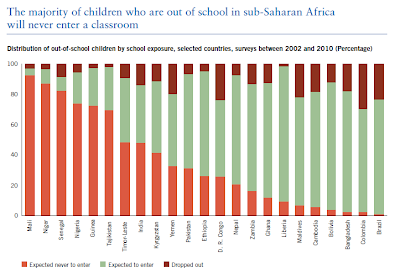
Pakistan has the second highest (after Nigeria) population of out-of-school children in the world, with almost five and a half million school-aged children not accessing school . This number accounts for 10% of the world’s out-of-school children. (UNESCO, 2014)
72% of school-aged children enroll in school. This is an improvement compared to two decades ago, when only 58% of children enrolled in school. One of key goals of the Education For All declaration is for countries to achieve a primary enrollment target of at least 95% by 2015. While Pakistan is rated as very far from target (with an enrollment rate below 80%), it is also rated as having relatively strong progress over the last two decades. (UNESCO, 2014)
However, only one out of every two children who enroll in school will make it to the last year of primary (Grade 5). On average, 4% of children will repeat any given grade. (UNESCO, 2014)
Before the end of Grade 1, 17.5% of enrolled children drop out of school. Another 4.9% repeat Grade 1. In other words, more than one in five children experiences failure before making it to Grade 2. (UNESCO, 2014)
Of those children completing primary school (Grade 5), 51% are unable to read at a Grade 2 level and 57% are unable to do arithmetic at a Grade 2 level (SAFED, 2014). This means that these children have spent five or more years of their lives attending school but are still without basic literacy and numeracy skills.
Outcomes for all learning indicators are lower in government schools than in private schools, and lower in rural areas than in urban areas. (SAFED, 2014)
The education system is failing too many children!
Education is critical for human development – and for national development. Consider this:
The Pakistani government invests only 2.3% of its Gross National Product in education – less than what it spends on the military (UNESCO, 2014). The effects on the availability and quality of the education system are clear, as seen above.
In Pakistan, the wages of a literate person are 23% higher than those of an illiterate person (UNESCO, 2014). However, the adult literacy rate is 55% (UNESCO, 2014), and it will be difficult to increase this number in the decades ahead with so many out-of-school children, and so many children leaving primary school without basic literacy skills.
We need to push for greater public investment in education in Pakistan. This means:
Increasing tax revenue and reducing tax evasion (less than 1% of Pakistanis pay income tax – Economist, 2012, as cited in UNESCO, 2014)
Prioritizing education at the policy and budget level – above the military for example (education is likely a stronger force against terrorism and war anyway, in the long run!), and
Identifying and implementing proven strategies to improve the quality of teaching and learning in primary schools across the country – especially in the early grades. (More on this in a later post.)
http://sadafshallwani.net/2014/08/07/primary-education-in-pakistan/
Take a look at these recent statistics:
Pakistan has the second highest (after Nigeria) population of out-of-school children in the world, with almost five and a half million school-aged children not accessing school . This number accounts for 10% of the world’s out-of-school children. (UNESCO, 2014)
72% of school-aged children enroll in school. This is an improvement compared to two decades ago, when only 58% of children enrolled in school. One of key goals of the Education For All declaration is for countries to achieve a primary enrollment target of at least 95% by 2015. While Pakistan is rated as very far from target (with an enrollment rate below 80%), it is also rated as having relatively strong progress over the last two decades. (UNESCO, 2014)
However, only one out of every two children who enroll in school will make it to the last year of primary (Grade 5). On average, 4% of children will repeat any given grade. (UNESCO, 2014)
Before the end of Grade 1, 17.5% of enrolled children drop out of school. Another 4.9% repeat Grade 1. In other words, more than one in five children experiences failure before making it to Grade 2. (UNESCO, 2014)
Of those children completing primary school (Grade 5), 51% are unable to read at a Grade 2 level and 57% are unable to do arithmetic at a Grade 2 level (SAFED, 2014). This means that these children have spent five or more years of their lives attending school but are still without basic literacy and numeracy skills.
Outcomes for all learning indicators are lower in government schools than in private schools, and lower in rural areas than in urban areas. (SAFED, 2014)
The education system is failing too many children!
Education is critical for human development – and for national development. Consider this:
The Pakistani government invests only 2.3% of its Gross National Product in education – less than what it spends on the military (UNESCO, 2014). The effects on the availability and quality of the education system are clear, as seen above.
In Pakistan, the wages of a literate person are 23% higher than those of an illiterate person (UNESCO, 2014). However, the adult literacy rate is 55% (UNESCO, 2014), and it will be difficult to increase this number in the decades ahead with so many out-of-school children, and so many children leaving primary school without basic literacy skills.
We need to push for greater public investment in education in Pakistan. This means:
Increasing tax revenue and reducing tax evasion (less than 1% of Pakistanis pay income tax – Economist, 2012, as cited in UNESCO, 2014)
Prioritizing education at the policy and budget level – above the military for example (education is likely a stronger force against terrorism and war anyway, in the long run!), and
Identifying and implementing proven strategies to improve the quality of teaching and learning in primary schools across the country – especially in the early grades. (More on this in a later post.)
http://sadafshallwani.net/2014/08/07/primary-education-in-pakistan/
Through market-driven schools, young Pakistani women are gaining access to opportunity.
By Tahir Andrabi
Dec. 11, 2014 11:59 a.m. ET , Wall Street Journal
When 17-year-old Malala Yousafzai accepted the Nobel Peace Prize in Oslo on Wednesday, the accompanying pomp and press coverage helped rekindle a global fascination with the fearless young Pakistani activist who was shot and wounded after speaking out against Taliban attacks on girls’ schools.
Back home in Pakistan, the international attention has only fed the polarized opinion surrounding Ms. Yousafzai, beloved by some and derided as a pawn of the West by others.
But to single out Ms. Yousafzai as either a national hero or tool of foreign influence is to miss the real story. After working as a field researcher in Pakistan for a decade, it’s become clear to me that Ms. Yousafzai represents a new generation in Pakistan, where an estimated 50 million children are of primary-school age. For the first time in the nation’s history, more girls—63%—of primary-school age are in school than not, even as they face Taliban and other extremist threats, and even amidst an ongoing national crisis of leadership.
Girls in every corner of Pakistan, including those bordering the tribal areas and in Ms. Yousafzai’s northwest home district of Swat, are not only passing high-school exit exams at a higher rate than boys, they also consistently rank among the top students in these exams. In the most recent rounds of admissions to medical and dental schools, Pakistani girls made up 70% of the successful candidates.
The most striking change in the educational landscape feeding this phenomenon is the tremendous growth in low-cost private schools and not, as is commonly believed, in religious schools, or madrassas. This is confirmed by surveys, by government data and now by an increasing body of my own team’s field research. Their growth is fastest in the rural areas, including the Pashtun belt, and their numbers increased to more than 70,000 in 2011 from 36,000 in 1999—with no signs of a slowdown. Today they account for almost 40% of enrollment of the country’s youth. In fact, Ms. Yousafzai’s father started one such school—the Khushal School and College—in Swat in the 1990s.
This phenomenon first began after the denationalization of schools and colleges in the 1980s, allowing a critical mass of modestly educated young women, which had emerged due to government investments in secondary schooling, to serve as teachers in these schools. Today these mom-and-pop-run schools are market driven, fiercely competitive and teach a mainstream curriculum focusing on languages and math. Staffed overwhelmingly with local female teachers and bereft of any organized support from foreign-aid donors or the Pakistani government, these schools outperform their public counterparts (admittedly a low bar) on learning outcomes by a wide margin—equivalent to one year’s worth of learning by grade five. And tuition is only about $2 a month, making the schools affordable to many families dependent on daily wage labor of about $2 per day—the nation’s poverty line.
In surveys conducted in poor rural areas by the research team to which I belong, Pakistani parents exhibit little gender bias in their belief in girls’ abilities to succeed academically. In carefully conducted field experiments, rural families tend to show high aspirations for their girls when told of the increasing performance of girls in urban areas. What also stands out in these surveys is how the aspirations of Pakistani parents are indistinguishable from those in similarly developed countries across Asia and Africa.
Pakistan is a large, complex country, and there is danger in pushing any single narrative too far....
http://www.wsj.com/articles/the-promise-of-pakistans-private-schools-1418317180
DFID is also supporting BISP’s Waseela-e-Taleem education conditional cash transfer programme, which encourages the poorest families to send their children to school. “DFID will continue to support the Government of Pakistan in expanding and strengthening the country’s largest national social safety net. This support is vital to empowering nearly five million women from some of Pakistan’s poorest families through monthly stipends,” Swayne said in a statement. He added that these stipends allow beneficiaries to buy essential items such as food and medicine, and to protect them from shocks such as illness or unemployment, which can push families deeper into debt and poverty.
“Alongside the main unconditional cash transfers, BISP’s use of supplementary conditional cash transfers is an impressive example of how to use small incentives to encourage the poorest families to educate their children,” Swayne added. He further said that education boosts the economy, broadens outlooks, and offers a brighter future for young people by giving them skills to improve their lives and employment opportunities. Memon said BISP is a vital tool in helping the poorest and most vulnerable in order to build a more inclusive Pakistan, where everyone has the opportunity to fulfill their potential and contribute to the economy. “We intend to make BISP the pride of Pakistan by offering seamless services, targeted products, and a medium of lifted empowerment to our most vulnerable,” she added.
http://tribune.com.pk/story/925427/rural-education-uk-reaffirms-commitment-to-bisp/
Schools are being established across Fata, encouraging conflict stricken children to continue learning
By FARID SHINWARI
As the sun sets behind the mountains, young boys ranging from nine to 16 sit on the floor of an empty classroom in Bara tehsil, some of them adorning a scarf and hat to keep warm.
“My mind does not grasp what is being taught in class,” says Asif Khan a student and resident of Bara Khyber Agency, expressing his disappointment at the time spent out of school.
Although he is not shy about reading aloud in front of his classmates, Asif says at times the pace of the lecture feels as if it’s in “slow motion.”
“The golden time for learning has almost passed,” he says, referring to the years long interval in his studies due to the conflict in his hometown.
Several children have recently enrolled in Alternative Learning Schools (ALS). The project is part of the ‘Literacy for All’ campaign under the Annual Development Program (ADP) which has been initiated to bring education to militancy-hit Fata.
Among them is 13-year-old Khalid Khan. A resident of Bara, Khalid is sitting at a Hujra (council of elders) now turned into a school. Much like other official buildings and gatherings in the community, the Hujra designates a minimum of two rooms which can be used as makeshift classrooms.
Before enrolling at his school, Khalid and many other children relocated to safer ground due to a rise in militancy and subsequent security operation. He now attends classes at a school a few meters away from what was previously a militant base.
“I had left my home due to their [Lashkar-e-Islam's] influence. During the military operation mortar shells were fired by unknown miscreants causing a lot of displacement,” he recounted. From 2009 to 2014 Khalid and his family took refuge in Zakha Khel in Landi Kotal.
After returning home, Khalid enrolled in an ALS school, established by the Fata Education Foundation (FEF) aiming to enhance enrollment of children who were displaced during military operations.
Despite being a progressive initiative, Asif feels that the school lacks facilities. “We need a bathroom, dustbin, furniture, big black board and other facilities so as to continue learning,” he says.
Laying the groundwork
Javed Iqbal, Manager Planning and Development of FEF, says arrangements have been made for the provision of desks and stationary. He claims they will “arrive over the next couple of months.” Iqbal also adds that checks will be conducted on each school via the Village Education Committees (VEC) before and during their operating hours of 2pm to 6pm..
According to FEF more than 76 schools for boys and 61 for girls have been established across tribal regions.
https://www.ndtv.com/india-news/only-4-5-population-in-india-is-graduate-or-above-census-1240996
Only 4.5 per cent of the population in the country is educated up to the level of graduate or above while a majority of 32.6 per cent population is not even educated up to the primary school level.
According to the census data for 2011 on literacy, workers and educational levels, released by the Registrar General and Census Commissioner of India, literate population who are presently attending any educational institution in the country, below primary occupies the major share of 32.6 per cent.
It was followed by primary (25.2 per cent), middle (15.7 per cent), matric (11.1 per cent), higher secondary (8.6 per cent) and Graduate and above (4.5 per cent).
During the decade 2001-11, improvement is observed at middle and above educational levels and decline in percentage share at lower levels (below-primary and primary).
The improvements at higher educational levels are indication of educational advancement in the country during the decade 2001-11.
The data on workers by five categories of literates namely literate but below matric/secondary, matric/secondary but below graduate, technical diploma or certificate not equal to degree, graduate and above other than technical degree and technical degree or diploma equal to degree or post-graduate degree have also been released.
The data that distributes the population, main workers, marginal workers, non-workers, marginal and non-workers seeking/available for work by literacy status and educational levels separately for total, scheduled castes and scheduled tribes population is also released.
The data reveals that during the decade 2001-2011, there is an overall improvement in literacy status and educational levels of various types of workers and non-workers among total and SC/ST population.
Census 2011 has further exhibited that out of about 55.5 million Marginal workers seeking/available for work in India, the majority of 21.9 million (39.4 per cent) are illiterates followed by 20.9 million (37.6 per cent) literates but below matric/secondary and 8.0 million (14.5 per cent) matric/secondary but below graduate.
https://www.dawn.com/news/1643918
The proportion of out-of-school children at the district, provincial and national level has been extracted from the Pakistan Social and Living Measurements Standards survey 2019-20 (PSLM). PSLM is conducted every two years by the Pakistan Bureau of Statistics, with data collection at the provincial and at the district levels in each alternate iteration.
-----------------
Out of all children in Pakistan between the ages of five to 16 years, 32 per cent, i.e. one third, are out of school. This amounts to an estimated total of over 20 million. Balochistan has the highest proportion of OOSC at 47 per cent followed by Sindh at 44 per cent.
In absolute terms, Punjab has the largest total population of OOSC roughly estimated at 7.7 million followed by Sindh at 6.5 million.
---------------
There are two types of OOSC (Out of School Children):
• Children who have never attended school
• Children who have attended school in the past but have since dropped out
---------------------
https://mathsandscience.pk/