India Ranks Near Bottom on Education
Indian students rank near the bottom on PISA, a global test of learning standards conducted in 74 nations this year. TIMSS, another standardized international test, produced similar results earlier in 2003.
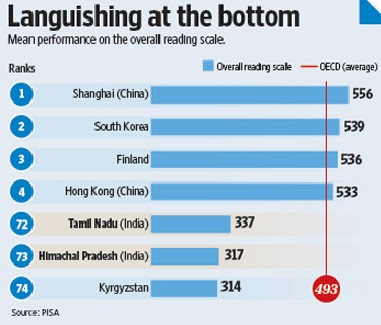
This is the first time that Indian students participated in PISA. Students from Himachal Pradesh and Tamil Nadu took the Program for International Student Assessment (PISA) test, coordinated by the Paris-based Organization for Economic Co-operation and Development (OECD). Prior to this participation, students from Indian states of Orissa and Rajasthan took a similar test called Trends in International Mathematics and Science Study (TIMSS) in 2003.
Tamil Nadu and Himachal Pradesh rank high on human development indicators among Indian states. The India Human Development Report 2011, prepared by the Institute of Applied Manpower Research (IAMR), categorized them as “median” states, putting them significantly ahead of the national average. IAMR is an autonomous arm of India's Planning Commission.
Himachal Pradesh ranked 4 and Tamil Nadu 11 in literacy rates on India's National Family Health Survey released in 2007. However, in the PISA study, Tamil Nadu ranked 72 and Himachal Pradesh 73, just ahead of the bottom-ranked Kyrgyzstan in mathematics and overall reading skills. Shanghai, China's biggest city, topped the PISA rankings in all three categories—overall reading skills, mathematical and scientific literacy. The new entrants included Costa Rica, Georgia, India (Himachal Pradesh & Tamil Nadu), Malaysia, Malta, Mauritius, Venezuela (Miranda), Moldova, United Arab Emirates. PISA 2009+ involved testing just over 46 000 students across these ten economies, representing a total of about 1,377,000 15-year-olds.

In Tamil Nadu, only 17% of students were estimated to possess proficiency in reading that is at or above the baseline needed to be effective and productive in life. In Himachal Pradesh, this level is 11%. “This compares to 81% of students performing at or above the baseline level in reading in the OECD countries, on an average,” said the study.
The average Indian child taking part in PISA2009+ is 40 to 50 points behind the worst students in the economic superstars. Even the best performers in Tamil Nadu and Himachal Pradesh - the top 5 percent who India will need in science and technology to complete globally - were almost 100 points behind the average child in Singapore and 83 points behind the average Korean - and a staggering 250 points behind the best in the best.
The average child in HP & TN is right at the level of the worst OECD or American students (only 1.5 or 7.5 points ahead). Contrary to President Obama's oft-expressed concerns about American students ability to compete with their Indian counterparts, the average 15-year-old Indian placed in an American school would be among the weakest students in the classroom, says Lant Pritchett of Harvard University. Even the best TN/HP students are 24 points behind the average American 15 year old.
The 2003 TIMSS study ranked India at 46 among 51 countries. Indian students' score was 392 versus average of 467 for the group. These results were contained in a Harvard University report titled "India Shining and Bharat Drowning".
These results are not only a wake-up call for the "India Shining" brigade, but also raise serious questions about the credibility of India's western cheerleaders like Indian-American journalist Fareed Zakaria and New York Times' columnist Tom Friedman.
Related Links:
Haq's Musings
India Shining, Bharat Drowning
Learning Levels and Gaps in Pakistan by Jishnu Das and Priyanka Pandey
Pasi Sahlberg on why Finland leads the world in education
CNN's Fixing Education in America-Fareed Zakaria
PISA's Scores 2011
Poor Quality of Education in South Asia
Infections Cause Low IQs in South Asia, Africa?
Peepli Live Destroys Western Myths About India
PISA 2009Plus Results Report

This is the first time that Indian students participated in PISA. Students from Himachal Pradesh and Tamil Nadu took the Program for International Student Assessment (PISA) test, coordinated by the Paris-based Organization for Economic Co-operation and Development (OECD). Prior to this participation, students from Indian states of Orissa and Rajasthan took a similar test called Trends in International Mathematics and Science Study (TIMSS) in 2003.
Tamil Nadu and Himachal Pradesh rank high on human development indicators among Indian states. The India Human Development Report 2011, prepared by the Institute of Applied Manpower Research (IAMR), categorized them as “median” states, putting them significantly ahead of the national average. IAMR is an autonomous arm of India's Planning Commission.
Himachal Pradesh ranked 4 and Tamil Nadu 11 in literacy rates on India's National Family Health Survey released in 2007. However, in the PISA study, Tamil Nadu ranked 72 and Himachal Pradesh 73, just ahead of the bottom-ranked Kyrgyzstan in mathematics and overall reading skills. Shanghai, China's biggest city, topped the PISA rankings in all three categories—overall reading skills, mathematical and scientific literacy. The new entrants included Costa Rica, Georgia, India (Himachal Pradesh & Tamil Nadu), Malaysia, Malta, Mauritius, Venezuela (Miranda), Moldova, United Arab Emirates. PISA 2009+ involved testing just over 46 000 students across these ten economies, representing a total of about 1,377,000 15-year-olds.

In Tamil Nadu, only 17% of students were estimated to possess proficiency in reading that is at or above the baseline needed to be effective and productive in life. In Himachal Pradesh, this level is 11%. “This compares to 81% of students performing at or above the baseline level in reading in the OECD countries, on an average,” said the study.
The average Indian child taking part in PISA2009+ is 40 to 50 points behind the worst students in the economic superstars. Even the best performers in Tamil Nadu and Himachal Pradesh - the top 5 percent who India will need in science and technology to complete globally - were almost 100 points behind the average child in Singapore and 83 points behind the average Korean - and a staggering 250 points behind the best in the best.
The average child in HP & TN is right at the level of the worst OECD or American students (only 1.5 or 7.5 points ahead). Contrary to President Obama's oft-expressed concerns about American students ability to compete with their Indian counterparts, the average 15-year-old Indian placed in an American school would be among the weakest students in the classroom, says Lant Pritchett of Harvard University. Even the best TN/HP students are 24 points behind the average American 15 year old.
The 2003 TIMSS study ranked India at 46 among 51 countries. Indian students' score was 392 versus average of 467 for the group. These results were contained in a Harvard University report titled "India Shining and Bharat Drowning".
These results are not only a wake-up call for the "India Shining" brigade, but also raise serious questions about the credibility of India's western cheerleaders like Indian-American journalist Fareed Zakaria and New York Times' columnist Tom Friedman.
Related Links:
Haq's Musings
India Shining, Bharat Drowning
Learning Levels and Gaps in Pakistan by Jishnu Das and Priyanka Pandey
Pasi Sahlberg on why Finland leads the world in education
CNN's Fixing Education in America-Fareed Zakaria
PISA's Scores 2011
Poor Quality of Education in South Asia
Infections Cause Low IQs in South Asia, Africa?
Peepli Live Destroys Western Myths About India
PISA 2009Plus Results Report
Comments
In the 1990s, the drive (Delhi-Simla) would take eight hours. In 2009, it took about 11, and this autumn it took almost 12. Stretches of the road, especially those near small cities, resembled four- lane highways anywhere in the world. Elsewhere, passing through roadside settlements, the road shrank to a single lane; and here the queues built up, the air grew thick with dust and exhaust, and road rage erupted out of even the air-conditioned vehicles.
------------
The metaphor of highways has been deployed frequently to describe India’s potential, most famously by Thomas Friedman, who claimed in 2005 that India “is like a highway full of potholes,” but “off in the distance, the road seems to smooth out, and if it does, this country will be a dynamo.”
Like many other popular metaphors about India -- tiger, elephant, cellphone -- this one isn’t wholly mistaken. Indian highways rank highly among the infrastructure projects crucial to sustaining the country’s rapid economic growth (INQGGDPY), which is threatened by inflation, declining industrial production, a weakening currency (the rupee has dropped about 15 percent against the dollar this year) and corruption scandals that implicate some of India’s most well-known politicians and businessmen.
The question that Friedman asked in 2005 has grown more urgent: “Is that smoother road in the distance a mirage or the real thing?” Or, to put it differently: Did the perennial gap between illusion and reality somehow widen imperceptibly in the New India?
Education Racket
The answer to this question seemed obvious on the half- built highway to Delhi. The most conspicuous sights along the roadside were the placards for shiny new private educational institutions. They seem -- if you have never been inside one or met any of their alumni and looked only at the (misspelled) signboards promising professional success -- to be hectically preparing the basis for India’s “demographic dividend”: an overwhelmingly youthful population (WPOPINDI) that will soon become producers and consumers in the global economy.
In actuality, while most state-funded schools and colleges are barely functional, private education in India is largely a money-making racket. In September this year, a study of schools in the biggest states discovered that India’s peers in adult literacy are Afghanistan and Papua New Guinea.
Hundreds of millions of poorly educated and unemployable youth increasingly find themselves drawn to some peculiar forms of entrepreneurship. Twice on the highway from Shimla to Delhi, we were flagged down by groups of young men collecting “taxes.”
I have often come across these soft forms of banditry on the country roads of Uttar Pradesh and Bihar, two of India’s poorest and most populous states. The only difference here was that the young men seemed better educated, more resourceful and authoritative. One of the groups that stopped us near the Indian capital, less than a mile from an authentic police checkpoint, even had a jeep with the words “Delhi Municipal Toll” painted on the windshield.
Bleak employment prospects and a general social breakdown - - of morality no less than law and order -- were pushing them into a career of crime. Their brazen modus operandi in one of the country’s richest regions hinted that India’s “demographic dividend” was more likely to boost crime rather than gross domestic product.
For most of the previous decade, many Indians have been spellbound by a vision of imminent national greatness, oblivious to the basic fact that no country without a substantial manufacturing base and skilled workforce has ever become an economic superpower.....
http://www.bloomberg.com/news/2011-12-30/on-road-to-delhi-india-s-economy-gets-real-commentary-by-pankaj-mishra.html
Primary education standards in India are as bad as in Papua New Guinea and crisis-torn Afghanistan and Yemen, according to a team of Indian development economists.
In a study of schools in the country’s most populous states they found that fast-paced economic growth has failed to improve India’s basic educational standards over the past 15 years. The Public Report on Basic Education Revisited showed some children were unable to read after three years of schooling across the Hindi-speaking northern belt.
“When the investigators arrived, half of the government schools were still devoid of any teaching activity,” the report said. “In a functioning democracy, this would be a major national concern. Yet little notice has been taken in the corridors of power.”
According to Jean Drèze, one of the report’s researchers and a prominent Indian policymaker, India now finds itself in an adult-literacy peer group that includes Afghanistan, Papua New Guinea and Yemen.
The ratio of students to teachers in Indian primary schools was three times higher than in China, with a typical class in Bihar, one of the poorest states, having as many as 92 pupils.
“After 20 years of meteoric economic growth, there’s been so little improvement in terms of the living standards of the people,” Mr Drèze said. “There’s a very serious crisis. We have to wake up to the fact that we are relying too heavily on economic growth.”
There are 5.5m teachers in India, but at least 1.2m more are required. “The reason there aren’t any teachers in school is because states have not recruited them for many years,” said Kapil Sibal, minister of Human Resources Development.
The report’s authors said that it had taken years to analyse and verify data collected in states such as Rajasthan, Madhya Pradesh, Uttar Pradesh and Bihar. One team member, A.K. Shiva Kumar, said that he and his colleagues had also reviewed educational data for the 2009-2010 year and found them to be “identical” to those of 2006.
The UN Development Programme’s Human Development Report for 2010 said Indians received just 4.4 years of schooling on average, compared with 7.5 years for China’s citizens. Sri Lanka outscores both with 8.2 years of schooling and is on par with China’s 99 per cent literacy rate for young female adults.
“Most developing countries are talking of [offering their children] 10 years of schooling,” said Mr Kumar, who is also a development economist and advises Unicef, the UN’s child welfare agency. “Here there’s lots of focus on growth rates but we are not looking at how India gets to 10 years of schooling.”
Meera Samson, a researcher at the Delhi-based Collaborative Research and Dissemination and report co-author, said head teachers had not been appointed at 20 per cent of the schools surveyed. At another 12 per cent of schools, only one teacher had been offered a position.
Last year, India’s parliament passed legislation requiring the state to provide universal education.
http://www.ft.com/cms/s/0/3b2c9da2-cf01-11e0-86c5-00144feabdc0.html#axzz1i06MWVHc
Bangalore: The draught of education in India has reached the extreme as it ranks sixth among the seven emerging economies of the world, in terms of education quality. The country has scored only 3.3 points in the study, in terms of primary, secondary, tertiary and demographic parameters, while Russia topped the chart with 7.3 points.
As per the Assocham study, India was at the last position in terms of quality of secondary education while Russia and Brazil had maximum scores. The quality of tertiary education in India was lowest among the other emerging nations. The points it scored on the scale of 2, was 0.1. Even though the demographics of India are considered its strength, the country has scored the minimum in this too and was ranked at last place. Moreover, in terms of students enrollment for primary education, India is highly incompetitive with the gross enrollment ratio standing at 98.1.
"Serious attention needs to be paid towards the education system. India may stand to loose its competitive advantages against the other countries in long term if corrective measures are not taken to strengthen the Indian education system qualitatively," said Sajjan Jindal, ASSOCHAM President while releasing the ASSOCHAM Eco Pulse (AEP) Study 'Comparative Study of Emerging Economies on Quality of Education'. It was carried out on the basis of 20 parameters relating to primary, secondary, tertiary education and higher education and demography and data provided by UNESCO, IMF, WEF, Financial Times was used for the purpose.
Among the rest five countries, China has secured second place with scoring 6.7 points, while Brazil has positioned itself at third place with 5.56 score points as the quality of education in Brazil remains stable across all levels of primary, secondary and higher education. Mexico has been ranked at fourth place on the strength of its higher education. South Africa, a relatively new entrant to the club of developing economies, has managed to be on fifth place on the strength of its tertiary education and demographic qualities though it lags far behind in primary education. However, Indonesia stands at the last position with an overall score of 2.68 points. The gross enrolment ratio is highest in Brazil (148.5), followed by China (116.2) and Russia (113.8). Even Indonesia (110.9) and South Africa (105.1) enjoy better enrolment ratio than India.
However, only in terms of teacher-student ratio the country outsmarts all as in India for every forty students, there is one teacher.
http://www.siliconindia.com/shownews/India_ranks_second_last_in_Quality_Education-nid-50034-cid-Others.html
Compared to the economic superstars India is almost unfathomably far behind. The TN/HP average 15 year old is over 200 points behind. If a typical grade gain is 40 points a year Indian eighth graders are at the level of Korea third graders in their mathematics mastery. In fact the average TN/HP child is 40 to 50 points behind the worst students in the economic superstars. Equally worrisome is that the best performers in TN/HP - the top 5 percent who India will need in science and technology to complete globally - were almost 100 points behind the average child in Singapore and 83 points behind the average Korean - and a staggering 250 points behind the best in the best.
As the current superpowers are behind the East Asian economic superstars in learning performance the distance to India is not quite as far, but still the average TN/HP child is right at the level of the worst OECD or American students (only 1.5 or 7.5 points ahead). Indians often deride America's schools but the average child placed in an American school would be among the weakest students. Indians might have believed, with President Obama, that American schools were under threat from India but the best TN/HP students are 24 points behind the average American 15 year old.
Even among other "developing" nations that make up the BRICs India lags - from Russia by almost as much as the USA and only for Brazil, which like the rest of Latin America is infamous for lagging education performance does India even come close - and then not even that close.
To put these results in perspective, in the USA there has been huge and continuous concern that has caused seismic shifts in the discourse about education driven, in part, by the fact that the USA is lagging the economic superstars like Korea. But the average US 15 year old is 59 points behind Koreans. TN/HP students are 41.5 points behind Brazil, and twice as far behind Russia (123.5 points) as the US is Korea, and almost four times further behind Singapore (217.5 vs 59) that the US is behind Korea. Yet so far this disastrous performance has yet to occasion a ripple in the education establishment.
------------
These PISA 2009+ results are the end of the beginning. The debate is over. No one can still deny there is a deep crisis in the ability of the existing education system to produce child learning. India's education system is undermining India's legitimate aspirations to be at the global forefront as a prosperous economy, as a global great power, as an emulated polity, and as a fair and just society. As the beginning ends, the question now is: what is to be done?
http://ajayshahblog.blogspot.com/2012/01/first-pisa-results-for-india-end-of.html
TED Fellow, social entrepreneur and filmmaker Sharmeen Obaid-Chinoy is on a mission to foment Pakistan's education revolution.
The province of Sindh, where Obaid-Chinoy is based, decided less than two months ago to completely revamp public school textbooks, and the government enlisted Obaid-Chinoy to help. "There needs to be an overhaul," Obaid-Chinoy tells Fast Company. "Textbooks are outdated and I've been working with the government on how to encourage critical thinking and move away from rote memorization....It's tough, because the mindset is not there. The teachers are essentially products of the same system. We have to break the culture, which takes a long time."
Sindh's teachers now spend extensive time in professional training with education experts to try and reform the instruction of English, math, and social studies. "We're really making this a movement for education for social change," Obaid-Chinoy says.
"People are excited by it. Everyone's getting into it, rolling up their sleeves. We're trying to bridge the divide between the public and private school systems," which, she says, is at the heart of Pakistan's education challenges. The poorer schools are under-resourced and are often recruiting grounds for young terrorists. By improving the public education system, the less-fortunate children have a better shot at a solid future, away from terrorist groups, and local leaders hope to accomplish improvements by focusing on textbooks and teacher trainings.
"Pakistan also feels it needs to catch up with the rest of the world in terms of education and that was the genesis for the education overhaul," says Obaid-Chinoy. "Terrorism defines us today," but, she says, there was a time when the country was known for its vibrancy and sense of hope.
Obaid-Chinoy is doing her part in other ways to revamp Pakistan's education system. In 2007 she started CitizensArchive.org, the country's first digital archive documenting its oral history with interviews, rare photos, and other online collections. The initiative allows students in schools throughout Pakistan, Bangladesh, and India to better understand Pakistan and its history and Obaid-Chinoy was able to interview several notable figures who have since passed away, such as Deena Mistri, one of the country's first female educators. And students around South Asia are now engaged in learning exchanges with students in Pakistan, to help the countries build bridges.
And throughout her education work, Obaid-Chinoy's medium is often filmmaking. She makes about one film per year and has covered a range of topics from jihadi schools to female victims of acid attacks. Her next film will look at 9/11 through the eyes of different figures, in commemoration of the 10th anniversary this year.
"My mother gave up her dream of becoming a journalist when she got married and I think she always wanted to make sure that her six children pursued their dreams. I have four sisters and all of us work in male-dominated professions in Pakistan." And Obaid-Chinoy now brings that same sense of passion and justice to her work and thanks to her, her country may soon become a bright spot for global-minded education.
http://www.fastcompany.com/1731268/pakistan-education-revolution
Based on the recent PISA test results, Obama may be right about threat from China. But India? I don't agree.
Here's why:
The average Indian child taking part in PISA2009+ is 40 to 50 points behind the worst students in the economic superstars. Even the best performers in Tamil Nadu and Himachal Pradesh - the top 5 percent who India will need in science and technology to complete globally - were almost 100 points behind the average child in Singapore and 83 points behind the average Korean - and a staggering 250 points behind the best in the best.
The average child in HP & TN is right at the level of the worst OECD or American students (only 1.5 or 7.5 points ahead). Contrary to President Obama's oft-expressed concerns about American students ability to compete with their Indian counterparts, the average 15-year-old Indian placed in an American school would be among the weakest students in the classroom. Even the best TN/HP students are 24 points behind the average American 15 year old.
http://www.riazhaq.com/2011/12/pisa-timss-confirm-low-quality-of.html
There are two stereotypes about schooling in east Asia: the students work extremely hard, and the learning is by rote. In fact, things are more complicated, as the OECD’s latest global schools survey has shown.
Shanghai came top in the Pisa survey, with three other east Asian territories in the first five. But not all east Asian countries did well, says the OECD’s Andreas Schleicher, adding that it’s innovative thought that is assessed. Shanghai schools aren’t turning children into walking textbooks: they are channelling their ability and enthusaism into exceptional results. How?
Undertaken every three years, the Pisa survey tests 15-year olds, with a rotating focus on maths, reading and science. The emphasis is on broad learning: literacy tests involve reasoning, for example. In the three previous editions – 2000, 2003 and 2006 – Finland came top. But this year, with the focus on reading, Finland was displaced by Shanghai, with South Korea second, Hong Kong fourth and Singapore fifth. (Thousands of children are normally tested in each country; but in China the survey was centred on Shanghai.)
So why did Shanghai do so well? The OECD points to Chinese school reforms: it was impressed by the initiative shown by teachers, who are now better paid, better trained and keen to mould their own curricula. Poor teachers are speedily replaced. China has also expanded school access, and moved away from learning by rote.
The last point is key: Russia performs well in rote-based assessments, but not in Pisa, says Schleicher, head of the indicators and analysis division at the OECD’s directorate for education. China does well in both rote-based and broader assessments.
The OECD also points to cultural factors – widespread expectations of high performance, and pressure from parents. And it’s the interaction between culture and the system that is hard to untangle, says Schleicher.
If schools did well just because of hard work, then countries with similar cultures should see similar results. But Finland beats Sweden by a distance, Shanghai beats Taiwan, and Hong Kong beats Macau. Equally, if the schools themselves were uniquely important, then why do young Chinese immigrants do so well in UK classrooms? Culture and system almost certainly reinforce each other: with a merit-based system stimulating hard work, and vice-versa.
What can the Pisa survey – recognised as authoritative by many education policymakers – say about universities and employment? Schleicher tells beyondbrics that, according to medium-term data from Canada, students who do well on the Pisa survey are very likely to do well in higher education and the job market.
However, that correlation would not necessarily be repeated in China. For one thing, parental pressure eases once students get to universities. For another, Chinese universities have been accused of corruption in how they award degrees – which may undermine the incentives for hard work.
There are other unanswered questions. Is Shanghai the exception or the rule in Chinese school standards? In some countries, major cities underperform the national average, but that seems less likely in China, given the coast-interior disparities. However, the OECD did look at some rural areas, and found they matched Shanghai’s quality.
Second, if school education is so strong in China, is the country at risk of over-educating its youth? South Korea, second in the Pisa list, has an enviable knowledge economy, for example in terms of patent applications. Yet even the mighty chaebol can’t employ all graduates – leaving some to retrain as bakers...
blogs.ft.com/beyond-brics/2010/12/07/why-are-chinese-schoolkids-so-good/
Cyber coolies or whatever, if IT industry generates good revenues, generates employment, we are more than happy to be called a cyber coolie. Will be only a matter of time when our IT companies start making proprietary products.
Even if they don't, we are happy to see the money flowing in. And as if Pakistan is doing any better.
Do I see a streak of jealousy. How biased are you Mr Haq. But wishful thinking aint going to take India down.But your belligerent attitude, negative approach sure will harm your country. Just like its happening now.
I was hoping people with credentials like yourself would have a mellowed down approach but I see its a national problem. The country survives and thrives hating others. Rather than getting their house in order.
Pakistan is a part of India and P V Narasimha Rao is the Prime Minister of the country, this is being taught to school students in some states, according to a member of Parliament.
AIADMK member S Semmalai highlighted this in Lok Sabha today while referring to the controversy over Ambedkar cartoon in CBSE textbooks during a discussion on Central Educational Institutions (Reservation in Admission) Amendment Bill, 2011.
"In the CBSE textbooks of Karnataka, it is mentioned even now that Pakistan is a part of India. It went on to state that American constitution is based on capitalism. Class-III students of Urdu medium in Andhra Pradesh are taught that P V Narasimha Rao is the Prime Minister of the country," Semmalai said, evoking laughter all around the House.
Finding further faults with the textbooks, he said, "In the CBSE textbooks, a forest is defined as a group of trees and heavy industry is defined as one where heavy type of raw materials are used."
The member said that only 15 per cent of graduates are suitable for employment and it is a sorry state of affairs. It reflects the poor quality of education at all levels, from primary to higher levels.
He lamented, "If this is the quality and stuff that we provide to our students, one can imagine what will be the standard of our students.
"Unless we make concerted efforts to allocate six per cent of the GDP to education, our goal will remain unreachable," he added.
http://timesofindia.indiatimes.com/india/School-textbooks-Pakistan-is-part-of-India-P-V-Narasimha-Rao-is-countrys-PM/articleshow/13170970.cms
I always try to keep up on China and India test score news, since the topic offers us important clues about the future of the world. From the Times of India:
After an earlier, embarrassing show, India has backed out of this year's Programme for International Student Assessment (PISA), a global evaluation process by the Organization for Economic Co-operation and Development (OECD) Secretariat that gauges where schoolchildren stand alongside their peers from other countries.
This academic Olympics measures the performance of 15-year-olds in their reading, math and science abilities.
... In the last assessment, Tamil Nadu and Himachal Pradesh, showpieces of India's education and development, were put through the PISA evaluation and they performed miserably. The idea was that the entire country would participate in the next round of assessment. However, that plan was also dropped.
http://isteve.blogspot.co.uk/2012/08/india-drops-out-of-2012-pisa-test.html
Here are some excuses for poor performance as reported in The Indian Express:
Just why did Indians perform so badly at the Programme for International Student Assessment (PISA) as to stand at the bottom of the ladder? The government thinks it is not a reflection on the country’s schooling. Advised by the NCERT, the HRD Ministry has concluded that India trailed in the international rankings because of the questions posed.
Terming these out of context, the government will take up the issue with organisers of PISA before deciding on full-scale participation in the test for 2012, with students from 10 of its states.
-----------
Incidentally, PISA results were reaffirmed by NGO Pratham’s annual ASER report on learning levels of schoolchildren.
Why ATM, air Bag questions: officials
The NCERT in its report concluded that “non-exposure of students (especially in rural areas) towards the items tested in PISA” was a critical factor in the poor performance by Indian students. They cited questions relating to ATMs and use of air bags in cars.
http://www.indianexpress.com/news/poor-pisa-score-govt-blames--disconnect--with-india/996890/0
Five out of 10 school students of class V in rural India cannot solve simple arithmetic problems, says a nationwide survey on education.
Putting a question mark on the quality of education imparted, the findings of the Annual Status of Education Report (ASAR) said while in 2010 more than half of class V students were able to read class II level texts, the proportion came down to 46.8 per cent in 2012.
"The decline in reading levels is more visible among children in government schools as compared to those in private schools... It has fallen from 50.7 per cent in 2010 to 41.7 per cent in 2010," the report prepared by Pratham, a voluntary organisation, said.
HRD Minister M M Pallam, who released the report, expressed his "dismay" over some of the findings even as he dismissed suggestion that the decline was due to introduction of contentious and comprehensive evaluation (CCE) process in classrooms.
"... I will certainly not attribute it to the factor of CCE," he said after president of Pratham Education Foundation Madhav Chavan sought to highlight CCE for some of the negative indicators.
Raju also appeared to play down the findings of the report, saying it is a "dipstick survey".
He said the ministry has its own NCERT survey conducted every three years though he acknowledged that the survey underscores that "it is important we all work together".
The report was based on a survey carried out in rural schools across 567 districts and covering about six lakh children in the age of 3-16.
Highlighting the declining reading level, the report said that while seven out of 10 children (70.9 per cent) in class 5 were able to solve simple two-digit subtraction problem, it declined to five out of 10 (53.5 per cent) in 2012.
http://www.business-standard.com/generalnews/news/sharp-decline-in-reading-level-among-kids-in-rural-india/111017/
03/12/2013 - Asian countries outperform the rest of the world in the OECD’s latest PISA survey, which evaluates the knowledge and skills of the world’s 15-year-olds.
The OECD’s PISA 2012 tested more than 510,000 students in 65 countries and economies on maths, reading and science. The main focus was on maths. Math proficiency is a strong predictor of positive outcomes for young adults. It influences their ability to participate in post-secondary education and their expected future earnings.
Shanghai-China, and Singapore were top in maths, with students in Shanghai scoring the equivalent of nearly three years of schooling above most OECD countries. Hong Kong-China, Chinese Taipei, Korea, Macao-China, Japan, Liechtenstein, Switzerland and the Netherlands were also in the group of top-performing countries.
“With high levels of youth unemployment, rising inequality and a pressing need to boost growth in many countries, it’s more urgent than ever that young people learn the skills they need to succeed,” said OECD Secretary-General Angel Gurría during the launch in Washington D.C. “In a global economy, competitiveness and future job prospects will depend on what people can do with what they know. Young people are the future, so every country must do everything it can to improve its education system and the prospects of future generations.”
The survey reveals several features of the best education systems. Top performers, notably in Asia, place great emphasis on selecting and training teachers, encourage them to work together and prioritise investment in teacher quality, not classroom sizes. They also set clear targets and give teachers autonomy in the classroom to achieve them.
Children whose parents have high expectations perform better: they tend to try harder, have more confidence in their own ability and are more motivated to learn.
Of those 64 countries with trend data in maths up to 2012, 25 improved in maths, 25 showed no change and 14 did worse. Brazil, Germany, Israel, Italy, Mexico, Poland, Portugal, Tunisia and Turkey have shown a consistent improvement over this period. Shanghai-China and Singapore improved on their already strong performance in 2009.
Italy, Poland and Portugal also increased their share of top performers and reduced their share of low performers. Germany, Mexico and Turkey also managed to improve the performance of their weakest students, many of whom came from socio-economically disadvantaged backgrounds. This shows that countries can simultaneously improve equity and raise performance.
Giving every child the chance to succeed is essential, says the OECD. 23% of students in OECD countries, and 32% overall, failed to master the simplest maths problems. Without these basic skills, they are most likely to leave school early and face a difficult future. Some countries have succeeded in helping underperformers: Colombia, Finland, Ireland, Germany, Mexico and Poland have put in place systems to identify and support struggling students and schools early, and have seen the PISA scores of this group increase...
http://www.oecd.org/newsroom/Asian-countries-top-OECD-s-latest-PISA-survey-on-state-of-global-education.htm
India is a country where, on the streets, everyone seems to be in a hurry, but no one is ever on time.
India is the only country where people fight to be termed 'backward.'
Being one in a million in India means that there are 1241 Indians just like you.
In India , you don't cast your vote, you vote your caste.
The ABC of what sells in India - Astrology, Bollywood and Cricket - in that order.
In India , it's okay to piss in public, but not kiss.
In the West people have sex and hope for a marriage In India people marry and hope for sex.
India doesn't have roads with potholes, but potholes with a bit of road around them.
In India to become rich you have to become a politician, to become a politician you have to be rich.
The most crucial part of a traffic signal in India without which it doesn't work at all, is a policeman.
The four most crucial pillars of Indian Society are – Religion, Caste, Corruption and Hypocrisy.
The only country where the reserved enjoy more benefits than the deserved ones
India is a place where the only rights people get are the last rites.
India is the only country where it takes 15 minutes to reach a place by walking, whereas it takes an
hour by car to reach the same place.
In India , there are two types of roads: Under Construction and Under Repair.
In India , the Capitalists are greedy and the Socialists are envious.
Where people worship Goddess Durga, but kill a girl even after a healthy delivery.
Where an Olympic shooter gets 3,000,000 (crore) rupees for a gold medal, but a soldier who dies getting shot while fighting with another nation gets a mere 100,000 (lakh).
India is a place where rules are made to be broken and roads are built to be dug.
Is your land in danger of being acquired by the government?
Don't worry, keep calm and build a temple there.
India is the only country in the world where more fighter pilots are killed and more fighter jets destroyed during peace than in a war.
In India , any time is a tea time. India is always on a list of developing countries.
In India , you don't drive on the left of the road, you drive on what is left of on the road.
http://www.indiatimes.com/news/india/if-india-could-be-defined-in-one-line-these-would-be-it-228236.html
India’s epidemic of lousy engineering colleges, which churned out millions of substandard engineers, may finally be ending.
The country’s technical education regulator, All India Council for Technical Education (AICTE), is planning to reduce over 600,000 engineering seats in colleges across India.
“We would like to bring it (engineering seats) down to between 10 lakh and 11 lakh (one million and 1.1 million) from a little over 16.7 lakh now,” Anil Sahasrabudhe, chairman of the AICTE, told the Mint newspaper.
The dismal quality of education at many of the country’s existing engineering colleges is one of the main reasons behind AICTE’s decision. The regulatory body plans to close down certain colleges and reduce the number seats in some others over the next few years.
“It is the colleges that are coming forward for closure. We are facilitating closure if the colleges are not able to manage with hardly 20-30% seats filled because these colleges become non-viable,” Sahasrabudhe told Quartz in an email.
This year alone, about 556 engineering courses or departments across colleges in India have closed down, according to AICTE.
The rise and fall of engineering
Engineering has been one of the most sought after professions in Asia’s third largest economy, where more than a million engineers graduate every year. India saw a boom in technical education after it opened up its economy in 1991, which allowed the IT sector to thrive.
The mid-1990s saw a huge spike in the number of engineering graduates, as the demand for them increased in sectors ranging from IT to infrastructure.
The phenomenal rise in engineering degrees also lead to a boom in the technical education sector with private colleges mushrooming all across the country. In the 2015 financial year, India had 3,389 graduate engineering colleges (pdf).
But the quality of engineering graduates in India is woeful. In fact, in 2011, Nasscom, the trade association of IT and business processing units, had estimated that only 25% of India’s IT engineering graduates were actually employable.
The result is that many graduates can’t find employment after earning their degrees. Last year, a study by Aspiring Minds (pdf), a firm that rates and evaluates employment, said that only 18.43% of the total engineers who graduate every year are employable in the IT sector. Only 7.49% are employable in core engineering jobs like mechanical, electronics and civil engineering.
Leading companies in technology and other sectors prefer to hire students only from a handful of engineering schools such as the the Indian Institutes of Technology (IITs), National Institutes of Technology (NITs) and some private institutions.
Vietnam's performance in the latest round of the Programme for International Student Assessment (Pisa) has created a stir among education experts and policymakers around the world. The country's 15-year...
When compared to student performance in India, a country with similar per capita GDP, 47% of grade 5 pupils were unable to subtract even two-digit numbers.
Please credit and share this article with others using this link:http://www.bangkokpost.com/opinion/opinion/753840/vietnam-high-pisa-scores-cause-a-stir. View our policies at http://goo.gl/9HgTd and http://goo.gl/ou6Ip. © Post Publishing PCL. All rights reserved.
Bengaluru’s startup ecosystem is what it is because of its engineers.
With an average annual salary of $8,600, engineers in India’s tech hub cost 13 times less than their Silicon Valley counterparts, according to the 2017 Global Startup Ecosystem Report released on March 14. The city is home to the world’s cheapest crop of engineers, with the average annual pay of a resident software engineer falling well below the global figure of $49,000.
And companies, Indian and otherwise, choose to work out of Bengaluru because it is the most cost-efficient.
Not only has the tech center nurtured startups like Flipkart and Big Basket, it is also home to big foreign firms like Uber and Amazon.
However, the city’s talent pool poses challenges in access and quality. For the most part, “engineers haven’t been hired very quickly, experience is average, and visa success is low,” the report says. “The quality and professionalism of resources is also questionable in many cases,” Abhimanyu Godara, founder of US-based chatbot startup Bottr.me, which has a development team in Bangalore, said in the report.
The city, home to between 1,800 and 2,300 active startups, also has the youngest tech talent among all startup ecosystems.
Overall, Bengaluru bagged the 20th spot out of 55 cities when evaluated on parameters such as performance, funding, market research, talent, and startup experience by research firm Startup Genome and the Global Entrepreneurship Network. Despite dropping five ranks from last year, it remains India’s favorite tech hub.
https://www.pakistantoday.com.pk/2020/09/11/pakistan-reading-project-declared-intl-literacy-program-of-year/
The United States Library of Congress Friday announced the United States Agency for International Development (USAID) literacy programme, “Pakistan Reading Project,” as the 2020 recipient of the International Literacy Programme of the Year.
According to a press statement issued here by the US Embassy, over the past seven years, and working in tandem with Pakistani education officials, USAID’s Pakistan Reading Project has improved the reading skills of 1.7 million Pakistani students by delivering reading instructional materials to classrooms, training teachers in new instruction techniques, and encouraging schools to dedicate more classroom time for reading.
This early grade literacy project has also worked closely with the government of Pakistan to improve policies and systems for early grade reading across national, provincial, and local levels, said the statement.
“We’re very honoured and pleased that the Pakistan Reading Project is this year’s Library of Congress recipient of this International Literacy Award,” said USAID/Pakistan Mission Director Julie Koenen.
“The programme has proved to be a cornerstone of our partnership with Pakistan in education by increasing the literacy rates across the country and improving the reading of so many Pakistani students,” said Koenen.
In 2013, the Library of Congress created the Literacy Awards to honour organizations working to promote literacy and reading in the United States and internationally. The project’s implementing partner, the International Relief Committee, will receive $50,000 from the Library of Congress for winning this.
--------
Pakistan Reading Project’s strategy is threefold: improve learning environments for reading in the classroom, advance policies and systems for reading instruction and rally community-based support for reading. In doing so, the project intends to reach 1.3 million students in grades one and two with reading interventions, not to mention training more than 23,000 teachers in reading instruction and developing reading curricula for more than 100 collegiate teaching programs.
From scholarships and grants for students pursuing teaching degrees to mobile bus libraries that bring books directly to children and their communities, the Pakistan Reading Program aims to comprehensively integrate reading into the lives of Pakistani children. The holistic approach of incorporating reading into both the institutional and communal lives of Pakistanis ensures the sustainability of the project’s efforts. In this way, children in Pakistan will be developmentally prepared for educational challenges they will face throughout their lives and consequently better able to pursue their goals and break from the cycle of poverty.
https://borgenproject.org/tag/pakistan-reading-project/
The Supertest showed that at the start of their studies, Russian students perform lower than Chinese students in mathematics and physics, but higher than students from India in mathematics. After two years of study, the gap between Russian and Chinese students narrows, while Indian students catch up with Russian students in mathematics.
-------
The Supertest was initiated by Stanford University, HSE University Moscow, the Educational Testing Service (ETS), and partner universities in China and India. The study authors include Prashant Loyalka, an associate professor at Stanford University and a leading researcher at the HSE International Laboratory for Evaluating Practices and Innovations in Education; Igor Chirikov a senior researcher at the Center for Studies in Higher Education at UC Berkeley and an affiliated researcher of the HSE Institute of Education; and Elena Kardanova and Denis Federyakin , leading researchers at the Centre for Psychometrics and Measurements in Education at the HSE.
----------
A group of researchers representing four countries summed up the results of a large-scale study of the academic performance of engineering students in Russia, China, India, and the United States. Supertest is the first study to track the progress of students in computer science and electrical engineering over the course of their studies with regard to their abilities in physics, mathematics and critical thinking and compare the results among four countries. The article about study in Nature Human Behavior.
-----------------
More than 30,000 undergraduate students participated in the study. The researchers collected a sample of students from elite and large universities, roughly equal in number for each country. In Russia, the sample included students from six Project 5-100 universities and 28 other universities. Their skill development was measured three times: upon entering university, at the end of their second year, and at the end of their studies.
The task of the specialists of the HSE Centre for Psychometrics and Measurements in Education was to develop tests that had questions that would be neutral for students of different countries and would yield adequately comparable results across different countries. "Over the course of analyzing the test results, we have proven that we were able to achieve both tasks," said Centre Director Elena Kardanova. "Testing in different countries was conducted in accordance with the same rules, with the assistance of specially trained examiners. All students were offered the same incentives to participate. We additionally tested the sensitivity of the results to possible differences in student motivation."
https://www.devex.com/news/india-s-re-entry-to-pisa-triggers-mixed-response-94286
Anit Mukherjee, a policy fellow focusing on education at the Center for Global Development, told Devex that by having Kendriya Vidyalayas and Navodaya Vidyalayas schools take part in the test, the government is trying to have more control over the sample in the hopes of getting a better score. However, he said this is not unusual and that other countries have done the same.
“Learning outcome measurement across the world against a global benchmark is good … I would rather have India going to PISA in some way which is acceptable to both the government in India and OECD than to sit outside, otherwise we don’t have any comparator,” he said.
But even with its best government schools being tested, India is still likely to come near the bottom of the PISA table, according to Jishnu Das, education economist at the World Bank's Development Research Group. This won’t come as a surprise to the government, which is already aware of declining education scores over the past decade thanks to school assessments conducted by education research nonprofit ACER India, he said.
As a result, PISA may have limited value as the test has been most effective when its results have surprised a government — with “PISA shock” forcing them to institute education reforms, he said. This happened in Germany in 2001 and in Peru in 2012.
“PISA made a big difference in Germany, it really woke them up, but ... India is not going to be shocked when it comes near the bottom,” Das said. He added that “these international things cause some embarrassment in international circles but they [don’t] impact the discussion in India at all.”
A better method would be to apply PISA in each Indian state and rank them against each other, which would create more “debate and discussion,” he suggested.
India’s decision to rejoin a prestigious global education ranking has been welcomed by education experts as a positive signal, but some questioned whether the move will bring about meaningful reform.
In January, the Indian government announced its plan to rejoin the Program for International Student Assessment, or PISA, after a 10-year absence. The country dropped out of the ranking, run by the Organisation for Economic Co-operation and Development, in 2009 after being placed 72nd out of 74 nations.
India was competing against high-income OECD member countries but also non-OECD countries including Brazil, China, Thailand, Indonesia, and Vietnam. The government claimed the test was unfair because it had not been sufficiently adapted to the Indian context.
OECD and India have now agreed to try again and a group of 15-year-olds from schools across Chandigarh, the capital of the northern Indian states of Punjab and Haryana, will be evaluated by PISA examiners in 2021. India wants pupils from its system of central government schools, known as Kendriya Vidyalayas and Navodaya Vidyalayas, to take the test.
The government has said that participating in PISA will help to assess the health of its education system, motivate schools and states to do better, and improve learning levels across the country. The test will also move India away from rote learning toward more “competency-based examination reforms,” according to a press release issued for the official signing ceremony last month.
https://www.timesnownews.com/business-economy/companies/infosys-founder-nr-narayana-murthy-says-iits-have-become-victims-to-rote-learning-due-to-coaching-classes-article-95545869
As more and more students leave India for higher studies, Infosys founder Narayana Murthy proposed that governments and corporates should “incentivise” researchers with grants and provide facilities to work here. “The 10,000 crore per year grants for universities under the New Education Policy will help institutions become competitive", he said.
https://youtu.be/2vzSwExIoNg
Infosys founder NR Narayana Murthy on Tuesday expressed concern over India’s education system saying that even the IITs are becoming a victim of learning by rote due to the “tyranny of coaching classes.” Murthy suggested that our education system needs a reorientation directed towards Socratic questioning.
The Infosys founder, who himself is an IIT alumnus, batted for Socratic questioning in the classroom in order to arrive at solutions to real-world issues. “Many experts feel that (in) our country, (there is an) inability to use research to solve our immediate pressing problems around us… (this) is due to lack of inculcating curiosity at an early age, disconnect between pure or applied research," he said.
As to what could be done to solve this, the 76-year-old suggested that the first component is to reorient teaching in schools and colleges towards Socratic questioning in the classroom to solve real-world problems rather than passing the examinations by rote learning. Socrates was a fifth century (BCE) Greek philosopher credited as the founder of Western philosophy.
Speaking at the 14th edition of the Infosys Prize event in Bengaluru, Murthy said that the nation’s progress on the economic and social front depends on the quality of scientific and technological research. Research thrives in an environment of honour and respect for intellectuals, meritocracy and the support and approbation of such intellectuals from society, he noted.
https://www.bloomberg.com/news/articles/2023-04-17/india-s-worthless-college-degrees-undercut-world-s-fastest-growing-major-economy#xj4y7vzkg
Business is booming in India’s $117 billion education industry and new colleges are popping up at breakneck speed. Yet thousands of young Indians are finding themselves graduating with limited or no skills, undercutting the economy at a pivotal moment of growth.
Desperate to get ahead, some of these young people are paying for two or three degrees in the hopes of finally landing a job. They are drawn to colleges popping up inside small apartment buildings or inside shops in marketplaces. Highways are lined with billboards for institutions promising job placements.
Around the world, students are increasingly considering the return on degree versus cost. Higher education has often sparked controversy globally, including in the US, where for-profit institutions have faced government scrutiny. Yet the complexities of education in India are clearly visible.
It has the world’s largest population by some estimates, and the government regularly highlights the benefits of having more young people than any other country. According to a study by talent assessment firm Wheebox, half of all graduates in India are unemployed in the future due to problems in the education system.
Many businesses say they have difficulty recruiting because of the mixed quality of education. This has kept unemployment at a high level of over 7%, even though India is the fastest growing major economy in the world. Education is also becoming a big issue for Prime Minister Narendra Modi as he tries to attract foreign manufacturers and investors from China. Modi vowed to create lakhs of jobs in his campaign speeches, and the issue is likely to be hotly debated in the 2024 national elections.
“We face a challenge in hiring as the specific skill sets required by the industry are not readily available in the market,” said Yashwinder Patial, Director, Human Resources, MG Motor India.
The complications of the country’s education boom are visible in cities like Bhopal, a metropolis of about 2.6 million in central India. Huge hoardings of private colleges are ubiquitous, promising degrees and jobs to young people. One such advertisement said, “Regular classes and better placements: We need to say more.”
It is difficult to resist such promises for millions of young men and women dreaming of a better life in India’s dismal job scenario. Higher degrees, once accessible only to the wealthy, hold a special hold for young people from middle- and low-income families in India. Students interviewed by Bloomberg cited a variety of reasons for investing in more education, ranging from attempting to boost their social status to improving their marriage prospects to applying for government jobs, for which applicants are required to pay. Degree certificate is required.
Twenty-five-year-old Tanmay Mandal, a Bhopal resident, paid $4,000 for a bachelor’s degree in civil engineering. He was convinced that a degree was a path to a good job and a better lifestyle. He was not bothered by the high fees for his family, whose monthly income is only $420. Despite the cost, Mandal says he learned almost nothing about construction from teachers who appeared to have insufficient training themselves. He could not answer technical questions in job interview and is unemployed for the last three years.
Mandal said, ‘I wish I had studied in a better college.’ “Many of my friends are also sitting idle without jobs,” Mandal said. He still hasn’t given up. Even though he did not find his final degree useful, he wants to avoid the stigma of being unemployed and sitting idle. So, he has signed up for a master’s degree in another private institution as he believes that more degrees can at least raise his social status.
https://www.bloomberg.com/news/articles/2023-04-17/india-s-worthless-college-degrees-undercut-world-s-fastest-growing-major-economy#xj4y7vzkg
There is a bustling market place in the heart of Bhopal with training institutes for civil services, engineering and management. The students said that they had enrolled for these courses to upgrade their skills and boost their career opportunities after regular degree, as they did not get jobs of their choice.
A Bhopal educational institution in particular hit the headlines in recent years because it was involved in a case that went all the way to the Supreme Court of India. In 2019, the Supreme Court barred the Bhopal-based RKDF Medical College Hospital and Research Center from admitting new students for two years for allegedly using fake patients to meet the requirements of the medical college. The college initially argued in court that the patients were genuine, but later apologized after an investigative panel found that the alleged patients were not in fact sick.
“We have noticed a disturbing trend of some medical colleges in projecting bogus faculty and patients to obtain permission for admission of students,” the court said in its judgement. The medical college did not respond to a request for comment.
The Medical School is part of the RKDF Group, a well-known name in Central India with a wide network of colleges in fields ranging from Engineering to Medicine and Management. The group faced another controversy last year. In May last year, police in the southern city of Hyderabad arrested the vice-chancellor of the RKDF group’s Sarvepalli Radhakrishnan University as well as his predecessor for their alleged involvement in awarding fake degrees. Still, a flood of students could be seen in many RKDF institutes in Bhopal. One branch had posters of their “bright stars”—students who got jobs after graduation.
SRK University and RKDF University of RKDF Group did not respond to multiple requests for comment. On its website, the group says that it provides quality education by imparting teaching and practical skills while striving to provide robust infrastructure and facilities.
Elsewhere in Bhopal, another college was functioning in a small residential building. One of the students who studied there said that it was easy to secure admission and get a degree without attending classes.
India’s education industry is projected to reach $225 billion by 2025 from $117 billion in 2020, according to the India Brand Equity Foundation, a government trust. This is still very small compared to the US education industry, where spending is estimated to exceed $1 trillion. In India, public spending on education has remained stagnant at around 2.9% of GDP, well short of the 6% target set in the government’s new education policy.
The problems at the colleges have spread across the country, with a range of institutions in different states under official scrutiny. In some parts of India, students have gone on hunger strike to protest against the lack of teachers and facilities in their institutions. In January, charges were filed against the Himachal Pradesh-based Manav Bharti University and its promoters for allegedly selling fake degrees, according to a press release from the Enforcement Directorate. Manav Bharati University did not respond to a request for comment.
While institutes promote campus placements for students, many are not able to deliver on this promise. In 2017, an institute in the eastern state of Odisha offered fake job offers during campus placements, prompting students to protest.
Anil Swaroop, former secretary of school education, estimated in a 2018 article that of the 16,000 colleges offering bachelor’s qualifications for teachers, a sizeable number exist only in name.
https://www.bloomberg.com/news/articles/2023-04-17/india-s-worthless-college-degrees-undercut-world-s-fastest-growing-major-economy#xj4y7vzkg
Anil Swaroop, former secretary of school education, estimated in a 2018 article that of the 16,000 colleges offering bachelor’s qualifications for teachers, a sizeable number exist only in name.
“To call such so-called degrees useless would be an understatement,” said Anil Sadgopal, former dean of education at Delhi University and former member of the Central Advisory Board of Education that guides the federal government. “When lakhs of youth become unemployed every year, the whole society becomes unstable.”
All this is a challenge for big business. A study by HR firm SHL found that only 3.8% of engineers have the skills needed to be employed in software-related jobs in start-ups.
“The experience everyone has in the IT industry is that graduates need training,” said Mohandas Pai, former chief financial officer and board member of Infosys Ltd. and co-founder of private equity firm Aarin Capital. Pai, one of the Manipal Education and Medical Group companies, “trains a lot of people for banking. They are not job ready, they need to be trained.”
Even though companies are looking to recruit in areas such as electric vehicle manufacturing, artificial intelligence and human-machine interfaces, smaller Indian universities still teach older material such as the basics of the internal combustion engine, Patial said. “There’s a gap between what the industry is seeing and the curriculum they’ve gone through.”
India has regulatory bodies and professional councils to regulate its educational institutions. While the government has announced plans for a single agency to replace all existing regulators, it is still at the planning stage. The Education Department did not respond to a request for comment.
The Modi administration is also trying to address the shortcomings of the education sector in its new education policy of 2020, committed to improving the quality of its institutions. It has also started the process of allowing leading foreign universities to set up campuses in the country and award degrees.
Meanwhile, finding work remains a challenge for this generation. According to the World Bank, unemployment is a ticking time bomb as nearly a third of the country’s youth are not working, studying or undergoing training. Some are getting involved in crime and violence. Last year, angry youths facing bleak job prospects blocked rail traffic and highways, even setting some trains on fire.
Pankaj Tiwari, 28, says he paid Rs 100,000 for a master’s degree in digital communication because he wanted a job and a higher status in society. It was a huge outlay for his family, which has an annual income of Rs 400,000. Though his college had promised campus placements, no company turned up and he is still unemployed after four years.
“Had I gotten some training and skills in college, I might have been in a different situation. Now I feel like I wasted my time.’ “I have obtained certificates only on paper, but they are of no use.”
https://twitter.com/haqsmusings/status/1674441854136512513?s=20
As the rich world and China grow older, India’s huge youth bulge—some 500m of its people are under 20—should be an additional propellant. Yet as we report, although India’s brainy elite hoovers up qualifications, education for most Indians is still a bustUnskilled, jobless youngsters risk bringing India’s economic development to a premature stop.
India has made some strides in improving the provision of services to poor people. Government digital schemes have simplified access to banking and the distribution of welfare payments. Regarding education, there has been a splurge on infrastructure. A decade ago only a third of government schools had handwashing facilities and only about half had electricity; now around 90% have both. Since 2014 India has opened nearly 400 universities. Enrolment in higher education has risen by a fifth.
Yet improving school buildings and expanding places only gets you so far. India is still doing a terrible job of making sure that the youngsters who throng its classrooms pick up essential skills. Before the pandemic less than half of India’s ten-year-olds could read a simple story, even though most of them had spent years sitting obediently behind school desks (the share in America was 96%). School closures that lasted more than two years have since made this worse.
There are lots of explanations. Jam-packed curriculums afford too little time for basic lessons in maths and literacy. Children who fail to grasp these never learn much else. Teachers are poorly trained and badly supervised: one big survey of rural schools found a quarter of staff were absent. Officials sometimes hand teachers unrelated duties, from administering elections to policing social-distancing rules during the pandemic.
Such problems have led many families to send their children to private schools instead. These educate about 50% of all India’s children. They are impressively frugal, but do not often produce better results. Recently, there have been hopes that the country’s technology industry might revolutionise education. Yet relying on it alone is risky. In recent weeks India’s biggest ed-tech firm, Byju’s, which says it educates over 150m people worldwide and was once worth $22bn, has seen its valuation slashed because of financial troubles.
All this makes fixing government schools even more urgent. India should spend more on education. Last year the outlays were just 2.9% of gdp, low by international standards. But it also needs to reform how the system works by taking inspiration from models elsewhere in developing Asia.
As we report, in international tests pupils in Vietnam have been trouncing youngsters from much richer countries for a decade. Vietnam’s children spend less time in lessons than Indian ones, even when you count homework and other cramming. They also put up with larger classes. The difference is that Vietnam’s teachers are better prepared, more experienced and more likely to be held accountable if their pupils flunk.
With the right leadership, India could follow. It should start by collecting better information about how much pupils are actually learning. That would require politicians to stop disputing data that do not show their policies in a good light. And the ruling Bharatiya Janata Party should also stop trying to strip textbooks of ideas such as evolution, or of history that irks Hindu nativists. That is a poisonous distraction from the real problems. India is busy constructing roads, tech campuses, airports and factories. It needs to build up its human capital, too.