IBA Study Ignores Grassroots Entrepreneurship in Pakistan
A recent report by the Center for Entrepreneurial Development (CED) of the Institute of Business Administration (IBA) finds that Pakistanis are less entrepreneurial than their counterparts in the majority of 59 member nations of Global Entrepreneurship Monitor (GEM), according to Express Tribune newspaper. The report says that the new business ownership rate, which is the percentage of owner-managers of a business that is three to 42 months old, is 2.7% in Pakistan, "considerably less" than the average rate for factor-driven economies (11.8%).
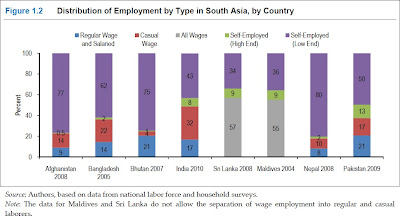
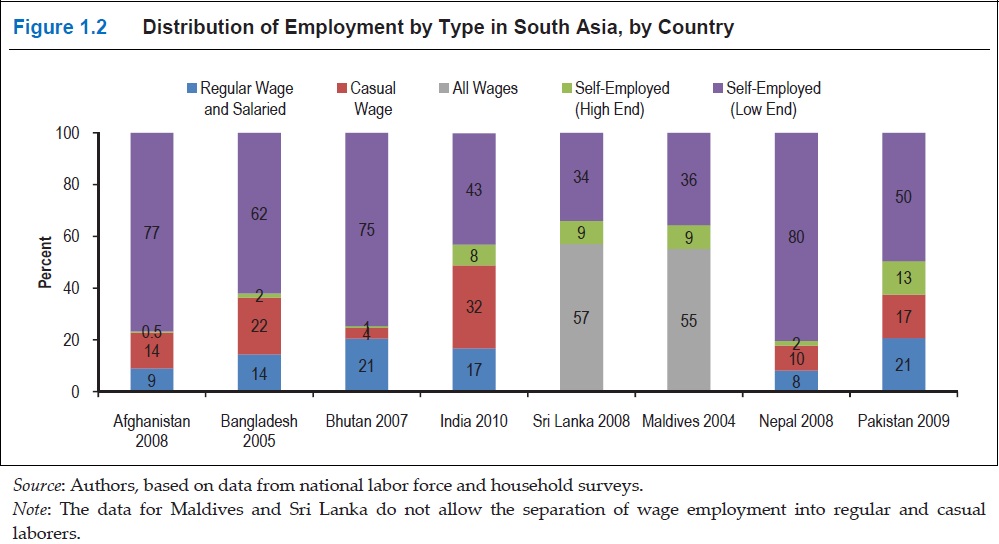
The results of this IBA CED study, as reported by the media, run counter to the findings of a recent World Bank report titled "More and Better Jobs in South Asia" which shows that 63% of Pakistan's workforce is self-employed, including 13% high-end self-employed. Salaried and daily wage earners make up only 37% of the workforce.
Even if one chooses to consider just the 13% who are high-end self-employed as entrepreneurs, it's still much higher than the 2.7% figure reported by CED, and higher than the 11.8% average reported for factor-driven economies covered by GEM.
It seems to me that this discrepancy stems from a very narrow and limited definition of entrepreneurship used in the IBA study which ignores the following realities:
1. The rapid urbanization from massive ongoing rural-to-urban migration in Pakistan is spawning a whole generation of small entrepreneurs who end up working for themselves as small vendors selling their wares on the streets and independent service providers who do basic chores like cooking and cleaning for dozens of clients. Each of these individuals is an entrepreneur by definition. Some of them have also found their way to other nations in Europe and the Middle East where they are earning a good living as street vendors. I saw a recent example of a Pakistani street vendor in Italy who earned enough to send his children to universities....a luxury he didn't have himself.
2. There are many small groups of men and women who are starting businesses at home in both urban and rural areas of the country to sell groceries, sew clothes, raise animals for milk, grow and sell fruits and vegetables, cater cooked food, etc. These small entrepreneurs are managing to put food on their families' tables and put children through good schools. Some of them are being funded and trained by microfinance institutions like Kashf Foundation and others.
People at academic institutions like the IBA who talk about entrepreneurship must research examples like Kraft Foods and Carl's Junior, both of which had humble beginnings on the streets of the United States.
James L. Kraft started Kraft foods by selling milk and cheese from a horse-drawn cart in Chicago in 1903; its first year of operations was "dismal", losing US$3,000 and a horse. Today, Kraft Foods is a multi-billion dollar multinational corporation selling a variety of food products around the globe, including Pakistan.
Carl's Jr, a multi-national fast food giant which operates Hardy's restaurants in Pakistan, began life as a hot dog stand in southern California 1941 with $311 in capital. One cart grew to four, and within five years, Carl's Drive-In Barbecue opened with hamburgers on the menu.
I believe that most Pakistanis are not risk-averse. What is lacking is a supportive environment to help nurture millions of small entrepreneurs to enable them to realize their dreams. The efforts of microfinance sector need to be supported by both the public and private sector through skills training, mentoring and greater funding. Each of us who can afford to help can do so by joining microfinance networks like Kiva.org to lend to such entrepreneurs in Pakistan.
Related Links:
Haq's Musings
Pakistani Entrepreneurs Survive Downturn
Pakistan Leads in Entrepreneurship Indicators
Microfinance to Fight Poverty in Pakistan
Pakistani Entrepreneurs Summit in Silicon Valley
Social Entrepreneurs Target India, Pakistan
Urbanization in Pakistan Highest in South Asia
Start-ups Drive a Boom in Pakistan
P.I.D.E. on Entrepreneurship in Pakistan
Light a Candle, Do Not Curse Darkness
Pakistan Tops Job Growth in Pakistan
Do South Asian Slums Offer Hope?
The results of this IBA CED study, as reported by the media, run counter to the findings of a recent World Bank report titled "More and Better Jobs in South Asia" which shows that 63% of Pakistan's workforce is self-employed, including 13% high-end self-employed. Salaried and daily wage earners make up only 37% of the workforce.
Even if one chooses to consider just the 13% who are high-end self-employed as entrepreneurs, it's still much higher than the 2.7% figure reported by CED, and higher than the 11.8% average reported for factor-driven economies covered by GEM.
It seems to me that this discrepancy stems from a very narrow and limited definition of entrepreneurship used in the IBA study which ignores the following realities:
1. The rapid urbanization from massive ongoing rural-to-urban migration in Pakistan is spawning a whole generation of small entrepreneurs who end up working for themselves as small vendors selling their wares on the streets and independent service providers who do basic chores like cooking and cleaning for dozens of clients. Each of these individuals is an entrepreneur by definition. Some of them have also found their way to other nations in Europe and the Middle East where they are earning a good living as street vendors. I saw a recent example of a Pakistani street vendor in Italy who earned enough to send his children to universities....a luxury he didn't have himself.
2. There are many small groups of men and women who are starting businesses at home in both urban and rural areas of the country to sell groceries, sew clothes, raise animals for milk, grow and sell fruits and vegetables, cater cooked food, etc. These small entrepreneurs are managing to put food on their families' tables and put children through good schools. Some of them are being funded and trained by microfinance institutions like Kashf Foundation and others.
People at academic institutions like the IBA who talk about entrepreneurship must research examples like Kraft Foods and Carl's Junior, both of which had humble beginnings on the streets of the United States.
James L. Kraft started Kraft foods by selling milk and cheese from a horse-drawn cart in Chicago in 1903; its first year of operations was "dismal", losing US$3,000 and a horse. Today, Kraft Foods is a multi-billion dollar multinational corporation selling a variety of food products around the globe, including Pakistan.
Carl's Jr, a multi-national fast food giant which operates Hardy's restaurants in Pakistan, began life as a hot dog stand in southern California 1941 with $311 in capital. One cart grew to four, and within five years, Carl's Drive-In Barbecue opened with hamburgers on the menu.
I believe that most Pakistanis are not risk-averse. What is lacking is a supportive environment to help nurture millions of small entrepreneurs to enable them to realize their dreams. The efforts of microfinance sector need to be supported by both the public and private sector through skills training, mentoring and greater funding. Each of us who can afford to help can do so by joining microfinance networks like Kiva.org to lend to such entrepreneurs in Pakistan.
Related Links:
Haq's Musings
Pakistani Entrepreneurs Survive Downturn
Pakistan Leads in Entrepreneurship Indicators
Microfinance to Fight Poverty in Pakistan
Pakistani Entrepreneurs Summit in Silicon Valley
Social Entrepreneurs Target India, Pakistan
Urbanization in Pakistan Highest in South Asia
Start-ups Drive a Boom in Pakistan
P.I.D.E. on Entrepreneurship in Pakistan
Light a Candle, Do Not Curse Darkness
Pakistan Tops Job Growth in Pakistan
Do South Asian Slums Offer Hope?


Comments
Students in Tamil Nadu-India attained an average score on the PISA reading literacy scale that is significantly higher than those for Himachal Pradesh-India and Kyrgyzstan, but lower than all other participants in PISA 2009 and PISA 2009+.
In Tamil Nadu-India, 17% of students are estimated to have a proficiency in reading literacy that is at or above the baseline needed to participate effectively and productively in life. This means that 83% of students in Tamil Nadu-India are estimated to be below this baseline level. This compares to 81% of student performing at or above the baseline level in reading in the OECD countries, on average.
Students in the Tamil Nadu-India attained a mean score on the PISA mathematical literacy scale as the same observed in Himachal Pradesh-India, Panama and Peru. This was significantly higher than the mean observed in Kyrgyzstan but lower than those of other participants in PISA 2009 and PISA 2009+.
In Tamil Nadu-India, 15% of students are proficient in mathematics at least to the baseline level at which they begin to demonstrate the kind of skills that enable them to use mathematics in ways that are considered fundamental for their future development. This compares to 75% in the OECD countries, on average. In Tamil Nadu-India, there was no statistically significant difference in the performance of boys and girls in mathematical literacy.
Students in Tamil Nadu-India were estimated to have a mean score on the scientific literacy scale, which is below the means of all OECD countries, but significantly above the mean observed in the other Indian state, Himachal Pradesh. In Tamil Nadu-India, 16% of students are proficient in science at least to the baseline level at which they begin to demonstrate the science competencies that will enable them to participate actively in life situations related to science and technology. This compares to 82% in the OECD countries, on average. In Tamil Nadu-India, there was a statistically significant gender difference in scientific literacy, favouring girls.
http://www.acer.edu.au/media/acer-releases-results-of-pisa-2009-participant-economies/
At the edge of India’s greatest slum, Shaikh Mobin’s decrepit shanty is cleaved like a wedding cake, four layers high and sliced down the middle. The missing half has been demolished. What remains appears ready for demolition, too, with temporary walls and a rickety corrugated roof.
Yet inside, carpenters are assembling furniture on the ground floor. One floor up, men are busily cutting and stitching blue jeans. Upstairs from them, workers are crouched over sewing machines, making blouses. And at the top, still more workers are fashioning men’s suits and wedding apparel. One crumbling shanty. Four businesses.
In the labyrinthine slum known as Dharavi are 60,000 structures, many of them shanties, and as many as one million people living and working on a triangle of land barely two-thirds the size of Central Park in Manhattan. Dharavi is one of the world’s most infamous slums, a cliché of Indian misery. It is also a churning hive of workshops with an annual economic output estimated to be $600 million to more than $1 billion.
“This is a parallel economy,” said Mr. Mobin, whose family is involved in several businesses in Dharavi. “In most developed countries, there is only one economy. But in India, there are two.”.....
Similar to Dharavi, Karachi's Orangi town is an example of undocumented entrepreneurship in the shanties. From garments to leather to furniture, there are many small cottage industries operated by small entrepreneurs in Orangi town.
Venture by Rehan (SuperTech)
http://www.youtube.com/watch?v=8BWdNC4lOy8
Venture by Adnan Shahid (Ideogeny)
http://www.youtube.com/watch?v=IGKhYnQ8vtk
Pakistan’s central bank aims to spur lending to small companies, farming and housing in the next three years to boost growth in an economy where government borrowing has curbed credit and kept interest rates elevated.
“These three areas have to be stimulated and will become engines of growth,” Governor Yaseen Anwar, 60, said in an interview at the State Bank of Pakistan in Karachi on March 2. He forecast the economy will expand by 3 percent to 4 percent in the year ending June.
Anwar has kept the benchmark rate at 12 percent since he was officially made governor in October, refraining from adding to two reductions in 2011 as the nation grapples with the fastest inflation in Asia after Vietnam. He said government borrowing is impeding credit, as insufficient tax collections force Prime Minister Yousuf Raza Gilani’s administration to turn to central bank funding to finance flood rehabilitation and a war against militants in the northwest.
“The State Bank cannot do much in isolation without the government taking some very basic corrective measures,” said Nasim Beg, executive vice chairman of Arif Habib Investments Ltd. in Karachi, which oversees 35 billion rupees ($385 million) in stocks and bonds. “The government will be likely to go for aggressive populist spending early in this election year and worry about meeting revenue targets later -- more pressures for the governor.”
----------------
Anwar, who worked at Merrill Lynch & Co. and Bank of America Corp. in his 33-year career before joining the State Bank, cited the government’s commitment to “zero borrowings” from the central bank as one of the reasons for reducing rates in July.
“We need attention on the revenue side in terms of tax reform,” Anwar said, adding he thinks the government may meet its collection target of 1.95 trillion rupees in the year ending June 30. The ratio of tax to gross domestic product, which the finance ministry estimates is 9 percent, “has to go up into the teens,” he said.
Only one in 10 Pakistanis pay taxes, limiting the government’s ability to fund a budget deficit that the International Monetary Fund estimates may widen to as much as 7 percent of gross domestic product this year.-----------
http://www.bloomberg.com/news/2012-03-04/pakistan-s-anwar-plans-lending-boost-to-bolster-economic-growth.html
When I ask entrepreneurs in most countries what drives them to innovate and succeed, they give similar answers: Inspiration. Passion. Vision.
During a recent trip to Pakistan, I heard those same responses. But after spending a week talking to Pakistani entrepreneurs, I realized that for them these qualities are mere afterthoughts. What really drives them is their country. Above all they are propelled by the desire to pull Pakistan out of its political and economic abyss and back to some semblance of normalcy. Their patriotism, combined with their entrepreneurial drive, makes me bullish on Pakistan.
-------------
Pakistan is in crisis. Serious and sobering crisis, not the rhetorical and idealistic “there is opportunity in crisis.” Security is a real threat. Corruption is a crippling problem. There is no confidence in the country’s laws, courts, or leadership. The Council on Foreign Relations recently issued a report on Pakistan that lists state collapse and authoritarianism as two possible future scenarios for the country. That is why I was surprised to hear from every entrepreneur I met with that not only did he or she believe in the country, but that his or her business was “about Pakistan.”
That was the response Shamoon Sultan gave when I asked him to describe the company he founded in 1998, Khaadi. The country’s leading design textile retailer, Khaadi produces high-quality fabrics and ready-to-wear his and hers loose shirts known as kurtas. They are products made out of locally sourced material and woven by local artisans. Most interestingly, they are products for locals who are not deterred, as I witnessed in one of 14 nationwide shops, by Khaadi’s high prices.
“For a country, it is important to create brands,” the soft-spoken and immaculately groomed Sultan said over breakfast at the garishly lit Marriott Karachi.
For him, a graduate of the prestigious Indus design school, Khaadi is a brand that reflects Pakistan’s rich tradition of handloom crafts and textiles. (Textiles account for 11 percent of Pakistan’s GDP.)
He isn’t necessarily selling something. “It’s not about the profits,” he said. He is the son of a successful businessman with options to leave the country, so that much was clear.
Much like Ralph Lauren tying his brand to America, Khaadi is the trim, bearded Sultan’s effort at providing an experience for his fellow countrymen to display pride. More importantly, he has created an enterprise where outsiders see another side of his country.
“Pakistan has a huge perception challenge,” said Monis Rahman, CEO of the Lahore-based Naseeb Networks. “That is interfering with investment that is badly needed to fuel growth.”
It has not interfered, however, with Rahman’s individual ability to raise capital for his several startups—capital raised not in Pakistan, but in Silicon Valley.
----------
Naseeb launched that September with 10,000 users. Six months in, the number rose to 80,000. That Pakistan has, according to Morgan Stanley, the third-fastest-growing number of Internet users made Naseeb.com’s prospects even brighter. And it firmly proved Rahman to be a worthy entrepreneur.
True to that identity, a few years later, in 2005, he launched another Web platform, this time through his own funding. It was a job-search site, Rozee.pk, which today is Pakistan’s No. 1 online employment site. Over 30,000 employers, including U.S.-based firms such as McDonald’s and Coca-Cola, advertise on Rozee.pk.
Read more: http://www.portfolio.com/companies-executives/2010/10/26/pakistani-entrepreneurs-are-in-it-for-country-and-profit/
US Chargé d’ Affaires Ambassador Richard Hoagland, US Consul General in Lahore Nina Maria Fite, Securities and Exchange Commission of Pakistan (SECP) Chairman Muhammad Ali, Nishat Group Chairman Mian Mansha, Dawood Hercules Corporation Chairman Hussain Dawood and Pakistan Business Council Chairman and Engro Corporation CEO Asad Umar attended the two-day event.
Talking to the entrepreneurs in Pakistan Richard Hoagland expressed his appreciation for fastest growing entrepreneurial companies who achieved exponential growth in the last few years. He advised Pakistani business community to lobby with its government to have strong legislation for the investors’ protection to ensure better environment for doing business.
He said that Central Asian states offer immense opportunities for Pakistani investors and Pakistani businesses should also take advantage of the same.
SECP Chairman Muhammad Ali said that SECP was working on detailed guidelines for the function of corporate social responsibility in the country in order to help the corporate sector helping the society back in a better manner. He said that success of Pakistani entrepreneurs was a testimony of the great potential this country possesses and how talented its human resources are. He appreciated the idea of having Pakistan 100 summit that seeks to highlight the success and achievements of resilient Pakistani entrepreneurs.
Dawood emphasised the need of having solid values for the successful business. He said that a business based on solid ethical values is bound to grow faster and is beneficial for the society at large.
Mansha said that Pakistani businesses need to venture out of the country and invest in potential markets like Africa too. He said that in next two decades the world would be at our doorstep to eagerly invest in Pakistan.
Cyan Limited CEO Samad Dawood said that the Pakistan100 are a testament to the zeal and passion of the Pakistani private sector. Their accomplishment is even more impressive given the challenges that they have had to endure in the recent years.
AllWorld Network also announced the winners of the Pakistan Fast Growth 100 (Pakistan100), a ranking of the fastest growing non-listed companies in Pakistan.
Leading the Pakistan100 is number 1 company e2e Supply Chain Management, which grew 1,918 percent between 2008 and 2010, with 2010 revenues above $50 million and 297 employees. Launched in 2005, e2e has risen to become one of the most successful end-to-end logistics companies covering Pakistan and Afghanistan. Taking the second spot for Pakistan was Exceed Private Limited, with a growth rate of 1,320 percent and 90 employees. Founded by the youngest entrepreneur on the Pakistan100, Exceed rose to prominence for its historic restoration of Saidpur Model Village, redeveloped as an 18th Century city-museum with 5,000 residents.
Commenting on the success of Pakistan100 at the Awards Ceremony, AllWorld co-founders Deirdre Coyle and Anne Habiby urged the Pakistan100 to go further when no one expected much, the Pakistan100 broke records for growth, transparency and competitiveness.
http://www.dailytimes.com.pk/default.asp?page=2012\03\11\story_11-3-2012_pg5_9
Islamabad—Citi Pakistan has been awarded the ‘Best Community Program’ Award for its pioneering work in microfinance and vocational training at the International CSR Awards 2012. This award comes on the heels of two global awards that Citi Pakistan received at the Global CSR Summit and at the Asian CSR Awards in 2011, for its corporate citizenship initiatives in Pakistan. The bank has been focusing its programs on microentrepreneurship for vulnerable groups, including helping female entrepreneurs set up businesses. This is evidenced through the Citi Microentrepreneurship Awards (CMA) program which has been run in association with the Pakistan Poverty Alleviation Fund (PPAF) for the past (8) years through an annual grant provided by the Citi Foundation.
Now in 28 countries, CMA promotes the effective role that individual microentrepeneurs have made to the economic sustainability of their families as well as their communities. This year also marks the completion of Citi’s flood relief efforts in Pakistan to provide reconstruction and rehabilitation for affectees of the 2010-11 disaster. ‘This award is a solid recognition of our commitment to responsible finance in the country, particularly through meaningful microfinance and income-generation programs,’ said Aliuddin Ahmed, Acting Citi Country Officer for Pakistan. ‘Our community projects in Pakistan aim to create sustainable small-scale businesses with clear and measurable objectives and good process tools attached to all our social responsibility initiatives.’
The bank has had a continuous presence in Pakistan over the last 50 years and remains fully committed to serving its corporate clients and retail customers in the country, as well as fulfilling its role as a responsible corporate citizen. As it marks its 200thanniversary this year, Citi is considered to be the world’s global bank and a key partner-in-progress by public sector entities, top corporations and MNCs that operate in Pakistan and elsewhere in the region.
http://pakobserver.net/detailnews.asp?id=153685
Have you ever wondered where the milk in packaged dairy products comes from? In case you assumed that big food companies maintained their own dairy farms that generated thousands of litres of milk daily and remained insulated from fluctuations in open market rates, you are wide of the mark.
In fact, only 5% of about 1.2 million litres of milk that Engro Foods collects every day for its dairy segment during the flush season – from January to April each year when fodder is available in abundance and milk production is high – comes from its own corporate farm located in Sukkur.
The rest of the milk supplies during the flush season and the summer, when milk production drops by roughly 50%, comes from about 15,000 small farmers scattered between Sanghar and Jhang districts, an area of 135,000 square kilometres.
Streamlined under Engro Milk Automation Network (EMAN), Engro Foods maintains a sales force of 1,500 people across 1,200 villages in Sindh and Punjab. They collect milk, mostly in small quantities, from farmers between 6:00am and 9:30am every day, which is then transported for further processing.
But why would a villager with just a few cattle sell the excess quantity of milk to Engro Foods instead of the traditional milk contractors known as dodhis?
According to Aamir Khawas, who works as head of milk procurement and agri services at Engro Foods, doing business with a large food company offers small farmers a number of benefits. “Animals are susceptible to diseases. Our network of veterinarians ensures sick animals receive immediate treatment. That’s a benefit no traditional milk contractor can offer,” he said.
Moreover, the moment a farmer sells milk to an Engro representative, in whatever small quantity, the transaction is recorded electronically in a centralised database by swiping the EMAN card that each of the 15,000 suppliers carries.
The availability of real-time data ensures that money is transferred to the farmer the day the transaction takes place. This is in contrast to the past practice of issuing receipts on paper that took at least a week before a transaction was recorded and payment processed.
In addition, Engro’s advisory service helps farmers increase milk production. “There’re two ways for a farmer to increase his revenue. If he gets Rs41 instead of Rs40 per litre, his revenue increases by Re1. But if the milk output increases by one litre, his revenue increases by Rs40. We help him do the latter,” Khawas said.
So how does Engro ensure that the milk is pure? “It’s very easy. We pay farmers not on the litres of milk they bring to us. Rather, the basis of payment is total solid contents of the milk,” he said, explaining that milk consists of three things – water, fat and solid non-fat (SNF). Total solid contents are the sum of fat and SNF.
“It’s hard to adulterate when the quantity is low. So no matter how much water you add, the solid contents can easily be determined by running a few tests,” he said.
A total of 13 tests are carried out when a farmer hands over milk to an Engro representative. It is picked up from there by an Engro van that carries out another 20 tests on the collected milk. It then reaches the regional office where 30 more tests are done to check its quality. Eventually, milk is taken to the Engro plant where the final 40 tests take place before it is processed, packaged and dispatched to the retail market.
With the demand of milk increasing by 15% annually and supply rising by just 2% a year in Pakistan, the dairy sector looks like a heaven for investment. The Sukkur farm of Engro Foods has already grown 10 times since its inception with about 3,000 cows. “Yet we’re looking for a major expansion in the near future.”
http://tribune.com.pk/story/378282/the-benefits-of-business-with-a-large-food-company/
A recent article in Wired, Danger Room highlighted the resurgence of the US drone campaign in Pakistan. While it focuses on the war, a lot was left untold about the nation’s story that is as heartening as it is heartrending, and as inspiring as it is seemingly dismaying.
---------
The story of four of these start-ups, that launched in 2012 speak volumes about the resilience, commitment and resourcefulness of its founders.
The first is Vital Agri Nutrients, a young, agricultural Research and Development focused company that is working on developing innovative products for farmers. It has had some recent breakthroughs with their micro-nutrients and soil amendments which are currently in field trials. Given the expected shortage of water and growing prices of fertilisers world-wide, the company and its products present a promising opportunity for small and large farmers to improve the crop yield and lower their input cost per acre by employing soil amendments that help with more efficient use of fertilisers and water in plants.
Next, four young entrepreneurs at Eyedeus, aided by decades of joint research in computer vision, have developed technology that enables mobile devices to have eyes and intelligently process real-world imagery using an increasingly powerful mobile processors. Unlike the cameras on mobile devices that just allow ‘dumb’ recording of images or videos, Eyedeus technology allows developers to augment the reality around users. The company’s first product, called ‘Groopic’ (beta available on the AppStore) is already getting rave reviews. Groopic allows group pictures to be taken in a way never before possible. The person taking the picture can now be part of the group picture, go figure!
Eyedeus, by the way, is part of a full-service technology incubator called Plan 9, that’s a visionary initiative of the government of Punjab, and it hosts at least a dozen other start-ups alongside Eyedeus, working on equally innovative products and services.
Similarly, Invest2Innovate is another accelerator that is supporting at least five entrepreneurial ventures focused on businesses with a large social impact.
Third is a new age production house called JugnooMedia, developing interactive, digital musical toys for mobile devices with an aim of providing toddlers and young children new avenues of learning that are more fun and effective than the traditional, classroom teaching. The demos of their first title are very impressive and the company has announced that it will be released on the Apple AppStore and Android Marketplace soon.
And finally, there is BLISS – a social venture that is aimed at improving the livelihood of women in Pakistan alongside educating them. BLISS has already done a pilot program in a small village of Pakistan where women were taught embroidery skills alongside formal school education in the first phase. In the second phase, BLISS provided the same women an opportunity to co-op with the company and develop handbags designed by professional designers which were then marketed by BLISS through its online store as well as an impressive list of global brand ambassadors. The women who made the bags got the lion’s share of the revenue from those sales and the rest of the money is being used to sustain the operations of the organisation and scale the program.
----------
The next time a story is told about the problems Pakistan is having with the political instability, corruption, energy shortage and terrorism the world must know, that to the same land belong some of the best, battle-tested and inventive entrepreneurs working on shaping the future of the world!
http://blogs.tribune.com.pk/story/15611/pakistan-more-than-just-drones-blasts-and-terrorism/
The State Bank of Pakistan's (SBP) Credit Guarantee Scheme (CGS) has helped small enterprises and farmers to access Rs 2.83 billion in bank financing over the last 18 months.
The Scheme (CGS) has facilitated financing in 105 districts across the country with 85 percent of loans provided to previously un-served/under-served clients in rural areas, of which 81 percent were subsistence farmers, said a SBP press statement on Wednesday.
Similarly, 91 percent of the loans under the Scheme were provided to small businesses with less than five employees of whom 90 percent were
Sole proprietors the statement added.
Under the CGS, banks also focused on serving the lower end of the commercial banking market through smaller loans, with an average loan size of Rs 390,000 for agriculture and Rs 2.1 million for small enterprises. Specific to the needs of the clients, the durations ranged from less than one year to three years.
The Scheme through its support to previously un catered small rural enterprises is likely to enhance economic opportunities and increase employment in the rural areas of the country.
The Technical Committee of the bank during its annual review of the Scheme observed that despite the extensive geographic spread and a focus on under-banked segments, the participating banks demonstrated prudent lending practices reflected in an infection ratio of only 2.91 percent for agriculture and 1.07 percent for small enterprise loan portfolios, which are much lower than the industry averages.
It shall be noted that the CGS is monitored by the Technical Committee drawing membership from the UK's Department for International Development (DFID), SBP and the Pakistan Banks Association (PBA).
The Scheme is working in tandem with nine banks including big five banks which were selected after due screening by the Committee.
http://www.pakistantoday.com.pk/2013/02/20/news/profit/smes-farmers-get-rs-2-83-bln-financing-under-cgs/
The number of wealthy entrepreneurs entering the UK on the government’s visa programme has doubled in the past year, boosted by people from China and Pakistan setting up businesses in London.
‘Entrepreneur visas’ allow foreign nationals to start a company and earn a fast track to UK citizenship, as long as strict criteria on access to funding, job creation, or business success are fulfilled.
London’s growing importance as a global tech hub, and the increasing difficulty in obtaining the right to work in the UK by other means, has hugely increased the interest in entrepreneur visas over the past year, say experts.
“Entrepreneurs from around the world are attracted to some of the UK’s fastest growing business sectors, such as the rapidly expanding IT start-up sector, which is centred around ‘Silicon Roundabout’ in London,” said Simon Horsfield, partner in the private wealth team of Pinsent Masons, the international law firm.
Take-up of the visas has increased sharply in recent years, jumping to 462 in the 12 months to the end of June 2012, compared with 199 in the same period a year earlier. In 2008 just 11 were issued, according to figures obtained by Pinsent Masons.
American entrepreneurs represented 22 per cent of successful applicants in the year to end of June. Chinese foreign nationals accounted for 11 per cent of the total – rising by 500 per cent to 54 applications last year – while entrepreneurs from Pakistan accounted for 16 per cent.
Mr Horsfield said unlike investor visas which have been criticised for being used as a quick route into the UK for wealthy investors, entrepreneur visas are not about people ‘buying’ a fast track to UK citizenship.
“To satisfy the visa criteria, applicants have to create jobs and prove that they will make a long-term contribution to the UK economy,” he said. “These entrepreneurs can be hugely beneficial to the UK economy. They’ll bring fresh ideas, create new jobs, and provide a boost just when the economy needs it.”
James Badcock, head of the Geneva office at law firm Collyer Bristow, said increasingly tight rules on immigration had boosted the popularity of specialist visas, such as entrepreneur or investor visas.
“Clients considering an entrepreneur visa are often those who are already entrepreneurs in their home country but are concerned about the stability or state of the political regimes where they live,” said Mr Badcock.
He said the visas were increasingly becoming popular among Asians because of the huge influx of Asian investment to London.
If after three years, holders of entrepreneur visas can demonstrate that they have created 10 permanent jobs in the UK or generated income over that period of at least £5m, they will be able to apply for indefinite leave to remain in the UK at that time, with no restriction on their right to work, rather than having to wait for the usual five years.
Successful applicants must start their business within six months of being granted the visa.
www.ft.com/intl/cms/s/0/553d1c5e-7d0a-11e2-8bd7-00144feabdc0.html
When Pakistan's new foreign minister arrived in India for talks in 2011 it triggered a media storm on both sides of the border – not because of policy but a Birkin bag. Hina Rabbani Khar, at 34 Pakistan's youngest and first female foreign minister, was put under international scrutiny for her pearl necklaces, Cavalli sunglasses and expensive handbags. "A guy in my place would never get such attention – nobody would be talking about his suit," she said at the time.
Powerful women the world over are evaluated on their appearance, but in Pakistan there are additional cultural constraints. However, as the country gears up for Saturday's general election – its first ever transition from one elected government to another – female politicians are standing up to change their future at the ballot box.
Figures released by the Election Commission show a 129.8% increase in the number of women contesting general seats since the 2008 election. As well as Khar, Pakistan has had a female prime minister in Benazir Bhutto and currently has Fehmida Mirza as speaker. Reserved seats for women have always been guaranteed in Pakistan's constitution, and over the years the number of quota seats has increased due to the efforts of activists. While reserved seats are improving representation (it stands at 22.5%, the same as in the UK, and better than the US's 17.8%), these women are predominantly from elite backgrounds. Those from poorer families remain excluded from the political system and, at the far end of the spectrum, many women are so disenfranchised that they cannot vote.
South Asia, despite its social conservatism, has a long history of female representation, with political systems often heavily dominated by a few families. Women such as Bhutto and India's Indira Gandhi stood in place of their father or husband, the family name allowing them to step outside traditional female roles: Khar contested elections because her father Noor was disqualified. Despite her swift rise to the cabinet she will not stand this year, because her father has been reinstated.
"It is difficult for women," says Anis Haroon, a caretaker minister for human rights and women. "It's non-traditional ground to tread, and women still bear the responsibility of home and children. Character assassination is easy in a patriarchal, conservative society. Women must work twice as hard to prove their worth." Last month, an election official in Lahore told the husband of prospective candidate Sadia Sohail that if she were elected, "the arrangements at your home will be ruined and no one will be there to attend your children"....
http://www.guardian.co.uk/lifeandstyle/2013/may/09/pakistan-female-election-candidates-confidence
Indonesia 131
India 127
Philippines 126
Pakistan 109
Egypt 103
In a study of 68 countries, Professor Erkko Autio and Dr Kun Fu from Imperial College Business School estimated that business activities conducted by informal entrepreneurs can make up more than 80 per cent of the total economic activity in developing countries. Types of businesses include unlicensed taxicab services, roadside food stalls and small landscaping operations.
In a study of 68 countries, Erkko Autio and Kun Fu of London's Imperial College Business School found that after Indonesia, India has the second highest rate of shadow entrepreneurs.
This is the first time that the number of entrepreneurs operating in the shadow economy has been estimated.
Shadow entrepreneurs are individuals who manage a business that sell legitimate goods and services but they do not register their businesses. They do not pay tax and operating in a shadow economy where business activities are performed outside the reach of government authorities.
Indonesia has 131 shadow businesses to every business that is legally registered compared to India's 127.
Philippines have 126, Pakistan has 109 and Egypt has 103 shadow businesses to every legally registered business.
Experts say the shadow economy results in loss of tax revenue, unfair competition to registered businesses and also poor productivity - factors which hinder economic development.
As these businesses are not registered it takes them beyond the reach of the law and makes shadow economy entrepreneurs vulnerable to corrupt government officials.
The researchers said, "If India improved the quality of its democratic institutions to match that of Malaysia for example, it could boost its rate of formal economy entrepreneurs by up to 50% while cutting the rate of entrepreneurs working in the shadow economy by up to a third. This means that the government could benefit from additional revenue such as taxes."
The UK exhibits the lowest rate of shadow entrepreneurship among the 68 countries surveyed, with a ratio of only one shadow economy entrepreneur to some 30 legally registered businesses.
Autio said, "Understanding shadow economy entrepreneurship is important for developing countries because it is a key factor affecting economic development. We found that government policies could play a big role in helping shadow economy entrepreneurs transition to the formal economy. This is important because shadow economy entrepreneurs are less likely to innovate, accumulate capital and invest in the economy, which hampers economic growth."
http://timesofindia.indiatimes.com/India/India-has-2nd-highest-no-of-shadow-entrepreneurs-in-the-world/articleshow/35653042.cms
http://www3.imperial.ac.uk/newsandeventspggrp/imperialcollege/newssummary/news_27-5-2014-9-53-29
http://link.springer.com/article/10.1007/s10490-014-9381-0