Economic Comparison Between Bangladesh & Pakistan
Economic gap between East and West Pakistan in 1960s is often cited as a key reason for the secessionist movement led by Shaikh Mujib's Awami League and the creation of Bangladesh in 1971. This disparity has grown over the last 40 years, and the per capita income in Pakistan now stands at 1.7 times Bangladesh's in 2011, slightly higher than 1.6 as it was in 1971.
Forty years after the Fall of Dhaka and the creation of Bangladesh on Dec 16, 1971, there's still much talk about it. The Daily Star, a Bangladeshi newspaper, has published a piece on the subject by Akbar Ali Khan marking the 40th anniversary of Bangladeshi independence. In his Op ED, Mr. Khan argues that "political independence provided much more conducive environment for growth in Bangladesh than united Pakistan. Though economic growth in East Pakistan was revived during Ayub Khan's so-called decade of reforms, growth rate in erstwhile East Pakistan was much lower than that of West Pakistan".
In his zeal to rationalize independence based on the economic argument, Mr. Khan has clearly ignored the following facts:
1. In 1969-70, the ratio of per capita incomes between West and East Pakistan was 1.6, as detailed by Mr. Khan. In 2011, however, this ratio has increased to 1.7, according to the IMF data.
2. Bangladesh is still categorized by the World Bank among low income and least developed countries of the world, while Pakistan is a middle income country and classified well above the list of least developed countries of the world.
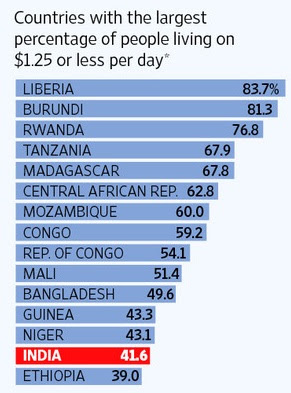
3. Bangladesh is ranked as 11th poorest country in the world by the World Bank in terms of the percentage of population living on $1.25 or less a day. Neighboring India is the 14th poorest on this list, while Pakistan does not show up on it. The rest of the nations on this list are all in sub-Saharan Africa.
3. In 1947, East Pakistan started with a lower economic base than West Pakistan, and the loss of its Hindu Bengali business elite in 1947 left it worse off. It also didn't have the benefit of the large number of Muslim businessmen who migrated to West Pakistan, particularly Karachi, after partition of India in 1947.
4. Pakistani economist Dr. Ishrat Husain explains it well when he says that "although East Pakistan benefited from Ayub’s economic reforms in 1960s, the fact that these benefits were perceived as a dispensation from a quasi-colonial military regime to its colony—East Pakistan—proved to be lethal."
It must, however, be acknowledged that Bangladeshi economy has been outperforming Pakistan's in the last few years, particularly since President Musharraf's departure in 2008. Bangladesh has also made significant strides on various social indicators and it now ranks just one notch below Pakistan on human development index 2011. Bangladesh's family planning efforts have been remarkably successful in lowering the fertility rate of Bangladeshi women, an area where Pakistan significantly lags behind the rest of South Asia.
Related Links:
Haq's Musings
Comparing India and Pakistan in 2011
Is This a 1971 Moment in Pakistan's History?
Pakistan Ahead of India in Graduation Rates
Pakistan Tops Job Growth in South Asia
Pakistan Needs More Gujaratis?
President Musharraf's Legacy
 |
| Pakistan-Bangladesh GDP Comparison (Source: World Bank) |
Forty years after the Fall of Dhaka and the creation of Bangladesh on Dec 16, 1971, there's still much talk about it. The Daily Star, a Bangladeshi newspaper, has published a piece on the subject by Akbar Ali Khan marking the 40th anniversary of Bangladeshi independence. In his Op ED, Mr. Khan argues that "political independence provided much more conducive environment for growth in Bangladesh than united Pakistan. Though economic growth in East Pakistan was revived during Ayub Khan's so-called decade of reforms, growth rate in erstwhile East Pakistan was much lower than that of West Pakistan".
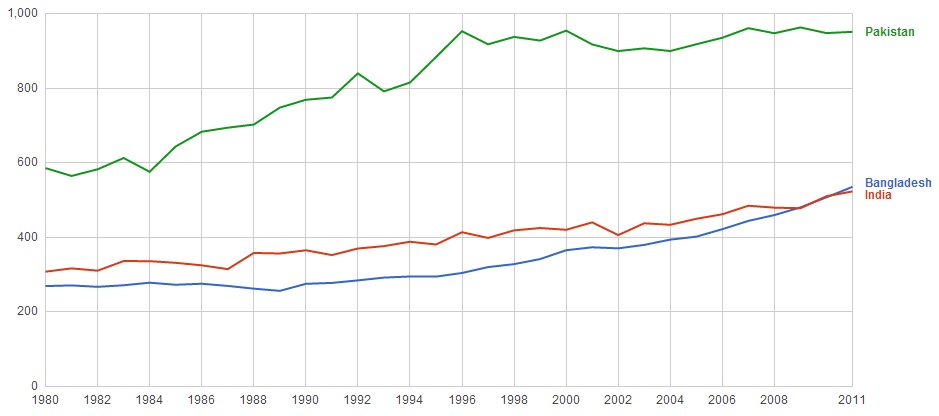 |
| Agriculture Value Added Per Worker in Constant 2000 US$ (Source: World Bank) |
In his zeal to rationalize independence based on the economic argument, Mr. Khan has clearly ignored the following facts:
1. In 1969-70, the ratio of per capita incomes between West and East Pakistan was 1.6, as detailed by Mr. Khan. In 2011, however, this ratio has increased to 1.7, according to the IMF data.
2. Bangladesh is still categorized by the World Bank among low income and least developed countries of the world, while Pakistan is a middle income country and classified well above the list of least developed countries of the world.

3. Bangladesh is ranked as 11th poorest country in the world by the World Bank in terms of the percentage of population living on $1.25 or less a day. Neighboring India is the 14th poorest on this list, while Pakistan does not show up on it. The rest of the nations on this list are all in sub-Saharan Africa.
3. In 1947, East Pakistan started with a lower economic base than West Pakistan, and the loss of its Hindu Bengali business elite in 1947 left it worse off. It also didn't have the benefit of the large number of Muslim businessmen who migrated to West Pakistan, particularly Karachi, after partition of India in 1947.
4. Pakistani economist Dr. Ishrat Husain explains it well when he says that "although East Pakistan benefited from Ayub’s economic reforms in 1960s, the fact that these benefits were perceived as a dispensation from a quasi-colonial military regime to its colony—East Pakistan—proved to be lethal."
It must, however, be acknowledged that Bangladeshi economy has been outperforming Pakistan's in the last few years, particularly since President Musharraf's departure in 2008. Bangladesh has also made significant strides on various social indicators and it now ranks just one notch below Pakistan on human development index 2011. Bangladesh's family planning efforts have been remarkably successful in lowering the fertility rate of Bangladeshi women, an area where Pakistan significantly lags behind the rest of South Asia.
Related Links:
Haq's Musings
Comparing India and Pakistan in 2011
Is This a 1971 Moment in Pakistan's History?
Pakistan Ahead of India in Graduation Rates
Pakistan Tops Job Growth in South Asia
Pakistan Needs More Gujaratis?
President Musharraf's Legacy
Comments
In the narrative adopted by Bangladesh and echoed by India and most of global discourse, about three million Bengalis were killed and about 300,000 women were allegedly raped by the Pakistan Army during the nine-month conflict resulting in the secession of Bangladesh. These numbers fail spectacularly on the anvil of factual scrutiny, documentation and rationality. In the 262 days between March 26 and December 16, 1971, Pakistan’s armed forces did not exceed 45,000 troops at optimal levels. The 90,000 prisoners-of-war held by India included over 50,000 non-combatant, unarmed West Pakistani civilians.
Spread out in small, embattled formations across East Pakistan, facing a newly unfriendly or uneasy population, an India-supported insurgency, preparing for an Indian invasion, constantly under-supplied and under-equipped, the Pakistani forces would have had to kill 11,450 Bengalis and rape 1,145 women every single day for 262 days to reach the levels claimed. Not a single credible document has been cited in 40 years to substantiate such absurd allegations of scale.
By unverified frequent repetition of the grotesque figures, the names of Pakistan and Pakistan’s armed forces have become synonymous with the charge of a ‘genocide’ in East Pakistan, which actually never took place. The unfounded charge amounts to the character assassination of a nation’s armed forces.
The Pakistani version is diametrically different. The official Commission of Inquiry headed by a former chief justice could only estimate 36,000 dead. Other estimates go between 100,000 to 200,000 killed. To contrast the two claims is not to demean the gravity of the catastrophe by cold statistics. Every human life is sacred. Every human being’s dignity is sacrosanct. Any violation of either is reprehensible.
Some atrocities by Pakistani troops did take place. Several eye-witness accounts state that the targets were almost always adult males, that women and children were spared. The killings were not one-sided. Many thousands of non-Bengalis and West Pakistanis, including women and children, were brutally slaughtered by Bengalis between 1st March and March 26, 1971, and subsequently as well, as also after December 16, 1971. About 4,000 Pakistani troops also perished in the conflict.
The need to revisit this facet of history to conclusively establish the truth is superbly highlighted by the meticulous research recorded by a scholar who is neither a Pakistani nor a Bangladeshi. In her unusually sensitive and remarkably balanced book, Dead Reckoning: Memories of the 1971 Bangladesh War, Sarmila Bose — an Indian Bengali Hindu by birth, a senior Research Fellow at Oxford University — powerfully and persuasively presents the case for a rigorous, evidence-based search for the truth.
http://www.dailytimes.com.pk/default.asp?page=2011\12\17\story_17-12-2011_pg3_5
ISLAMABAD, Dec 19 (APP): Federal Minister for Finance, Dr Abdul Hafeez Shaikh here on Monday said economic indicators were showing positive results due to prudent economic policies initiated by the government.Briefing a newsmen, here at the Ministry of Finance, the Minister said the government wanted to improve the workings, efficiency and performance of State Owned Enterprises like Pakistan International Airlines (PIA), Pakistan Steel Mills (PSM) and Pakistan Railways through introducing efficient management and operating through the professionals in order to make them profitable entities for the economic development of the country.
He added that government has fulfilled the minimum financial requirements of the PSM in order to help the organization improve its working capacity.
He informed the media that large scale manufacturing sector has registered growth of 3.6 percent during the first quarter of current financial year which was a health sign for national economy.
He added that revenue collection up to December 16 stood at Rs. 715 billion which was realized at Rs. 555 billion during the same period of last financial year.
Besides, the governmental expenditures were fixed at 42.5 percent during first five months of current financial year which was recorded at 38 percent, he added.
He further informed that government expenditure had targeted to 50 percent of the total expenditures by December this year which would reach up to 42 percent.
However , he said that it would spent about 40 percent of (PSDP) by December.Secretary Finance, Dr Waqar Masood said that export grew by 11.5 percent against the expected targets of 5 percent,while imports grew by 20 percent as against the expected targets of 10 percent.
He informed that inflation rate was recorded at 10.2 percent during the period under review which was recorded at 14 percent during the last year.
Foreign remittances in the country were increased by 18 percent which crossed US $ 5 billion mark during last five months of current financial year.
Secretary Finance said that Federal Board of Revenue (FBR) was determined to achieve its revenue targets of Rs. 1952 billion as revenue collection has registered 28 percent growth as compared to same period last year.
http://app.com.pk/en_/index.php?option=com_content&task=view&id=171141&Itemid=1
However Bangladesh started to picking up from 1990s and 2000s. If you see the development in this 2 decades is much more then that of Pakistan. In the coming decades this trends will continue where Bangladesh is expecting to get a 7-8% GDP growth within 2-3 year, Pakistan got only 2% gdp growth last year. The internal chaos will hinder the growth more.
Now lets come to the GDP or per capita GDP. The GDP of Bangladesh is a hugely underestimated one that people usually quote mainly due to the fact that it is based on 1995 economic base year. Since then economic structure of Bangladesh has changed completely. Most of the new emerging industries are not counted in the total economy such as private banks, trading companies, private universities, cellular companies, tv stations etc but they contribute to a great extent. Other part is that economic activities at the villages. Due to receiving of high amount of reminiscences economic activities that occur there is huge. On top of it in Bangladesh provide only less then 1% of the people pays taxes with mostly fake information. That actually helped to create a shadow economy. Recently finance ministry indicated that 37-81% economy is shadow economy and size is 50-100 billion usd. Even though other country's also have shadow economy but this size is massive for Bangladesh where as other have only in between 6-20% where as for Bangladesh it is 37-81%.
If we sum up all we will find that at present there is not much difference between the per capita gdp of Pakistan and Bangladesh. This year Bangladesh will publish updated GDP based on 2005 economic baser year. This will give a clear picture what is the present status of the economy though it will not count shadow or black economy.
Lastly Bangladesh has done so far really well after getting independence from Pakistan even better then Pakistan. It will continue at more faster scale in the coming year. But still has some challenges such as corruption, political instability, poor infrastructure, load shedding etc. Bangladesh needs to focus on these stuff if we want to attain more faster growth or 10% GDP growth within the next couple of years.
this still pakistan economy is growing. Bandladesh is enjoying prefential treatment being a poor and low income country where as in the case of Pakistan it is not so. Pakistan is oblige to maintain a huge army because of its big enemy India where in case of Bangldesh, the country is ruling as a part of India and not obliged to maintain a big and advance army. Pakistan is hosting 3 million refugees from Afghanistan Iran and African countries where as Bangladesh pushed back to their country a very little refugees from Burma when they tried to take shelter and save their live from Budhist terrorists.
Quality of life is much better in Pakistan as compared to Bangladesh and even India. There is no long term investment in Big projects in Bangladesh while in case of Pakistan the case is reverse
On a warm Sunday morning in November, Arif Habib leaves his posh home near the seafront in southern Karachi and drives across town in a silver Toyota Prado SUV. About half an hour later, he arrives to check up on his latest project: a 2,100-acre residential development at the northern tip of this city of 20 million. He hops out, shakes hands with young company call-center workers who are dressed for a cricket match, and joins them at the edge of the playing field for a traditional Pakistani breakfast of curried chickpeas and semolina pudding. After a quick tour of the construction site, he straps on his leg pads, grabs his bat, and heads onto the field. “The principles of cricket are very effective in business,” says Habib, 59. “The goal is to stay at the wicket, hit the right balls, leave the balls that don’t quite work, and keep an eye on the scoreboard. I feel that my childhood association with cricket has contributed to my success.”
Habib, who started as a stockbroker more than four decades ago, has expanded his Arif Habib Group into a 13-company business that has invested $2 billion in financial services, cement, fertilizer, and steel factories since 2004. His group and a clutch of others have become conglomerates of a kind that went out of fashion in the West but seem suited to the often chaotic conditions in Pakistan. Engro (ENGRO), a maker of fertilizer, has moved into packaged foods and coal mining. Billionaire Mian Muhammad Mansha, one of Pakistan’s richest men, is importing 2,500 milk cows from Australia to start a dairy business after running MCB Bank, Nishat Mills, and D.G. Khan Cement.
These companies have prospered in a country that, since joining the U.S. in the war on terror after Sept. 11, has lost more than 40,000 people to retaliatory bombings by the Taliban. Political violence in Karachi has killed 2,000 Pakistanis this year, and an energy crisis—power outages last as long as 18 hours a day—has led to social unrest. Foreign direct investment declined 24 percent to $244 million in the four months ended Oct. 31, according to the central bank.
At the same time, some 70 million Pakistanis—40 percent of the population—have become middle-class, says Sakib Sherani, chief executive of Macro Economic Insights, a research firm in Islamabad. A boom in agriculture and residential property, as well as jobs in hot sectors such as telecom and media, have helped Pakistanis prosper. “Just go to the malls and see the number of customers who are actually buying in upscale stores and that shows you how robust the demand is,” says Azfer Naseem, head of research for Elixir Securities in Karachi. “Despite the energy crisis, we have growth of 3 percent.”
Sherani of Macro Economic Insights estimates the middle class doubled in size between 2002 and 2012. “Those who understand the difference between the perception of Pakistan and the reality have made a killing,” Habib says. “Foreigners don’t come here, so the field is wide open.” The KSE100, the benchmark index of the Karachi Exchange, has risen elevenfold since mid-2001. Shares in the index are up 43 percent this year alone. Over the past decade, stocks have been buoyed by corporate earnings, which were bolstered in turn by rising consumer spending.
---------
Today, Habib has 11,000 employees and annual revenue of 100 billion rupees. He plans to expand into commodities trading and warehousing. “I’ve created all my wealth in Pakistan and reinvested all of it here,” says Habib, who drives himself to his cricket matches and is never accompanied by security guards. In 1998, when Pakistan’s share index fell to a record low after the government tested nuclear weapons, Habib bought shares even though “people thought I was mad.”...
http://www.businessweek.com/articles/2012-11-29/pakistan-land-of-entrepreneurs
Chadigarh Rs. 140,073
Punjab Rs. 78,594
Haryana Rs. 109,064
West Bengal Rs. 55,222
http://unidow.com/india%20home%20eng/statewise_gdp.html
Li & Fung — the most important company that most American shoppers have never heard of — has long been on the cutting edge of globalization, chasing cheap labor to garment factories first in China, then elsewhere in Asia, including Bangladesh.
---------
In Bangladesh, Li & Fung has been tied to several calamities. It arranged the production of clothing for Kohl’s at one factory where 29 workers died in a fire in 2010. It brokered some work at another in 2011 where more than 50 workers who made Tommy Hilfiger clothing were injured and at least 2 died in an explosion and a stampede.
And last year, Li & Fung was responsible for some garments produced at the Tazreen Fashions factory, when 112 workers died in November in a fire after many of them were ordered to continue working even though alarms had sounded.
Such episodes highlight the often hidden role played by sourcing companies in trying to feed the West’s seemingly insatiable demands for ever cheaper merchandise. Worker advocates say that Li & Fung and others make accountability more difficult by adding a layer of insulation between reputation-conscious retailers and often poorly treated workers, allowing businesses to avoid bad publicity and legal liability when things go wrong.
Sourcing companies face an inherent conflict: they are expected to find low-cost factories for clients, but also to blow the whistle if the factories violate safety standards. Some critics say that the scale of Li & Fung’s operations and the speed at which it shifts production from one site to another give owners less incentive to improve their factories and make it difficult for Li & Fung to deliver on its pledges of carefully vetting its suppliers.
“We make our best effort to weed out bad factories,” said Bruce Rockowitz, chief executive of Li & Fung. “But we don’t always succeed.”
Mr. Rockowitz added that Li & Fung employees conduct rigorous on-site audits — unlike many competitors — to ensure that the company does business only with factories that adhere to safety regulations. In the case of Tazreen, Li & Fung had acquired a new subsidiary that placed orders at the factory, but the changes sought by Li & Fung had not been made 11 weeks later when the fatal fire occurred, a company spokesman said....
http://www.nytimes.com/2013/08/08/world/linking-factories-to-the-malls-middleman-pushes-low-costs.html?pagewanted=all&_r=0
1. Only a third of the population of Balochistan is Balochi speaking. The Baloch Nationalists are too few number, highly disorganized and deeply divided among themselves. They are no more than a nuisance that Pak military can effectively handle. Besides, almost as many ethnic Baloch people live outside of Balochistan province (in Sindh and Southern Punjab) as in Balochistan, according to Anatol Lieven(Pakistan-A Hard Country)....and they are quite well integrated with the rest of the population in Pakistan. Asif Zardari, the current president of Pakistan, is an ethnic Baloch, as was former President Farooq Laghari and recent interim Prime Minister Mir Hazar Khan Khoso. Pakistan's COAS Gen Musa was a Hazara from Balochistan.
2. In East Pakistan, there was an election won by Sheikh Mujib with heavy mandate. Nothing like that has happened nor likely happen with a bunch of fractious Baloch tribesmen who represent only a few districts in Balochistan.
3. East Pakistan was split by an outright foreign invasion which is highly unlikely to happen to nuclear-armed Pakistan.
4. Retired US Army Col Ralph Peters is a CIA guy who knows a lot of Balochistan. Here's an excerpt of a Huffington Post Op Ed on Baloch insurgents:
According to Peters, one of the most serious issues with the Baloch independence movement is "deeply troubling" infighting. In fact, he is emphatic in his condemnation of such bickering; going so far as to assert: "they are quickly becoming their own worse enemies."
In his view, individual Baloch simply don't understand that their personal feuding undermines the larger movement: "Certain Baloch fail to understand that their only hope in gaining independence is if they put their own egos and vanity aside and work together. This is the cold hard fact. They are already outgunned and outmanned. Pakistan will continue to to exploit their differences until they realize this."
So long as the Baloch continue to engage in "petty infighting," including "savaging each other in emails," (Ralph) Peters is pessimistic they can garner widespread support in the West. In fact, he warns that such infighting could eventually put off even their staunchest supporters.
As a result, he recommends that the Baloch leadership and activists set the example and halt their public bickering: "The Baloch leaders need to stop their severe personal attacks on each other and others. In the military, we say that you don't let an entire attack get bogged down by a single sniper. But, there are individuals out there who are causing divisions and attacking people. They tend to look at the debate as if you don't agree with me completely then you're my enemy. This undermines their cause."
Until these leaders and activists "support the big picture," Peters offers little hope that the broader Baloch nation will be able to "work together, put aside their deep divide, and unify." This troubles Peters as he confides: "At this point, do I believe they have a good chance of achieving independence? No. But, it would be much higher in the future if they just start working together. It's frustrating that the leaders can't unite."
Peters is also bothered by the Baloch tendancy to blame such infighting on covert operations by Pakistan's military and security services: "The region as a whole tends to blame conspiracy theories. But, I have come to believe that you never accept conspiracies when something can be explained by incompetence..."
http://www.huffingtonpost.com/eddie-walsh/baloch-pakistan_b_1326421.html
http://www.dawn.com/news/753508/east-wing-beats-west-wing-in-literacy-rate …
https://www.youtube.com/watch?v=n0WzeKVMzy4
Excepts of Dead Reckoning by Sarmila Bose:
On Page 10: An interesting example is Anthony Macarenhas' famous report in Sunday Times published on 13 June 1971. His eyewitness description from Comilla of how a Bengali, especially a Hindu, could have his life snuffed out at the whim of a single army officer serves as a powerful indictment of the military action, but his description of the army's attack on the Hindu area of Shankharipara in old Dhaka on 25-26 March--where he was not present--given without citing any source and turns out to be entirely inaccurate according to the information obtained from my interviews with survivors of Shakharipara.
On Page 73: In his (Mascarenhas') book that followed his report in the Sunday Times condemning the military crackdown in East Pakistan, Anthony Mascarenhas wrote ," In Shankaripatti an estimated 8000 men, women and children were killed when the army, having blocked both ends of the winding street, hunted down house by house:". This is not an eyewitness account, as Mascarenhas was not there, and he does not cite any sources for his information---which in this case s totally wrong in all aspects.
Mascarenhas' reports, like many foreign press reports in 1971, are a mixture of reliable and unreliable information, depending on where the reporter is faithfully reporting what he has actually seen or is merely writing an uncorroborated version of what someone else has told him. ......According to survivors of Shankharipara, the army did not go house to house. They entered only one house, Number 52.
by Ian Jack
https://www.theguardian.com/commentisfree/2011/may/21/ian-jack-bangladesh-war-genocide
What the (Anthony Mascarenhas) story forgets is the prelude. At Khulna, for example, there was a kind of genocide, but it was perpetrated by Bengalis against the non-Bengalis they worked beside in the town's jute mills. The non-Bengalis were mainly Urdu-speaking migrants from Bihar, Muslims who had fled India at partition. On 28 March 1971, their fellow workers slaughtered large numbers of them, sometimes methodically in what Bose calls slaughter houses that had been set up inside the mills. Exact numbers will never be known; a reasonable estimate is several thousand men, women and children. According to testimony collected by Bose, their bloated corpses clogged the rivers for days. This happened before the Pakistan army embarked on its countrywide repression. After its defeat, with Bangladesh's independence established, Khulna's Bengali mill workers repeated their original atrocity of the previous year and sent thousands more non-Bengalis into the rivers. They were seen as traitors who supported the wrong side.
Bose's book (Dead Reckoning), however, raises troubling questions about the (Anthony Mascarenhas's) report's complete veracity – a massacre said to have killed 8,000 Hindus probably killed only 16 at most – as well as its effect. Soon after the war ended, a prediction (or threat) of 2 million dead had been elevated to the widely publicised fact of 3 million dead, which is still commonly accepted in India and Bangladesh. A truth about the Bangladesh war is that remarkably few scholars and historians have given it thorough, independent scrutiny. Bose's research has taken her from the archives to interviews with elderly peasants in Bangladesh and retired army officers in Pakistan. Her findings are significant.
------------
She estimates that during the conflict of 1971 a total of somewhere between 50,000 and 100,000 combatants and non-combatants perished on all sides.
Much beyond 100,000 and "one enters a world of meaningless speculation". As to genocide, it would be more accurate to accuse the Pakistan army of political killing. Many Bengalis remained loyal to the old regime and went unharmed. The army and its paramilitaries (who were mainly Biharis) were at their most genocidal in their persecution of Hindu Bengali men, whom they believed as a group to be disloyal. By contrast, many Bengali Muslim civilians attacked non-Bengalis and Bengali Hindus purely on the grounds of their ethnic or religious identity and/or for material gain. In terms of genocide, their guilt is much clearer.
Goldberg: Was the opening to China worth the sacrifices, the deaths, experienced in the India-Pakistan Bangladesh crisis?
Kissinger: Your question on Bangladesh demonstrates how this issue has been confused in our public debate. There was never the choice between suffering in Bangladesh and the opening to China. It is impossible to go into detail in one far-ranging interview. However, allow me to outline some principles:
The opening to China began in 1969.
The Bangladesh crisis began in March 1971.
By then, we had conducted a number of highly secret exchanges with China and were on the verge of a breakthrough.
These exchanges were conducted through Pakistan, which emerged as the interlocutor most acceptable to Beijing and Washington.
The Bangladesh crisis, in its essence, was an attempt of the Bengali part of Pakistan to achieve independence. Pakistan resisted with extreme violence and gross human-rights violations.
To condemn these violations publicly would have destroyed the Pakistani channel, which would be needed for months to complete the opening to China, which indeed was launched from Pakistan. The Nixon administration considered the opening to China as essential to a potential diplomatic recasting towards the Soviet Union and the pursuit of peace. The U.S. diplomats witnessing the Bangladesh tragedy were ignorant of the opening to China. Their descriptions were heartfelt and valid, but we could not respond publicly. But we made available vast quantities of food and undertook diplomatic efforts to resolve the situation.
After the opening to China via Pakistan, America engaged in increasingly urging Pakistan to grant autonomy to Bangladesh. In November, the Pakistani president agreed with Nixon to grant independence the following March.
The following December, India, after having made a treaty including military provisions with the Soviet Union, and in order to relieve the strain of refugees, invaded East Pakistan [which is today Bangladesh].
The U.S. had to navigate between Soviet pressures; Indian objectives; Chinese suspicions; and Pakistani nationalism. Adjustments had to be made—and would require a book to cover—but the results require no apology. By March 1972—within less than a year of the commencement of the crisis—Bangladesh was independent; the India-Pakistan War ended; and the opening to China completed at a summit in Beijing in February 1972. A summit in Moscow in May 1972 resulted in a major nuclear arms control agreement [SALT I]. Relations with India were restored by 1974 with the creation of a U.S.-Indian Joint Commission [the Indo-U.S. Joint Commission on Economic, Commercial, Scientific, Technological, Educational and Cultural Cooperation], which remains part of the basis of contemporary U.S.-India relations. Compared with Syria, Libya, Egypt, Iraq, and Afghanistan, the sacrifices made in 1971 have had a far more clear-cut end.
VOLUME XI, SOUTH ASIA CRISIS, 1971, DOCUMENT 20
20. Transcript of Telephone Conversation Between Secretary of State Rogers and the President's Assistant for National Security Affairs (Kissinger)1
Washington, April 6, 1971, 9:35 a.m.
R: I wanted to talk about that goddam message from our people in Dacca.2 Did you see it?
K: No.
R: It's miserable. They bitched about our policy and have given it lots of distribution so it will probably leak. It's inexcusable.
K: And it will probably get to Ted Kennedy.
3
R: If you can keep it from him I will appreciate it. In the first place I think we have made a good choice.
K: The Chinese haven't said anything.
R: They talk about condemning atrocities. There are pictures of the East Pakistanis murdering people.
K: Yes. There was one of an East Pakistani holding a head. Do you remember when they said there were 1000 bodies and they had the graves and then we couldn't find 20?
R: To me it is outrageous they would send this.
K: Unless it hits the wires I will hold it. I will not forward it.
R: We should get our answers out at the same time the stories come out.
K: I will not pass it on.4
[Omitted here is discussion unrelated to South Asia.]
1Source: Library of Congress, Manuscript Division, Kissinger Papers, Box 367, Telephone Conversations, Chronological File. No classification marking.
2See Document 19.
3Reference is to the speech Nixon delivered to the nation on April 7 on the situation in Southeast Asia. For text, see Public Papers: Nixon, 1971, pp. 522–527.
4In his memoirs Kissinger writes that the dissent cable from Dacca pointed up a dilemma for the administration. “The United States could not condone a brutal military repression,” and there was “no doubt about the strong-arm tactics of the Pakistani military.” He explains the administration's decision not to react publicly to the military repression in East Pakistan as necessary to protect “our sole channel to China.” As a result of the cable, President Nixon ordered Consul General Archer Blood transferred from Dacca. Kissinger conceded that “there was some merit to the charge of moral insensitivity.” (White House Years, p. 854)
The excerpts above, that reference physical evidence and attempts to validate exaggerated claims by the East Pakistani terrorists & rebels, support the points made in Riaz Haq's post. The declassified parts of the Hamood-ur-Rehman commission investigation and report and the newly formed Bangladesh government's own attempts to register and aid families who were victims of violence also validate the more recent investigations and research by individual's such as Bose, who failed to find credible evidence supporting the exaggerated claims of 'millions killed and hundreds of thousands raped'.
Recently declassified White House tapes reveal how President Nixon’s racism and misogyny led him to ignore the genocidal violence of the Pakistani military in what is today Bangladesh.
https://www.nytimes.com/2020/09/03/opinion/nixon-racism-india.html
On June 3, 1971, Mr. Kissinger was indignant at the Indians, while the country was sheltering millions of traumatized Bengali refugees who had fled the Pakistan army. He blamed the Indians for causing the refugee flow, apparently by their covert sponsorship of the Bengali insurgency. He then condemned Indians as a whole, his voice oozing with contempt, “They are a scavenging people.”
-----------
On June 17, 1971 — in the same conversation as Mr. Nixon’s outburst at “sexless” Indian women — the president was furious at Kenneth B. Keating, his ambassador to India, who two days earlier had confronted Mr. Nixon and Mr. Kissinger in the Oval Office, calling Pakistan’s crackdown “almost entirely a matter of genocide.”
Mr. Nixon now asked what “do the Indians have that takes even a Keating, for Christ, a 70-year-old” — here there is cross-talk, but the word seems to be “bachelor” or “bastard.” In reply, Mr. Kissinger sweepingly explained: “They are superb flatterers, Mr. President. They are masters at flattery. They are masters at subtle flattery. That’s how they survived 600 years. They suck up — their great skill is to suck up to people in key positions.”
Mr. Kissinger voiced prejudices about Pakistanis, too. On Aug. 10, 1971, while discussing with Mr. Nixon whether the Pakistani junta would execute the imprisoned leader of the Bengali nationalists, Mr. Kissinger told the president, “I tell you, the Pakistanis are fine people, but they are primitive in their mental structure.” He added, “They just don’t have the subtlety of the Indians.”