Sharing Blaochistan's Vast Mineral Wealth
The US state of Alaska has a small population of only 680,000 people and vast territory measuring 1.5 million square kilometers. The state is endowed with tremendous mineral wealth--particularly oil and gas. Alaska Permanent Fund was set up in 1976 to ensure that ordinary Alaskans get a share of this natural wealth. Currently the fund has assets of over $38 billion and each Alaskan will receive $1,174.00 in cash from it for 2011.
Pakistan's Balochistan province shares some similarities with the US state of Alaska. It is the largest of Pakistan's four provinces in terms of area (347,190 square kilometers) but the smallest in terms of population (6.6 million). With large reserves of copper, gold and natural gas, it is probably the richest of Pakistan's provinces in terms of its natural resources.
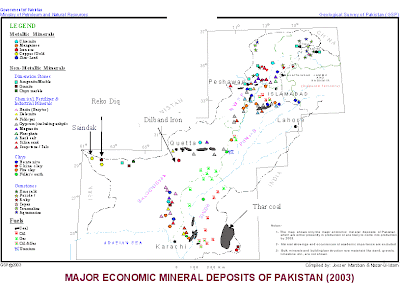
Most of the grievances of the people of Balochistan stem from a sense that they have not benefited from the resources under their land. Powerful tribal chieftains in the province have exploited this sense of deprivation to demand and receive significant funds for themselves while ordinary Balochis have remained among the poorest and most backward in Pakistan.
As Pakistan moves forward with vast new mineral discoveries such as Reko Diq in Balochistan, it's essential that there be a mechanism to equitably share with ordinary Balochis the billions of dollars in revenue expected to flow from these resources.
Balochistan Fund can be modeled on Alaska Permanent Fund. It is a constitutionally established and professionally managed fund which is run by a semi-independent corporation. Shortly after the oil from Alaska's North Slope began flowing to market through the Trans-Alaska Pipeline System, the Permanent Fund was created by an amendment to the constitution of the U.S. state of Alaska to be an investment for at least 25% of proceeds from some minerals [such as oil and gas] sale or royalties.
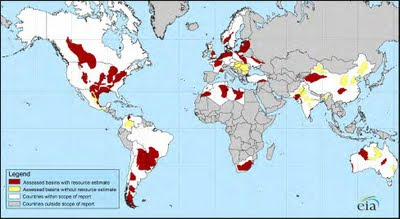
Similar funds should be established for other provinces as well. For example, energy-rich Sindh has large coal deposits and huge shale gas reserves which are worth at least hundreds of billions of dollars. Revenues from these resources should be shared equitably to benefit ordinary citizen of Sindh province.
Sharing of the wealth with the people in each province will give them a tangible stake in national development. It will help bring and maintain peace and stability necessary to attract badly needed investments for developing Pakistan's vast mineral resources.
Related Links:
Haq's Musings
Pakistan's Vast Shale Gas Reserves
Reko Diq Copper & Gold
Pakistan's Mineral Wealth
Thar Coal Deposits
USGS Minerals Overview For Pakistan
US Dept of Energy Report on Shale Gas
Pakistan's Twin Energy Crises
Pakistan's Electricity Crisis
Pakistan's Gas Pipeline and Distribution Network
Lure of Pakistan's Riches Calls
Israel in Alaska?
Pakistan's Balochistan province shares some similarities with the US state of Alaska. It is the largest of Pakistan's four provinces in terms of area (347,190 square kilometers) but the smallest in terms of population (6.6 million). With large reserves of copper, gold and natural gas, it is probably the richest of Pakistan's provinces in terms of its natural resources.
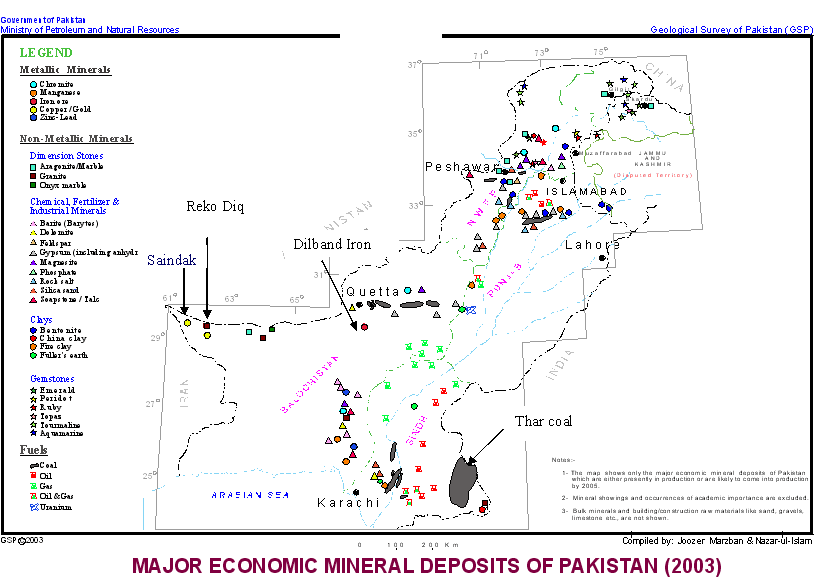
Most of the grievances of the people of Balochistan stem from a sense that they have not benefited from the resources under their land. Powerful tribal chieftains in the province have exploited this sense of deprivation to demand and receive significant funds for themselves while ordinary Balochis have remained among the poorest and most backward in Pakistan.
As Pakistan moves forward with vast new mineral discoveries such as Reko Diq in Balochistan, it's essential that there be a mechanism to equitably share with ordinary Balochis the billions of dollars in revenue expected to flow from these resources.
Balochistan Fund can be modeled on Alaska Permanent Fund. It is a constitutionally established and professionally managed fund which is run by a semi-independent corporation. Shortly after the oil from Alaska's North Slope began flowing to market through the Trans-Alaska Pipeline System, the Permanent Fund was created by an amendment to the constitution of the U.S. state of Alaska to be an investment for at least 25% of proceeds from some minerals [such as oil and gas] sale or royalties.

Similar funds should be established for other provinces as well. For example, energy-rich Sindh has large coal deposits and huge shale gas reserves which are worth at least hundreds of billions of dollars. Revenues from these resources should be shared equitably to benefit ordinary citizen of Sindh province.
Sharing of the wealth with the people in each province will give them a tangible stake in national development. It will help bring and maintain peace and stability necessary to attract badly needed investments for developing Pakistan's vast mineral resources.
Related Links:
Haq's Musings
Pakistan's Vast Shale Gas Reserves
Reko Diq Copper & Gold
Pakistan's Mineral Wealth
Thar Coal Deposits
USGS Minerals Overview For Pakistan
US Dept of Energy Report on Shale Gas
Pakistan's Twin Energy Crises
Pakistan's Electricity Crisis
Pakistan's Gas Pipeline and Distribution Network
Lure of Pakistan's Riches Calls
Israel in Alaska?

Comments
LONDON: Pakistan’s Balochistan province has rejected a mining lease application from Chilean copper producer Antofagasta and Canada’s Barrick Gold, raising questions over the future of their Reko Diq copper-gold project.
The two miners’ joint venture, Tethyan Copper, said last month it had filed a “notice of dispute” with the province over Reko Diq, after Balochistan government officials refused to meet the company’s executives or extend a deadline for a response to objections raised over the lease.
The mining lease application, for an area including the Reko Diq deposit, was submitted in February.
“Tethyan strongly believes that the Reko Diq project can contribute significantly to the development of a modern mining industry in Balochistan and will consider its options for further courses of action,” Antofagasta said in a statement on Wednesday.
Reko Diq – only the second significant project in the mineral-rich region and potentially a source of much needed inward investment for Pakistan – holds an estimated 5.9 billion tonnes of mineral resources, with an average copper grade of 0.41 per cent and an average gold grade of 0.22 grams a tonne.
The joint venture partners spent $200 million in 2006 buying the exploration licence from rival BHP Billiton.
Construction has been projected to cost some $3.3 billion, but that is expected to climb given rising costs faced by the mining industry, particularly in remote locations like Balochistan.
http://www.dawn.com/2011/11/16/pakistan-says-no-to-antofagasta-barrick-gold-mine.html
Pakistan's Reko Diq, an untapped copper and gold mine of fabulous potential, was meant to be the biggest foreign investment in the country's mining sector, but it's beginning to look more like fool's gold to the companies involved.
Set in one of the most godforsaken places on earth, in a Baluchistan desert at the foot of an extinct volcano, Reko Diq was expected to yield revenues of at least $60 billion over the 56-year life of the mine.
Tethyan Copper Company (TCC), a joint venture between Chile's Antofagasta and Canadian-based Barrick Gold, had sunk $220 million over the past five years into exploring the deposit in the ochre sand desert, where temperatures reach 130 degrees Fahrenheit in the summer. It was planning to invest a total of $3.3 billion when the provincial government abruptly refused to grant a mining license last year.
TCC says it never did get an explanation.
"It's been difficult to define what their actual issues were," Tim Livesey, CEO of TCC, told Reuters in an exclusive interview. "We went back to them for clarification, as many of their issues are not covered in the Baluchistan Mining Regulations."
A local government official, who requested anonymity, said TCC took too long to complete its feasibility study and that it was "cheating" Baluchistan by under-valuing the worth of the copper and gold.
"They are the monopoly," the official said angrily. "They are the monopolists of the gold! They don't want to disclose the worth of the gold in Baluchistan."
The case is now before the Pakistan Supreme Court, and TCC has filed for international arbitration. The Baluchistan government, meanwhile, has recently handed out exploration permits in the area around Reko Diq to new Pakistani and Chinese companies with no mining experience.
Pakistan is already viewed as a high risk investment due to chronic civil and sectarian conflict, terrorism, corruption, poor regulation and chronic power outages. Legal uncertainty would only add to that list.
-------------
The Baluchis have staged five uprisings since the province was incorporated into Pakistan in 1948, each time demanding more control over their natural resources.
Because of this, some analysts speculate that the powerful Pakistani army sees Reko Diq as a strategic resource and hopes to keep the mineral wealth out of the hands of the Baluchistan government, in case separatist political parties win provincial elections.
The army, acknowledging Pakistan's inexperience in large-scale commercial mining, might also want to bring China into the picture. China is the world's largest consumer of copper, has experience in large-scale mining, and has a record of building infrastructure in exchange for resources in developing countries.
"Everywhere I look, there are indications of Chinese interest in developing this area, more than Barrick Gold could," said Shamila Chaudhary of Eurasia Group.
The Chinese government-owned Metallurgical Construction Corp (MCC) already runs the nearby Saindak Copper-Gold Project, and submitted a counter-proposal to develop the Reko Diq mine during a visit to Pakistan by Chinese Prime Minister Wen Jibbao in December 2010. Pakistan media say MCC's proposal was similar to TCC's, but was sweetened with a larger share of the royalties going to the government. This was after TCC had submitted its feasibility report. MCC has not commented on those reports.
TCC is still hoping for a negotiated settlement outside arbitration, but Chaudhary thinks its parent companies are looking to cut their losses.
"From what I hear on the Barrick Gold side ... they're looking to come to closure on this issue," she said.
http://www.reuters.com/article/2012/02/17/us-pakistan-goldmine-idUSTRE81G06E20120217
According to Peters, one of the most serious issues with the Baloch independence movement is "deeply troubling" infighting. In fact, he is emphatic in his condemnation of such bickering; going so far as to assert: "they are quickly becoming their own worse enemies."
In his view, individual Baloch simply don't understand that their personal feuding undermines the larger movement: "Certain Baloch fail to understand that their only hope in gaining independence is if they put their own egos and vanity aside and work together. This is the cold hard fact. They are already outgunned and outmanned. Pakistan will continue to to exploit their differences until they realize this."
So long as the Baloch continue to engage in "petty infighting," including "savaging each other in emails," (Ralph) Peters is pessimistic they can garner widespread support in the West. In fact, he warns that such infighting could eventually put off even their staunchest supporters.
As a result, he recommends that the Baloch leadership and activists set the example and halt their public bickering: "The Baloch leaders need to stop their severe personal attacks on each other and others. In the military, we say that you don't let an entire attack get bogged down by a single sniper. But, there are individuals out there who are causing divisions and attacking people. They tend to look at the debate as if you don't agree with me completely then you're my enemy. This undermines their cause."
Until these leaders and activists "support the big picture," Peters offers little hope that the broader Baloch nation will be able to "work together, put aside their deep divide, and unify." This troubles Peters as he confides: "At this point, do I believe they have a good chance of achieving independence? No. But, it would be much higher in the future if they just start working together. It's frustrating that the leaders can't unite."
Peters is also bothered by the Baloch tendancy to blame such infighting on covert operations by Pakistan's military and security services: "The region as a whole tends to blame conspiracy theories. But, I have come to believe that you never accept conspiracies when something can be explained by incompetence. There are probably a mix of things going on here. The Pakistani military and intelligence services probably have provocateurs working in Balochistan just like they do in Afghanistan. They live by the old rule of divide and conquer and they are good at that. But, the bigger issue is the Baloch's own egos. That's what needs addressed."
http://www.huffingtonpost.com/eddie-walsh/baloch-pakistan_b_1326421.html
QUETTA: The federal government has agreed to declare Reko Diq gold and copper mining project area as export processing zone and the Balochistan government and the EPZ Authority will sign a memorandum of understanding soon.
Dr Samar Mubarakmand, vice chairman of board of governors of the Reko Diq Project, informed Chief Minister Nawab Raisani about the centre’s willingness during a briefing on the project here on Tuesday. The provincial government had requested the EPZ Authority to declare the project area as export processing zone.
The chief minister, who is chairman of the project’s board of governors, reiterated his government’s stance to run the project on its own.
“Whether we remain in power or not, we will give these great assets to Balochistan and the country as gift,” Mr Raisani said, adding that he and his government had faced immense pressure in efforts to make the stakeholders realise that the people of Balochistan were real owners of the project.
“We rejected all pressures and did not bow down to the forces who wanted to deprive the province of ownership of the Reko Diq project,” Mr Raisani said.
He alleged that some elements had tried to “sell the project at a throwaway price” with the connivance of some vested interests. “But my government has foiled all conspiracies.”
The chief minister said some “international forces” did not want Balochistan and Pakistan to benefit from the Reko Diq project.
Earlier, Mr Raisani approved a proposal for allocating Rs1.8 billion in the next budget for the project and revival of the recruitment committee.
The chief minister was informed that the Geological Survey of Pakistan had promised to extend all help and cooperation, including training facilities and making geographical survey drawing of the project.
Mr Mubarakmand said the authorities concerned were vetting applications for recruiting technical and other staff.
The chief minister said recruitment should be made on merit and local people be given priority.
http://dawn.com/2012/04/11/reko-diq-project-area-to-be-declared-epz/
A local MP in Pakistan has been arrested for running a private dungeon at his home after five people were found chained up.
Some of the captives had been held in Abdul Rehman Khetran's cellar for several years.
The dungeon only came to light after private guards working for the lawmaker attacked police at a checkpoint at the weekend, beating them up and stealing their weapons.
Police then raided the lawmaker's fortified home in lawless Baluchistan province, freed the prisoners, including one woman, and arrested Khetran, his son and six private guards.
Barkhan district police chief Abdul Ghafoor Marri said the prisoners had been mistreated, and a truck packed with ammunition and weapons had also been found.
But Khetran claimed the arrests were politically motivated.
The mineral-rich western region of Baluchistan is deeply impoverished and a haven for smugglers, drug lords, Taliban insurgents and separatist rebels.
http://www.mirror.co.uk/news/world-news/pakistani-mp-arrested-after-five-3020456
http://www.mining-technology.com/features/featurewhy-is-illegal-mining-flourishing-in-pakistan-5731542/
Many challenges face Pakistan as it strives to stamp out illegal mining and attract investment to take full advantage of its rich variety of resources. As the eight-year ban on excavation in the Northern Province of Khyber Pakhtunkhwa ends, Molly Lempriere takes a look at the challenges in this region and the country as whole, and asks what the government can do to unlock the next step in Pakistan’s mineral journey.
Mining is a crucial industry in Pakistan, but one which faces a host of challenges. Regional and national governments are working to improve the regulatory and operational landscape for miners and mining companies, but with regional instability and illegal mining pervasive, is there still a long way to go?
Pakistan is a resource-wealthy country with large quantities of coal, iron and copper, as well as gold and gemstones. Currently, Pakistan hosts the world’s second-largest coal deposits with as much as 185 billion tonnes, as well as being the third-largest producer of iron ore pigments.
Pakistan has only begun to scratch the surface of its resource potential. The last few years have seen large mineral deposits being unearthed, including an iron ore body in the central province of Punjab. This discovery, announced in 2015, reportedly contains an estimated 500 million tonnes (Mt) of iron ore and is owned by the Metallurgical Corporation of China.
However, a history of corruption and illegal mining has deterred international investment in the mining industry. Globally, mining has a long history of operating in dangerous and underdeveloped areas, but the insecurity of assets in Pakistan continues to deter many companies from investing.
A moratorium on mining excavation in the northern Khyber Pakhtunkhwa province was introduced eight years ago, but this has been repealed by an ordinance in August 2016. The ordinance brings in a series of regulations that the local government claims will increase international investment, but some have reacted with anger. The province, which has been plagued by illegal mining, highlights the widespread problems affecting the country as a whole.
Illegal competition
Illegal mining has flourished in Khyber Pakhtunkhwa since the ban; as legitimate mining efforts have ceased, mafia groups and other gangs have taken over. GlobalData head of research and analysis for mining Clifford Smee says the mafia’s presence is unsurprising, as “mining needs a somewhat sophisticated organisation to successfully operate”.
“Illegal mining is always an issue in developing countries,” Smee adds. “We see large illegal mining in major producing countries such as Indonesia (100Mt of coal is illegally mined), and we have seen issues with illegal mining in neighbouring India.
“Typically, illegal mining flourishes in periods of high prices, such as the high coal and iron ore prices which drove illegal mining of these commodities in South East Asia during the Chinese mining super cycle,” Smee continues.
"Khyber Pakhtunkhwa is an area rich in gems and semiprecious stones, with Swat alone boasting 70 million carats of emerald reserves."
Khyber Pakhtunkhwa is an area rich in gems and semiprecious stones, with Swat alone boasting 70 million carats of emerald reserves. The Mardan district has nine million carats of pink topaz reserves while Kohistan has ten million carats of peridot, all of which are currently being illegally traded by organised gangs.
http://english.alarabiya.net/en/business/markets/2017/10/16/Azad-Kashmir-Pakistan-s-treasure-chest-of-rubies.html
The people of Azad Jammu and Kashmir (AJK) are sitting on a treasure chest: millions of rubies, estimated to be worth up to half a billion dollars, are lying beneath them.
But archaic tools and a lack of investment in infrastructure and techniques are hampering efforts to transform the area into a significant player in the gem industry.
"Mining is done by small blasts – and we lose 40 to 50 percent of the value of the stones, and secondly due to lack of investment in our corporation we are not making the most of our resources," said Shahid Ayub, Azad Kashmir Mine and Industry Development Company director general.
Just one mine and an exploration site are operational in Kashmir.
It's hard labor at more than 3,500 metres above sea level. But for miners working on the mountains, it is valued work.
"I have been working in this mine for the past four years. For the first two years, I worked here as an intern and after that I got a job. We work here four months in a year,” said Muhammad Azeem, a mine worker.
“I have earned enough money to lead a good life," Azeem added.
The rubies are sold in their raw form at a highly-regulated annual auction.
Many change hands informally too. Last year, a government training center was launched to develop the trade.
"We are providing training and assistance to these people about mining and gemstone development. God willing, soon all of them will be able to extract precious stones by themselves. With the availability of skilled workforce in this field, Azad Kashmir will shortly become an international hub of gemstones," said Imran Zaffar, principal Pakistan Gem and Jewellery Training and Processing centre.
The stones are said to account less than one percent of the region's tax revenue. But hopes are high these rubies will one day help Kashmir sparkle in the international gem industry.
Balochistan can earn Pakistan up to $1 billion a year
https://tribune.com.pk/story/1543268/2-balochistan-can-earn-pakistan-1-billion-year/
Balochistan alone has the potential to earn Pakistan up to $1 billion a year from fruit and vegetable exports, according to initial findings of All Pakistan Fruit and Vegetable Exporters, Importers & Merchants Association (PFVA).
But this will happen if international good practices are adopted, added the representative organisation of fresh food exporters that has recently completed a consultative process with stakeholders in Balochistan to develop a road map for the sector.
“The PFVA’s vision would provide long-lasting solutions of problems like food security,” a press release quoted former PFVA chairman Waheed Ahmed as saying.
A PFVA delegation recently met Balochistan Governor Mohammad Khan Achakzai, growers and trade organisations and briefed them about the vision of the association to develop a national policy of horticulture.
The PFVA is gathering support throughout the country for its upcoming “National conference on Horticulture” which will be organised in February 2018.
The association briefed the governor and held consultative meetings at the Quetta Chamber of Commerce to increase the participation of farmers and other stakeholders in highlighting issues of the sector.
The current share of export volume of fruits and vegetables from the province is $45 million, which can be enhanced to $1 billion by establishing Research and Development facilities, Ahmed said.
Pakistan suffers due to low volume of exports overall, aggravating economic issues like a widening trade and current account deficit. Experts have time and again highlighted the need to increase exports and tap sectors other than textile to address economic issues.
The PFVA says that the establishment of grading, processing and packing plants as common facilities in various parts of Balochistan is imminent to achieve this objective. The governor assured to render full support and assistance is setting up common facilities centres in Balochistan, the release added.
Pakistan exported $641 million worth of horticulture products in fiscal year 2016. However, PFVA officials say the country can touch a volume of up to $7 billion within a decade if the federal and provincial governments frame friendlier policies.
https://www.fool.com/earnings/call-transcripts/2022/02/16/barrick-gold-corporation-gold-q4-2021-earnings-cal/
Tanya Jakusconek -- Scotiabank -- Analyst
OK. And just my last question, if I could, just on your copper strategy. Just wanted to understand a little bit how Reko Diq fits into that strategy and just where we are on this asset?
Mark Bristow -- Chief Executive Officer
So right now, the asset that we have is the arbitration award of which we share with Antofagasta and ourselves, Barrick. We are working and have been in its general knowledge in the spirit of Barrick philosophy of how we can convert that into something that's more meaningful. And that's something that doesn't end up with the Pakistan government having to write out a big check without any benefits. And Reko Diq is an opportunity that we've been working on whereby everyone will benefit.
Our shareholders, of course, and same with the Balochistan government and the Pakistan government. And that's really where I would want to stop it because there's still a lot of work and water to flow under the bridge, but that's the tactic. And as I said, and I think I told Greg at this conference that it's a real asset. And we would like as miners to convert that into our mining asset.
It's one of the better ones around. Otherwise, we end up in conflict and that's not a good thing to do with your host country or potential host country.
Tanya Jakusconek -- Scotiabank -- Analyst
OK. So is it fair to say that this is a ways out in terms of fitting into your 10-year pipeline?
Mark Bristow -- Chief Executive Officer
It would be fantastic in our 10-year pipeline. It's a real deal.
Graham Shuttleworth -- Senior Executive Vice-President, Chief Financial Officer
But it's not in our 10-year pipeline.
Mark Bristow -- Chief Executive Officer
But it's not in -- yes, sorry, it's not in our 10-year pipeline right now.
Tanya Jakusconek -- Scotiabank -- Analyst
I understand that. But in terms of resolving everything and then probably having a feasibility study and other stuff in country, would you be able to even fit it into your 10-year pipeline?
Mark Bristow -- Chief Executive Officer
Sure. Absolutely.
Tanya Jakusconek -- Scotiabank -- Analyst
OK. Great. Thank you.
Mark Bristow -- Chief Executive Officer
Thanks, Tanya.
Operator
Our next question is from Mike Parkin with National Bank Financial. Please go ahead.
Mike Parkin -- National Bank Financial -- Analyst
Hey, guys. Congrats on the good quarter. Just a question with respect to the performance dividend. Does that indicate kind of a comfort level with carrying debt on the balance sheet? Or are you agnostic to where the debt is given that performance dividend is linked to the net cash position?
Mark Bristow -- Chief Executive Officer
So I think you've just answered your own question, Mark. Net cash means there's no net debt. And so the way it's designed is that if we have -- because what we've done initially is our debt to pay it all up is expensive. Hopefully, it gets cheaper and cheaper with the growing interest rates.
But we've offset it. We've got cash balancing the debt. And what we've said is anything above 0. So from zero to $500 million net cash payout of $0.05 dividend and then $500 million to $1 billion and $1 billion to $1.5 billion.
And so that's -- and what it does is it's -- it really is -- it's a nonnegotiable process because if we're investing heavily in a big project, for example, and we drive -- we increased the net debt to fund that. Then we are investing our shareholders' money into that project. And given our return criteria, we think most -- in fact, more than most of our shareholders would support that. If we don't and we build cash on the balance sheet, we make sure that we don't create an easy balance sheet and that on a formulaic basis money goes back to shareholders.
https://www.globalvillagespace.com/breakthrough-pakistan-to-get-50-share-in-reko-diq/
Sources claim that Pakistan and TCC will most likely sign the deal in February. If finalized, the deal will avert the threat of imposition of a $10 billion dollar fine on Pakistan.
-------------------
Sources revealed to The Express Tribune that the project’s development would result in an investment of approximately $10 billion in Balochistan, including $1 billion which would be invested in social uplift projects such as roads, schools, hospitals, and the creation of technical training institute for mining. The investment is also said to result in the creation of over 8,000 jobs.
“This project shall make Balochistan the largest recipient of foreign direct investment in Pakistan and the Reko Diq project shall be one of the largest copper and gold mining projects in the world”, sources added.
50 per cent of the new project’s shares will be owned by Barrick Gold, while the remaining shares shall be owned by Pakistan, divided equally between the federal government and the provincial government of Balochistan.
The federal government’s shares of 25% shall be divided equally amongst three state-owned entities (SOE), namely Oil & Gas Development Corporation Limited (OGDCL), Pakistan Petroleum Limited (PPL), and Government Holdings Pakistan Limited (GHPL).
-----------------
The reconstituted project will be held 50% by Barrick and 50% by Pakistan stakeholders, comprising a 10% free-carried, non-contributing share held by the government of Balochistan, an additional 15% held by a special purpose company owned by the government of Balochistan and 25% owned by other federal state-owned enterprises. A separate agreement provides for Barrick’s partner Antofagasta PLC to be replaced in the project by the Pakistani parties.
https://www.barrick.com/English/news/news-details/2022/barrick-pakistan-and-balochistan-agree-in-principle-to-restart-reko-diq-project/default.aspx
Barrick will be the operator of the project which will be granted a mining lease, exploration licence, surface rights and a mineral agreement stabilizing the fiscal regime applicable to the project for a specified period. The process to finalize and approve definitive agreements, including the stabilization of the fiscal regime pursuant to the mineral agreement, will be fully transparent and involve the federal and provincial governments, as well as the Supreme Court of Pakistan. If the definitive agreements are executed and the conditions to closing are satisfied, the project will be reconstituted including the resolution of the damages originally awarded by the International Centre for the Settlement of Investment Disputes and disputed in the International Chamber of Commerce.
https://www.marketplace.org/2023/01/24/surging-demand-for-copper-means-its-price-is-rising-too/
The world cannot seem to get enough copper. This metal is mined in places as disparate as China, the Democratic Republic of Congo and Utah.
Copper prices have risen around 10% since the start of this year, in part because the metal is crucial to renewable energy technology and the transition away from fossil fuels.
Copper is often referred to as “Dr. Copper,” because it’s considered a barometer for the health of the global economy.
Traders like to play off that saying, according to Bobby Iaccino, co-founder of Path Trading Partners.
“They say copper has a Ph.D. in economics,” he said. “That still doesn’t really explain it, OK? So anywhere where there’s electricity, there’s copper usage.”
Demand for copper is especially high now as the market for renewable energy expands, said Michael Klare, a professor emeritus at Hampshire College.
“You’re going to need a lot more copper for wiring to connect various sources of renewable energy — wind farms and solar farms — to wherever you’re going to use the renewable energy,” Klare said.
And in electric vehicles, the amount of copper needed can be more than double what’s used to make traditional gas-powered vehicles.
This year’s surge in copper prices is in part due to China and its emergence from pandemic-related shutdowns, said Rohan Reddy, director of research at Global X ETFs.
“China makes up about half of all global copper demand. So typically, there’s a saying, ‘As China goes, so does copper,'” Reddy said.
That’s the other copper adage you’ll hear a lot — and one that seems to be holding true. The question now is what happens next in China, said Bart Melek, global head of commodity strategy for TD Securities.
“We continue to see a very significant amount of infections in that country,” Melek said. “And that is something that will take time to work its way through.”
That’s why Melek’s call on copper for the coming months is relatively cautious. Rising interest rates, a potential global economic slowdown — all of it, he said, could take the shine off copper demand.
https://english.almayadeen.net/articles/analysis/pakistan-is-sitting-on-a-gold-mine
The Reko Diq mine, renowned for its massive gold and copper deposits, is thought to contain the fifth-largest gold deposit in the world.
Reko Diq is a small desert village in the Balochistan district of Chagai, 70 kilometers northwest of Naukundi and close to Pakistan's border with Iran and Afghanistan. This region is situated within the Tethyan belt, which extends from Turkey and Iran to Pakistan. Reko Diq, which in Balochi means "sandy mountain," is also the name of an extinct volcano.
The Reko Diq mine, renowned for its massive gold and copper deposits, is thought to contain the fifth-largest gold deposit in the world. The mine is in a small desert area in the northeast of Balochistan, near the border with Iran and Afghanistan.
600,000 tons of concentrate produce an estimated 200,000 tons of copper and 250,000 ounces of gold on a yearly basis. The annual profit from the mines is estimated by the TCC to be approximately $1.14 billion for copper and $2.50 billion for gold, totaling $3.64 billion annually. Independent estimates suggest the number is as high as $500 billion, which is significantly higher than the TCC's estimation of $200 billion.
https://www.barrick.com/English/news/news-details/2023/reko-diq-constitutes-community-development-committee-for-locally-driven-development/default.aspx
NOKKUNDI, BALOCHISTAN – Reko Diq Mining Company (RDMC), a subsidiary of Barrick Gold Corporation, has constituted a 25-member Community Development Committee (CDC) at Nokkundi in the Chagai district. The CDC comprises local stakeholders and community leaders who will guide the company’s social investment plan in the area.
Speaking at the event, Ali Ehsan Rind, the country manager of RDMC said: “In all its operations worldwide, Barrick strives to be a good corporate citizen and a genuine partner of the host communities in locally led development. With the formation of this CDC, representing all the key local stakeholders, I am confident that our work will become a catalyst for the social development of the local communities.”
The meeting was also attended by the district commissioner of Chaghi, the deputy director of mines (Balochistan), tribal elders, local notables and a cross-section of representatives from the district.
The Nokkundi CDC was formulated after an extensive consultative process and engagement with 62 stakeholders. Its mandate includes consultation for consensus on the selection of social investment initiatives to be undertaken by the company.
Community Development Committees
CDCs are our community development partnership model, comprised of community members, elected locally and include a representative from the company to ensure projects chosen align with the five sustainable development focus areas and adhere to our policies including procurement and accountable governance.
The formation of this CDC is a concrete step taken by RDMC to ensure that the business delivers social investment projects of significant and lasting benefit to the local communities among whom it will operate. The management of RDMC values sustainable development and mutual advantage and seeks to build a harmonious partnership amongst the communities in and around the RD project area.
Reko Diq will be a multi-generational mine with a life of at least 40 years. During peak construction the project is expected to employ 7,500 people and once in production it will create 4,000 long-term jobs. Barrick’s policy of prioritizing local employment and suppliers will have a positive impact on the local economy. The company plans to finish the Reko Diq feasibility study update by the end of 2024, with 2028 targeted for first production from the giant copper-gold mine in the country’s Balochistan province. The new Reko Diq agreement ensures that benefits from the project start accruing to the people of Balochistan well before the mine goes
“Reko Diq is one of the bigger copper-gold undeveloped projects in the world,” said Mark Bristow, chief executive of Barrick, which aims to start mining in 2028 subject to an ongoing feasibility study. “It’s a very big deal. Any copper mine right now is a big deal.”
The project highlights how the copper shortfall is pushing miners into ever trickier markets in search of supply. Pakistan’s repeated political and economic crises have scared away all but the most determined foreign investors, and local authorities had blocked an earlier attempt involving Barrick to mine Reko Diq.
---
Bristow argues that the project, in which Barrick has a 50 per cent stake alongside the Pakistan and Balochistan governments, will bring much-needed development to the region.
“Mining, when it goes into emerging markets, is obsessed with getting its money back,” he said. “We’ve learned that you start paying benefits and dividends early on.”
As countries transition to clean energy sources, copper — whose conductive properties make it crucial to transporting electricity — is only expected to become more important to the global economy.
But with supply from incumbent mines in countries such as Chile and Peru stalling, an estimated $118bn of investment by 2030 is needed to plug a supply gap that will by next decade be equivalent to 35 Reko Diq-sized projects, according to analysts at CRU Group.
Th a record of operating in riskier markets such as Mali and the Democratic Republic of Congo.
While Reko Diq adds “a lot of uncertainty” for Barrick investors, “Barrick is no stranger to frontier jurisdictions”, said Canaccord Genuity analyst Carey MacRury.
Another factor that could help steer the Reko Diq project is the presence of a new investor. Saudi Arabia’s Public Investment Fund and state mining company Ma’aden have expressed interest in a stake. Analysts said the involvement of one of Pakistan’s most important allies would help shield the project from future political U-turns.
If successful, the mine could turn the company into one of the world’s largest copper producers. Diversifying its portfolio into copper is particularly important for gold miners such as Barrick to stay relevant with investors focused on environmental, social and governance issues, since the company’s core product plays no role in the energy transition.
Reko Diq sits along the largely untapped south Asian leg of a rock formation from Europe to south-east Asia that is believed to hold rich copper deposits. Analysts believe there is the potential for more mines.
Ahsan Iqbal, who recently stepped down as Pakistan’s planning minister and worked on the project, argued that Reko Diq would “put Balochistan on the mining map of the world”.
----------
Reko Diq “is 50 miles from Afghanistan and 40 miles from Iran”, one person involved with the project said. “So it will be a target.”
For support, Barrick has turned to Pakistan’s powerful army, which helps control the country’s politics and helped negotiate last year’s deal to revive the project, according to a person involved.
Pakistan’s army chief also this month attended a local mining conference alongside Bristow. “The military are a steadying hand,” Bristow said. “They are absolutely essential on the security side.”
Yet rights groups have repeatedly accused the army of abuses in Balochistan, including extrajudicial executions, allegations it denies.
Bristow has welcomed the potential Saudi interest in Reko Diq and dismissed hand-wringing over whether he can see through the project.
“When you look at the world, it is more complex than when I started,” he said. “Gone are the days that you can control a mining company from a multistorey, cushy building in the developed world.”
https://finance.yahoo.com/news/gold-billionaire-sawiris-eyes-stake-041314342.html
(Bloomberg) -- Egyptian billionaire Naguib Sawiris, who has forged a fortune in telecom and gold, is eyeing an investment in Barrick Gold Corp.’s $7 billion Reko Diq copper-gold project as he looks to expand his business in Pakistan.
Reko Diq, in the Balochistan region that borders Afghanistan and Iran, is one the world’s largest undeveloped copper and gold deposits, capable of producing 200,000 tons of copper and 250,000 ounces of gold a year for more than half a century. The project is jointly owned by Barrick and Pakistan.
Asked whether he was interested in investing, Sawiris, a major investor in gold miners including Endeavour Mining Plc through his La Mancha Resources Inc., said “yes.”
“I have an advantage compared to other investors. I know the country, I have friends here,” Sawiris said in an interview in Islamabad. “We want to be on the Pakistani side, because I have been here for 25 years.”
He did not elaborate on the potential scale of the investment, but added there were few other options, in part due to the lack of geological data: “We tried here to look but unfortunately there is only this one big project.”
Last month, Barrick Chief Executive Officer Mark Bristow said he was seeing newfound “interest” in Reko Diq from multinational mining firms that have to date been hesitant to venture into tricky regions of the world. The mine has also attracted interest from Saudi Arabia, whose presence could serve to stabilize the project in a contentious part of the world.
Pakistan’s state-owned energy exploration companies, which have a stake in the project, said last month they were looking into “potential engagement” with sovereign foreign investors, without giving details.
Sawiris’ Ora Developers is separately working on a luxury housing project, Eighteen, and he earlier set up one of Pakistan’s first mobile phone companies, Mobilink, now owned by Veon Ltd., and the nation’s largest cellular firm by subscriber numbers.
Pakistan’s lengthy, difficult official procedures, an unstable currency and capital restrictions are hurdles for investment, but Sawiris said he remained optimistic.
“If there is concrete in my way, I’ll drill through it and I’ll go,” he said. “I have never let anybody in my life hold me back from what I wanted to achieve.”