Pakistan Ranks Among Fastest Growing Broadband Markets
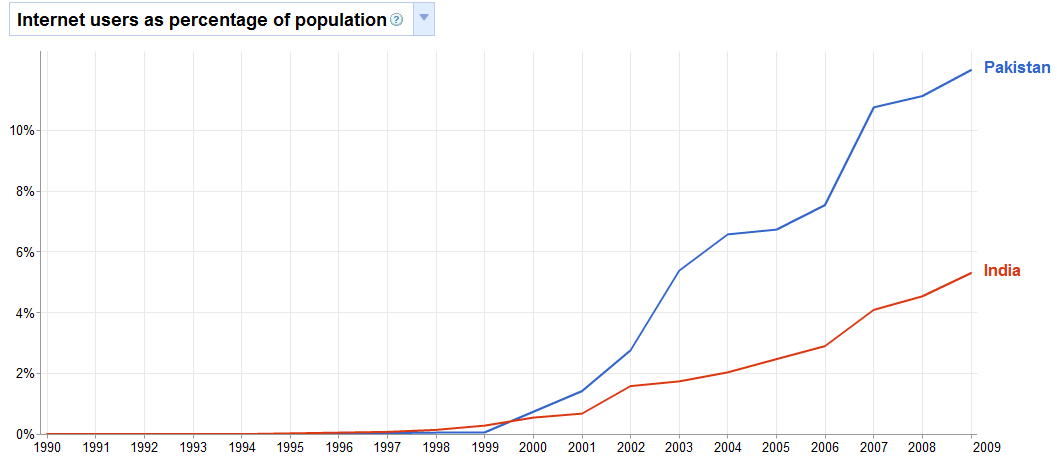
High-speed broadband expansion led by PTCL has propelled Pakistan to become the fourth fastest growing broadband market in the world and the second fastest in Asia, according to a recent industry report. Serbia leads all countries surveyed with a 68% annual growth rate from Q1 2010 to Q1 2011. Thailand (67%), Belarus (50%), Pakistan (46%), and Jordan (44%) follow Serbia. India is in 14th place worldwide with a 35% annual growth rate.

Leading the charge is PTCL (Pakistan Telecommunications Ltd.), Pakistan's state-owned telecommunications company, which recently launched 100 Mbps fiber to the home broadband service using Gigabit Passive Optical Network (GPON) technology. Earlier this year PTCL rolled out bonded VDSL2 technology to deliver 50 Mbps to its existing DSL customers, five times the top speed of the nation's highest level of service at the time, at a construction cost of just $200-300 per home passed.
Nearly 200,000 new subscribers signed up for broadband from the end of Feb to the end of May. At the end of May 2011, Pakistan had 1.4 million broadband subscribers, up from 1.2 million in February, according to figures from Pakistan Telecommunication Authority (PTA). The number of DSL subscribers rose to 654,000 compared with 595,038 in Feb, while the number of Wimax internet users stood at 397,155, up from 338,962 Wimax users in February. Some 294,161 people connected to the internet via EV-DO, up from 234,113 in Feb, and 42,490 people used HFC (Hybrid Fiber Coax, or cable) to access the internet, compared with 43,193 HFC users in February. Fiber is growing as well, and there were 6,222 FTTH users in March, up from 5,818 in Feb, and 1,873 broadband subscribers used other technologies.

In addition to GPON and VDSL2, PTCL offers DSL and EVO broadband services as well. PTCL's EVO-WiFi Cloud at 3G speeds (upto 3.1 Mbps) offers a mobile hotspot that intelligently converts your home/work/vehicle space into a personalized wifi zone anywhere in over 100 Pakistani cities and towns covered by EVO service. The EVO-WiFi cloud device costs Rs. 7000 upfront with Rs. 2000 a month for unlimited service.

PTCL has recently launched an Android based thin Apple iPAD2 like tablet computer with EVO 3G and WiFi connectivity built-in. 3G EVO Tab is a 7 inch touch screen tablet with built-in EVO service to offer wireless broadband internet on the go in more than 100 cities and towns across Pakistan. Powered by Google Android Froyo 2.2 Operating system, 3G EVO Tab offers support for both 3G and Wi-Fi for an un-interrupted on-the-go connectivity. With a 5 MegaPixel Camera, a variety of built-in applications, 3G EVO Tab lets users browse, snap, share, communicate, navigate, play games and do a lot more on-the go, thereby making it an ideal connectivity solution for users looking for high speed on-the-go 3G connectivity on an Android platform. PTCL 3G EVO Tab offers convenience and speed with three diverse economy packages to suit individual needs and pockets. Its 12-month bundle offer has been very successful with majority sales in this bracket.Customers can get EVO Tab for as low as Rs 7,999 plus 12-month unlimited EVO service, all at Rs 31,999. In addition to the 12-month contract, EVO Tab offers bundled packages based on 3 and 6 month contracts at Rs 27,999 and Rs 29,999, respectively with 3 and 6 month of unlimited EVO service.

Growing broadband and Internet access by itself is of no value. However, such capabilities can enable huge opportunities for education, communication, business and entertainment. Take distance learning as an example. The quickest and the most cost-effective way to broaden access to education at all levels is through online schools, colleges and universities. Sitting at home in Pakistan, self-motivated learners can watch classroom lectures at world's top universities including UC Berkeley, MIT and Stanford. More Pakistanis can pursue advanced degrees by enrolling and attending the country's Virtual University that offers instructions to thousands of enrolled students via its website, video streaming and Youtube and television channels.
There are many online learning channels, like the Khan Academy, which help advance learning at secondary and tertiary levels. For those interested in vocational training and specialized work-related skills, there are plenty of Youtube channels and videos which are becoming accessible with increasing bandwidth of connections available to people at their homes, schools and offices.
In summary, I believe that the growing bandwidth available for the Internet users in Pakistan, with all its great applications for learning, work and play, is good news for the future of Pakistan. It will open a whole new world of opportunities for the nation's youth and ultimately produce significant demographic dividend.
Here's a video clip about PTCL's EVO 3G tablet:
Related Links:
Haq's Musings
Pakistan Rolls Out 50Mbps Broadband Service
More Pakistan Students Studying Abroad
Mobile Internet in South Asia
Online Courses at Top International Universities
Pakistan Virtual University
Media and Telecom Sectors Growing in Pakistan
Internet Service Providers of Pakistan
Poverty Reduction Through Telecom Access
Pakistan's Telecom Boom
Pakistan Tops Text Message Growth
WiMax Rollout in Pakistan
Mobile Internet in Pakistan
Smartphones in Pakistan
Low Literacy Threatens Pakistan's Future
Gender Gap in South Asia
Mobile Financial Services in Pakistan
ITU Internet Access Data by Countries
Financial Services in Pakistan
Distance Learning in Pakistan
Pakistan Telecommunications Authority
Top 5 ICT4D Trends in 2010
ICT4D in Pakistani Hospital
ITCN Asia 2010 Conference in Karachi
State of Telecom Industry in Pakistan

Leading the charge is PTCL (Pakistan Telecommunications Ltd.), Pakistan's state-owned telecommunications company, which recently launched 100 Mbps fiber to the home broadband service using Gigabit Passive Optical Network (GPON) technology. Earlier this year PTCL rolled out bonded VDSL2 technology to deliver 50 Mbps to its existing DSL customers, five times the top speed of the nation's highest level of service at the time, at a construction cost of just $200-300 per home passed.
Nearly 200,000 new subscribers signed up for broadband from the end of Feb to the end of May. At the end of May 2011, Pakistan had 1.4 million broadband subscribers, up from 1.2 million in February, according to figures from Pakistan Telecommunication Authority (PTA). The number of DSL subscribers rose to 654,000 compared with 595,038 in Feb, while the number of Wimax internet users stood at 397,155, up from 338,962 Wimax users in February. Some 294,161 people connected to the internet via EV-DO, up from 234,113 in Feb, and 42,490 people used HFC (Hybrid Fiber Coax, or cable) to access the internet, compared with 43,193 HFC users in February. Fiber is growing as well, and there were 6,222 FTTH users in March, up from 5,818 in Feb, and 1,873 broadband subscribers used other technologies.

In addition to GPON and VDSL2, PTCL offers DSL and EVO broadband services as well. PTCL's EVO-WiFi Cloud at 3G speeds (upto 3.1 Mbps) offers a mobile hotspot that intelligently converts your home/work/vehicle space into a personalized wifi zone anywhere in over 100 Pakistani cities and towns covered by EVO service. The EVO-WiFi cloud device costs Rs. 7000 upfront with Rs. 2000 a month for unlimited service.

PTCL has recently launched an Android based thin Apple iPAD2 like tablet computer with EVO 3G and WiFi connectivity built-in. 3G EVO Tab is a 7 inch touch screen tablet with built-in EVO service to offer wireless broadband internet on the go in more than 100 cities and towns across Pakistan. Powered by Google Android Froyo 2.2 Operating system, 3G EVO Tab offers support for both 3G and Wi-Fi for an un-interrupted on-the-go connectivity. With a 5 MegaPixel Camera, a variety of built-in applications, 3G EVO Tab lets users browse, snap, share, communicate, navigate, play games and do a lot more on-the go, thereby making it an ideal connectivity solution for users looking for high speed on-the-go 3G connectivity on an Android platform. PTCL 3G EVO Tab offers convenience and speed with three diverse economy packages to suit individual needs and pockets. Its 12-month bundle offer has been very successful with majority sales in this bracket.Customers can get EVO Tab for as low as Rs 7,999 plus 12-month unlimited EVO service, all at Rs 31,999. In addition to the 12-month contract, EVO Tab offers bundled packages based on 3 and 6 month contracts at Rs 27,999 and Rs 29,999, respectively with 3 and 6 month of unlimited EVO service.

Growing broadband and Internet access by itself is of no value. However, such capabilities can enable huge opportunities for education, communication, business and entertainment. Take distance learning as an example. The quickest and the most cost-effective way to broaden access to education at all levels is through online schools, colleges and universities. Sitting at home in Pakistan, self-motivated learners can watch classroom lectures at world's top universities including UC Berkeley, MIT and Stanford. More Pakistanis can pursue advanced degrees by enrolling and attending the country's Virtual University that offers instructions to thousands of enrolled students via its website, video streaming and Youtube and television channels.
There are many online learning channels, like the Khan Academy, which help advance learning at secondary and tertiary levels. For those interested in vocational training and specialized work-related skills, there are plenty of Youtube channels and videos which are becoming accessible with increasing bandwidth of connections available to people at their homes, schools and offices.
In summary, I believe that the growing bandwidth available for the Internet users in Pakistan, with all its great applications for learning, work and play, is good news for the future of Pakistan. It will open a whole new world of opportunities for the nation's youth and ultimately produce significant demographic dividend.
Here's a video clip about PTCL's EVO 3G tablet:
Related Links:
Haq's Musings
Pakistan Rolls Out 50Mbps Broadband Service
More Pakistan Students Studying Abroad
Mobile Internet in South Asia
Online Courses at Top International Universities
Pakistan Virtual University
Media and Telecom Sectors Growing in Pakistan
Internet Service Providers of Pakistan
Poverty Reduction Through Telecom Access
Pakistan's Telecom Boom
Pakistan Tops Text Message Growth
WiMax Rollout in Pakistan
Mobile Internet in Pakistan
Smartphones in Pakistan
Low Literacy Threatens Pakistan's Future
Gender Gap in South Asia
Mobile Financial Services in Pakistan
ITU Internet Access Data by Countries
Financial Services in Pakistan
Distance Learning in Pakistan
Pakistan Telecommunications Authority
Top 5 ICT4D Trends in 2010
ICT4D in Pakistani Hospital
ITCN Asia 2010 Conference in Karachi
State of Telecom Industry in Pakistan



Comments
KARACHI: Pakistan Telecommunication Company Limited (PTCL) launched the country’s first 3G enabled tablet with built in EVO Wireless Broadband (3G EVO tab) on August 14th this year. The product has received tremendous response from the users resulting in a runaway success. The reason for its success is cited to be the fact that it is user friendly, offering on the go connectivity and affordable package price.
3G EVO Tab is a 7 inch touch screen tablet with built-in EVO service to offer wireless broadband internet on the go in more than 100 cities across the country. Powered by Google Android Froyo 2.2 Operating system, 3G EVO Tab offers support for both 3G and Wi-Fi for an un-interrupted on-the-go connectivity. With a 5MegaPixel Camera, a variety of built-in applications plus access to latest Android market, 3G EVO Tab lets a user browse, snap, share, communicate, navigate, play games and do a lot more on-the go, thereby making it an ideal connectivity solution for users looking for high speed on-the-go 3G connectivity on an Android platform. PTCL 3G EVO Tab offers convenience and speed with three diverse economy packages to suit individual needs and pockets. Its 12-month bundle offer has been very successful with majority sales in this bracket.Customers can get EVO Tab for as low as Rs 7999 plus 12-month unlimited EVO service, all at Rs 31,999. Apart from the 12-month contract, EVO Tab also offers bundled packages based on 3 and 6 month contracts at Rs 27,999 and Rs 29,999, respectively with 3 and 6 month of unlimited EVO service. Executive Vice President Wireless Business Syed Asim Ali said that it is always company’s top priority to facilitate its customers to the maximum.
http://www.dailytimes.com.pk/default.asp?page=2011\09\06\story_6-9-2011_pg5_12
This month there are fresh rumors that Apple may be planning to introduce a smaller and less costly "iPad mini." But nothing is confirmed, so don't hold your breath.
The tablet market is growing fast, and its dynamics are shifting quickly. According to a new report from Strategy Analytics, in the last year Android tablets grew from 2% of the global tablet market to 27%. Meanwhile, the iPad's global tablet market share has dropped from 96% to 67%.
That doesn't reflect a decrease in the iPad's popularity, but rather that consumer demand for tablets is not one-size-fits-all.
In fact, size is a key issue for people shopping for tablets. The iPad measures roughly 7-by-10 inches -- too big for a typical pocket or purse, and nearly twice the size of the basic Kobo Vox, Nook Color and Kindle Fire models. Digital devices that aren't as easy to carry around tend to mainly get used only at certain times of day, in certain settings.
For this reason it's questionable how "mobile" larger tablets like the iPad really are.
Aside from the Vox, Fire, and Nook Color, there are lots of other small Android tablets available. But so far these products have faced various challenges in the consumer market:
Cost: The Wi-Fi-only version of Samsung's 7-inch Galaxy Tab costs about $350, which is on the pricier side. The carrier-branded versions cost much less to buy up front if you agree to a two-year contract. For instance, Verizon currently sells the 7-inch Galaxy Tab for just $200, but data plans cost $30-$80 per month, and there's a $350 early termination fee.
Philadelphia Newspapers Inc., publisher of the Philadelphia Inquirer and Daily News, is selling a small Android tablet by Arnova for just $99-$129 in a small pilot program -- but for that bargain-basement price you have to agree to a one- or two-year newspaper subscription, costing up to $13 per month.
Device quality: This is an issue for the cheapest tablets. For instance, one reviewer noted that the touchscreen performance on the Philly.com tablet is less than stellar.
In contrast, the Nook Color has been getting generally favorable reviews for device quality. The advance Kindle Fire reviews are also mostly positive.
Android's learning curve: This can be an obstacle for some. The straightforward Android experience that comes with tablets by Samsung, Motorola, Lenovo, and other manufacturers can be daunting to typical consumers -- especially the majority of U.S. consumers who don't yet own a smartphone. A more constrained but dependable out-of-the-box user experience can be simpler to learn and can make the average consumer happier, at least initially.
---------
However, most "pure" Android tablets do offer one key advantage over constrained e-reader tablets: direct access to Google's Android Market, where there's a virtually unlimited choice of apps.
----------
The coming year -- especially the 2011 holiday season -- will probably indicate whether smaller tablets will play a leading role in the U.S. digital media landscape. If these devices start becoming as commonplace as iPhones and Kindles, they may become popular and powerful tools for the delivery of mobile services for health, education, jobs, and more.
Sure, you can use a small, cheap tablet to read books, watch YouTube, and play "Angry Birds." But maybe someday lots of people will be using these devices to get a college degree -- or perhaps to learn to read in the first place.
http://www.cnn.com/2011/10/25/tech/gaming-gadgets/smaller-cheaper-tablets/
This tablet is manufactures by IVIO China.
Here are some of PTCL's EVO 3G mini-tablet's specs;
Salient Features:
Weigh: 429 grams
Dual Sim: 2 sim card slots
Quad Core Processor
7 inch screen WVGA LCD 800 X 480 resolution Capacitive touch screen with multi-touch support
512 MB RAM
Android Froyo
Modem: Built-in Device
WiFi
Bluetooth
A-GPS
Office viewer and editor
3.5mm jack
Box PackingBox Contains:
3G Evo Tab
Stereo Earphones with Mic
Micro USB Cable
USB Power Adapter
Free Sleeve Pouch
Documentation
Warranty Card
A Silicon Valley venture capitalist has donated $100 million to Stanford University's Graduate School of Business to establish a new institute to promote entrepreneurship in developing countries and eventually alleviate poverty.
Robert King, along with his wife, Dorothy, also gave a second gift to the entire university, $50 million in matching funds to encourage more donations to Stanford. The couple's gift is the second-largest publicly disclosed single donation to the school, behind a $400 million donation in 2001 by the William and Flora Hewlett Foundation.
---------------
"The institute will be about sponsoring and creating entrepreneurial activity in developing economies," said Robert King, 76, who founded Peninsula Capital in Menlo Park. "Stanford is in an absolutely leading position to do that."
The Stanford Institute for Innovation in Developing Economies will be devoted to research, education and on-the-ground support to help entrepreneurs innovate and grow their businesses. Students and faculty will travel abroad to help businesses overcome obstacles to growth. The institute also will provide formal courses for entrepreneurs and nonprofit employees overseas.
----------------
The Kings say the inspiration for their philanthropy grew from hosting foreign students while they attended Stanford, a more than four-decade experience that underscored the importance of the link between education and entrepreneurship. It also led to a successful investment by Robert King, who provided seed money for China's giant search engine, Baidu, after he met the company's co-founders, Eric Xu and Robin Li, through one of the couple's home-stay students more than a decade ago.
"If anyone knows the value of encouraging entrepreneurship in the developing world, it's Bob King," Li said in an email statement. "Bob took a big chance on Baidu in our earliest days, investing in a Chinese search engine at a time when China's Internet was still in its infancy. I'm sure that this generous endowment will help create some great business leaders in the developing world."
The institute will build on work Stanford students and faculty already are engaged in through a collaboration of the business school and the university's Hasso Plattner Institute of Design in which products and business models are created for the developing world.
One venture to emerge from this work is d.light, a company creating products for people without access to reliable electricity. The institute will dispatch students and faculty members to work with overseas businesses and NGOs, or nongovernment organizations, identified as having great promise by other organizations.
---------------
"If their research is focused on Guatemala, we will send them there," Lee said.
The university is beginning the process to hire three tenure-track professors to fill research positions in the institute. They will join four current Stanford professors, Saloner said.
The Kings, who are active philanthropists, also founded the Thrive Foundation for Youth, which supports research on youth development and organizations that work with young people.
....................
http://www.mercurynews.com/top-stories/ci_19262908
LAHORE - The broadband segment of the telecom sector has witnessed a tremendous growth over the years, with subscribers growing by threee-year Compound Annual Growth Rate (CAGR) of 85 percent.
According to telecom industry experts, though the growth could be attributed to a low base effect; nonetheless low broadband density of only 0.8 percent compared to country’s total teledensity of 69 percent leaves ample room for further growth.
Latest data reveals that in 1QFY12 PTCL’s DSL, customer base increased by 9 percent with a steady market share of 95 percent. Therefore, with available growth room, it is believed the broadband would also shoulder the declining fixed line business. Experts estimate that the broadband will contribute approximately 8 percent to the topline of the company in FY12.
They said that the segment growth prospects also stems from being the major beneficiary of company’s CAPEX program. In the last thee years, PTCL capital expenditure stood at Rs24b with major expansionary projects like expansion of optical fibre network in Balochistan to acquiring of VDSL2 bonding technology for high speed data transfer and many more all coming under the broadband segment.
The largest telecom operator has underperformed the broader KSE index by 33 percent during 2011YTD, on concerns of its ailing fixed line business segment. However, Muhammad Milwala, a telecom sector expert, believed that fixed line is only one-half of the PTCL coin and investors have overlooked the growth story in PTML (Ufone), PTCL’s 100 percent owned cellular firm. Therefore, in order to capture the complete essence of Ufone’s story, he advises investors to look at company’s consolidated earnings rather than stand-alone which is usually announced at the Karachi bourse after the PTCL board meeting.
This investment case is also driven from growth prospects of its broadband business (subscribers witnessed CAGR of 85 percent in last 3 years) that has a potential to cushion the decline of fixed line. Overall, it is expected company to post double-digit increase in consolidated profitability of 20pc.
Investors must only look at consolidated statistics as Ufone is becoming a large part of PTCL. Due to the changing dynamics of telecommunication industry (fixed line to wireless technology), Ufone has become the spearhead of PTCL’s earnings growth. As per estimates, the segment contributed approximately 47 percent to company’s topline while, approximately 50 percent of PTCL’ 1QFY12 is attributed to Ufone. During FY12, it is expected the pendulum would further swing towards Ufone, with estimate Ufone’s revenue to surpass that of its parent company and segment contribution to consolidated bottomline is estimated to stand around 68 percent. In addition to Ufone, broadband would also be the potential savior for PTCL.
http://nation.com.pk/pakistan-news-newspaper-daily-english-online/Business/06-Nov-2011/Broadband-to-shoulder-declining-fixed-line-business
....Commenting on the adoption of new technologies by MNOs, Yaseen (PTA Chairman) asserts "the time has come for the introduction of 3G and 4G technology in the country".
---------
----------
"As long as the MNOs are not hurting the interests of customers, PTA does not actively regulate rates charged by them" reveals the PTA chairman, explaining that in the past when Mobilink was the only MNO in the local market, its rates were regulated much more stringently by the regulatory body, but that this practice was abandoned with the deregulation of this sector.
On the other hand, Yaseen insists that the regulator is very much involved in ensuring that customers' complaints and feedback are heeded.
He highlights that "PTA is the only regulator in the country that has specific regulations and mechanisms in place to address customers' grievances in the form of the Customer Protection Department (CPD)".
Focus on low costs, newer technology
Acknowledging that costs related to infrastructure development have gone up for MNOs, he lauded recent moves by different cellular service providers to share infrastructure.
He said that not only would such arrangements help lower costs for these companies, but also they would allow better coverage across the country when service providers move into un-served or under-served areas.
----------
When asked whether rising costs and a slower pace of growth in the number of cellular subscribers could force out some competitors from the local market, Yaseen responds, "although I personally believe that the size of the local market is big enough to accommodate all existing MNOs; still the market forces will determine the optimum number of operators for the local market".
While Yaseen appreciates the efforts of the industry in infrastructure development, he calls on policy makers to "go into 700 and 800 megahertz spectrums as the capital expenditure required in these spectrums is relatively low and they also supported 4G technology adequately".
The chairman explains that these bandwidths require lesser infrastructure to cover the same distance when compared to higher bandwidths.
He adds that higher spectrums can be tapped once economies of scale emerge and the use of smart phones becomes more popular in the local market.
Communication: a basic human right
"When it comes to broadband services, we believe the whole nation is currently under served and should be classified as such," he says adding that "the operators should be subsidised to enhance broadband services in the country."
Yaseen asserts that "communication is a basic right of every citizen so even if there is a small, secluded village in Balochistan, they should still be provided fixed line as well as broadband services." Chairman PTA also believes that the development of the required infrastructure can be practically achieved "because in the form of USF, the funds needed are available".
Muhammad Yaseen also highlights that enhanced coverage of telecommunications networks across the country can be leveraged to turn the country into a communication hub that can connect China and other East Asian countries to other regions.
----------
"There are about 20 million smart phones connected to our networks at present, so any operator entering into the 4G realm can count on a prospective market among these connections," says Yaseen, adding that "the total size of the Australian market is 20 million subscribers." He concludes that "even if ARPU is low, the number of subscribers still provides lucrative opportunities in this sector!"
http://www.brecorder.com/component/news/single/592/0/1260076/
-Smart TV Service
-256Kbps Broadband data rate with 1 GB data limit (Unlimited in September only)
-Zero Line Rent Landline Package
PTCL also offers Quad Play Services that includes unlimited voice calls, internet, IPTV and surveillance services.
Cost:
The new package is offered to at Rs.749 / month.
Existing customer can also avail this package but they have to pay one time charges of Rs.1500 as downgrade charges.
One time Equipment (Smart TV STB & Camera) charges may apply.
Highlights:
Access to PTCL Smart TV
Access to 100 + digital quality TV channels
Freedom to pause and rewind live TV programs
Library of 500 video on demand.
24/7 service availability from PTCL’s side.
Parental control on TV channels and video on demand.
Access to rich HD multimedia resources over the internet
Access to free movies, music, classical Pakistani plays, famous cricket matches, educational content exclusively for PTCL broadband customers on ‘Buzz’ broadband web infotainment portal.
At Camp Blessing in Afghanistan’s Pech Valley, some American soldiers played “Angry Birds” on their iPhones when off-duty. Jonathan Springer decided to put his device to a different use: building an app to help fight the Taliban.
“I wanted to give something back to soldiers that might help save their lives,” Springer, 32, said in an interview from his base at Fort Bragg, North Carolina.
The result is Tactical Nav, an iPhone application the U.S. Army captain built with $30,000 of his savings and a maxed-out credit card a year ago. The $5.99 app uses GPS technology and the iPhone’s camera to chart coordinates and guide artillery fire. It has been downloaded about 8,000 times by U.S., Canadian and Australian soldiers, as well as hunters and hikers, Springer said. From e-mails he has received from soldiers who have gone on patrol with it, the app has been used in both combat and training, Springer said.
If Teri Takai gets her way, American soldiers, sailors and marines may all soon be able to download Tactical Nav and other military programs through a dedicated U.S. Defense Department app store. Takai, the department’s chief information officer, wants to build a secure network of smartphone apps to help soldiers fight in new ways, from more precise maps to better manuals. If security challenges get resolved, the project will result in a revenue source for app developers and a potential boon for iPhones, iPads and Android devices.
http://www.bloomberg.com/news/2011-12-15/soldiers-iphones-guide-artillery-fire-as-pentagon-plans-app-store-tech.html
ISLAMABAD - Nokia and UNESCO Islamabad have launched “Mobile Learning Project for Teacher’s Professional Development” on Thursday as formal collaboration took place in the presence of senior government officials, Nokia and UNESCO representatives.
As part of this programme, UNESCO and Nokia are joining hands, where Nokia is providing a technology solution known as Nokia Education Delivery to the UNESCO project ‘use of ICT for professional development of public school teachers’ in remote areas.
In Pakistan, through the project, Nokia will help UNESCO to enable the delivery of high- quality educational materials to teachers who lack training and resources.
Through mobile phones teachers will be given an opportunity to train themselves. Nokia developed the Nokia Education Delivery programme to allow using a mobile phone to access and download videos and other educational materials from a constantly updated education library.
Speaking about the project, UNESCO Director, Kozue Kai Nagata said, “In 21st century public-private partnerships are enjoying growing attention and support as a new and sustainable modality for development.
We are confident to collaborate with Nokia to provide us with the best platform to train public school teachers. Nokia Education Delivery programme is fit to match our need of delivering quality training to a large number of public school teachers across Pakistan through the project named “Mobile Learning for Teachers”.
Amir Jahangir, President AGAHI and a Young Global Leader of the World Economic Forum, shared his views on the launch that “Pakistan is a knowledge starved country, where universal education has its own challenges. To meet the target of the Millennium Development Goals (MDG) on education, Pakistan needs to address its education challenges through innovation and technology which can reach to a larger population with cost effective solutions”.
This unique pilot project for Pakistan has been initiated by UNESCO and AGAHI while Nokia Pakistan will enable the project implementation by providing not just Nokia devices but a complete solution via its Nokia Education Delivery programme.
http://nation.com.pk/pakistan-news-newspaper-daily-english-online/Business/23-Dec-2011/Nokia-Unesco-join-hands
Telecom sector has a potential to attract billions dollars of Foreign Direct Investment (FDI) as total revenues of telecom operators in the country has been swelled to an all time high Rs 362 billion in 2011 at the end of financial year.
The telecom sector has expanded its services rapidly in many parts of the country over the period of past one decade. It is still in the evolving stage to deploy its services in many un-served small cities and villages and companies are plan to increase their operation areas in maximum locations to get handsome number of customers of their different services.
According to a report of Pakistan Telecommunication Authority (PTA) the telecom sector contributed more than Rs 116.9 billion to the national exchequer in the outgoing financial year during 2010-11.
Accordingly, the GST/FED collections from the sector spike by 20% to reach Rs 52.6 billion in the same year whereas Rs 7.2 billion activation tax collected.
According to this report PTA deposits reached to Rs12 billion whereas other taxes reached to Rs 45.2 billion.
Cellular income which constitutes major chunk of the telecom revenues was boosted by 11% to Rs. 262 billion from Rs. 236 billion. A modest increase in cellular industry’s ARPU was witnessed from US$ 2.41 in the previous fiscal year to US$ 2.45.
The revenues of local loop operators recorded Rs58.32 billion. The wireless operators earned Rs4.84 billion and LDI sector revenues reached to Rs 29.95 billion. The value added sector made Rs 7.02 billion revenues during fiscal year 2011..
The number of mobile subscribers at the end of fiscal year 2011 stood at 108.9 million, showing growth rate of 10%, double than that of the last year. Mobile penetration rose to 65.4% from 60.4% in the previous year.
In this report it has been said that during the past three years, PTA has collected around Rs. 40 billion against APC for USF. In its drive to curb grey traffic, the Authority saved revenue of US$ 26 million.
Pakistan Telecommunication Authority in its report “Vision 2020” estimated that telecom investments in Pakistan would be landed more than US$ 2.4 billion by 2020. The mobile subscribers’ base is expected to be widened to 161 million, hence approximately 89% of the total population by 2020.
http://www.onlinenews.com.pk/details.php?id=188473
<i>Pakistan Telecommunication Company Limited (PTCL) claimed that it acquired 95 percent of the DSL market share with increase of 17 percent subscribers’ base in the first half of the current financial year 2011-12, the company financial report said.
According to an estimate, the company has nearly been subscribed by 1.5 million users. PTCL’s efforts in DSL business expansion were instrumental in making Pakistan one of the fastest growing countries in the world in terms of broadband growth.
The product portfolio was suitably diversified providing unparallel range from 256Kbps to 50 Mbps at competitive pricing to meet individual requirements of a wide range of customer base encompassing urban and rural communities alike.
Besides the company special promotions and bundled deals were encourages subscribers to upgrade their connections in terms of speed without any price increase.
Moreover, the introduction of Videophone with plug and play feature linking the service through regular DSL connection improved the subscriber experience.
The company also introduced FTTH (fibre to the home) in major urban areas to meet the ever-increasing demand of higher bandwidth and superior quality of services.
EVO Witnesses 30% Growth in H1FY12
In the half-year 2011-12, ‘EVO’ the wireless broadband service based on 3G technology witnessed a 30% growth in its customer base. This was made possible by introducing various products and packages encompassing latest technology.
The 3G EVO Tablet, launched on the Independence Day of 14th August 2011, is Pakistan’s first 3G enabled Android Tablet with built-in EVO wireless broadband for high speed on-the-go internet connectivity.
Similarly, economical packages were also offered on the EVO Cloud – the product enabling simultaneous 3G wireless broadband connectivity through Wi-Fi multiple devices.
Ufone Revenue up by 6%
The revenues of PTML (Ufone), the wholly owned subsidiary of PTCL also rose by 6 percent in the half year under review. The revenues of PTCL were Rs. 29 billion registering 6 percent increase.
PTCL Group earned revenues of Rs. 55 billion which were 6 percent higher compared to same period last year. The Group’s net profit after tax remained at Rs. 4.6 billion during the period under review depicting a decrease of 21 percent over corresponding period last year. PTCL’s net profit after tax was Rs. 2.9 billion which is 29 percent lower than the profit in same period last year mainly on account of decrease in Other Operating Income.</i>
http://www.thenewstribe.com/2012/03/13/ptcl-claims-to-hold-95-share-of-dsl-broadband-sector
BR Research: What does it really mean when PTCL says 'Hello to the future'?
Naveed Saeed: PTCL has undergone massive transition since it has been taken over by Etisalat in 2006.
Now, it's a transformed company with a new outlook, new culture, new management, and new focus, and has become more customer-friendly and customer-centric.
It has moved on to the next level, and launched new services for both the wireless and wire line segments.
Today, PTCL's portfolio includes services like Smart TV and EVO, and products like Smartphones and tablets.
This essentially takes us into the futuristic direction.
Thanks to the large platform and network available with PTCL, our capacities to design, host, store and manage multiple services are immense.
So, we are actually telling our customers to say "Hello to the future" with PTCL.
This reflects our brand philosophy and our future direction in the business.
----------
Today, we have close to 800,000 DSL users, over 200,000 EVDO users, and these numbers are growing.
These are high revenue and high margin customers, so it makes more business sense for us to sell one broadband connection rather than running after 3 or 4 PSTN connections.
BRR: So, what is the strategy in action at PTCL, to diversify the revenue mix away from Voice to other emerging segments?
NS: The strategy is to make the PSTN connection a prerequisite for a customer to avail broadband services.
For the future, we are contemplating to offer double play services, rather than giving the PSTN connection alone.
That's the model, and then we'll gradually go for triple play (voice, data and video), and then quad play which includes surveillance, too.
Our "PTCL Jadoo campaign" is a step in that direction, which offers a PSTN connection, bundled with DSL broadband, IPTV, wifi hotspot and EVO backup.
Our business is to specialise in certain domains and provide customised solutions in every single one of them.
Through unified connectivity platforms, we are moving towards cloud services where businesses would have dumb terminals and computers at their end, and their data storage would be happening at our end.
That's the dimension we are moving towards where businesses get rid of their data warehouses and telephone terminals, and depend on us from emails to phone calls (VoIP) to broadband to mobility.
We have the capacity to offer all these services under one umbrella............
http://www.brecorder.com/company-news/235/1158667/
.........BRR: How well-poised is PTCL to take advantage of the evolving data-age in Pakistan?
NS: Globally, data connectivity platforms, which are more efficient and accessible, are being used for Voice services, too.
Smartphones and tablets, coupled with a plethora of applications, have given a boom to this data age.
The Pakistani telecom market, which has hit saturation point in the Voice segment, is going in that direction; therefore, growth will be driven by the data market.
PTCL is extremely well-positioned to take advantage of that because we are backed up by the fiber optic, backhaul, long haul infrastructure, and under-sea cable infrastructures.
We have data centers, landing stations, internet gateways, IPTV services and unified communication platforms.
On the business side, the per capita data consumption is going to be far bigger than that in Voice, because there is so much that can be extracted from data services.
Commerce, logistics, trading, and banking - all of them have to eventually move on to the data platforms.
This has already started in Pakistan.
For instance, we have connected over a thousand branches of National Bank of Pakistan, and given them a total new network and centralised connectivity.
So, whether one likes it or not, Voice is going to take a back seat, and data is going to be the primary driver for connectivity and business growth.
Customised iPads for various business functions have been launched in the West.
For instance, Industrial iPads have been marketed in the US for inventory management, logistics, etc.
I believe that Pakistanis are going to be early adopters in this data age.
We have been gearing up for that by launching customised, 3G-enabled Smartphones and tablets.
We are offering the device as well as data connectivity in a price that is unmatchable, and the market uptake has been really good.
We are contemplating to launch another tablet device soon.
BRR: Since you are marketing customised Smartphones too, what is your take on the dynamics of the Smartphone market in Pakistan.
Will the device usage increase in the foreseeable future?
NS: The mobile network operators have the ability to identify the exact profile of the Smartphone users on their respective networks.
That's one of the bases that the MNOs are ambitious about the upcoming 3G spectrum auction.
The size of the Smartphone market is estimated to be between five to six million users in Pakistan.
This market will eventually outgrow the dumb phone market because a smart phone is capable to communicate with platforms like Android and Apple's iOS, which are very versatile compared to conventional STK platforms.
Mobile applications and the 3G-enabled data experience are worthwhile only on a Smartphone.
After the 3G spectrum auction, the circulation of smartphones is bound to increase.
MNOs would be pushing themselves to protect their 'Smartphone category' of high-end users....
http://www.brecorder.com/company-news/235/1158667/
...BRR: How do you see the future of tablet computers in Pakistan?
NS: The uptake is already happening.
We recently gave a presentation to CM Punjab, who is now contemplating to adopt the tablet model after distributing laptops to students.
PTCL is trying to evolve applications that can potentially transform the way education is provided.
We are envisaging a scenario where education is provided through tablet computers.
This model would offer a complete academic environment on a single device.
Students wouldn't have to buy books, because they will be available on an e-Reader on the tablet.
We are trying to develop a column where they can write notes and highlight important points.
The teacher would immediately learn about the class attendance as students walking into the class would automatically be registered.
Class work, quizzes, home assignments and final exams would be disseminated through these tablets and submitted back through the same.
This model has received immense attention in India, where the government is soon going to make it mandatory for all the schools.
Tablets costing less than $50 are on offer in India.
I have a feeling, if we adopt this model we are going to leap much ahead because we are less structured than India.
We at PTCL are convinced that we have to bring this service to the community.
BRR: Pakistan's is over a hundred million mobile-user market.
Why is it that not a single mobile manufacturing company is found in Pakistan?
NS: That is really ironic because the mobile handsets market in Pakistan is still very large, as roughly one million new cellular subscribers are being added to the tally every month.
This is a big market where roughly one million handsets are required by just the new subscribers.
Add to this the upgrades and replacement of handsets and we are looking at a demand of at least two million new handsets per month.
If we take the average price at $50, which is a very conservative price, then that's at least $100 million in foreign exchange lost every month.
The mobile handset manufacturers should have come to Pakistan long ago.
Hundreds of millions of dollars are unnecessarily going out of the country on handset purchases.
At least some brands, if not the top brands, should have been here.
BRR: Being a wireless broadband service provider, how would PTCL compete with the soon-to-enter 3G operators who will be offering high-speed mobile broadband?
NS: We are in no way threatened because our primal business is wire line and our support is wireless.
Thanks to its optic fiber network, PTCL can offer upto 100MB broadband to its users, and a host of other services including IPTV, surveillance, etc.
We are selling our dongles, and we will continue that after the 3G rollout.
Today, our wireless footprint, spreading over 200 cities, is at par with any GSM operator.
BRR: How do you foresee the appetite and uptake of 3G-enabled services in the low ARPU segments?
NS: We have already seen very high usage of internet services from rural areas, and interestingly the per capita data usage is actually higher in smaller cities compared to large cities.
This is perhaps because of greater quest for knowledge due to lesser access to the information highways among the dwellers of these areas.
So, the uptake would happen.
There was a stage when many in Pakistan did not know how to use SMS.
Yet today, Pakistanis are one of the most SMS savvy nations in the world.
This service is going to affect everyone in society.
The content is there, the platforms are there, the applications are there, the push is there, and the will and desire are there...
http://www.brecorder.com/company-news/235/1158667/
...BRR: Any progress vis-à-vis stepping into the branchless banking market?
NS: The Etisalat group is very much interested in this market.
Though it is still evolving, we, as a group, feel that we can really benefit out of the huge market of commerce, remittances, banking and financial transactions and cross-border commerce by leveraging the outreach of Ufone and PTCL.
We are looking at having our own financial institution to be able to offer branchless banking services.
Ideally, we are best suited to lay the platforms, connect all the banks and the MNOs.
http://www.brecorder.com/company-news/235/1158667/
China Mobile Communications Corp, the parent company of the world's biggest mobile operator by user numbers, has confirmed its participation in an auction of Pakistan's third-generation wireless spectrum.
With Pakistan as an example, the company intends to expand its operations to a greater number of emerging markets, according to Wang Jianzhou, chairman of China Mobile, in an exclusive interview with China Daily.
The company is also seeking opportunities to become a minority shareholder in telecom carriers in the European or North American markets, said Wang.
"We would like to be strategic investors (in them), which will help us achieve synergies," said Wang.
The company's decision to join the auction may help it strengthen its foothold in the fast-growing telecom market in South Asia.
Pakistan has been the only overseas market for China Mobile since it bought Paktel Ltd, a loss-making Pakistani carrier, for $284 million from Millicom International Cellular SA in 2007. The company was renamed China Mobile Pakistan, or CMPak, and its services were rebranded as "Zong" in 2008.
"If we succeed (in the auction), we will provide the Pakistani people with 3G services on a Wideband Code Division Multiple Access network, as the spectrums being auctioned are suitable for WCDMA technology," Wang said.
China Mobile's business in Pakistan is performing well, although CMPak is still only the fifth-largest telecom operator among the six players in the market, according to the company.
"More than four years ago, when we bought Paktel, it was on the brink of bankruptcy, but now the company can generate enough cash flow to maintain its operations," Wang said.
The Zong brand has seen the largest net growth in mobile users in Pakistan in the past three years, according to the Pakistan Telecommunications Authority. Zong had a user base of 13.2 million by October, rising from less than 1.5 million in 2007.
Earlier this month, Fan Yunjun, chief executive officer of CMPak Ltd, told the website of China Radio International that China Mobile has invested $1.5 billion in Pakistan to date.
Wang said one of the advantages for China Mobile in overseas business is that its subsidiaries will be able to leverage the parent company's economies of scale to reduce costs and maintain competitiveness. For example, China Mobile's procurement plan means that CMPak can buy cheaper equipment than its domestic rivals.
"We have the intention to expand overseas," Wang emphasized. The experience gained from its operations in China and Pakistan will boost the company's confidence in stepping into other overseas markets, especially in the emerging markets. ....
http://www.chinadaily.com.cn/cndy/2012-03/14/content_14827869.htm
While the expert stressed on developing content for 3G, PTA argued launching the spectrum will automatically lead to content development.
“Demand for data is increasing and the availability of infrastructure (3G) will enhance usage of data services and improve the content development, which will make business case for a new player,” PTA’s chairman Mohammed Yaseen said.
The PTA chief also said it was a misconception that the average revenue per user (ARPU) is low in Pakistan. “The ARPU of voice services for 2G should be relevant to economies of scale,” he said, adding, “3G enhances ARPU in any case. There are case studies of developing countries where introduction of 3G increases the ARPUs of operators like in Egypt.”
Pakistanis, Yaseen said, are already using 17 million smart phones. The import and adoption of smart phones is very high and is increasing every year while more people are using tablets, he said. The use of these devices is not expected to decrease by any chance, which means appetite for “wireless high speed internet on move” will also increase; he said.
Additionally, Yaseen said, there are consumers who want to use data services on their handsets. However, they have either not subscribed to it or subscribed to it but don’t use it because of low speed and freezing of the operating system – Last year’s BBM outages frustrated the users for example.
Personal Computer (PC) internet usage is stagnant for the last three years due to cost of PC, he said. However, the internet usage by mobile phones is increasing exponentially, he said, presently 13 million people are using mobile internet. “It shows the growth potential of mobile phone internet usage,” he added.
Presently the data contributions to the ARPU range from 12% to 17% as calculated by PTA, he said.
The experts have also argued the base price – $210 million – is high. The base price, PTA chief said, was calculated keeping in view various factors and international best practices and was smaller than some markets of smaller economies where 3G was auctioned.
Whether or not a new player should enter the market is debatable. The existing players, however, seem to be gearing up for the much delayed auction. Mobilink, Ufone and Zong have confirmed their participation and even upgraded their telecom hardware to 3G.
Despite the global economic recession, there is an enabling environment for cellular business in Pakistan; Mobilink president Rashid Khan said. Referring to the base price for 3G auction, he added, it was reasonable and determined on the basis of telecom policy.
Ufone will be the first to compete for a 3G license in Pakistan; said Walid Irshaid who is the CEO and President of PTCL – parent company of Ufone. “We have no option but to succeed,” he said. It is going to be really difficult for the 2G “leftover” operators in the post-3G environment, Irshad said, because high revenue-generating subscribers would switch over to 3G networks.
http://tribune.com.pk/story/352827/feasibility-pta-makes-a-business-case-for-3g-spectrum-in-pakistan/
WiMAX technology has achieved a penetration rate of 50 percent of all broadband connections in urban centers in Pakistan.
Pakistan has a huge untapped market with only 7 percent of households having subscribed to broadband internet. The fixed market space is virtually untapped and future potential for growth is immense for broadband operators.
Pakistan has 4 WiMAX operators, namely Wateen, Qubee, Mobilink Infinity and Wi-Tribe who account for around 29 percent of the broadband market share. Consumers in the country are showing their preference for wireless broadband, which offers a lucrative untapped broadband market.
Recently, the WiMAX Forum hosted the South Asia Conference 2012 in Islamabad, Pakistan. The forum conducted the conference under the patronage of Pakistan Telecommunication Authority, and co-organized by Wateen Telecom.
The conference was aimed at creating awareness about how WiMAX is a cost-efficient, sustainable and easily scalable solution for broadband distribution.
WiMAX can help improve the country's economy by helping industries such as electricity, aviation, oil & gas, agriculture, healthcare amongst others in becoming more efficient, transparent and vertical through its various applications.
WiMAX can help resolve Pakistan's electricity crisis through smart grid applications, through efficient and secure electricity distribution.
"This success of the technology is unparalleled anywhere else in the world. I am delighted to come to Pakistan and look forward to returning to continue supporting the success of WiMAX operators in the country," said Declan Byrne, president of the WiMAX Forum.
The conference included speakers from Airspan, Fanoos Telecom, Gemtek Technology and Banglalion among others who discussed various go-to-market strategies, planning considerations and applications for WiMAX operators. Alepo, a provider of WiMAX solutions shared how broadband and mobile networks can collaborate for better provisioning of data services for consumers.
Mohammed Yaseen, chairman, PTA, shared his vision for the country's broadband policy in enabling the country's economic and social needs, spoke to the delegates present at the conference.
"Wateen Telecom is focused on proliferating broadband internet in Pakistan and we are firmly committed to the idea that WiMAX can change every aspect of life in Pakistan for the better. Being one of the pioneers for the technology in the world, Wateen believes WiMAX is the solution of choice for emerging countries and can leapfrog Pakistan to progress," said Naeem Zamindar, CEO Wateen Telecom.
http://telecomlead.com/inner-page-details.php?id=8081&block=News
Pakistan is among very few countries where various competing broadband technologies have been allowed by the regulator.
Though current broadband subscriptions are abysmally low at less than two million; PTA expects subscriptions and users to reach 19.5 million and 78 million respectively by 2020.
Future growth is expected to be driven by wireless broadband, as it can substitute fixed broadband (DSL) and offer mobile internet through dongles & wifi hotspots.
The WiMAX (Worldwide Interoperability for Microwave Access) technology is a serious contender for future broadband uptake in Pakistan because it can roll out broadband very quickly, and operators can rapidly expand their footprints if things work out with the telcos.
Globally, the highest WiMAX penetration is witnessed in Pakistan, with nearly one in three wireless broadband subscribers using WiMAX technology.
Pakistan is hosting four WiMAX operators, and all of them are competing to establish their strongholds in major metropolis....
http://www.brecorder.com/br-research/35:science-and-technology/2414:prospects-for-wimax-in-pakistan/?date=2012-04-06
Pakistan Telecommunication Company Limited (PTCL) is offering free 3G EVO Nitro 9.3 Mbps USB with 3 months free internet for advance payment of Rs 6,000 only. The small and compact 3G Nitro USB is an easy-to-manage USB dongle that offers a truly mobile Broadband internet experience at hyper fast speeds up to 9.3 Mbps. The 200 plus EVO coverage areas ensure that PTCL customers remain connected on the go. All new customers can avail this offer by making advance payment of Rs 6,000 only. The offer comes with free 3G EVO Nitro USB and 3 months free internet. PTCL is continuously building a truly mobile telecommunications infrastructure across Pakistan, said PTCL Senior Executive Vice President (SEVP) Commercial, Naveed Saeed.
http://www.dailytimes.com.pk/default.asp?page=2012\08\04\story_4-8-2012_pg5_14
Huawei, a leading player in telecommunication is all set to launch 5 touch screen Android mobile phones in Pakistani market on July 16 in Lahore. The models are expected to be Ascend P1, U8860 Honor, U8850 Vision, Ascend G300, Ascend Y200.
Huawei has long been present in Pakistan providing network solutions to cellular operators. Although it has floated lower price handsets as a part of bundle offers in association with the leading cellular operators in Pakistan but this is the first official launch of Huawei’s smartphones in the local market. We cannot rule out the possibility of making available these smartphones as a bundle offer through cellular operators as being one of the largest network equipment provider in the world Huawei already has strong ties with the cellular operators.
Ascend P1 is the finest among all 5 having 7.7 mm thin body, Quad-band GSM and penta-band 3G with HSPA support, 4.3″ 16M-color capacitive Super AMOLED touchscreen, latest stable flavor Android OS v4.0 Ice Cream Sandwich, Dual-core 1.5GHz processor, 1GB of RAM, 8 MP autofocus camera with LED flash, Standard 3.5 mm audio jack; Dolby Mobile 3.0+, SNS integration and everything else that what Android offers.
A little lower in price is U8860 Honor that is 11 mm in total and offers TFT capacitive touchscreen of 4.0 inches and 480 x 854 pixels of display, 1 GB storage, 512 MB RAM, 4 GB ROM, Qualcomm 1.4 GHz Scorpion, Android OS, v2.3 (Gingerbread), 8 MP, 3264×2448 pixels, autofocus, LED flash, SNS integration and much more.
With Huawei joining the scene, it will be a good sign for the local market where Samsung leads the smartphone category (thanks to Galaxy series) followed by HTC offering a wide range of smartphones.
As Nokia no more considered to be a challenge soon in the future and particularly after the fall of MegaGate, Q Mobile appears to be a third contender for a pie in the local Android market which is getting charged up with low priced Android based mobilephones.
Market analysts believe that Huawei with huge funds and better R&D will be a much better competitor for Samsung and HTC. It may knock out QMobile in the first round provided the distribution and sales network perform as per expectation. Nevertheless, it would be interesting to see how market reacts to this new entrant.
We have heard that expected price range of Huawei’ upcoming smartphones is PKR. 9,500 to PKR. 42,000.
http://www.moremag.pk/2012/07/14/huawei-launching-5-android-smartphones-in-pakistan-with-competitive-prices/
When it comes to average connection speeds, all of the top 10 countries experienced positive year-over-year changes in average connection speeds. Globally, a total of 125 countries experienced year-over-year increases and only 10 countries that qualified for inclusion saw declines in connection speeds. The global average connection speed in the first quarter was 2.6 Mbps.
Once again, South Korea (15.7 Mbps) featured the fastest average connection speed. Countries/regions rounding out the top 5 included Japan (10.9 Mbps), Hong Kong (9.3 Mbps), the Netherlands (8.8 Mbps) and Latvia (8.8 Mbps).
Year-over-year, the global average peak connection speed increased by 25 percent, and increases were also seen across all of the top 10 countries. Globally, nearly 130 qualifying countries saw year-over-year increases in average connection speeds, ranging from 3.8 percent growth in Pakistan (to 5.9 Mbps) to a 213 percent jump in Libya (to 3.8 Mbps). Only five countries saw a yearly decline in average peak connection speed, with the greatest loss in Tanzania, which dropped 21 percent (to 5.1 Mbps).
In the first quarter, Hong Kong took the top spot for average peak connection speed (49.3 Mbps), dropping South Korea (47.8) to second place. The remaining top 5 included Japan (39.5 Mbps), Romania (38.8 Mbps) and Latvia (33.5 Mbps).
---------
In the first quarter of 2012 Akamai found that a mobile provider in Germany delivered the fastest average connection speed at slightly less than 6 Mbps. Of all mobile operators tracked, five had an average connection speed of greater than 4 Mbps, while 65 mobile operators had average connection speeds greater than 1 Mbps. Only three providers had average connection speeds below 500 kbps.
When looking at peak connection speeds for the mobile providers worldwide for which Akamai analyzed data, a provider in Hong Kong offered the highest average peak connection speed of 32.2 Mbps. A German provider came in a close second at 31.2 Mbps. Overall, six mobile operators had average peak connection speeds of greater than 20 Mbps - double the number of the previous quarter. 31 providers had average peak connection speeds above 10 Mbps and all providers had average peak connection speeds above 2 Mbps.
http://www.darkreading.com/security/news/240005229/akamai-releases-first-quarter-2012-state-of-the-internet-report.html
ISLAMABAD - Pakistan Telecommunications Company Limited (PTCL) has introduced Pakistan’s First Wi-Fi enabled USB ‘3G EVO Wingle’ that connects multiple Wi-Fi enabled devices simultaneously at hyper speeds of up to 9.3 Mbps, says a Press release.
PTCL 3G EVO Wingle is a perfect work and travel companion providing a powerful Wi-Fi experience on the go, connecting 5 Wi-Fi enabled devices to PTCL’s revolutionary 3G EVO Wireless Broadband. The tremendous ease and comfort of 3G EVO Wingle with its state of the art Wi-Fi capability and fast internet browsing brings an unparalleled experience for PTCL customers.
“3G EVO Wingle will revolutionize the way people connect and surf on the go”, said Senior Executive Vice President (SEVP) Commercial, Naveed Saeed. “Being the largest telecommunication company in Pakistan PTCL has always been the trendsetter for other companies”.
3G EVO Wingle launch comes with a special bundle offer of 3 months unlimited internet and free Wingle device for just Rs 7,500. PTCL also offers customers the flexibility to opt for various post and prepaid packages based on their needs and requirement and access to broadband internet anywhere anytime.
“We are constantly bringing products that provide maximum utility to our customers” said Executive Vice President (EVP) Wireless, Omer Khalid. “PTCL has specially taken this initiative so that our valued customers can work play and surf on the go”.
PTCL 3G EVO Wingle provide customers seamless roaming experience at speeds up to 9.3 Mbps in over 200 cities, with auto switch over to 3.1 Mbps speeds in over 250 cities. The devices come with secure password protection to ensure optimal connection security.
http://www.nation.com.pk/pakistan-news-newspaper-daily-english-online/business/20-Oct-2012/ptcl-launches-first-wi-fi-enabled-usb
Pakistan Telecommunications Co. (PTC), the country’s biggest phone-service provider, forecast a return to profit by its fiscal fourth quarter as workers opting for early retirement cut labor costs.
“We will return to profitability after we absorb the cost of retiring employees,” Naveed Saeed, senior executive vice president for the Islamabad-based company’s commercial unit, said in an interview on Oct. 22. “Our revenue growth is strong and we are really trying to contain the costs.”
Pakistan Telecom has struggled to increase revenue from its fixed-line unit as mobile-phone operators including Telenor ASA (TEL) and China Mobile Ltd. (941) grab market share. The telecommunications market was deregulated in 2004, and the number of mobile-phone users jumped more than ninefold in the past seven years in the country of 180 million people.
Profitability for Pakistan Telecom was hurt in the first quarter as it absorbed the cost of a voluntary retirement progam that reduced its workforce by between 5,000 and 6,000 employees, Saeed said at the company’s headquarters. A similar program in 2008 saw 35,000 of 50,000 employees retire early.
Saeed forecast 7 percent sales growth for the current financial year, which ends in June. That’s higher than the 6.4 percent average annual revenue growth for Pakistan Telecom in the past five fiscal years, according to data compiled by Bloomberg. About half of the company’s revenue goes to paying salaries for an estimated 25,000 permanent and contractual employees.
Stock Performance
Pakistan Telecom fell 3.3 percent to 18.57 rupees yesterday. That pared the stock’s gain this year to 79 percent, compared with an advance of about 40 percent for the Karachi Stock Exchange 100 Index.
Pakistan Telecom, controlled by Emirates Telecommunications Corp. (ETISALAT), posted a loss of 8.26 billion rupees ($86.4 million) in the three months through September, its first quarterly loss in more than four years. That compared with a profit of 2.23 billion rupees a year earlier.
Fixed-line users fell to 2.9 million last year from the peak of 5.2 million in Pakistan Telecom’s financial year that ended in June 2005, as more people switched to mobile phones.
The number of mobile-phone users in the country grew to 119.8 million as of May this year from 12.7 million in 2005, according to the Pakistan Telecom Authority.
‘Steady Growth’
“They will be back to profit by the end of this year,” said Ayub Ansari, a Karachi-based analyst at AKD Securities, in a telephone interview. “There has been a steady growth in their core businesses. The cellular segment continues to grow, plus the broadband segment is also very exciting. That’s the next big thing for Pakistan and PTCL in particular.”
Pakistan Telecom derives most of its sales from the broadband unit, which has more than 1 million customers and contributes about 25 percent to profit, Saeed said. Aqeel Shigri, a spokesman, said the unit has a market share of 90 percent.
The company, which also owns the country’s third-largest mobile-phone operator Ufone, plans to bid for 3G bandwidth licenses the government plans to auction this financial year, Saeed said.
http://www.businessweek.com/news/2012-10-24/pakistan-telecom-sees-return-to-profit-as-workers-retire-early
KARACHI: With Islamabad still in the process of launching third generation (3G) cellular spectrum, Mobilink awarded a nationwide network expansion and modernisation project to Huawei and Alcatel-Lucent.
Orascom Telecom – the Egypt-based parent company of Mobilink – signed a five-year agreement with China’s Huawei and France’s Alcatel-Lucent to provide for the design, purchase, deployment, and maintenance of next-generation mobile network equipment and supporting services from two of the world’s leading telecom hardware providers; company’s website said on Sunday.
Huawei was awarded 50% of the radio network and 100% of the core and value-added services network, while Alcatel-Lucent was awarded the other 50% of the radio access network.
It is relevant to mention that Mobilink – Pakistan’s largest mobile phone operator – had raised Rs2 billion in secured loan through institutional investors, according to a notice sent to Karachi Stock Exchange in June, 2012. It, however, did not specify if this was meant for network expansion, 3G roll out or mobile banking.
The cellular giant was yet to make an official announcement about this agreement locally. The monetary value of the project was also not made public either by Orascom or Mobilink.
Mobilink refused to give any details, saying the development was not made public in Pakistan.
“Any cellular company that is seeking a long-term future in Pakistan has to invest in 3G,” Hussain Ali Talib, company’s manager of corporate communications said in a comment that he related to a press conference by CEO Rashid Khan in January, 2012. Khan had announced Mobilink’s participation in 3G bidding and their network expansion plans for 2012.
http://tribune.com.pk/story/464790/mobilink-to-get-network-upgrades-for-3g-rollout/
2013 will see the adoption of Cloud services continue to grow in Pakistan. Increasingly, customers – both individuals and companies – will seek to store their data ‘in the Cloud’ as opposed to physical data servers, as well as avail of software services on a ‘rental’ basis. Large MNCs, banks and other financial services companies have already moved into this domain some time ago. Looking forward, educational institutions are likely to take the next step, as digitisation of educational content takes place. Some progressive institutions have already adopted softwares such as Moodle and Learning Management Systems and incorporated their curriculum on them, thereby preparing their scholars for a digital future.
-------------
Pakistan has over 100 million cellular subscribers; reportedly, around 10% of these use smart phones. Data usage has grown substantially, and there are an estimated 10 million mobile data users in Pakistan. However, it is important to note that 3G has been overhyped and may actually fall short of expectations, as it has in India.
Almost a year into its launch in India, only 2% of subscribers have opted for 3G services. 3G will require ubiquitous coverage for consumers to be satisfied with the services. WiMAX can play an important role here by offering a solution for data backhauling for telecom operators. Wateen has already deployed around 250 WiFi hotspots in Karachi, Lahore and Islamabad, and is ideally positioned to fulfill the data needs for mobile operators.
---------------
Branchless banking and m-commerce services will be the biggest innovations for the year. New entrants (Zong and Askari Bank, and Mobilink and Waseela) have recently launched their offerings and promise to improve the take-up of this service. New payment solutions will also be a first in the country, as smart phones enable swipe magnetic card readers and pioneering companies such as Inov8 Ltd begin to deliver on their potential for the consumer market. Smart phone apps will also be big.
-----------
In Pakistan, some companies have already started bringing Android-based devices for as low as Rs5,000. Indians have recently announced that they will be developing the world’s cheapest tablet for $35. These devices will play an exceptional role in transforming societies. The consumerisation of IT has already started taking place in Pakistan. Companies like QMobile will play an important role in the proliferation of low-cost handheld devices. This, in turn, will impact the use of mobile internet and broadband, open WiFi and WiMAX, as well as Cloud services, as consumers look to access data and media on their handheld devices.
http://tribune.com.pk/story/499410/notes-from-the-world-of-it-2013--looking-ahead-into-the-year/
Pakistan Telecommunication Company (PTCL) has launched an enhanced version of its Evo Tab tablet. The 7-inch new tablet is powered by a 1.2 GHz dual-core Snapdragon processor and runs on Android 4.0, Pro Pakistani writes. The tablet connects via EV-DO or Wi-Fi technology and can also create a Wi-Fi hotspot for other devices. The Evo Tab also comes with a 5-megapixel camera and 4 GB of memory which can be expanded with microSD cards up to 32 GB. PTC offers the Evo Tab with three months of unlimited internet at PKR 18,000.
http://www.telecompaper.com/news/ptcl-launches-fresh-evo-tab--938973
KARACHI, PAKISTAN: Effective Measure, a rapidly expanding leader in digital audience profiling and measurement in emerging markets, has marked its official entry into the booming online media market of Pakistan.
Founded in Australia and operational in some of the world's most dynamic digital growth markets, Effective Measure has made a further commitment to assisting in the development of the Pakistan online media industry.
Effective Measure has been on the ground in the Pakistan market for over a year and has now formalised its presence following a series of key client wins and the coveted official industry endorsement by the Pakistan Advertisers Society (PAS) to facilitate digital audience measurement for the Pakistan digital media industry.
Effective Measure marked its official entry to the Pakistan market by supporting the PAS Awards on the 26th of April and hosting a series of high level briefings with key clients over the last week with visiting Effective Measure CEO Richard Webb and Effective Measure Regional Managing Director MEA, Brendon Ogilvy.
"The vibrant, emerging Pakistan market represents a great opportunity for Effective Measure to help transform a nascent digital media industry into a booming digital economy. We are delighted with the support and collaboration that we have experienced with local media and industry over the last year as we solidified our position in the market. The year ahead will be an extremely exciting time to be part of the local digital market and we will endeavour to share our international expertise to assist in expediting that growth potential and providing world class metrics and data that serve this diverse audience," Webb.
The Effective Measure solution benefits advertisers and media owners by offering superior access to audience reach and demographic data.
And heading up the Pakistan expansion is...
Leading Effective Measure's expansion in Pakistan is Effective Measure Country Manager-Pakistan, Imtiaz N. Mohammad, who has been developing market alliances and relationships over the last year. He joined the Effective Measure team with a rich background in both entrepreneurial digital projects, with technology consultancy Inspire-X and Crosby Asset Management and fixed and mobile content expertise with companies including SmartPhonz Wireless.
"As the Pakistan media market embraces digital it also faces regulatory, technology centric and economic challenges. Effective Measure's global experiences at the grass roots of emerging markets can help ease those challenges and turn them into electric opportunities. The potential in the Pakistan digital media market is huge and armed with the right tools we will assist in fostering the collective goal of turning Pakistan into a knowledge based economy," said Mohammad.
Under the PAS alliance Effective Measure has been working in collaboration with PAS to establish a market leading digital audience measurement service for the Pakistan industry. The breakthrough recognition of the Effective Measure platform, which was announced in March, has given Pakistan's advertising, publishing and digital media sectors a new level playing field to accurately assess measure and develop their valuable digital assets.
"The MEA region continues to exceed expectations across the digital media industry. The diversity of content and enthusiasm for digital engagement across all technology platforms is forcing advertising agencies and publishers to lift their game on all fronts. Insight, audience depth and accountability are no longer luxuries but mandatory tools of the trade and Effective Measure relishes bringing these opportunities for world-class digital development to the Pakistan market," said Effective Measure Regional Managing Director MEA, Brendon Ogilvy.
http://m.bizcommunity.com/Article.aspx?l=163&c=16&i=92755
If the government is able to strike the right balance between upfront 3G licence fees and the industry’s capacity to invest in infrastructure, Pakistan is looking at potential investment of $5-10 billion over the next five to eight years from the five players already operating in the country.
These are the words of Jon Fredrik Baksaas, CEO of the Telenor Group. He also added that his company was looking at a potential investment of anywhere up to $1 billion over the next two to three years in Pakistan, including the upfront 3G licence fees. “Telenor is already in the process of a network swap in Pakistan. We are upgrading our base stations, which will then be ready to receive 3G equipment. We are about 50% done and should be finished by the end of this calendar year,” he said.
Baksaas was speaking to a group of telecom journalists from Pakistan at the headquarters of the Telenor Group in Oslo. Contrary to common belief, he insisted that Pakistan was not really late in upgrading to 3G. “Pakistan is not necessarily late on 3G, but it is about time to get it done.”
He believes that the Pakistani market is now mature enough, with enough mobile penetration, for the demand for 3G to be building up to a healthy level. “On paper, there is about 70% mobile penetration in Pakistan, but probably a bit less in reality, since many people have more than one SIM,” he observed.
This indicates that there is a lot of pent-up demand, which means better-than-average growth rates in the initial years of 3G, as was the case in Thailand when it finally jumped on the 3G bandwagon.
He also hoped that now that Pakistan was finally gearing up, it would be smarter than India in launching 3G. “When India had their 3G auctions, the government was too concerned with how much money they could pocket upfront and did not focus on how much financial resources to leave behind in the industry for the infrastructure to be built up. My advice to the Government of Pakistan would be to think of the balance of upfront auction fees against the ability of the companies to build quality networks in the country.”
Baksaas said this would be great for the country. “Through investment, you create profitable companies which create employment and can then be taxed. I believe that if you can raise internet penetration in a country by 10%, you can raise the GDP by about 1.5 basis points.”
He also felt that a countrywide rollout of 3G, and subsequently 4G, was very important, instead of just in major cities. “The benefits of 3G to the countryside of Pakistan will be relatively higher than 3G in the city, when you think of the daily lives of individuals and services like health, education, financial services, etc.”
He, however, did not feel that new players would be able to capitalise on the opportunity for 3G. “It has been proven difficult for newcomers to get into 3G or 4G if they don’t already have an existing network. We believe telecom is an evolution that starts with voice and sms.” When asked about Telenor’s readiness, he had just this to say: “We are ready and we are willing and we have the capacities and the competencies to build 3G in Pakistan.”
Baksaas was, however, concerned with regular cellular shutdowns in the country, as he felt that this was not a practical or efficient solution and perhaps needed to be better thought out.
------
He insisted that so far growth and penetration in Pakistan has been much better than regional peers like India, because of the way the local industry is structured and regulated. In India, he said, the focus is on intense competition in the cities alone, because of which rural areas are still not covered. In Pakistan, geographical coverage is excellent in comparison.
..
http://tribune.com.pk/story/567313/high-growth-market-telenor-upbeat-on-pakistan-as-focus-shifts-from-voice-to-data/
Minister of State for Information Technology Anusha Rehman on Thursday announced to lay optic fiber across Pakistan for spreading telecom facilities to create equal opportunities for masses.
She stated this while making a surprise visit to the fiber optic route of Chirah-Lehtrar-Kotli Sattian.
“An optic fiber cable of about 40 km has been laid and has proved to be an asset for a populace of about 101,000 people and further initiatives will be taken in future by the ministry of IT to spread optic fiber across all the union council's of the country to connect the entire nation,” she said.
So far more than 4,250 km of optic fiber cable has been laid to connect the un-served tehsil's and towns. With these achievements, USFCo and ministry of IT has created a success story for the public-private partnership entities nationally and internationally, she added.
“The ministry of IT, Telecom and USFCo stands committed to the envisioned goal of spreading innovative yet affordable ICT and telecom solutions to the masses across the country and this project has particularly played an important role in facilitation of ICT services and has generated socio-economic benefits for the locals of this area.”
Anusha during her visit to the site was accompanied by the secretary MOITT and the senior management of USFCo.
http://dawn.com/news/1059171/it-ministry-to-lay-optic-fiber-across-pakistan-anusha
Huawei is working on a project which will connect Pakistan and China, through fiber-optic cable.
According to the Associated Press of Pakistan (APP) on Monday, citing an unnamed source at Huawei, the connection will run from the countries' borders near Khunjerab to Rawalpindi, spanning a distance of 820km. The project will cost US$44 million and will be completed within a span of two years, the report noted.
The new connection will help with connectivity issues and assuage security concerns in Pakistan, the source added. At the moment the country is connected to the Internet through a few undersea cables so the new connection will bring added redundancy which can reduce Internet downtime and additional security.
The project is also expected to stimulate trade, tourism and IT awareness in the region and generate economic opportunities, the source added, noting it is set to generate revenue of 1.5 billion rupees (US$24.3 million) in its first three years.
In March this year, a fiber optic cable in the Arabian Sea near Karachi got cut and resulted in nearly 50 percent decrease in Internet speed across Pakistan, affected almost 50 percent of Pakistan's Internet traffic.
http://www.zdnet.com/cn/huawei-to-build-fiber-optic-cable-between-pakistan-china-7000019035/
Pakistan Telecommunications Company Limited (PTCL) has once again added another feather to its cap. The country’s largest Information Communications Technology (ICT) services provider, has introduced 4Mbps as a minimum benchmark for broadband speeds nationwide.
Launched on Pakistan Day, in reaffirming its commitment to Pakistan, the company has taken the initiative to connect the country to the world at such high speeds, thus setting a benchmark equal to some of the advanced economies in the world and surely the highest benchmark in the South Asian region.
Walid Irshaid, President & CEO of PTCL, said, “PTCL is passionately pursuing its vision to bring broadband access to everyone, regardless of income levels and geographic terrain. Over the last few years, the expansion of PTCL broadband footprint and upgrade of existing infrastructure have all come together to change the very dynamics of information and communications technology services in Pakistan. This new initiative is a step further in ensuring that country progresses at faster speed and creates opportunities for the citizens of Pakistan to make economic gains using ICT services. And this is just the beginning of our high speed broadband initiative; there will be more to come in the future.”
PTCL being the leader in the broadband services, connects customers in more than 2,000 cities and towns across Pakistan. The company’s vast infrastructure serves as the back-bone of Pakistan’s growing telecom needs and the company continues to focus its investments in that direction to maintain the leadership in the industry. Ever since PTCL commenced broadband services in Pakistan, it has fueled a broadband revolution in the country, empowering people to come on the information communication highway and enabling every citizen and business to reach out to the world.
http://www.pakistantoday.com.pk/2014/03/24/business/ptcl-introduces-4-mbps-speed-as-minimum-benchmark-across-pakistan/
The market share of smartphones is expected to double next year as stiff competition rages among cellphone makers with moderate prices and cheap Chinese brands penetrating the market.
Nokia Android phones have also hit the markets where Q Mobile, Samsung, Huawei, Sony, LG, Voice, G-Five, VGO Tel, etc continue introducing new smartphones with more advanced features and competitive prices. However, feature phones (not smart or android) still hold 80 per cent market share and cost between Rs2,500 to Rs4,000.
According to Director United Mobile, Azad Lalani, smartphones share will jump to about 40pc next year from the current 15-20pc.
Pakistan’s monthly sales of overall cellphones is estimated at 1.5 to 1.7 million units. The start of 3G services will further boost sales of smartphones.
Market sources said that one of the Chinese cellphones now holds a major market share with sales of 600,000-700,000 units per month, a sector that was previously dominated by Nokia. The price of smartphones (Chinese brands) starts from Rs7,000 and touches up to Rs60,000 plus for many major brands.
Country General Manager Nokia Pakistan and Afghanistan, Arif Shafique said, “We have recently launched the first of our Nokia X range of smartphones in Pakistan. The device runs on the Nokia X Software Platform, which is built on the standard Android Open Source Project (AOSP).”
Shortly, the company will expand the range of Nokia X devices in Pakistan across all price points. The recently launched Nokia X is available at an estimated price of Rs13,500.
“Pakistan’s mobile market is burgeoning and the users are becoming more and more tech savvy,” he said.
On grabbing market share in Nokia Android phones, he said as per Nokia policy he cannot comment on the company’s market share by country or region. “I believe there is consumer demand especially in the affordable smartphone space,” he added.
Regarding investment in the launch of Android phones in Pakistan, he said: “The investment is largely in the marketing and promotion of this new range, as well as in supporting Pakistani developers to come up with more locally relevant apps for Nokia X family.”
Currently Nokia phones are arriving from China for the Pakistani market. “As and when trade between India and Pakistan opens, we will weigh both options — of importing from China and India.”
“We will opt for the one that will offer the best value to our consumers in Pakistan,” he said.
On Microsoft’s acquisition of Nokia devices and services business, the general manager said, “Our transition with Microsoft is shaping up to close in April and our journey towards bringing smarter mobile devices and smarter technology is going ahead with this transition.”
http://www.dawn.com/news/1096258/smartphone-market-to-double-next-year
After last week’s report that Pakistan would be handing out 3G licenses, it looks like those licenses are already being used, at least by Telenor. We’ve viewed a number of tweets from users in Pakistan who say they are testing 3G service.
However, with no official announcement about who the bidders were or what the process was like, it is certainly a surprise that Telenor suddenly has 3G on its network, particularly since executives from Mobilink and Vimpelcom were part of the delegation from the telecom industry which met with government officials. http://www.valuewalk.com/2014/04/pakistan-launches-3g-on-telenor/
Pakistan is one of the fastest emerging e-commerce markets in the region.
The level of trust global online groups are showing in the talents of the Pakistani youth and the e-commerce industry here suggests that, in the near future, it is likely to hold a significant share in Pakistan’s economy.
Kaymu.pk, a venture of Rocket Internet, a German based internet incubator operating in Pakistan, has built a reputation in the eyes of the decision makers of its parent company within just 15 months since it began operations.
The team, which is successfully operating kaymu.pk, has been given a task to launch the same portal in 26 other countries of Europe and the Asian region.
“The level of trust by the parent company shows huge potential and bright future for the e-commerce industry in Pakistan,” said Managing Director Asian Region Kaymu.pk Ahmed Khan in an interview with The Express Tribune.
“Pakistan e-commerce industry has just started its journey and the youth is driving this sector,” he added.
Kaymu.pk launched in Pakistan in January 2013 and is known as one of the best online platforms with 600 retailers offering their products to online shoppers. Khan believes that they still have a long journey and a big market to cover.
The portal is maturing some 1,000 transactions daily with an average turnover of Rs1.2 million per day. According to Khan, around 40% of the total transactions are of the apparel and jewelry segments. Due to suspicion and other issues with using plastic for payments, more than 99% of transactions are cash-based.
Khan said that the online transaction ratio will surge once the use of plastic money becomes common and the number of smartphone users also increase with the introduction of 3G and 4G services.
The exercise for online shopping via different portals for convenient shopping is increasing with each passing day. E-commerce is now spreading and is creating its share in the overall retail segment, with small, medium and large-scale retailers becoming eager to sell their products via such portals.
http://tribune.com.pk/story/694838/expansion-e-commerce-future-bright-in-pakistan/
http://www.kaymu.com/
http://www.rocket-internet.de/about-us
The mobile operators are going to submit their sealed bids on Monday (today) for the next generation spectrum auction that offers 3G and 4G licences simultaneously.
Presently there are 6 blocks available with PTA to be auctioned and there are five players in the market. One block is reserved only for the new entrant and no one from the existing telecom company can bid for that but the new entrants can bid for the reserved block and for the other 5 blocks too. Sources in the telecom sector say that the government will not be able to obtain $2 billion that it is aiming and the maximum gains it can get will stand at $1.4 billion with minor up and down.
There is 30 MHz available in 2100 MHz band for 3G, 20 MHz available in 1800 band for 4G services and 7.38 MHz available in 850 MHz band for 2G service and the last one is reserved for new entrant. All the players are bound to bid for the first mentioned 2100 MHz band to qualify for the bid of 1800 MHz band that offers 4G services.
Sources told The Nation that in 2100 MHz band, a bidder can bid for at least 5 MHz and in 1800 MHz band they can bid for at least 10 MHz. The base price set for the 2100 MHz band is $29.5/MHz and it is $21/MHz for the later.
Presently there are 5 companies operating in the market and among them Warid Telecom seems not interested in bidding for the next generation spectrum auction. Most probably the remaining 4 will take part in the auction and all of them might be successful in obtaining licence for the next generation mobile services but only two will be able to get 4th generation licence.
The bids submitted today will decide, whether the next stage of auction will be held or the licences will be allotted to the bidders. The sources said that if the number of applicants exceed the number of licences available that technically are 4 then the next round of auction will start on April 23 and the bidders will have to compete to obtain a licence.
But the sources said that apparently there is no hope that the number of applicants will exceed so today might be considered the last day of auction and Pakistan Telecom Authority will decide, who to allot a licence for what.
The sources said that most probably the licences will be auctioned at the base price and the government might not meet its expectations to earn much from this auction, not at least $2 billion that it was aiming to obtain from it.
The major reason is that the licence reserved for the new entrant fall in the category of 2G technology and no company seems interested to buy a 2nd generation licence while others players in the market having 3G or 4G licences. The sources said that government claimed Turk Cell was taking interest for the spectrum reserved for new entrant but there is no evidence yet that it will submit a bid for that.
http://www.nation.com.pk/business/14-Apr-2014/bids-for-3g-4g-licences-auction-today
Bilal Munir Sheikh, Chief Commercial Officer Mobilink commenting on the success said; “Reaching the 1 million mark is only the beginning of a delightful journey for our customers and manifestation of our strategic approach towards building an ecosystem of high-speed internet in Pakistan.
Our roll-out plan is carefully designed to ensure that we provide the most robust 3G coverage in cities in which we are present. Our teams on-ground continue to work towards ensuring that that we providing the best customer experience in existing cities and locations before committing to new ones. I thank our customers for putting their trust in Mobilink for their data and connectivity needs.”
Earlier this year, following the auction of 3G license Mobilink was the only operator to empower customers with free 3G services as a means to celebrate its 20 years of operations in Pakistan as well as increase awareness about high-speed internet. This gesture was much welcomed by customers as it enabled them to try out Mobilink’s high-speed mobile internet services free of charge for a period of 2 months. Mobilink continues to grow its footprint across Pakistan through systematic rollout of 3G services across major cities of Pakistan.
http://pakobserver.net/detailnews.asp?id=254961
----------
The market for budget smartphones in India is massive: though the per capita income is just under $1,600, this year India is projected to overtake the United States in smartphone purchases. Currently, the market is dominated by a few major players: Samsung, Micromax, and Intex. Using manufacturing facilities in China, companies like Micromax and Intex produce hardware replicas of iPhones, Samsung Galaxys, and HTC Ones, trying their best to provide specifications that keep up with the current global standards. These efforts include Micromax’s $34 3G enabled phone and Intex’s HTC-inspired model for just $50.
------------
But until now, no one had tried to market a phone for less than $4. What’s it like to use a $4 smartphone? I decided to investigate. From the start, something about the Freedom 251 didn’t seem right: though the expected delivery date is set at June 2016, it was almost impossible to obtain a review unit after the big reveal. I reached out to Ringing Bells’ media relations team to get one and was repeatedly stonewalled.
Then, reports surfaced indicating that the review units that were made available weren’t actually Freedom 251s. They were Adcom Ikon 4s, a $61 handset developed by a Delhi based company, and manufactured in Chinese, and Taiwanese units, and currently available in the market.
Amidst the confusion, reports of fraud surfaced. India’s Income Tax Department paid the company’s head office —which was shut down earlier this month— a visit. Since their initial announcement, the Ringing Bells’ website has listed all of its phones, including the Freedom 251 as unavailable for immediate sale, and their social media channels are flooded with unhappy customer comments. All their phones have reached pre-order limits according the communication on their website. Customer support is unavailable, and after failing to get in touch with company representatives over phone and email, it is difficult to understand whether Ringing Bells is still a functioning company. The enforcement directorate has ordered an investigation into Ringing Bells possible breach of the Foreign Exchange Management Act.
Ringing Bells has admitted to purchasing demo handsets from Adcom and dressing them up as Freedom 251s to give the press an idea of what their eventual product would look like. But there’s no way Ringing Bells could build a phone comparable to the Ikon 4: a breakdown of the phone’s parts reveals it would cost roughly ₹2500 ($37.33) to build. Adcom, along with everyone else, was dumbfounded by Ringing Bells’ logic; the company has threatened to seek damages against Ringing Bells for dragging its company, and brand name, into this mess.
Eventually I did get my hands on one of the Adcom Ikon 4s, shabbily repackaged as the Freedom 251. While booting up, it pops up a rather optimistic screen that has the Hindi line ‘your dreams will come true,’ written in English. The inside panel and battery were taped over with Freedom 251 branding, and the Indian flag was printed across the back panel. In the week I used it, the phone held up pretty well, maintaining a solid 3G connection and functioning about as well as I could expect a $60 smartphone to.
http://www.theverge.com/2016/3/18/11260488/india-ringing-bells-4-dollar-smartphone-controversy
https://propakistani.pk/2022/06/02/it-ministry-launches-optical-fiber-cable-projects-worth-rs-5-billion/
The Ministry of Information Technology and Telecommunication (MoITT) has launched three more projects of Optical Fiber Cable (OFC) worth Rs. 5 billion for six districts in Sindh.
The projects will provide high-speed connectivity to 4.2 million people in Larkana, Hyderabad, Badin, Qambar Shahdadkot District, Jamshoro, and Badin, and will be completed in 16 months. The contract for the projects was signed between the Universal Service Fund (USF) and Pakistan Telecommunication Company Limited (PTCL).Speaking at the signing ceremony, Sindh Chief Minister Syed Murad Ali Shah said in line with the vision of Digital Pakistan, the MoITT has been running diverse projects through the Universal Service Fund (USF). These projects are playing a huge role in the socio-economic development of the locals.
Federal Minister for Information Technology and Telecommunication Syed Amin uI Haque speaking at the occasion said that the ministry aims to connect all the citizens of Pakistan through the USF as digitalization has become a priority for businesses and communities.
Under its Next Generation Optic Fiber (NG-OF) Network & Services program, the USF has contracted over 16,000 km of OFC to benefit 31.5 million people across the country by providing access to information and e-suite services, such as e-healthcare, e-finance, e-agriculture, and e-education.
The minister added that the MoITT is enabling the rural and remote communities to compete better and support economic development for a positive impact on the national GDP while contributing to the United Nations Sustainable Development Goals (SDGs).