India Public Hygiene Worst in the World
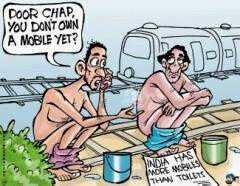
India's rivers have been turned into open sewers by 638 million Indians without access to toilets, according to rural development minister Jairam Ramesh. He was reacting a UNICEF report that says Indians make up 58% of the world population which still practices open defection, and the sense of public hygiene in India is the worst in South Asia and the world.
India(638m) is followed by Indonesia (58m), China (50m), Ethiopia (49m), Pakistan (48m), Nigeria (33m) and Sudan (17m). In terms of percentage of each country's population resorting to the unhygienic practice, Ethiopia tops the list with 60%, followed by India 54%, Nepal 50%, Pakistan 28%, Indonesia 26%, and China 4%.
18 percent of urban India still defecates in open while the percentage of rural India is as high as 69 percent of the population. It is the key reason why India carries among the highest infectious disease burdens in the world.
The number of open defecators in rural India alone is more than twice those in the whole of sub-Saharan Africa, according to a report by DFID, the UK's Department for International Development.
The World Bank has estimated that open defecation costs India $54 billion per year or $48 per head. This is more than the Government of India’s entire budget for health.
The UNICEF report says that with only four more years to go until 2015, a major leap in efforts and investments in sanitation is needed to reach the targets of Millennium Development Goals.
After the embarrassing headlines, it appears that Minister Ramesh is ready to step up the efforts to improve sanitation. He is quoted by Times of India as saying that "we are going to focus now on `nirmal gram abhiyan' -- today 25,000 nirmal grams are a tiny fraction of 6 lakh villages. These nirmal grams are in Maharashtra and Haryana. Maharashtra is a success of social movements while Haryana an example of determined state government action."
Here's a video clip of Indian environment minister Jairam Ramesh saying "if there was a Nobel Prize for dirt and filth, India would win it hands down":
Related Links:
Haq's Musings
Fixing Sanitation Crisis in India
Food, Clothing and Shelter in India and Pakistan
Heavy Disease Burdens in South Asia
Peepli Live Destroys Indian Myths
India After 63 Years of Independence
Poverty Across India 2011
India and Pakistan Contrasted

India(638m) is followed by Indonesia (58m), China (50m), Ethiopia (49m), Pakistan (48m), Nigeria (33m) and Sudan (17m). In terms of percentage of each country's population resorting to the unhygienic practice, Ethiopia tops the list with 60%, followed by India 54%, Nepal 50%, Pakistan 28%, Indonesia 26%, and China 4%.
18 percent of urban India still defecates in open while the percentage of rural India is as high as 69 percent of the population. It is the key reason why India carries among the highest infectious disease burdens in the world.
The number of open defecators in rural India alone is more than twice those in the whole of sub-Saharan Africa, according to a report by DFID, the UK's Department for International Development.
The World Bank has estimated that open defecation costs India $54 billion per year or $48 per head. This is more than the Government of India’s entire budget for health.
The UNICEF report says that with only four more years to go until 2015, a major leap in efforts and investments in sanitation is needed to reach the targets of Millennium Development Goals.
After the embarrassing headlines, it appears that Minister Ramesh is ready to step up the efforts to improve sanitation. He is quoted by Times of India as saying that "we are going to focus now on `nirmal gram abhiyan' -- today 25,000 nirmal grams are a tiny fraction of 6 lakh villages. These nirmal grams are in Maharashtra and Haryana. Maharashtra is a success of social movements while Haryana an example of determined state government action."
Here's a video clip of Indian environment minister Jairam Ramesh saying "if there was a Nobel Prize for dirt and filth, India would win it hands down":
Related Links:
Haq's Musings
Fixing Sanitation Crisis in India
Food, Clothing and Shelter in India and Pakistan
Heavy Disease Burdens in South Asia
Peepli Live Destroys Indian Myths
India After 63 Years of Independence
Poverty Across India 2011
India and Pakistan Contrasted



Comments
"Amid population boom, India hopes for ‘demographic dividend’ but fears disaster. The article is OK, but I feel as usual it doesn’t do a good enough job highlighting the huge variation in fertility across India the nation-state. Tamil Nadu has the fertility of Northern Europe while Uttar Pradesh is like West Africa. Unfortunately the “demographic dividend” is going be driven by the most backward and unproductive regions of the nation on a per unit basis…."
http://www.brownpundits.com/2011/10/15/indias-demographic-dividend-and-despair/
http://www.washingtonpost.com/world/asia_pacific/amid-population-boom-india-hopes-for-demographic-dividend-but-fears-disaster/2011/10/12/gIQA9I4nmL_story.html
My Indian friends and I joke around a lot about me as the typical white American guy visiting India. Cows! Con men! Colors! Most people I’ve met in India have restricted their reactions to my westerner-in-the-east experiences to gentle teasing. When I stuck a picture of a man urinating in public on my Facebook page, calling it one more picture of what you see everywhere you go in India, people weren’t as patient. What was I doing? Insulting the nation? Focusing on the ugly because it’s what all the westerners do when they visit India? Why does India provoke such visceral reactions in visitors?
Public urination, public defecation, dirt, garbage, filth, the poor living on the street — talking about these things, even acknowledging that they’re in front of your face, risks making your hosts unhappy, and possibly angry. It’s the third rail of India, and the voltage can be lethal. That’s why I was surprised when B.S. Raghavan decided to touch it with all 10 fingers.
Raghavan’s column in The Hindu Business Line newspaper begins with this headline: Are Indians by nature unhygienic?
Consider these excerpts:
From time to time, in their unguarded moments, highly placed persons in advanced industrial countries have burst out against Indians for being filthy and dirty in their ways of life. A majority of visitors to India from those countries complain of “Delhi belly” within a few hours of arrival, and some fall seriously ill.
There is no point in getting infuriated or defensive about this. The general lack of cleanliness and hygiene hits the eye wherever one goes in India — hotels, hospitals, households, work places, railway trains, airplanes and, yes, temples. Indians think nothing of spitting whenever they like and wherever they choose, and living in surroundings which they themselves make unliveable by their dirty habits. …
Open defecation has become so rooted in India that even when toilet facilities are provided, the spaces round temple complexes, temple tanks, beaches, parks, pavements, and indeed, any open area are covered with faecal matter. …
Even as Indians, we are forced to recoil with horror at the infinite tolerance of fellow Indians to pile-ups of garbage, overflowing sewage, open drains and generally foul-smelling environs.
There’s plenty more that you can read in that story, but I’ll direct you to the article. I’ll also ask you some questions:
Some people say you shouldn’t point out these problems, and that every country has problems. Do you agree with this statement? Why?
Does anyone disagree with Raghavan’s descriptions of these sights and smells?
Is this even a problem? Or should people get used to it?
Should visitors, especially ones from countries where people are generally wealthier, say nothing, and pretend that they don’t see unpleasant things?
As for me, I can say this: I got used to it, but I would be lying if I said I didn’t notice it. Indians notice it too. Otherwise, people wouldn’t suggest public shaming campaigns against people urinating in public, they wouldn’t threaten fines for doing it, and they wouldn’t respond with relief to plans to finally make sure that toilets on India’s trains don’t open directly onto the tracks. Of course, these are people in India. It’s a family, taking care of business the family way.
As for me, the message usually seems to be: “If you don’t love it, leave it.” It would be nice if there were some other answer. Acknowledging problems, even ones that are almost impossible to solve, makes them easier to confront.
http://blogs.reuters.com/india/2012/11/17/indians-inherently-unhygienic-indian-writer-touches-third-rail/
Children in India are exceptionally short, with their stunted growth historically attributed to malnutrition. However, new evidence is suggesting that food, or lack of it, is not the cause. Noticing that Indian children were smaller than their counterparts in Sub-Saharan Africa — who are, on average, poorer and hence less well fed — researchers have been coming to the conclusion that diseases stemming from poor sanitation are more to blame than diet.
More than half of India’s population — over 600 million people — do not use a toilet because sanitation is inaccessible or unaffordable. At the same time 61.7 million Indian children are stunted, the highest prevalence in the world.
The atrocious hygiene that results from widespread lack of sanitation is made worse by the density of the population. With large numbers of people openly defecating, fecal-oral-transmitted infections are common, leading to diarrhea, with such diseases draining growing children of vital nutrients. Growing up in environments teeming with fecal pathogens has a permanently debilitating effect, experts say. Overtime, a large build-up of fecal germs in the body can also manifest as severe intestinal diseases.
Last month, a group of economists, epidemiologists, pediatricians and nutritionists gathered at a conference in New Delhi to push for recognition of poor sanitation as the cause of child stunting in India. “It was striking that each of them [participants] had something to say about sanitation being important for child health,” Sangita Vyas, of the Research Institute for Compassionate Economics, which coorganized the meeting, told TIME. Such claims emerge at a time when the results of a massive government survey into the availability of sanitation have become available and converged with long-standing epidemiological literature.
Rural Indians remain hard to convince that this is a health epidemic, researchers say, because stunting creeps through communities, affects “everybody on average” and there are “no real dramatic cases,” Princeton University economist Dean Spears, who is currently at the Delhi School of Economics, told TIME. “The sorts of dramatic tragedies that persuade people [to change] don’t happen,” he says.
(MORE: Are Toilets a Feminist Issue? Why the Burden of Bad Sanitation Falls on Women)
A few years ago, a government sanitation program was implemented in half of 60 villages in Ahmednagar, Maharashtra, Western India. After the program, Spears and fellow economist Jeff Hammer found on average, that the height of children in the experimental group had increased by about one centimeter, relative to those in the 30 villages where the program had not been introduced.
“Widespread child-stunting in India is a human development emergency,” Spears says. “It matters for everybody.”
http://world.time.com/2013/09/09/poor-sanitation-not-malnutrition-may-be-to-blame-for-indias-notoriously-stunted-children/
...The United States Food and Drug Administration will soon release a comprehensive analysis that pinpoints imported spices, found in just about every kitchen in the Western world, as a surprisingly potent source of salmonella poisoning.
In a study of more than 20,000 food shipments, the food agency found that nearly 7 percent of spice lots were contaminated with salmonella, twice the average of all other imported foods. Some 15 percent of coriander and 12 percent of oregano and basil shipments were contaminated, with high contamination levels also found in sesame seeds, curry powder and cumin. Four percent of black pepper shipments were contaminated.
Each year, 1.2 million people in the United States become sick from salmonella, one of the most common causes of food-borne illness. More than 23,000 are hospitalized and 450 die. Symptoms include diarrhea, fever and abdominal cramps that begin 12 to 36 hours after infection and can last three to five days. Death can result when infection spreads from the intestines to the bloodstream and affects vital organs. Infants and older people are most at risk.
Mexico and India had the highest share of contaminated spices. About 14 percent of the samples from Mexico contained salmonella, the study found, a result Mexican officials disputed.
India’s exports were the second-most contaminated, at approximately 9 percent, but India ships nearly four times the amount of spices to the United States that Mexico does, so its contamination problems are particularly worrisome, officials said. Nearly one-quarter of the spices, oils and food colorings used in the United States comes from India.
The findings, the result of a three-year study that F.D.A. officials have on occasion discussed publicly and recently published in the journal Food Microbiology, form an important part of the spice analysis that will be made public “soon,” agency officials said.
“Salmonella is a widespread problem with respect to imported spices,” Michael Taylor, deputy F.D.A. commissioner for food, said in an interview. “We have decided that spices are one of the significant issues we need to be addressing right now.”
Westerners are particularly vulnerable to contaminated spices because pepper and other spices are added at the table, so bacterial hitchhikers are consumed live and unharmed. Bacteria do not survive high temperatures, so contaminated spices present fewer problems when added during cooking, as is typical in the cuisine of India and most other Asian countries.
-------------
Salmonella can survive indefinitely on dried spices, and killing the bacterium on the craggy surface of dried peppercorns without ruining their taste is especially challenging.
Government officials in India emphasized in interviews that spices slated for export are often treated to kill any bacteria. Such treatments include steam-heating, irradiation or ethylene oxide gas. But F.D.A. inspectors have found high levels of salmonella contamination in shipments said to have received such treatments, documents show. Much of the contaminated pepper in the 2010 outbreak had been treated with steam and ethylene oxide and had been certified as tested and safe, officials said.
At another spice farm, in the village of Chemmanar, Bipin Sebastian is in the midst of a four-year transition to organic farming in hope of earning a premium price for his pepper, cloves, cardamom, turmeric and coffee. Mr. Sebastian says he has used government subsidies to buy tarps, netting and a machine thresher.
“We used to put our pepper directly on the ground,” Mr. Sebastian said. “Now, we put down tarps and netting over it to protect it from the birds. And I’ve been getting a higher price. It’s been great.”
http://www.nytimes.com/2013/08/28/world/asia/farmers-change-over-spices-link-to-food-ills.html
SHEOHAR DISTRICT, India — He wore thick black eyeliner to ward off the evil eye, but Vivek, a tiny 1-year-old living in a village of mud huts and diminutive people, had nonetheless fallen victim to India’s great scourge of malnutrition.
His parents seemed to be doing all the right things. His mother still breast-fed him. His family had six goats, access to fresh buffalo milk and a hut filled with hundreds of pounds of wheat and potatoes. The economy of the state where he lives has for years grown faster than almost any other. His mother said she fed him as much as he would eat and took him four times to doctors, who diagnosed malnutrition. Just before Vivek was born in this green landscape of small plots and grazing water buffalo near the Nepali border, the family even got electricity.
So why was Vivek malnourished?
It is a question being asked about children across India, where a long economic boom has done little to reduce the vast number of children who are malnourished and stunted, leaving them with mental and physical deficits that will haunt them their entire lives. Now, an emerging body of scientific studies suggest that Vivek and many of the 162 million other children under the age of 5 in the world who are malnourished are suffering less a lack of food than poor sanitation.
Two years ago, Unicef, the World Health Organization and the World Bank released a major report on child malnutrition that focused entirely on a lack of food. Sanitation was not mentioned. Now, Unicef officials and those from other major charitable organizations said in interviews that they believe that poor sanitation may cause more than half of the world’s stunting problems.
“Our realization about the connection between stunting and sanitation is just emerging,” said Sue Coates, chief of water, sanitation and hygiene at Unicef India. “At this point, it is still just an hypothesis, but it is an incredibly exciting and important one because of its potential impact.”
This research has quietly swept through many of the world’s nutrition and donor organizations in part because it resolves a great mystery: Why are Indian children so much more malnourished than their poorer counterparts in sub-Saharan Africa?
A child raised in India is far more likely to be malnourished than one from the Democratic Republic of Congo, Zimbabwe or Somalia, the planet’s poorest countries. Stunting affects 65 million Indian children under the age of 5, including a third of children from the country’s richest families.....
-------
No Indian city has a comprehensive waste treatment system, and most Indian rivers are open sewers as a result. But Varanasi, India’s oldest and holiest city, is so awash in human waste that its decrepit condition became a national issue in recent elections. The city’s sewage plants can handle only about 20 percent of the sewage generated in the city, said Ramesh Chopra of Ganga Seva Abhiyanam, a trust for cleaning the river. The rest sloshes into the Ganges or fetid ponds and pits.
Millions of pilgrims bathe in the Ganges along Varanasi’s ancient riverfront, but a stream of human waste — nearly 75 million liters per day — flows directly into the river just above the bathing ghats, steps leading down to the river. Many people wash or brush their teeth beside smaller sewage outlets.
Much of the city’s drinking water comes from the river, and half of Indian households drink from contaminated supplies.
“India’s problems are bigger than just open defecation and a lack of toilets,” Dr. Laxminarayan said.
http://www.nytimes.com/2014/07/15/world/asia/poor-sanitation-in-india-may-afflict-well-fed-children-with-malnutrition.html?_r=0
My Indian friends and I joke around a lot about me as the typical white American guy visiting India. Cows! Con men! Colors! Most people I’ve met in India have restricted their reactions to my westerner-in-the-east experiences to gentle teasing. When I stuck a picture of a man urinating in public on my Facebook page, calling it one more picture of what you see everywhere you go in India, people weren’t as patient. What was I doing? Insulting the nation? Focusing on the ugly because it’s what all the westerners do when they visit India? Why does India provoke such visceral reactions in visitors?
Public urination, public defecation, dirt, garbage, filth, the poor living on the street — talking about these things, even acknowledging that they’re in front of your face, risks making your hosts unhappy, and possibly angry. It’s the third rail of India, and the voltage can be lethal. That’s why I was surprised when B.S. Raghavan decided to touch it with all 10 fingers.
Raghavan’s column in The Hindu Business Line newspaper begins with this headline: Are Indians by nature unhygienic?
Consider these excerpts:
From time to time, in their unguarded moments, highly placed persons in advanced industrial countries have burst out against Indians for being filthy and dirty in their ways of life. A majority of visitors to India from those countries complain of “Delhi belly” within a few hours of arrival, and some fall seriously ill.
There is no point in getting infuriated or defensive about this. The general lack of cleanliness and hygiene hits the eye wherever one goes in India — hotels, hospitals, households, work places, railway trains, airplanes and, yes, temples. Indians think nothing of spitting whenever they like and wherever they choose, and living in surroundings which they themselves make unliveable by their dirty habits. …
Open defecation has become so rooted in India that even when toilet facilities are provided, the spaces round temple complexes, temple tanks, beaches, parks, pavements, and indeed, any open area are covered with faecal matter. …
Even as Indians, we are forced to recoil with horror at the infinite tolerance of fellow Indians to pile-ups of garbage, overflowing sewage, open drains and generally foul-smelling environs.
There’s plenty more that you can read in that story, but I’ll direct you to the article. I’ll also ask you some questions:
Some people say you shouldn’t point out these problems, and that every country has problems. Do you agree with this statement? Why?
Does anyone disagree with Raghavan’s descriptions of these sights and smells?
Is this even a problem? Or should people get used to it?
Should visitors, especially ones from countries where people are generally wealthier, say nothing, and pretend that they don’t see unpleasant things?
As for me, I can say this: I got used to it, but I would be lying if I said I didn’t notice it. Indians notice it too. Otherwise, people wouldn’t suggest public shaming campaigns against people urinating in public, they wouldn’t threaten fines for doing it, and they wouldn’t respond with relief to plans to finally make sure that toilets on India’s trains don’t open directly onto the tracks. Of course, these are people in India. It’s a family, taking care of business the family way.
As for me, the message usually seems to be: “If you don’t love it, leave it.” It would be nice if there were some other answer. Acknowledging problems, even ones that are almost impossible to solve, makes them easier to confront.
Indian Prime Minister Narendra Modi has made sanitation a priority for his country, saying he would rather build toilets than temples and setting a goal for every home in the country to have a place to go to the bathroom by 2019.
But new data show India is lagging behind its neighbors in providing access to adequate sanitation.
“Progress on Sanitation and Drinking Water,” a report published by the United Nations Children’s Fund and the World Health Organization this week, says that advancements in meeting Millennium Development Goals, or MDGs, by 2015 in relation to sanitation have faltered worldwide. The report says 2.4 billion people still don’t have access to improved sanitation.
Mr. Modi launched his Clean India, or Swachh Bharat, campaign last year for good reason. Research shows that the practice of open defecation is linked to a higher risk of stunting in children and the spread of disease. A World Health Organization report said in 2014 that 597 million people in India still relieved themselves outdoors. And the new WHO/Unicef report says that the Southern Asia region has the highest number of people who defecate in the open.
The new data show that despite recent efforts, over the past 25 years, India has been losing the regional race to improve sanitation.
Its neighbors, Nepal, Bangladesh and Pakistan led the way with the greatest percentage-point change in the proportion of the population with access to improved sanitation facilities between 1990 and 2015.
Pakistan’s percentage point change was 40–64% of people have use an improved sanitation facility. In Nepal, a country in which just 4% of people had access to improved sanitation facilities in 1990, access rose by 42 percentage points to 46%. Bangladesh improved its score by 27 percentage points — 61% now have access to improved sanitation facilities.
India meanwhile, had a lower 23 percentage point increase in the same period – bringing the number of people with access to improved sanitation facilities to 40%.
And Sri Lanka is way ahead, with 95% of people having access to improved sanitation.
The report defines an improved sanitation facility as one that hygienically separates excreta from human contact and the target was for 50% or more of those with inadequate water or sanitation in 1990 to have adequate sanitary services in 2015.
Likewise, rates of open defecation have reduced, but India still has the highest percentage of the population defecating in the open–with 44% of people going outside in 2015—down from 75% in 1990, compared with a 13% figure for Pakistan in 2015, 32% for Nepal and only 1% for Bangladesh.
But, the report says: “The 31 per cent reduction in open defecation in India alone represents 394 million people, and significantly influences regional and global estimates.”
http://www.hindustantimes.com/india-news/girl-kills-self-in-jharkhand-after-parents-refuse-toilet-in-home/article1-1365606.aspx via @htTweets
A class 12 student allegedly committed suicide on Friday in Jharkhand’s Dumka district after her parents turned down her repeated pleas to construct a toilet at home as they wanted to save money for the 17-year-old’s marriage, police said.
Khushbu Kumari, a resident of Dudhani colony in the town, was found hanging from the ceiling of her room by family members, the police added.
The tragedy underlined a growing awareness on hygiene among the younger generation in the state which has country’s highest rate of open defecation.
The 2011 census had said that 92.4% people in Jharkhand’s rural areas do not have toilets.
In recent times, there have been several instances of women refusing to marry into families who don’t have toilets in their homes, which officials attribute to growing public awareness about the health hazards of open defecation.
Dumka police, quoting Khushbu’s family-members, said that she was pressurising her parents for a toilet in her home as she was fed up and ashamed of defecating in open fields.
“Girl’s parents told her that they couldn’t afford a toilet as they were saving money for her marriage,” said investigating officer Manoj Mishra.
Her father Shripati Yadav is a driver.
“For us marriage was more important. She was demanding a toilet and on Friday we had a heated argument. She was stubborn and ended her life,” said a tearful Sanju Devi, Khushbu’s mother.
Police said that the girl ended her life when her parents were not at home.
“It is a tragic incident as girl’s parents were unaware of the importance of toilets,” said Dumka SP Bipul Shukla.
A government official said that under a government scheme, individuals are provided Rs 4,600 for household toilet construction.
“The parents seemed uninformed,” said a senior sanitation officer requesting anonymity.
A study by the Unicef earlier had identified poor sanitation as a major cause for diseases and deaths among children in the state and also showed how open defecation had a strong correlation with malnutrition (55%) and stunting (47%) among children of the state.
India, the world’s second most populous nation, has a well-known problem with sanitation. Cities growing at an incredible pace with unofficial, unserviced slums, combined with cultural preferences for open defecation in fields rather than enclosed spaces, mean India has the World’s Longest Queues for Toilets. If you stretched all 774 million people in India now waiting for household toilets, the queue would stretch from Earth to the moon – and beyond! That queue would take 5,892 years to work through,assuming each person needs about four minutes in the toilet. The resulting health crisis is a serious matter. More than 140,000 children younger than five years die each year in India from diarrhoea. Nearly 40% of India’s children are stunted; this will affect both their life chances and the future prosperity of India. India also has high rates of maternal and newborn mortality linked to sepsis. The equipment necessary to prevent infection during and after childbirth is simple and inexpensive, but requiresclean water and soap, and clean surroundings, which are difficult to achieve in an environment contaminated by open defecation, and without good hygiene practices such as handwashing with soap by clinic staff and midwives. Work is underway in India to end the crisis. Prime Minister Narendra Modi has given the issue high political priority, and in autumn 2014 announced the Swachh Bharat (Clean India) Mission. Swachh Bharat aims to ensure every household has a toiletby 2019 and to educate people about the long-term health and economic benefits of using a toilet. This is an important and long-overdue initiative, and is bringing change to India’s communities. But simply building the toilets won’t be enough. What will be absolutely crucial is getting local, state and national government to make this a priority, and creating the cultural shift that will ensure that once the toilets are built they are used – by everyone.
http://www.wateraid.org/what-we-do/our-approach/research-and-publications/view-publication?id=c8e9d0b5-3384-4483-beff-a8efef8f342a
I recently picked up V.S. Naipaul’s book An Area of Darkness, a chronicle of his first trip to India published in 1964. Although some view the book as overly pessimistic and scathing, his portrayal of India’s culture of open defecation is uncannily accurate.
Shankaracharya Hill, overlooking the Dal Lake, is one of the beauty spots of Srinagar. It has to be climbed with care, for large areas of its lower slopes are used as latrines by Indian tourists. If you surprise a group of three women, companionably defecating, they will giggle: the shame is yours, for exposing yourself to such a scene.
In Madras the bus station near the High Court is one of the more popular latrines. The traveller arrives; to pass the time he raises his dhoti, defecates in the gutter. The bus arrives; he boards it; the woman sweeper cleans up after him.
—
In Goa, you might think of taking an early morning walk along the balustrade avenue that runs beside the Mandovi River. Six feet below, on the water’s edge, and as far as you can see, there is a line, like a wavering tidewrack, of squatters. For the people of Goa, as for those of Imperial Rome, defecating is a social activity; they squat close to one another; they chatter. When they are done they advance, trousers still down, backsides bare, into the water to wash themselves.
—
Indians defecate everywhere. They defecate, mostly, beside the railway tracks. But they also defecate on the beaches; they defecate on the hills; they defecate on the river banks; they defecate on the streets; they never look for cover.
—
A handsome young Muslim boy, a student at a laughable institute of education in an Uttar Pradesh weaving town, elegantly dressed in the style of Mr. Nehru, even down to the buttonhole, had another explanation. Indians were a poetic people, he said. He himself always sought the open because he was a poet, a lover of Nature, which was the matter of his Urdu verses; and nothing was as poetic as squatting on a river bank at dawn.
He eloquently describes in these vignettes what we have found 50 years later in the SQUAT and Switching Studies: that defecating in the open is the social norm. It is considered to be a part of the wholesome, rural life, in which one takes a walk outside in nature, socializes with friends, and avoids polluting oneself and one’s home.
Full text HTML
PDF
Free access
DOI:10.1080/13688790.2015.1065714
Assa Doron & Ira Raja
pages 189-207
In this article we seek to interrogate the cultural, political and economic conditions that generate the crisis of sanitation in India, with its severe implications for the poor and the marginalized. The key question we ask is how to interpret and explain the spectre of ‘open defecation’ in India's countryside and its booming urban centres. The discussion is divided into three parts. Part one examines the cultural interpretation of ‘shitting’ as symbolic action underpinned by ideas of purity, pollution and ‘the body politic’. Part two takes the political economic approach to gain further insights into contemporary discourse, performance and cultural politics surrounding toilets and open defecation in India. Part three examines civil society activities, state campaigns and media accounts of open defecation to explore the disruptive potency of everyday toilet activities, and how these interplay with issues of class, caste, and gender. Drawing on interviews and a review of ethnographic work, we seek to interrogate the idiom of modern sanitation, with its emphasis on cleanliness, progress and dreams of technology, as a constitutive idea and an explanatory force in Indian modernity.
http://www.tandfonline.com/doi/full/10.1080/13688790.2015.1065714
https://www.washingtonpost.com/news/worldviews/wp/2016/04/21/how-bad-are-most-of-indias-medical-schools-very-according-to-new-reports/
In a country with the world's heaviest health burden, and highest rates of death from treatable diseases like diarrhea, tuberculosis and pneumonia, corruption at medical schools is an extremely pressing issue. The Indian Medical Association estimates that nearly half of those practicing medicine in the country do not have any formal training, but that many of those who claim to be qualified may actually not be.
a couple of recent studies and reports have cast serious doubts on the quality and ethics of the country's vast medical schooling system. The most recent revealed that more than half of those 579 didn't produce a single peer-reviewed research paper in over a decade (2005-2014), and that almost half of all papers were attributed to just 25 of those institutions.
The 2011 court case against a man, Balwant Arora, was one of the earlier indications of the massive levels of fraud. Arora brazenly admitted to issuing more than 50,000 fake medical degrees at around $100 apiece from his home, saying that each of the recipients had "some medical experience" and that he was doing it in service to a country that desperately needs more doctors. He had served four months in jail in 2010 for similar offences.
Private medical colleges have proliferated rapidly in India. When in 1980 there were around 100 public colleges and 11 private, the latter now outnumber the former by 215 to 183. Most are run by businessmen with no medical experience. Last January, the British Medical Journal found that many private medical colleges charged "capitation" fees, which are essentially compulsory donations required for admission. Jeetha D'Silva, who authored that report, wrote, "Except for a few who get into premier institutions of their choice purely on merit, many students face Hobson's choice — either pay capitation to secure admission at a college or give up on the dream of a medical degree."
The best public medical colleges have acceptance rates that are minuscule, even compared to Ivy League universities. Those colleges also tend to be the ones that produce the most research papers, as well as handle the most patients, which would seem to eliminate the possible excuse that overwhelming patient burdens prevent private colleges from producing valuable research.
The most productive medical college in India is also its largest public health institution, the All India Institute of Medical Sciences, or AIIMS. In the 10-year period that Samiran Nundy and his colleagues examined, AIIMS published 11,300 research papers. For context, that is about a quarter of what Massachusetts General Hospital produced in the same time frame.
Women in India who don’t have adequate access to sanitation facilities and are forced to openly defecate are more likely to experience sexual violence, according to a new study.
Approva Jadhav, a researcher from the University of Michigan, said that “open defecation places women at uniquely higher risk of type of sexual violence: non-partner” in the co-authored report.
In their findings, researchers said it was twice as likely for women without access to “household toilets” to face sexual violence than women who do have such access, suggesting that improvement of infrastructure and access to toilets would provide a safer environment for women.
“Women who use open defecation sites such as open fields or the side of a railway track are twice as likely to get raped when compared with women using a home toilet,” the study stated.
“Our findings provide further rationale for NGO’s and the Indian government to expand sanitation programs, and raise new questions about the potentially protective role of sanitation facilities in other contexts beyond India,” the research found.
Almost half of India’s population do not have access to basic sanitation and have to defecate in public and women appear to be affected the most.
“This is an urgent need that cannot be ignored anymore,” Ms Jadhav, lead author of the report, told NDTV. “We need more than anecdotes to bring a policy change.”
By analyzing data from the Indian National Family Health Survey along with an overall representative sample of 75,000 women who answered questions on accessibility to toilets in their homes and experiences of various types of violence, the researchers found that previous sanitation studies did not examine the synonymous link between the two.
The issue of India’s sanitation crisis being linked to sexual violence came to light in 2014 when two teenage girls were raped and hanged in Uttar Pradesh while they were making their way to fields to defecate.
In the slums of Delhi, where communities often have to share public toilets, girls under the age of 10 have been found to be at risk of “being raped while on their way to use a public toilet,” according to a BBC report, which also states that around 300 million women and girls in the country defecate in the open.
https://www.ncbi.nlm.nih.gov/pmc/articles/PMC5100257/
Paurush Ambesh1 and Sushil Prakash Ambeshcorresponding author2
Author information ► Article notes ► Copyright and License information ► Disclaimer
Sir,
https://www.ncbi.nlm.nih.gov/pmc/articles/PMC5020240/
“Cleanliness is next to Godliness”, a proverbial adage that traces its inception to ancient Indian times, is the epitome of irony in the current Indian health situation. The lost Indus Valley Civilization, with modern cities like Harappa and Mohenjodaro, was once the gold standard of sanitation infrastructure. Its extensive and efficient sewage system was not only an exemplary gem, but also a gift of knowledge to entire mankind. However history resides in books and has little relevance to the current situation.
Though over the last 50 years, the general health of Indians has improved and the life expectancy has increased, myriad health and sanitation problems still stare one in the face. The biggest one, open defecation, is the mother of all infection and morbidity. The WHO declared the year 2008 as International Year of Sanitation. It was here that the term ‘Open Defecation’ was widely publicized. Community Led Total Sanitation (CLTS) programs helped spread the term all around the globe.
It is a matter of national concern as India has the most number of people practicing open defecation in the world, around 600 million [1], and is followed by Indonesia, Pakistan, Nigeria and Ethiopia. Still these countries come nowhere close to the staggering number contributed by India.
Most of it occurs in villages with a prevalence of 65% [2]. In urban settings the prevalence is close to 16%. The problem has thick deep roots with a multi-factorial origin. Unavailability of proper toilets or toilets with dimly lit, broken or clogged latrines is common. However, the biggest problem is the mindset of people in both rural and urban settings. Children grow watching parents and grandparents practice open defecation. Most farmers believe that waking up early and defecating in the field, not only adds natural fertilizer to the soil, but also rejuvenates the bowel and the mind.
Open defecation is a major cause of fatal diarrhea. Everyday about 2000 children aged less than five succumb to diarrhea and every 40 seconds a life is lost [3]. It is depressing that all this needless suffering is actually preventable. In densely populated countries like India, the health impact is magnified many fold [4]. There is evidence to suggest that water sanitation and hygiene practices are associated with child linear growth [5]. Children have a tendency to put common things in their mouth. In rural settings where open defecation is prevalent, large amounts of fecal pathogens via human and animal feces, are ingested by children. This creates a massive reservoir of bacteria, parasites and viruses that keep spreading gastrointestinal infection. An eventual result is growth stunting and malnutrition.
Though the health challenges seem to compound with time, the health budget allocation by the Government of India is getting smaller every year. This year also it is quite meager, only about 1% of the Gross Domestic Product. This may put financial constraints on dealing with sanitation linked diseases.
An incident in Badaun district, where two teenage sisters who ventured out to defecate due to lack of a private toilet, were raped and murdered, stimulated the masses into anger and dissent. Investigating authorities admitted that 95% of all rapes in India occur when girls go out alone in secluded places, to urinate or defecate. Delinquent men have been known to cluster at such locations, awaiting helpless victims. Similar situation exists in many African countries like Kenya, Zimbabwe and Somalia. Thus, a direct correlation between crime and open defecation seems to exist.
https://www.ncbi.nlm.nih.gov/pmc/articles/PMC5020240/
#sanitation #toilets #hygiene #rape #Modi #BJP http://www.ecoti.in/zJBrLY via @economictimes
1,00,000 tonne of excreta every day produced by 720 million people using 144 million household toilets -- just to give a sense of scale, more than 5,200 trucks would be needed every day to transport this amount of excreta!
The CSE has based this estimate on the standard calculation that on an average, an individual produces 128 gram of excreta every day.
https://www.washingtonpost.com/goingoutguide/movies/the-white-tiger-movie-review/2021/01/06/35d7fa02-4d48-11eb-a9d9-1e3ec4a928b9_story.html
There’s a sense of snarling menace implicit in “The White Tiger,” a subversive, sharp-toothed dramedy of upward social mobility by writer-director Ramin Bahrani (“99 Homes”), based on Aravind Adiga’s best-selling 2008 novel, which won the Man Booker Prize. It’s not just in the title, a metaphorical moniker for uniqueness slapped on the film’s ambitious protagonist, a canny but impoverished low-caste Indian named Balram (Adarsh Gourav), as a child. It’s there, lurking in every shadow of this dark rags-to-riches tale itself: a coiled threat to the traditional world order of haves and have-nots, just waiting to pounce.
After the opening scene, set in a car careening through the streets of Delhi at night — a short, alarming prologue that is quickly interrupted by Balram’s narration, framed somewhat preposterously as an email he’s composing to Chinese Premier Wen Jiabao on the eve of his 2010 visit to India — the film gets down to business. Told mostly in flashback, “Tiger” follows Balram’s rise from poverty to become the No. 2 chauffeur for a rich, corrupt landlord known as the Stork (Mahesh Manjrekar) and his son Ashok (Rajkummar Rao).
It isn’t long that he’s No. 2. Balram soon supplants the Stork’s top driver (Girish Pal) when he reveals that the longtime employee — or servant, in the parlance of the film — is a Muslim. (The Stork hates Muslims.) Soon Balram is making money in side hustles that involve submitting fake invoices to his boss for unnecessary repairs, and siphoning gas to sell on the streets, all the while ingratiating himself with the Western-educated Ashok and his American-raised wife, a chiropractor named Pinky (Priyanka Chopra Jonas). Both of them are progressive enough to treat Balram not as their servant but their pal — until it no longer serves them, that is.
Such polarization and inequality — Balram casts it as another dichotomy: an India of darkness, and an India of light — isn’t unique to his country. And as the blithely clueless cheerfulness of film’s antihero gradually curdles to cunning connivance, so does the narrative’s black comedy congeal, taking on a tone that is less jokey than sickening. (Balram cracks wise throughout the film, saying at one point, about the world’s largest democracy: “If I were in charge of India, I’d get the sewage pipes first, then the democracy.”)
But it may suit Narendra Modi just fine
https://www.economist.com/asia/2023/01/05/postponing-indias-census-is-terrible-for-the-country
Narendra Modi often overstates his achievements. For example, the Hindu-nationalist prime minister’s claim that all Indian villages have been electrified on his watch glosses over the definition: only public buildings and 10% of households need a connection for the village to count as such. And three years after Mr Modi declared India “open-defecation free”, millions of villagers are still purging al fresco. An absence of up-to-date census information makes it harder to check such inflated claims. It is also a disaster for the vast array of policymaking reliant on solid population and development data.
----------
Three years ago India’s government was scheduled to pose its citizens a long list of basic but important questions. How many people live in your house? What is it made of? Do you have a toilet? A car? An internet connection? The answers would refresh data from the country’s previous census in 2011, which, given India’s rapid development, were wildly out of date. Because of India’s covid-19 lockdown, however, the questions were never asked.
Almost three years later, and though India has officially left the pandemic behind, there has been no attempt to reschedule the decennial census. It may not happen until after parliamentary elections in 2024, or at all. Opposition politicians and development experts smell a rat.
----------
For a while policymakers can tide themselves over with estimates, but eventually these need to be corrected with accurate numbers. “Right now we’re relying on data from the 2011 census, but we know our results will be off by a lot because things have changed so much since then,” says Pronab Sen, a former chairman of the National Statistical Commission who works on the household-consumption survey. And bad data lead to bad policy. A study in 2020 estimated that some 100m people may have missed out on food aid to which they were entitled because the distribution system uses decade-old numbers.
Similarly, it is important to know how many children live in an area before building schools and hiring teachers. The educational misfiring caused by the absence of such knowledge is particularly acute in fast-growing cities such as Delhi or Bangalore, says Narayanan Unni, who is advising the government on the census. “We basically don’t know how many people live in these places now, so proper planning for public services is really hard.”
The home ministry, which is in charge of the census, continues to blame its postponement on the pandemic, most recently in response to a parliamentary question on December 13th. It said the delay would continue “until further orders”, giving no time-frame for a resumption of data-gathering. Many statisticians and social scientists are mystified by this explanation: it is over a year since India resumed holding elections and other big political events.