Pakistan Led South Asian Jobs Growth in 2000-2010
Pakistan's employment growth has been the highest in South Asia region since 2000, followed by Nepal, Bangladesh, India, and Sri Lanka in that order, according to a recent World Bank report titled "More and Better Jobs in South Asia".
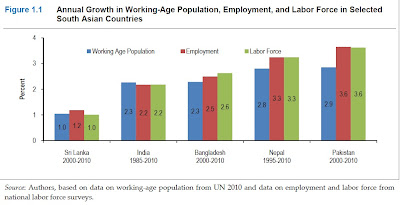
Total employment in South Asia (excluding Afghanistan and Bhutan) rose from 473 million in 2000 to 568 million in 2010, creating an average of just under 800,000 new jobs a month. In all countries except Maldives and Sri Lanka, the largest share of the employed are the low‐end self-employed.
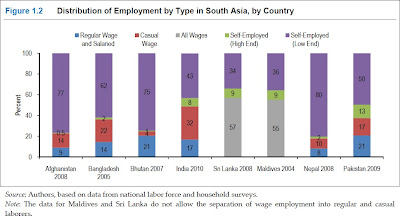
The report says that nearly a third of workers in India and a fifth of workers in Bangladesh and Pakistan are casual laborers. Regular wage and salaried workers represent a fifth or less of total employment.
Analysis of the labor productivity data indicates that growth in TFP (total factor productivity) made a larger relative contribution to the growth of aggregate labor productivity in South Asia during 1980–2008 than did physical and human capital accumulation. In fact, the contribution of TFP growth was higher than in the high‐performing East Asian economies excluding China.

India's labor productivity growth since 1980 has been the highest in South Asia, followed by Sri Lanka and Pakistan. This was particularly the case in India where TFP rose by 2.6% versus 1.4% in Pakistan during this period.
The report argues that South Asia region needs to create a million jobs a month just to keep up with the growth of the workforce. In addition to corruption, conflicts and political instability, the report specifically mentions electricity shortage as a key factor inhibiting job growth in the region. Power sector financial losses across the region are large, resulting from the misalignment of tariffs, the high cost of power procurement, and high transmission and distribution losses. In India the combined cash loss of state-owned distribution companies is more than $20 billion a year, compared with $300 billion of investment needs in 2010–15. The sector deficit in Pakistan is estimated at about $2 billion a year, compared with $32 billion of investment needs in 2010–20.
Increased load shedding in Pakistan alone has cost 400,000 jobs in recent years, according to the World Bank. Although the World Bank report does not address it directly, the anecdotal evidence suggests that almost all of Pakistan's job growth for the decade occurred from 2000-2007 when the economy showed robust gdp growth. During 2000-2007, Pakistan's economy became one of the four fastest growing economies in Asia with its growth rate averaging 7.0 per cent per year for most of this period. As a result of strong economic growth, Pakistan succeeded in reducing poverty by one-half, creating almost 13 million jobs, halving the country's debt burden, raising foreign exchange reserves to a comfortable position and propping the country's exchange rate, restoring investors' confidence and most importantly, taking Pakistan out of the IMF Program. Contrary to its public criticism of the Musharraf-era economy, the preceding facts were acknowledged by the current government in a Memorandum of Economic and Financial Policies (MEFP) for 2008/09-2009/10, while signing agreement with the IMF on November 20, 2008.
It's important for Pakistani government to seriously address the energy and security crises to restore investor confidence and bring back the strong economic growth necessary for creating millions of jobs for its growing youth population entering the workforce. The consequences of inaction on this front would be far more disastrous than the negative effects of the current Taliban insurgency.
Related Links:
Haq's Musings
More and Better Jobs in South Asia
Incompetence Worse Than Corruption in Pakistan
Pakistan's Circular Debt and Load Shedding
Pakistan Planning Commission
US Fears Aid Will Feed Graft in Pakistan
Pakistan Swallows IMF's Bitter Medicine
Shaukat Aziz's Economic Legacy
Pakistan's Energy Crisis
Karachi Tops Mumbai in Stock Performance
India Pakistan Contrasted 2010
Pakistan's Foreign Visitors Pleasantly Surprised
After Partition: India, Pakistan and Bangladesh
The "Poor" Neighbor by William Dalrymple
Pakistan's Modern Infrastructure
Video: Who Says Pakistan Is a Failed State?
India Worse Than Pakistan, Bangladesh on Nutrition
UNDP Reports Pakistan Poverty Declined to 17 Percent
Pakistan's Choice: Talibanization or Globalization
Pakistan's Financial Services Sector
Pakistan's Decade 1999-2009
South Asia Slipping in Human Development
Asia Gains in Top Asian Universities
BSE-Key Statistics
Pakistan's Multi-Billion Dollar IT Industry
India-Pakistan Military Comparison
Food, Clothing and Shelter in India and Pakistan
Pakistan Energy Crisis
IMF-Pakistan Memorandum of Economic and Financial Policies
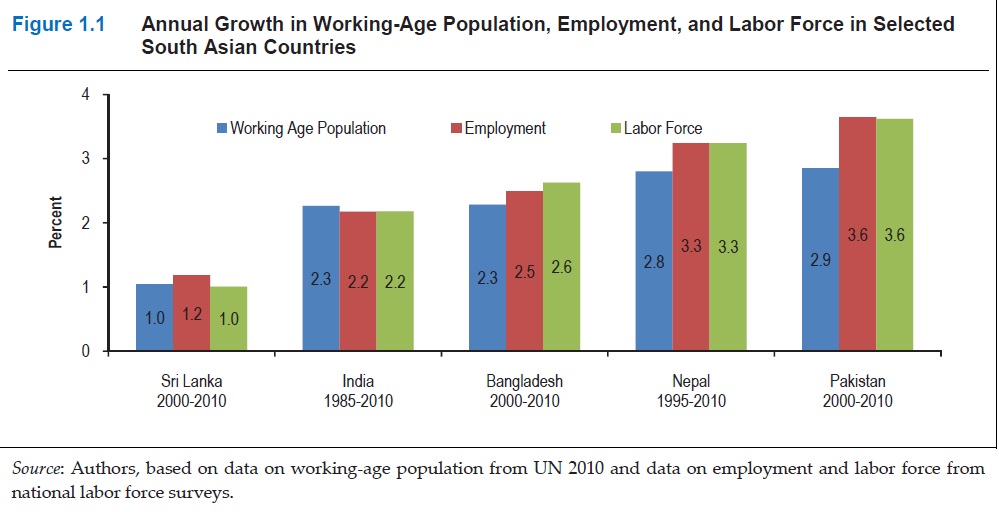
Total employment in South Asia (excluding Afghanistan and Bhutan) rose from 473 million in 2000 to 568 million in 2010, creating an average of just under 800,000 new jobs a month. In all countries except Maldives and Sri Lanka, the largest share of the employed are the low‐end self-employed.
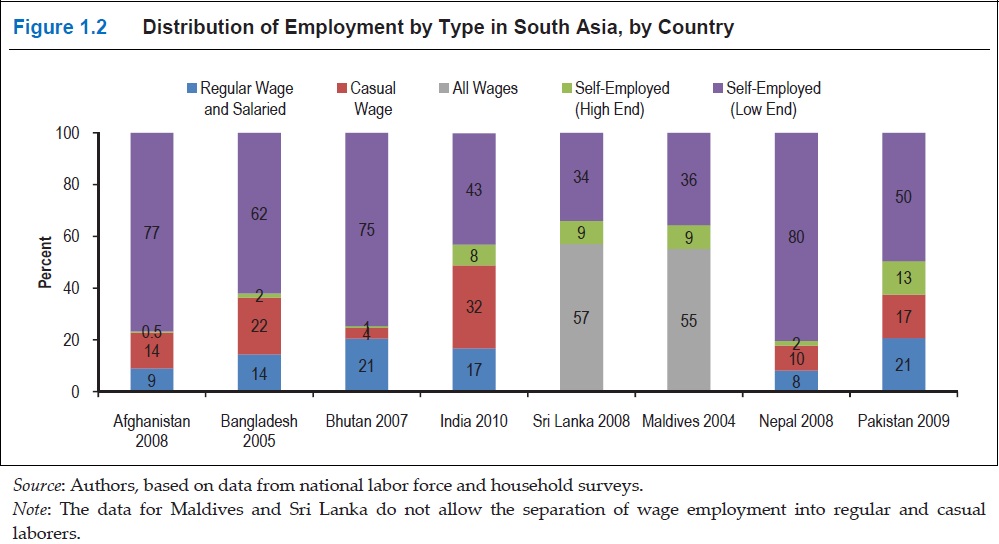
The report says that nearly a third of workers in India and a fifth of workers in Bangladesh and Pakistan are casual laborers. Regular wage and salaried workers represent a fifth or less of total employment.
Analysis of the labor productivity data indicates that growth in TFP (total factor productivity) made a larger relative contribution to the growth of aggregate labor productivity in South Asia during 1980–2008 than did physical and human capital accumulation. In fact, the contribution of TFP growth was higher than in the high‐performing East Asian economies excluding China.

India's labor productivity growth since 1980 has been the highest in South Asia, followed by Sri Lanka and Pakistan. This was particularly the case in India where TFP rose by 2.6% versus 1.4% in Pakistan during this period.
The report argues that South Asia region needs to create a million jobs a month just to keep up with the growth of the workforce. In addition to corruption, conflicts and political instability, the report specifically mentions electricity shortage as a key factor inhibiting job growth in the region. Power sector financial losses across the region are large, resulting from the misalignment of tariffs, the high cost of power procurement, and high transmission and distribution losses. In India the combined cash loss of state-owned distribution companies is more than $20 billion a year, compared with $300 billion of investment needs in 2010–15. The sector deficit in Pakistan is estimated at about $2 billion a year, compared with $32 billion of investment needs in 2010–20.
Increased load shedding in Pakistan alone has cost 400,000 jobs in recent years, according to the World Bank. Although the World Bank report does not address it directly, the anecdotal evidence suggests that almost all of Pakistan's job growth for the decade occurred from 2000-2007 when the economy showed robust gdp growth. During 2000-2007, Pakistan's economy became one of the four fastest growing economies in Asia with its growth rate averaging 7.0 per cent per year for most of this period. As a result of strong economic growth, Pakistan succeeded in reducing poverty by one-half, creating almost 13 million jobs, halving the country's debt burden, raising foreign exchange reserves to a comfortable position and propping the country's exchange rate, restoring investors' confidence and most importantly, taking Pakistan out of the IMF Program. Contrary to its public criticism of the Musharraf-era economy, the preceding facts were acknowledged by the current government in a Memorandum of Economic and Financial Policies (MEFP) for 2008/09-2009/10, while signing agreement with the IMF on November 20, 2008.
It's important for Pakistani government to seriously address the energy and security crises to restore investor confidence and bring back the strong economic growth necessary for creating millions of jobs for its growing youth population entering the workforce. The consequences of inaction on this front would be far more disastrous than the negative effects of the current Taliban insurgency.
Related Links:
Haq's Musings
More and Better Jobs in South Asia
Incompetence Worse Than Corruption in Pakistan
Pakistan's Circular Debt and Load Shedding
Pakistan Planning Commission
US Fears Aid Will Feed Graft in Pakistan
Pakistan Swallows IMF's Bitter Medicine
Shaukat Aziz's Economic Legacy
Pakistan's Energy Crisis
Karachi Tops Mumbai in Stock Performance
India Pakistan Contrasted 2010
Pakistan's Foreign Visitors Pleasantly Surprised
After Partition: India, Pakistan and Bangladesh
The "Poor" Neighbor by William Dalrymple
Pakistan's Modern Infrastructure
Video: Who Says Pakistan Is a Failed State?
India Worse Than Pakistan, Bangladesh on Nutrition
UNDP Reports Pakistan Poverty Declined to 17 Percent
Pakistan's Choice: Talibanization or Globalization
Pakistan's Financial Services Sector
Pakistan's Decade 1999-2009
South Asia Slipping in Human Development
Asia Gains in Top Asian Universities
BSE-Key Statistics
Pakistan's Multi-Billion Dollar IT Industry
India-Pakistan Military Comparison
Food, Clothing and Shelter in India and Pakistan
Pakistan Energy Crisis
IMF-Pakistan Memorandum of Economic and Financial Policies



Comments
Check out your groceries or drugstore purchases using a kiosk? A worker behind a cash register used to do that.
Buy clothes without visiting a store? You’ve taken work from a salesman.
Book your vacation using an online program? You’ve helped lay off a travel agent — perhaps one at American Express Co., which announced this month that it plans to cut 5,400 jobs, mainly in its travel business, as more of its customers shift to online portals to plan trips.
Software is picking out worrisome blots in medical scans, running trains without conductors, analyzing Twitter traffic to tell where to sell certain snacks, sifting through documents for evidence in court cases, recording power usage beamed from digital utility meters at millions of homes, and sorting returned library books.
Year after year, the software that runs computers and an array of other devices becomes more capable of doing tasks that humans have always done. For decades, science fiction warned of a future when we would be architects of our own obsolescence, replaced by our machines; an Associated Press analysis finds that the future has arrived.
‘’I have never seen a period where computers demonstrated as many skills and abilities as they have over the past seven years,” says Andrew McAfee, principal research scientist at the Center for Digital Business at the Massachusetts Institute of Technology and co-author of “Race Against the Machine.”
The global economy is being reshaped by machines that generate and analyze vast amounts of data; by devices such as smartphones and tablet computers that let people work just about anywhere, even when they’re on the move; by smarter, nimbler robots; and by services that let businesses rent computing power when they need it, instead of installing expensive equipment and hiring IT staffs to run it. Whole employment categories, from secretaries to travel agents, are disappearing.
“There’s no sector of the economy that’s going to get a pass,” says Martin Ford, who runs a software company and wrote “The Lights in the Tunnel,” a book predicting widespread job losses. “It’s everywhere.”
The numbers startle even labor economists. In the United States, half of the 7.5 million jobs lost during the Great Recession paid middle-class wages, ranging from $38,000 to $68,000. But only 2 percent of the 3.5 million jobs gained since the recession ended in June 2009 are midpay. Nearly 70 percent are low-paying jobs; 29 percent pay well.
In the 17 European countries that use the euro as their currency, the numbers are even worse. Almost 4.3 million low-pay jobs have been gained since mid-2009, but the loss of midpay jobs has never stopped. A total of 7.6 million disappeared from January 2008 through last June.
Some occupations are beneficiaries of the march of technology, such as software engineers and app designers. But, overall, technology is eliminating far more jobs than it is creating.
To better understand the impact of technology on jobs, The Associated Press analyzed employment data from 20 countries; and interviewed economists, technology experts, robot manufacturers, software developers, CEOs, and workers who are competing with smarter machines.
The AP’s key findings:
■ Over the past 50 years, technology has drastically reduced the number of jobs in manufacturing. Robots and other machines controlled by computer programs work faster and make fewer mistakes than humans. Now, that same efficiency is being unleashed in the service economy.
■ Technology is being adopted by every kind of organization that employs people — in large corporations and small businesses, established companies and startups, schools, hospitals, nonprofits and the military.
http://jacksonville.com/news/national/2013-01-28/story/ap-investigation-technology-killing-millions-middle-class-jobs
HUMAN hands are extremely good at making clothes. While many manufacturing processes have been automated, stitching together garments remains a job for millions of people around the world. As with most labour-intensive tasks, much of the work has migrated to low-wage countries, especially in Asia. Factory conditions can be gruelling. As nations develop and wages rise, the trade moves on to the next cheapest location: from China, to Bangladesh and, now that it is opening up, Myanmar. Could that migration be about to end with the development of a robotic sewing machine?
There have been many attempts to automate sewing. Some processes can now be carried out autonomously: the cutting of fabric, for instance, and sometimes sewing buttons or pockets. But it is devilishly difficult to make a machine in which fabric goes in one end and finished garments, such as jeans and T-shirts, come out the other. The particularly tricky bit is stitching two pieces of material together. This involves aligning the material correctly to the sewing head, feeding it through and constantly adjusting the fabric to prevent it slipping and buckling, while all the time keeping the stitches neat and the thread at the right tension. Nimble fingers invariably prove better at this than cogs, wheels and servo motors.
“The distortion of the fabric is no longer an issue. That’s what prevented automatic sewing in the past,” says Steve Dickerson, the founder of SoftWear Automation, a textile-equipment manufacturer based in Atlanta, where Dr Dickerson was a professor at the Georgia Institute of Technology.
The company is developing machines which tackle the problems of automated sewing in a number of ways. They use cameras linked to a computer to track the stitching. Researchers have tried using machine vision before, for instance by having cameras detect the edge of a piece of fabric to work out where to stitch.
The Atlanta team, however, have greatly increased accuracy by using high-speed photography to capture up to 1,000 frames per second. These images are then manipulated by software to produce a higher level of contrast. This more vivid image allows the computer to pick out individual threads in the fabric. Instead of measuring the fabric the robotic sewing machine counts the number of threads to determine the stitching position. As a consequence, any distortion to the fabric made by each punch of the needle can be measured extremely accurately. These measurements also allow the “feed dog”, which gently pulls fabric through the machine, to make constant tiny adjustments to keep things smooth and even.
------
Shoemakers are already using 3D printers, which build up material additively, to make prototypes of shoes. Exotic clothing and shoes made with 3D printers are becoming regulars on the catwalks at many of the world’s leading fashion shows, although the materials they are printed from tend to be various sorts of plastic, which can make the garments somewhat clunky and shoes a bit clog-like. However, researchers are working on ways to print more flexible materials. One such project involves a collaboration between Disney, Cornell University and Carnegie Mellon University. Their 3D printer uses layers of off-the-shelf fabric to make soft objects, such as cuddly toys.
http://www.economist.com/news/technology-quarterly/21651925-robotic-sewing-machine-could-throw-garment-workers-low-cost-countries-out?fsrc=scn/tw/te/pe/ed/madetomeasure
http://economictimes.indiatimes.com/news/economy/policy/raghuram-rajan-flags-indias-biggest-worry-that-could-cost-modi-a-win-in-2019-elections/articleshow/60434472.cms
"Remember that we have what we call the population dividend. A million new people entering the labor force every month," Rajan said. "If we don’t provide these jobs that are required, you have a million dissatisfied entrants. And that could create a lot of social mischief."
Rajan is right in this aspect. India will have the world’s biggest labor force by 2027 and the millennial generation is crucial to anchor one of the fastest paces of economic growth. However, fresh employment opp ..
Under Modi, just over 10,000 jobs a month are being created instead, according to government figures from 2015.
Read more at:
http://economictimes.indiatimes.com/articleshow/60434472.cms?utm_source=contentofinterest&utm_medium=text&utm_campaign=cppst
By Dr. Selim Raihan, Professor, Department of Economics, University of Dhaka, Bangladesh, and Executive Director, South Asian Network on Economic Modeling (SANEM).
http://www.thedailystar.net/opinion/economics/are-we-entering-jobless-growth-phase-south-asia-1459387
The relationship between economic growth and employment is an important issue in economics discourse. Promotion of inclusive growth also requires economic growth processes to be employment friendly. The measure that captures the employment effect of economic growth is the "employment elasticity" of economic growth, which is the ratio of percentage change in employment to the percentage change in real gross domestic product (GDP).
We have calculated the employment elasticity with respect to the change in real GDP for the South Asian countries for three different periods from 2001 to 2015. There are mixed patterns among the South Asian countries. During 2001 and 2005, Maldives had the largest employment elasticities (1.39) and Sri Lanka had the lowest one (0.08). India, with a share of 75 percent of the total population in South Asia, had the employment elasticity of only 0.38, one of the lowest in South Asia. Two other large countries, Pakistan and Bangladesh, had employment elasticities of 0.70 and 0.77 respectively.
For the period of 2006-2010, India experienced a drastic fall in employment elasticity to only 0.03 despite the fact that the average GDP growth rate of India increased from 6.6 percent (2001-2005) to more than 8 percent (2006-2010). Over these periods, Bangladesh also had a similar experience where employment elasticity declined from 0.77 to 0.4 in the wake of a rising average GDP growth rate from 5 to 6 percent. While Afghanistan, Maldives, and Nepal also experienced a decline, Pakistan and Sri Lanka could increase the elasticities.
Over the recent period between 2011 and 2015, Bangladesh experienced a further fall in the employment elasticity to 0.28, while India's improvement is meagre (from 0.03 to only 0.09). Despite the slower economic growth rates during this period, Afghanistan, Maldives, Nepal, and Pakistan could increase their employment elasticities. Sri Lanka had a further fall in employment elasticity to only 0.14. During this period, India had the least employment elasticity among all South Asian countries.
The aforementioned analysis points to the concern that two major South Asian countries, India and Bangladesh, experienced a substantial reduction in employment elasticities throughout the periods of high economic growth. While during 2001 and 2005, the annual average job creation in Bangladesh and India were 1.6 million and 11.3 million respectively, in 2011-2015, such numbers declined to 1 million and 3.2 million for Bangladesh and India respectively. Most of the other South Asian countries experienced either volatile, or slow or stagnant economic growth, and therefore, despite a rise in employment elasticities, the actual employment generation in these countries had not been substantial. It is also important to mention that while SDG 8 talks about ensuring "decent" jobs for all, South Asian countries are seriously lagging far behind. In most of the South Asian countries, there are persistent employment challenges such as lack of economic diversification, poor working conditions, low productivity and a high degree of informality. This is reflected by the fact that among the top five countries in the world with very high proportion of informal employment in total employment, four are from South Asia (Bangladesh, India, Nepal, and Pakistan).
https://asia.nikkei.com/Politics-Economy/International-Relations/Japan-to-provide-4-million-to-help-generate-employment-in-Pakistan
Japan signed a commitment Monday to provide $3.9 million to the United Nations Development Program in Pakistan for an initiative aimed at generating nearly 20,000 jobs for youth in the provinces of Sindh and Khyber Pakhtunkhwa.
The agreement, signed by Japanese Ambassador Takashi Kurai and UNDP Country Director Ignacio Artaza at a ceremony in Islamabad, covers funding to help set up 50 community centers in the two provinces.
The centers will provide vocational training, particularly in information technology, to young people to prepare them for self-employment or employment in different vocations.
"Japan will continue to support youth and young women so that they can take the lead in development of the country, which has bright future with young population," Kurai said in his speech.
Pakistan has a population of 207 million, with 31 percent between 15 and 29 years, and a youth unemployment rate of over 10 percent.
"It is crucial to invest in this 'youth bulge' and provide young people with the skills and knowledge they need to operate in an increasingly competitive employment market, and to help Pakistan's youthful population to contribute in its sustainable development," the Japanese Embassy said in a statement.
Khyber Pakhtunkhwa and adjacent tribal areas bordering Afghanistan have been dubbed as nursing grounds for terrorism, with officials and studies often attributed this to lack of employment opportunities and poverty.
https://www.dawn.com/news/1446301
https://www.ilo.org/wcmsp5/groups/public/---asia/---ro-bangkok/---sro-bangkok/documents/publication/wcms_649885.pdf
In its ‘Asia-Pacific Employment’ and ‘Social Outlook 2018’, released on Friday, ILO pointed out that although the regional unemployment rate is projected to remain 4.1 per cent through 2020, the vulnerable employment rate is expect to creep up towards 49pc, reversing a downward trend of at least two decades.
The region’s future prospects will require that economic growth go hand in hand with a further expansion of decent work, it says.
While real wage growth surpassed labour productivity growth between 2010 and 2016 in almost all countries, the increase in wages of employees looked especially strong in China, Thailand and Vietnam. However, negative wage growth was witnessed in Pakistan in 2015-16 at minus 4.7pc.
In Pakistan’s education sector, 6.6pc of the total female employment in 2016 was well behind the 72.9pc share in agriculture and 12.7pc in manufacturing.
Pakistan stands out with 15.3pc of women working from their homes, and 37pc working on the land (in agriculture) in 2017.
Structural transformation has been strongly felt in the region, with employment moving from agriculture mainly into services and only to some extent into industry. Most of the loss in agriculture was taken up by the increase in employment in the services sector, where 740 million jobs have been gained since 2000.
Manufacturing jobs decreased slightly from the peak in the mid-2000s, with more job losses accruing to women than men.
The report says while the Asia-Pacific region has made rapid progress to substantially reduce extreme poverty, one fourth of all workers in the region — 446m workers — still lived in moderate or extreme poverty in 2017 and nearly half of the workforce — 930m people — were still making a living in vulnerable employment as own-account or unpaid contributing family workers.
With 1.9bn workers — 1.2bn men and 700m women, the Asia-Pacific region represented 60pc of the global workforce in 2017.
Asia and the Pacific has the most people working, relative to the working-age population. Employment-to-population ratio stands at 59.7pc, compared with 58.6pc at the global level.
Large numbers of workers in the region, especially those in low-paid jobs, work more than 48 hours per week.
The average hours worked in Southern Asia and Eastern Asia in 2017 were the world’s highest, at 46.4 and 46.3 hours per week, respectively.
In Eastern Asia, almost one in five workers worked in excess of 60 hours per week. The regional unemployment rate at 4.1pc is the world’s lowest and well below the global rate of 5.5pc in 2017. But while the global unemployment rate has held steady since 2015, the rate in the Asia-Pacific region has increased slightly by 0.1 percentage point.
In total there were 80.9m unemployed persons in Asia and the Pacific in 2018.
At 10.4pc, unemployment rate among youth remained unchanged from 2015, while the global rate increased to 12.6pc. Thirty five per cent of the region’s unemployed were youth (aged 15—24), although youth made up only 20pc of the working-age population.
In general terms, the labour market gains evident in the Asia-Pacific region in the past few years remain present but fragile.
Decent work deficits persist in all countries in the region and continue to weigh heavily on development trajectories.
Over the coming years, economic growth is expected to remain strong in the region, with growth rates of 5.6pc expected for 2018 and 2019, compared with 3.9pc at the global level.
https://dunyanews.tv/en/Business/473968-Unemployment-ratio-stands-at-5.8-percent-survey
http://www.pbs.gov.pk/sites/default/files//Labour%20Force/publications/lfs2017_18/Annual%20Report%20of%20LFS%202017-18.pdf
http://www.pbs.gov.pk/content/labour-force-survey-2017-18-annual-report
While the ratio of male unemployment stood at 5.1 percent, unemployment ratio in female stood at 8.3 percent.
As per the data released by PBS, agriculture sector provided 38 percent of employment in FY17-18, less than the 42 percent it was providing five years ago.
Industrial sector provided 23.7 percent of jobs in the said period, whereas the ratio was 22.6 percent five years back.
Service sector provided jobs to 37.8 percent, a slight jump from 35.1 percent five years back
Furthermore, literacy rate in country stood around 62.2 percent, with literacy rate for male at 71.6 percent and female at 51.8 percent.