Shale Gas Reserves in Pakistan
Reports of new gas reserves of 40 trillion cubic feet (upped to 105 TCF in 2013 by US EIA) are specially welcome at this moment in Pakistan when it is facing a very serious and growing energy crisis. The US Energy Information Administration (EIA) puts the estimates even higher at 51 trillion cubic feet. Even if the demand doubles from the current one trillion cubic feet a year to two trillion cubic feet a year, the estimated current gas reserves can last as long as 30 years or more.
Pakistan is particularly heavily dependent on natural gas for its energy needs. Demand for natural gas in Pakistan has increased by almost 10 percent annually from 2000-01 to 2007-08, reaching around 3,200m cubic feet per day (MMCFD) last year, against the total production of 3,774 MMCFD, according to Pakistani official sources. But, during 2008-2009, the demand for natural gas exceeded the available supply, with production of 4,528 MMCFD gas against demand for 4,731 MMCFD, indicating a shortfall of 203 MMCFD.
The gas supply-demand imbalance is expected to grow every year to cripple the economy by 2025, when shortage will be 11,092 MMCFD (Million standard cubic feet per day) against total 13,259 MMCFD production. The Hagler Bailly report added that Pakistan's gas shortage would get much worse in the next two decades if it did not bring on any alternative sources.

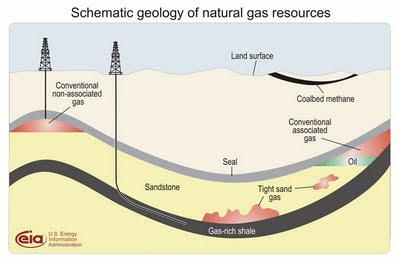
Shale gas offers an alternative source for energy-starved Pakistan. Rough estimates indicate the presence of at least 33 trillion cubic feet of unconventional gas reserves trapped in tight sands, according to an ENI Pakistan report. Another report by Shahab Alam, technical director of Pakistan Petroleum Concessions, puts the estimate at 40 trillion cubic feet of tight gas reserves in the country. These unconventional gas reserves are in addition to the remaining conventional proven gas reserves of over 30 trillion cubic feet.
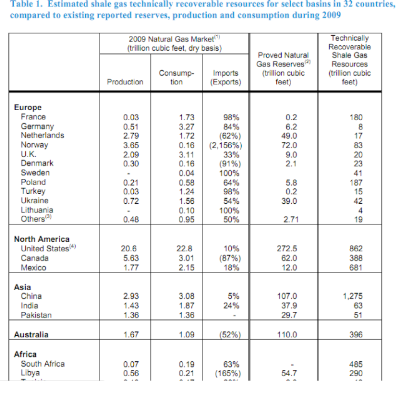
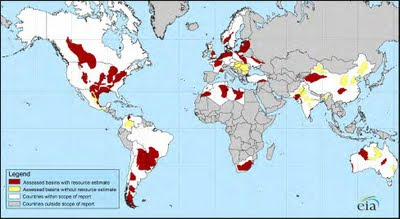
With the pioneering work done in the United States on deep drilling and hydraulic fracturing (fracking) to extract hydrocarbons from shale rock, it is now estimated that the US alone has over 1000 trillion cubic feet of recoverable unconventional gas, according to the Wall Street Journal. Unlike the bulk of world's conventional natural gas reserves that are found in Russia, Iran, Venezuela and Qatar, the shale gas reserves have been discovered in rock formations spread across many parts of the world, including Australia (396 TCF), China (1275 TCF), North America (1931 TCF), South America (1225 TCF), Europe (639 TCF), South Africa (485 TCF), India (63 TCF) and Pakistan (51 TCF). Many energy analysts argue that tapping these new hydrocarbon resources could be a game-changer in terms of global economics and geo-politics.
Increased production of gas from shale in the US has created a glut, pushing down gas prices from $13/BTU (million British thermal units) four years ago to just $4.23/BTU today, even as the price of oil has more than doubled. By contrast, the Iran pipeline gas formula links the gas price to oil prices. It means that Pakistan will have to pay $12.30/BTU at oil price of $100/barrel, and a whopping $20/BTU for gas if oil returns to its 2008 peak of $150/barrel.
To encourage investment in developing domestic shale gas, Pakistan has approved a new exploration policy with improved incentives as compared with its 2009 policy, a petroleum ministry official said recently. Pakistan Petroleum is now inviting fresh bids to auction licenses to explore and develop several blocks in Dera Ismail Khan (KPK), Badin (Sind), Naushero Firoz (Sind) and Jungshahi (Sind), according to Oil Voice.
Under the new policy, exploration companies will be offered 40-50% higher prices for the extracted gas compared with the $4.26/Btu price announced in Exploration and Production Policy 2009. Companies which succeed in recovering gas from tight fields within two years will get 50% hike over the 2009 price and if it takes more time they will get only a 40% hike on the 2009 price. As an added incentive, the leases for the fields will now be for 40 years instead of 30 in the 2009 policy, the official said.
Even with the higher prices for the tight gas offered to the exploration companies, it is estimated that Pakistan will have to pay a maximum of $6.50/Btu for the gas compared with $12.30/Btu for gas imports, according to a report by Platts.
Although it does burn much cleaner than coal and oil, the process of extraction of shale gas in Pakistan, or anywhere else, is not without risks, particularly risks to the environment. In the United States, there have been many reports of ground water contamination from chemicals used to fracture rocks, as well as high levels of methane in water wells. In the absence of tight regulations and close monitoring, such pollution of ground water could spell disaster for humans and agriculture.
Given Pakistan's heavy dependence on natural gas for energy and as feedstock for industries such as fertilizer, fiber and plastics, it's important to pursue shale gas fields development under reasonably tight environmental regulations to minimize risks to the ground water resources.
Related Links:
Haq's Musings
Abundant and Cheap Coal Electricity
US Dept of Energy Report on Shale Gas
Pakistan's Twin Energy Crises
Pakistan's Electricity Crisis
Pakistan's Gas Pipeline and Distribution Network
Pakistan's Energy Statistics
US Department of Energy Data
Electrification Rates By Country
CO2 Emissions, Birth, Death Rates By Country
China Signs Power Plant Deals in Pakistan
Pakistan Pursues Hydroelectric Projects
Pakistan Energy Industry Overview
Water Scarcity in Pakistan
Energy from Thorium
Comparing US and Pakistani Tax Evasion
Zardari Corruption Probe
Pakistan's Oil and Gas Report 2010
Circular Electricity Debt Problem
International CNG Vehicles Association
Rare Earths at Reko Diq?
Lessons From IPP Experience in Pakistan
Correlation Between Human Development and Energy Consumption
BMI Energy Forecast Pakistan

Pakistan is particularly heavily dependent on natural gas for its energy needs. Demand for natural gas in Pakistan has increased by almost 10 percent annually from 2000-01 to 2007-08, reaching around 3,200m cubic feet per day (MMCFD) last year, against the total production of 3,774 MMCFD, according to Pakistani official sources. But, during 2008-2009, the demand for natural gas exceeded the available supply, with production of 4,528 MMCFD gas against demand for 4,731 MMCFD, indicating a shortfall of 203 MMCFD.
The gas supply-demand imbalance is expected to grow every year to cripple the economy by 2025, when shortage will be 11,092 MMCFD (Million standard cubic feet per day) against total 13,259 MMCFD production. The Hagler Bailly report added that Pakistan's gas shortage would get much worse in the next two decades if it did not bring on any alternative sources.

Shale gas offers an alternative source for energy-starved Pakistan. Rough estimates indicate the presence of at least 33 trillion cubic feet of unconventional gas reserves trapped in tight sands, according to an ENI Pakistan report. Another report by Shahab Alam, technical director of Pakistan Petroleum Concessions, puts the estimate at 40 trillion cubic feet of tight gas reserves in the country. These unconventional gas reserves are in addition to the remaining conventional proven gas reserves of over 30 trillion cubic feet.

With the pioneering work done in the United States on deep drilling and hydraulic fracturing (fracking) to extract hydrocarbons from shale rock, it is now estimated that the US alone has over 1000 trillion cubic feet of recoverable unconventional gas, according to the Wall Street Journal. Unlike the bulk of world's conventional natural gas reserves that are found in Russia, Iran, Venezuela and Qatar, the shale gas reserves have been discovered in rock formations spread across many parts of the world, including Australia (396 TCF), China (1275 TCF), North America (1931 TCF), South America (1225 TCF), Europe (639 TCF), South Africa (485 TCF), India (63 TCF) and Pakistan (51 TCF). Many energy analysts argue that tapping these new hydrocarbon resources could be a game-changer in terms of global economics and geo-politics.

Increased production of gas from shale in the US has created a glut, pushing down gas prices from $13/BTU (million British thermal units) four years ago to just $4.23/BTU today, even as the price of oil has more than doubled. By contrast, the Iran pipeline gas formula links the gas price to oil prices. It means that Pakistan will have to pay $12.30/BTU at oil price of $100/barrel, and a whopping $20/BTU for gas if oil returns to its 2008 peak of $150/barrel.
To encourage investment in developing domestic shale gas, Pakistan has approved a new exploration policy with improved incentives as compared with its 2009 policy, a petroleum ministry official said recently. Pakistan Petroleum is now inviting fresh bids to auction licenses to explore and develop several blocks in Dera Ismail Khan (KPK), Badin (Sind), Naushero Firoz (Sind) and Jungshahi (Sind), according to Oil Voice.
Under the new policy, exploration companies will be offered 40-50% higher prices for the extracted gas compared with the $4.26/Btu price announced in Exploration and Production Policy 2009. Companies which succeed in recovering gas from tight fields within two years will get 50% hike over the 2009 price and if it takes more time they will get only a 40% hike on the 2009 price. As an added incentive, the leases for the fields will now be for 40 years instead of 30 in the 2009 policy, the official said.
Even with the higher prices for the tight gas offered to the exploration companies, it is estimated that Pakistan will have to pay a maximum of $6.50/Btu for the gas compared with $12.30/Btu for gas imports, according to a report by Platts.
Although it does burn much cleaner than coal and oil, the process of extraction of shale gas in Pakistan, or anywhere else, is not without risks, particularly risks to the environment. In the United States, there have been many reports of ground water contamination from chemicals used to fracture rocks, as well as high levels of methane in water wells. In the absence of tight regulations and close monitoring, such pollution of ground water could spell disaster for humans and agriculture.
Given Pakistan's heavy dependence on natural gas for energy and as feedstock for industries such as fertilizer, fiber and plastics, it's important to pursue shale gas fields development under reasonably tight environmental regulations to minimize risks to the ground water resources.
Related Links:
Haq's Musings
Abundant and Cheap Coal Electricity
US Dept of Energy Report on Shale Gas
Pakistan's Twin Energy Crises
Pakistan's Electricity Crisis
Pakistan's Gas Pipeline and Distribution Network
Pakistan's Energy Statistics
US Department of Energy Data
Electrification Rates By Country
CO2 Emissions, Birth, Death Rates By Country
China Signs Power Plant Deals in Pakistan
Pakistan Pursues Hydroelectric Projects
Pakistan Energy Industry Overview
Water Scarcity in Pakistan
Energy from Thorium
Comparing US and Pakistani Tax Evasion
Zardari Corruption Probe
Pakistan's Oil and Gas Report 2010
Circular Electricity Debt Problem
International CNG Vehicles Association
Rare Earths at Reko Diq?
Lessons From IPP Experience in Pakistan
Correlation Between Human Development and Energy Consumption
BMI Energy Forecast Pakistan


Comments
More LNG supplies are being diverted to the Asia-Pacific region instead, Qatari Energy Minister Mohammed Saleh Al Sada said in Doha today.
The minister said 60 percent of Qatari LNG “moved to the east” in 2009.
ISLAMABAD: Pakistan has sought German assistance in developing its oil shale potential and transfers of clean coal technologies for utilising Thar lignite coal.
Federal Minister for Petroleum and Natural Resources Amanullah Khan Jadoon has expressed this desire during his visit to headquarters of the German Institute of Geosciences and Natural Resource (BGR) in Hannover. He has led a three member Pakistani delegation to Germany to explore avenues of Pak-German cooperation in the energy sector, says a message received here on Friday.
The two sides reviewed the past cooperation between BGR with Pakistani institutions including HDIP, GSP and WAPDA. BGR also informed Mr Jadoon about their work in earthquake-affected areas of Pakistan for damage prevention and mitigation purposes.
The minister highly appreciated the contribution of BGR in economic and social development of Pakistan and urged them to continue their good work in the energy sector of Pakistan. He said that Pakistan economy’s growing at a rate of 7 percent per year requires increasing quantities of energy for its socio- economic needs.
In the wake of increasing international oil prices, Pakistan is seriously looking at developing alternatives to hydrocarbon, like oil and gas. A significant potential of oil shale deposits was identified in Pakistan in Dera Ghazi Khan and adjoining areas by HDIP and BGR in 1990s. Mr Jadoon invited BGR to work with HDIP to asses feasibility and potential of economic utilisation of oil shale resources of Pakistan.
The minister also showed keen interest in BGR’s technology for upgradation of brown lignite coal into smokeless briquettes, which can be used as clean and cheap household fuels in rural and urban areas of Paksitan. He invited BGR to develop technical cooperation with Pakistani institutions for production of such briquettes. He expressed the hope that this technology would be very useful not only for Pakistan but also for the entire South Asia region. The minister took round of BGR laboratories in Hannover dealing with petroleum geochemistry and application of satellite remote sensing methods in oil and gas exploration.
Islamabad – While Pakistan is facing acute energy shortage, urgent steps are needed to explore the vast potential of hydrocarbon in Pakistan. In this connection President Zardari and Prime Minister Gilani have rightly sought Chinese assistance in onshore and offshore drilling for oil and gas as well as for reactivating the depleted and abandoned fields in different parts of the country.
Talking to a delegation of Chinese oil and gas conglomerate, Orient Group, the two leaders assured that Pakistan would facilitate the Chinese investment, Pakistan Observer reported.
The Chinese group has already acquired BP projects in Pakistan and is investing more so as to increase the production of oil products. Certainly Chinese companies are in a position to help Pakistan in oil exploration as they have the necessary technical know how, rich experience in drilling and the financial resources.
Federal Minister for Petroleum and Natural Resources Dr Asim Hussain has also assured the delegation to provide necessary facilities for investment in oil and gas sector. “If arrangements for exploration of natural resources is matured with the Chinese and an enabling environment is provided, it will certainly go a long way in achieving a breakthrough. We think there is lot of potential for some major discovery in offshore but so far half hearted efforts made for the purpose has yielded no results.”
The need is that the Chinese Company be persuaded to enter into a joint venture with OGDCL for drilling in the offshore prospective areas.
Many countries in the region have discovered oil in the offshore areas and there is every possibility to strike a major find in Pakistani territorial waters. If routine bottlenecks are removed and security situation is improved, we think Pakistan can discover at least some major gas fields in Balochistan and in the offshore areas.
The existing gas fields are depleting and as a result the country is facing acute shortage of gas and twice a week loadshedding is being applied at the CNG stations. If new discoveries were not made, the situation would get worse in the coming winter season.
http://english.irib.ir/subcontinent/analysis/commentaries/item/79094-pakistan-seeking-chinese-help-in-oil-drilling
See the latest market Sina Financial News July 15 News, Alliant Energy Chairman and Executive Director Zhang Hongwei, said at a news conference to $ 775 million (approximately HK $ 6.0 billion) acquisition of British Petroleum in Pakistan's oil and gas business, expected to be 7 the end of the transaction. He pointed out that the first half of this year, the project's production of crude oil and natural gas, 129 oil wells, the average monthly net production of 2.29 million barrels of oil equivalent per day, of which 73% of natural gas production in the project's oil and gas producers in Pakistan accounted for 18% share of natural gas share of 6 percent, he added referring the project area is currently mined only 16% of the total area of exploration potential(http://www.f-paper.com/)(Finance News http://www.f-paper.com/).
When asked whether there are tender when the central enterprises to participate, Zhang Hongwei, said bids are at different stages of the central enterprises expressed interest, but the Chinese government do not want to engage in international tenders in internal competition, it is noted that other central enterprises into joint energy first bid program, will no longer enter.
Zhang Hongwei also pointed out that Pakistan is an old oil field project, and only land-based oil fields have been mined, there is exploitation of offshore oil field yet, so there is no risk of oil spills.
He expects oil prices will shock upstream on the existing basis.
http://www.f-paper.com/?i587317-United-Energy-$-6.0-billion-purchase-of-oil-and-gas-projects-in-Pakistan
There is no place where the country's energy shortage isn't profound. Rural areas are without electricity for up to 16 hours a day while towns often go without for as many as 12 hours daily, forcing factories to close and plunging homes into darkness.
Natural gas supplies are rationed, with factories in the country's most populous province, Punjab, going without two days a week.
Pakistan's economic output is cut by at least 4 percent because of the shortages, the government estimates, something that hampers the country's hopes to battle extremism by creating more economic opportunities. The outages also feed political discontent, triggering frequent, if local, street protests.
Solving the energy problems is a top priority for the United States' aid program, with a State Department delegation here this week, led by Ambassador Carlos Pascual, the Obama administration's special envoy on international energy affairs.
But Pakistan's plans for a 1,700-mile natural gas pipeline from Iran, which would provide Pakistan with a cheaper source of fuel for electricity generation, is a stumbling block.
-------------------
Despite Pakistan's huge hydroelectric potential, it hasn't built a big dam project since the 1970s. Since the U.S.-backed government of President Asif Zardari was elected in 2008, a mushrooming chain of "circular" debt has enveloped the power sector.
The government has assumed $3.6 billion of the power industry's debt. The government-owned power grid owes another $2.5 billion to private-sector generators, even as the government, according to Finance Ministry figures, spent at least $7.4 billion on electricity subsidies during the 2008-2010 period.
Washington and international lenders such as the International Monetary Fund have repeatedly urged Pakistan to cut subsidies, which anemic government finances cannot afford.
Critics say that the government hasn't added to the electricity infrastructure in its three-and-a-half year term, while sinking billions of dollars into unproductive subsidies and taking on debt.
Of the $3.6 billion debt the government assumed, half were bills the government itself hadn't paid, said Ejaz Rafiq Qureshi, the spokesman of the Pakistan Electric Power Co., the state-owed national electricity grid. The rest is owed by private consumers.
At the end of August, a group of nine private power plants demanded that the government pay them within 30 days $540 million it owed for power generation.
Roughly half of Pakistan's current electricity output of 13,000 megawatts comes from the private generators. But there is more capacity that the government doesn't use. Government-owned equipment that could generate another 2,000 megawatts has been sidelined because of poor maintenance. Private equipment that could generate another 2,500 megawatts has been taken out of service because the government hasn't paid its bills, said Abdullah Yusuf, who represents the private producers. Combined, that amounts roughly to the entire immediate shortfall.
"If you had this capacity available, straight away your problem would be solved," said Yusuf.
A longer-term energy project is Pakistan's proposed $12 billion Diamer Basha dam, which would add 4,500 megawatts to Pakistan's electricity generating capacity. Washington is considering providing significant funding to the project. Separately, the U.S. Agency for International Development is currently working on projects that will add 900 megawatts to the Pakistani grid next year.
Read more: http://www.miamiherald.com/2011/09/16/2410787_p2/pakistan-search-for-energy-could.html#ixzz1YBKY4KxS
The United States is a country that has received many blessings, and once upon a time you could assume that Americans would come together to take advantage of them. But you can no longer make that assumption. The country is more divided and more clogged by special interests. Now we groan to absorb even the most wondrous gifts.
A few years ago, a business genius named George P. Mitchell helped offer such a gift. As Daniel Yergin writes in “The Quest,” his gripping history of energy innovation, Mitchell fought through waves of skepticism and opposition to extract natural gas from shale. The method he and his team used to release the trapped gas, called fracking, has paid off in the most immense way. In 2000, shale gas represented just 1 percent of American natural gas supplies. Today, it is 30 percent and rising.
John Rowe, the chief executive of the utility Exelon, which derives almost all its power from nuclear plants, says that shale gas is one of the most important energy revolutions of his lifetime. It’s a cliché word, Yergin told me, but the fracking innovation is game-changing. It transforms the energy marketplace.
The U.S. now seems to possess a 100-year supply of natural gas, which is the cleanest of the fossil fuels. This cleaner, cheaper energy source is already replacing dirtier coal-fired plants. It could serve as the ideal bridge, Amy Jaffe of Rice University says, until renewable sources like wind and solar mature.
Already shale gas has produced more than half a million new jobs, not only in traditional areas like Texas but also in economically wounded places like western Pennsylvania and, soon, Ohio. If current trends continue, there are hundreds of thousands of new jobs to come.
Chemical companies rely heavily on natural gas, and the abundance of this new source has induced companies like Dow Chemical to invest in the U.S. rather than abroad. The French company Vallourec is building a $650 million plant in Youngstown, Ohio, to make steel tubes for the wells. States like Pennsylvania, Ohio and New York will reap billions in additional revenue. Consumers also benefit. Today, natural gas prices are less than half of what they were three years ago, lowering electricity prices. Meanwhile, America is less reliant on foreign suppliers.
All of this is tremendously good news, but, of course, nothing is that simple. The U.S. is polarized between “drill, baby, drill” conservatives, who seem suspicious of most regulation, and some environmentalists, who seem to regard fossil fuels as morally corrupt and imagine we can switch to wind and solar overnight.
The shale gas revolution challenges the coal industry, renders new nuclear plants uneconomic and changes the economics for the renewable energy companies, which are now much further from viability. So forces have gathered against shale gas, with predictable results.
The clashes between the industry and the environmentalists are now becoming brutal and totalistic, dehumanizing each side. Not-in-my-backyard activists are organizing to prevent exploration. Environmentalists and their publicists wax apocalyptic.
Like every energy source, fracking has its dangers. The process involves injecting large amounts of water and chemicals deep underground. If done right, this should not contaminate freshwater supplies, but rogue companies have screwed up and there have been instances of contamination.
The wells, which are sometimes beneath residential areas, are serviced by big trucks that damage the roads and alter the atmosphere in neighborhoods. A few sloppy companies could discredit the whole sector...........
http://www.nytimes.com/2011/11/04/opinion/brooks-the-shale-gas-revolution.html?_r=1&scp=2&sq=brooks&st=cse
Nov. 15 (Bloomberg) -- Oil & Gas Development Co., Pakistan’s biggest energy explorer, expects to increase output by as much as 20 percent in the year through June after adding resources in the country’s northwest.
“New oil and gas discoveries will certainly increase our profitability,” Managing Director Basharat Mirza said yesterday in an interview in Islamabad. “I expect a 15 percent to 20 percent addition to our oil and gas production this year.”
OGDC, the largest company on the Karachi Stock Exchange, reported a gas find this week at the Nashpa-2 well in Khyber Pakhtunkhwa province. The discovery may help boost energy supplies in a country where factories are facing three days a week without gas this winter.
The company plans to spend $270 million on drilling some 27 new wells this financial year, Mirza said. It expects to produce 10 million to 12 million cubic feet of gas a day at Nashpa-2 and 5,000 barrels of oil, he said at the company’s headquarters.
An increase in domestic energy supplies may help boost South Asia’s second-biggest economy, which has been hurt by terrorism and dwindling foreign investment. Pakistan is preparing for a gas shortfall of 1.05 billion cubic feet a day by February, Petroleum Minister Asim Hussain said Nov. 13. That may exacerbate the daily power cuts that have forced textile and engineering plants to close and caused riots across the country.
Shares Slip
OGDC dropped 0.6 percent to 155.11 rupees at the close in Karachi yesterday, extending its decline this year to 9.2 percent. The benchmark KSE100 Index is little changed over the period.
As it expands in Khyber Pakhtunkhwa, the company has limited its exploration in the western province of Baluchistan, where attacks on pipelines and other energy infrastructure have disrupted gas supplies, Mirza said. OGDC has taken all “low- hanging fruit” and is left with “difficult areas that include Baluchistan and offshore blocks that require huge investment.”
The company has the protection of the Pakistan army at its Zin block in Baluchistan, where it plans to produce its first gas flows in the “next four weeks” to gather data on the reservoir, Mirza said. The block holds an estimated 10 trillion cubic feet of gas reserves, former Chief Executive Officer Shah Mehboob Alam said last year.
OGDC also expects a further 100 million cubic feet a day from a well in Tando Allah Yar in Sind province by December after completing a pipeline, according to Mirza. Further infrastructure at the field would allow an increase in output capacity to 400 million cubic feet a day, he said.
Payment Defaults
The company is pressing ahead with its investment plan even as domestic oil refineries and gas distributors fail to pay for supplies.
The company is owed about 93 billion rupees ($1.07 billion) in back payments, Mirza said, adding that “so far this default by our customers has not impacted our ability to finance our exploration. We might issue bonds or borrow from banks if this situation persists, let’s say for another year.”
Power utilities, whose earnings are sapped by unpaid customer bills and price controls, have delayed payments to fuel suppliers, which in turn owe money to the oil refiners. The total dues, known as circular debt in Pakistan, amount to more than 300 billion rupees, according to government estimates.
OGDC reported net income of 63.5 billion rupees in the year ended June 30, up 7 percent from the previous year, according to data compiled by Bloomberg.
http://www.businessweek.com/news/2011-11-14/ogdc-of-pakistan-to-raise-output-up-to-20-after-nashpa-gas-find.html
KARACHI: The Oil and Gas Development Corporation Limited (OGDCL) operator of Nashpa Exploration License, together with its joint venture partners Pakistan Petroleum Limited (PPL) and Government Holding Private Limited (GHPL) have discovered a new hydrocarbon-bearing horizon from its appraisal well Nashpa 02, located in District Karak, Khyber Pakhtoonkhwa. The structure of well was delineated, drilled and tested utilising indigenous expertise.
Nashpa Well No 02 was drilled down to the depth of 4340 metres targeting to test the oil and gas potential of Datta, Shinawari, Samanasuk, Lumshiwal, Hangu and Lockhart formations.
Significant reserves of hydrocarbons have been found at Nashpa Well No II. The first targeted zone “Datta Sandstone” has been tested and produced 3370 barrels per day of crude oil and 11 MMCFD gas through 32/64” choke at well head flowing pressure 3800 psi.
This discovery will add to the hydrocarbon reserves base of the company and joint venture partners, bringing significant savings to the country in term of oil import bill. Testing of another four potential reservoir formations will also be undertaken wherein similar encouraging results are expected. The full flow potential of this well and the extent of the discovery will be determined after completing the testing programme.
http://www.dailytimes.com.pk/default.asp?page=2011\11\15\story_15-11-2011_pg5_5
The session, a first of its kind in the country, drew high-level participation from government representatives, management and technical staff of leading local and international Exploration and Production (E&P) companies, including overseas delegates.
Welcoming the participants, Managing Director and Chief Executive Officer PPL Asim Murtaza Khan highlighted the significance of the session not only in bringing shale gas exploration on the country's E&P map but also encouraging participation by leading international E&P players in the dialogue around the policy and fiscal framework necessary for a breakthrough in this direction.
------------
He hoped that the session would provide a platform for collective thinking and knowledge sharing around the issue and fuel further strategic interest and engagement by the international E&P community in exploiting shale gas resources in the country to meet future energy needs in the face of depleting conventional reservoirs.
Secretary Petroleum Muhammad Ejaz Chaudhry also spoke on the occasion, reiterating the government's resolve to open new E&P opportunities in line with the global shift towards exploration of unconventional gas reservoirs and ensure an enabling business environment to attract international expertise and investment.
"The government looks forward to the recommendation emerging from the session today which will be incorporated into the country's E&P policy."
Chaudhry expressed his gratitude to the Government of Poland for its proactive role in strengthening bilateral ties with Pakistan, particularly with respect to the E&P sector, evident by the presence of Polish Ambassador Andrzeg Ananicz at the seminar.
He also acknowledged the efforts of the Pakistan Embassy in Warsaw in this regard.
Similarly, Chaudhry lauded PPL's efforts in serving as the conduit for drawing local and international attention to prospects for shale gas exploration in the country and organising the session to forge a way forward for government and industry.
"It is initiatives such as these through which local E&P companies can serve as the eyes and ears of the ministry, helping us move forward with our ambitious agenda."
Local and foreign delegates presented several papers during a dedicated segment of the session chaired by Peter Seitinger, General Manager, OMV (Pakistan) Exploration Gmbh.
These included Methodology and Technology for Prospecting Unconventional Plays, especially Shale Gas, in Pakistan by PPL's General Manager Exploration Moin Raza Khan and Senior Manager Dr Nadeem Ahmad, Lessons Learned: Shale Gas Exploitation in Poland by Marcin Józwaik of PGNiG Technologie Sp.zo.o, Shale Gas Exploitation in North America and its Replication in Pakistan by Robert Kuchinski, Wireline Business Development Manager, Weatherford, Middle East and North Africa.
A roundtable was also held on the Technical, Commercial and Fiscal Strategies to Promote Shale Gas Exploitation in Pakistan with Paolo Giraudi, Managing Director, Eni Pakistan Limited in the chair.
------------
"Going by the valuable ideas exchanged and the enthusiastic response of key players, including government and international E&P companies, I am led to conclude that this session has indeed been successful in spotlighting prospects for shale gas exploration and reiterating foreign interest in Pakistan's E&P sector."
-----------
Preliminary estimates suggest 65 Tcf of shale gas resources within the country's accessible basins and regions.-PR
http://www.brecorder.com/market-data/stocks-a-bonds/single/636/0/1253370/
Pakistan has a multifaceted strategy to address growing energy shortages, including quick action on a pipeline from Iran, a government agency said.
Pakistani natural gas supplies fell 33 percent compared with last year. Rolling blackouts are common and the government has worked with consumers to limit consumption. Islamabad last week said it would ration natural gas to cope with the deficit.
The Pakistani Ministry of Petroleum and Natural Resources said it had a series of measures it could take to address the shortages.
"The government is implementing a multi-pronged strategy, which includes several measures such as timely completion of the Pakistan-Iran gas pipeline project to meet the growing energy deficit and, in particular, shortages in gas supplies, which constitute nearly 50 percent of the energy mix of the country," the ministry was quoted by Pakistan's News International as saying.
An economic steering committee, meanwhile, said Pakistan remained committed to a rival pipeline, the Turkmenistan-Afghanistan-Pakistan-India project.
Pakistan gets about 30 percent of its energy needs from imports, mostly from oil. The volatile commodity market is putting additional strain on the country's energy sector, officials said.
Petroleum Minister Asim Hussain said conservation of natural resources is essential for energy security.
Read more: http://www.upi.com/Business_News/Energy-Resources/2011/12/28/Pakistan-goes-all-in-for-energy-security/UPI-25701325075547/#ixzz1hqv5mvZl
Sindh produces 69% and consumes 41%
Balochistan produces 17% consumes 7%
KPK produces 10% consumes 7%
Punjab produces 4% consumes 45%
When landlord Muneer Ahmed ordered the digging of a well in Bahawalpur, the last thing he expected to strike was black gold.
Following the discovery of oil near the Lal Sohanra National Park, the area was taken into custody by the ministry of petroleum and natural resources. The ministry also deputed security officials around the well and its surrounding areas.
A joint team of Pakistani and Chinese engineers has been formed to work in the area, said an official from the petroleum ministry. A large oil reservoir has been discovered but we are trying to locate its depth, the official said.
He added that engineers are also studying other areas in district Bahawalpur to check the availability of oil in the region.
The property where oil was found had been part of agricultural land donated to farmers, said Hassan Daha, former mayor from the area.
The land, however, is under the jurisdiction of Lal Sohanra National Park, he added.
Ahmed, who made the inadvertent discovery, said he was not aware of it earlier but has now been informed by officials that the area where the discovery was made did not fall in his property. The China National Petroleum Corporation has been tasked to work, in coordination with local engineers, in the area.
Meanwhile, the site has been cordoned off with barbed wire on the orders of local police chief Ishaq Jehangir.
http://tribune.com.pk/story/339971/striking-black-gold-man-digs-for-water-finds-oil-in-bahawalpur/
Khattan oil would be more valuable to the railway now than it was formerly. As fuel it was worth not more than 1½ times in weight to Khost coal and so could not possibly compete, but it was mainly as a possible substitute for pitch, the agglomerate used in fuel briquette manufacture, that it is to be now considered. Borings were also commenced in 1891 at Pir Koh near Spintangi, but were abandoned after they had reached a depth of 560 feet as no signs of petroleum were discovered. Gypsum occurs in considerable quantities near Khattan and Tung near Spintangi.
Another detailed, modern, scientific seismic survey was conducted in the mid-1990s, which proved the presence of tremendous gas and oil deposits across Balochistan, including the Marri Bugti areas, near the Quetta Zargoon belt. There are proven big gas fields, very good quality and at a large scale, explored near Barkhan at Jandran in the 1970s, and only require to be linked to the Dera Ghazi Khan pipeline. Oil also has been found at Kingari District Loralai and it needs to be pumped out. In Dera Bugti near Sui three more gas fields with very big deposits; all three estimated to hold about ten trillion cubic meters, have been explored very recently. According to reports, all proven explored gas is estimated to be about 20 trillion cubic meters, whereas Pakistan requires 700 million cubic feet and is clamouring to get it from Tajikistan, Turkmenistan, Iran or Qatar.
It is also reported that the cost of imported gas either from Central Asia, Iran or Qatar would be double of local available gas in Balochistan. The important point worthy of attention in any case is that if a pipeline is built to import gas from Central Asia, Iran or Qatar, it has to cross Balochistan. Now the question is, why is the local Balochistan oil and gas not extracted to meet Pakistan’s life and death energy crisis?
------------
The reports observe that this security assessment about shifting trends in the insurgency comes with the warning that the “unthinkable situation” may worsen, which could further aggravate if the political leadership does not wake up to the situation. One high security official in the briefing realises, “Balochistan is no longer a local issue. It has acquired the international limelight.” Now the main question is, whose is the policy failure in Balochistan, politicians or the use of force? If at all the political leadership wakes up to the situation today, what options are left to them? Recently, moderate pro-federation, former chief minister Sardar Ataullah Mengal said that the Baloch are pushed to a position of no return. In this background, the basic question under discussion is how to cope with the energy crisis. In any case, exploration of local Balochistan resources or the pipeline have to be laid across thousand of miles of the Baloch land.
http://www.dailytimes.com.pk/default.asp?page=2012\03\19\story_19-3-2012_pg3_4
According to Pakistan Petroleum Information Services (PPIS), Pakistan’s gas production has increased to 4,339mmcfd by March from 4,011mmcfd in June 2011. Similarly, oil production has jumped to 72,411bpd in March from 65,659bpd in June 2011.
The Oil and Gas Development Company Limited (OGDCL) is leading the industry volume growth as a renewed focus of management on early development of fields and success on appraisal drillings, which led to a strong 12-13 percent volumetric growth.
A key positive surprise in the fiscal year stems from production recovery on Pakistan Petroleum Limited (PPL) operated Sui field as production jumped by five percent in the second quarter, defying previous trend of four to five percent decline in production
and prospect of 100mmcfd of gas volume addition on Kadanwari in which OGDCL stake is 50 percent, with initial 30-40mmcfd already hooked up.
Fawad Khan, an analyst at KASB Securities, said that the regulatory issues post-introduction of 18th Amendment, poor law and order situation in selected areas and backlog of incomplete wells have restricted the drilling activity.
All exploration activities are concentrated in the onshore area, he said, adding that year to date, the E&P sector has drilled 14 exploration and 24 development wells against the fiscal year targets of 31 exploration and 45 development wells.
Unlike previous years, foreign E&P companies have contributed heavily to the exploration activities with the United Energy, which acquired BP Pakistan assets last year, drilling six exploration wells in the year so far.
A successful drilling in high-profile well at Zin, though results are below expectation, finds in Hilani near Tal Block by Mari Gas and successful development drillings in Sui are noteworthy events.
However, appraisal activity has slowed down. Results of Nashpa III and Makori East II, which were earlier targeted in the third quarter, have now slipped into fourth quarter due to reconfiguration of the target depth.
Similarly, the start of appraisal drilling in Maramzai and Mamikhel, both in Tal Block, earlier scheduled for the third quarter is now likely in the fourth quarter.
http://www.newspakistan.pk/2012/03/31/Pakistan-gas-production-increasing-Oil-and-gas-news-update/
Who would have thought that an obscure bean could eat into the profits of some of North America‘s largest oil services companies?
The humble guar bean, grown primarily in India and Pakistan, has shot to instant fame in oil markets as it is a crucial ingredient in fracking fluid mixtures used to blast natural gas and oil out of shale rock.
“Shortages of guar beans, an essential component in the shale gas ‘fracking’ process, have resulted in huge price hikes for the commodity in 2012,” said risk consultancy Maplecroft in a 70-page report. “This has hit the profits of oil and gas companies hard and a search is under way to find supply chain alternatives, such as direct farm contracts and man-made substances.”
In India, the National Commodity and Derivatives Exchange (NCDEX) banned trading of guar future on March 21 after prices rallied nine-fold to a record US$1,680 per 100 kilograms, according to Bloomberg data. But for now shale gas producers remain highly dependent on guar gum from India and Pakistan, which exposes them to significant supply chain risks.
In June, Halliburton Co., the world’s largest provider of fracking service warned that it expects to see lower second-quarter margins due to rising guar costs.
“Everybody’s struggling for guar,” Halliburton Chief Financial Officer Mark McCollum told an investor conference. “We’re aware that there are some of our primary competitors missing jobs because of the unavailability of guar.”
Calgary-based Trican Wells Services also reported on July 4 that its bottomline would be directly hit by the elusive and expensive bean.
“Average guar costs increased sequentially in the second quarter and we were largely unable to pass these costs on to our customers due to the competitive pricing environment,” the company said, explaining its larger-than-expected estimated loss of $24-million to $34-million.
But the inventive oil service companies are already looking for guar substitutes. Trican, for example, is looking to introduce a new hybrid fluid system that will reduce its guar usage.
“We have started to see a reduction in guar prices and we expect guar prices to continue to decrease throughout the remainder of 2012 as a result of the development of hybrid systems and guar substitutes, and the new guar crop that is expected to increase supply later in 2012.”
There may be other good reasons for services companies to move away from the bean.
India and Pakistan dominate global production and processing of guar, with India accounting for an estimated 80% of production and Pakistan a further 15%, but sourcing guar from both countries is beset with a range of risks, notes Maplecroft. Labour violations, corruption, a lack of regulation and environmental risks as factors within these countries that can not only impact the price of guar, but also expose oil and gas companies to legal and reputational risks, as they try to secure stable supplies, said the risk consultancy....
http://www.edmontonjournal.com/business/Humble+guar+beans+stump+mighty+companies/6924183/story.html
Italy’s largest oil company, reported a natural gasdiscovery in Pakistan, a country where reserves have been in decline.
The find was made 350 kilometers (269 miles) north of Karachi in the Khirtar Fold Belt region. The well was drilled in the Badhra Area B block to a depth of 2,450 meters, Eni said in a statement today.
Eni said the size of the discovery was probably 300 billion to 400 billion cubic feet of gas in place. Pakistan’s total gas reserves were 27.5 trillion cubic feet at the end of 2011, down 5.5 percent from a year earlier, according to BP Plc (BP/)’s Statistical Review of World Energy.
The discovery is 20 kilometers east of Eni’s Bhit gas processing facility and the company said it has already started discussions with the Pakistani regulator to speed up the production from the discovery. The company produced approximately 54,800 barrels of oil equivalent per day in 2011 in Pakistan, making the Rome-based explorer the country’s largest producer.
“The drilling of Badhra North B-1 is part of Eni’s new strategy in Pakistan which aims to refocus exploration activities in the neighboring areas to productive fields,” the company said.
The Badhra block is operated by Eni, with a 40 percent stake in the project, Premier Oil Plc (PMO), which has 6 percent, Kufpec Pakistan Ltd. with 34 percent and Oil & Gas Development (OGDC) Company Ltd., which has 20 percent.
Premier Oil’s shares rose as much as 3.2 percent, to 391.4 pence. They were trading at 383.5 pence as of 9:56 a.m. London time. Eni SpA’s shares were up 0.7 percent at 18.42 euros after reaching a high of 18.56 euros.
http://www.businessweek.com/news/2012-09-19/eni-discovers-natural-gas-in-pakistan-at-field-north-of-karachi
PESHAWAR:
The Federally Administered Tribal Areas (Fata) and Frontier Regions (FR) have enormous reserves of minerals, oil and natural gas that can augment economic activity in the war-torn areas, a research project concluded.
Talking to The Express Tribune ‘Source Rock Mapping and Investigation of Hydrocarbon Potential (SRMIHP)’ Project Coordinator Dr Fazal Rabi Khan said that exploration and excavation of oil and gas will introduce a new era of development and prosperity in the tribal areas.
“There can be many job opportunities created for people in the tribal belt if mineral exploration and extraction is pursued properly,” said Khan, who is also the chairman of the Geology Department in Abdul Wali Khan University Mardan (Palosa Campus).
The project was launched in 2008 under an agreement between the Fata Development Authority and National Centre of Excellence in Geology University of Peshawar. The project, which was completed at an estimated cost Rs40 million, was completed in June 2012.
Khan said that their objectives include identifying hydrocarbon generating rocks and its distribution in the region, preparing a geo-database regarding hydrocarbon potential and generating a systematic data to attract oil and gas companies for exploration.
The project has successfully collected, processed and digitised the data as a result of which, 80% of the project area has been mapped digitally. “This mapping has led to the discovery of seven new oil and gas seepages.”
He added that 11 oil and gas exploration companies have reserved 16 blocks in Fata, which go across from FR Peshawar and Kohat to Khyber, Orakzai, Bannu, Tank and up to North and South Waziristan.
He said that recently 17 oil and gas exploration companies initiated their operations in Khyber, Orakzai, North and South Waziristan agencies as well as in FR Peshawar, Kohat, Bannu, Tank and DI Khan.
Khan said that Mari Gas Company, HYCARBEX Inc, Oil and Gas Development Company, Tullow, Saif Energy, MOL Pakistan Oil and Gas, Orient Petroleum International, Pakistan Petroleum, ZHEN, ZAVER and others are currently working in Fata.
Oil and Gas Development Company (OGDC) will start drilling in these areas for the exploration of oil and gas reservoirs. The chairman said that the foreign oil company, Tullow, has obtained a licence for the exploration of oil and gas in North Waziristan Agency and Bannu, while MOL has shown interest in Khyber Agency, Kohat and Peshawar.
“Although law and order problems can become a hindrance, the project can be managed considering its importance,” he added.
Khan elaborated that the process in Fata would not only help overcome the energy crisis but will also give a big boost to efforts for the socio-economic development of the region. Khyber-Pakhtunkhwa is teeming with minerals and Fata is a new oil estate, he said. “In the next five years, this province will produce more oil than Dubai and as far as shortage of gas is concerned, the hills of FR Tank are full of it.”
He said Governor Masood Kausar has also taken keen interest in the project. “The best news for the tribal areas is that there are large reserves of natural resources and foreign and local companies interested in its extraction can exploit the resources,” said Kausar.
http://tribune.com.pk/story/484440/new-hope-springs-fata-fr-regions-abundant-in-oil-gas-says-report/
Advisor to Prime Minister on Petroleumand Natural Resources Dr. Asim said that Pakistan offers great potential in the oil and gas sector and the government is doing its part by introducing new policies to meet the rising energy demand .
He was presiding over a seminar organized by the Petroleum Institute of Pakistan (PIP), a representative body of the oil and gas industry, on the topic "Shale Gas Potential in Pakistan" on Saturday.
The purpose of holding this seminar was to create awareness aboutpotential and challenges of shale gas in Pakistan and establish PIP'sprofessional standing in view of assisting the government on dealing with the energy crises in the country.
The forum consisted of 150 distinguished guests from the oil and gas fraternity including government officials, media personnel and students from Karachi's top universities/colleges.
Dr. Asim Hussain said he has been advocating the need to balancecountry's energy mix, which currently is heavily dependent on natural gas.
He stated that the US Energy Information Administration have estimated 51 TCF Shale Gas Reserves in Pakistan, while as estimated reserves for Low BTU Gas are 2 TCF and that of tight gas are 40 TCF.
He added that Shale Gas exploration is high technical and costly, therefore, in order to encourage its exploration, pilot projects are planned.
The Ministry of Petroleum and Natural Resources will facilitate E&P Companies wishing to explore shale gas, by granting special concessions through transparent process and based on merit.
Chairman PIP Asim Murtaza Khan stressed on PIP's role as an effective energy sector advisory body, supporting government and industry in Pakistan todevelop a progressive and sustainable roadmap to meet present and futurechallenges.
He said that PIP is planning to hold series of seminars in nearfuture. The big ticket items that will be discussed and which need theimmediate attention will be the "LPG Outlook in Pakistan", "Fast-trackingimports of LNG", "Refining Vision 2020", "Energy conservation" and"Restructuring of the Pakistan's gas sector".
http://www.brecorder.com/pakistan/business-a-economy/107602-pakistan-offers-great-potential-in-oil-gas-sectors-dr-asim-.html
The US EIA report estimates Pakistan's total shale oil reserves at 227 billion barrels of which 9.1 billion barrels are technically recoverable with today's technology. In addition, the latest report says Pakistan has 586 trillion cubic feet of shale gas of which 105 trillion cubic feet (up from 51 trillion cubic feet reported in 2011) is technically recoverable with current technology.
The top ten countries by shale oil reserves include Russia (75 billion barrels), United States (58 billion barrels), China (32 billion barrels), Argentina (27 billion barrels), Libya (26 billion barrels), Venezuela (13 billion barrels), Mexico (13 billion barrels), Pakistan (9.1 billion barrels), Canada (8.8 billion barrels) and Indonesia (7.9 billion barrels).
Pakistan's current annual consumption of oil is only 150 million barrels. Even if it more than triples in the next few years, the 9.1 billion barrels currently technically recoverable would be enough for over 18 years. Similarly, even if Pakistan current gas demand of 1.6 trillion cubic feet triples in the next few years, it can be met with 105 trillion cubic feet of technically recoverable shale gas for more than 20 years. And with newer technologies on the horizon, the level of technically recoverable shale oil and gas resources could increase substantially in the future.
The Federally Administered Tribal Areas (Fata) and Frontier Regions (FR) have enormous reserves of minerals, oil and natural gas that can augment economic activity in the war-torn areas, a research project concluded.
Talking to The Express Tribune ‘Source Rock Mapping and Investigation of Hydrocarbon Potential (SRMIHP)’ Project Coordinator Dr Fazal Rabi Khan said that exploration and excavation of oil and gas will introduce a new era of development and prosperity in the tribal areas.
“There can be many job opportunities created for people in the tribal belt if mineral exploration and extraction is pursued properly,” said Khan, who is also the chairman of the Geology Department in Abdul Wali Khan University Mardan (Palosa Campus).
The project was launched in 2008 under an agreement between the Fata Development Authority and National Centre of Excellence in Geology University of Peshawar. The project, which was completed at an estimated cost Rs40 million, was completed in June 2012.
Khan said that their objectives include identifying hydrocarbon generating rocks and its distribution in the region, preparing a geo-database regarding hydrocarbon potential and generating a systematic data to attract oil and gas companies for exploration.
The project has successfully collected, processed and digitised the data as a result of which, 80% of the project area has been mapped digitally. “This mapping has led to the discovery of seven new oil and gas seepages.”
He added that 11 oil and gas exploration companies have reserved 16 blocks in Fata, which go across from FR Peshawar and Kohat to Khyber, Orakzai, Bannu, Tank and up to North and South Waziristan.
He said that recently 17 oil and gas exploration companies initiated their operations in Khyber, Orakzai, North and South Waziristan agencies as well as in FR Peshawar, Kohat, Bannu, Tank and DI Khan.
Khan said that Mari Gas Company, HYCARBEX Inc, Oil and Gas Development Company, Tullow, Saif Energy, MOL Pakistan Oil and Gas, Orient Petroleum International, Pakistan Petroleum, ZHEN, ZAVER and others are currently working in Fata.
Oil and Gas Development Company (OGDC) will start drilling in these areas for the exploration of oil and gas reservoirs. The chairman said that the foreign oil company, Tullow, has obtained a licence for the exploration of oil and gas in North Waziristan Agency and Bannu, while MOL has shown interest in Khyber Agency, Kohat and Peshawar.
“Although law and order problems can become a hindrance, the project can be managed considering its importance,” he added.....
http://tribune.com.pk/story/484440/new-hope-springs-fata-fr-regions-abundant-in-oil-gas-says-report/
KARACHI: Pakistan has an estimated tight gas reserves of 33 trillion cubic feet (tcf) which are more than the existing estimated natural gas reserves of 27 tcf in the country, said the Deputy Managing Director (operations) of Sui Southern Gas Company (SSGC) Syed Hassan Nawab.
Hassan Nawab was delivering a presentation on “Natural Gas Industry in Pakistan: Progress and Prospects” at 7th International POGEE Conference 2011 for Oil and Gas and Energy Industry at Karachi Expo Centre on Wednesday. Joint Secretary Ministry of Petroleum and Natural Resources Raashid Bashir Maser was the chairman of the session. Referring to a report of Pakistan Petroleum Exploration and Production Companies Association (PPEPCA), Hassan Nawab said the country will have sufficient natural gas if tight gas is explored with the help of advanced technology. He pointed out that the government has prepared the draft policy for tight gas and it is currently with the Council of Common Interest (CCI) and this will be approved soon.
Quoting some of the incentives in the draft tight gas policy, he said that investors will be offered 40 percent premium on the current gas price for exploring tight gas. Similarly, 50 percent premium will be offered on current gas price to investors if they commission their project by December 2011.
Hassan Nawab said that Pakistan can also produce gas from Thar coal with the help of underground coal gasification (UCG) technology. There is a potential to produce 35 tcf of coalbed methane from Thar coal, he noted.
He said that the availability of natural gas can be enhanced through import of liquefied natural gas (LNG) from neighbouring countries like Qatar and Iran—through 3rd party arrangments. He said the country has a very large network of pipelines and the importer of LNG can pump this gas to their buyers in upcountry destinations.
http://www.dailytimes.com.pk/default.asp?page=2011%5C05%5C19%5Cstory_19-5-2011_pg5_2
SULIGE, China (Reuters) - At the heart of the vast desert region of Inner Mongolia, half a dozen young engineers from PetroChina <0857.HK> watch huge, flat screens in a brightly lit central control office that oversees 5,000 wells at China's largest gas field.
Just a few years ago, two workers travelling in a truck would need three days to check conditions at 50 wells at the Sulige field, which spans 20,000 sq km (7,700 sq miles) in the middle of Maowusu, China's third-largest desert: now, the task can be done in just five minutes.
Remote Sulige, which means "uncooked meat" in Mongolian, is testament to China's success in developing its giant reserves of so-called "tight gas", part of a drive to dramatically boost consumption of cleaner burning natural gas to help replace dirty coal and costly oil imports.
Like the better-known shale gas revolution in the United States, tight gas is transforming China's gas production - accounting for a third of total output in 2012 -- and will form the backbone of the country's push to expand so-called "unconventional" gas production nearly seven-fold by 2030.
The speed and size of the boom has outstripped forecasts and has been led by local firms developing low-cost technology and techniques, already being rolled out by Chinese companies in similar gas fields outside of China.
Like shale gas, although less difficult to extract, tight gas is an unconventional deposit that needs special technology such as horizontal drilling or fracturing to free gas trapped in tiny cavities in rocks like sandstone.
Output of tight gas hit 30 billion cubic metres (bcm) in 2012 -- nearly a third of China's total gas output -- and is expected to rise to 100 bcm by 2030, leading an unconventional fuel boom ahead of shale or coal-seam gas.
"We found our own approach to develop tight gas," said Hu Wenrui, a former Petrochina vice president and a key architect behind developing the deposits. "With this, China's tight gas has entered the fast track."
Forecasts by the China Academy of Engineering (ACE) put 2020 output of tight gas at 80 bcm, more than a forecast 50 bcm of coalbed methane and 20 bcm of shale gas combined.
Despite the excitement over shale gas, of which China holds larger reserves than the United States, the world's top energy user has taken only baby steps to exploit the more complex deposits, drilling just 80 or so wells by the end of last year.
Its output of coal-seam gas continues to disappoint after two decades of development, reaching about 6.5 bcm in 2012.....
http://www.business-standard.com/article/reuters/tight-gas-china-s-unsung-unconventional-energy-revolution-113070900065_1.html
ISLAMABAD: The Ministry of Petroleum and Natural Resources has drilled 131 exploratory wells during the last five years to meet the growing needs of oil and gas in the country.
"It a fact that the production of oil and gas in the country is less than their demand. However, the government has taken numerous steps to enhance their production," official sources said on Saturday.
The sources said exploration licences for 30 blocks were granted during the year 2010. In the Petroleum Exploration and Production Policy - 2011, additional incentives have been offered to the investors for exploration of oil & gas in Pakistan, they added. The sources said the additional incentives would take care of extra risk taken by exploration and production companies for doing business under the prevailing security, law and order situation in the country.
They said presently 133 exploration licences had been granted for exploration of oil & gas in the country while 130 D&P leases were operative for the enhancement of production of oil and gas. Some 127 fields were producing 64,655 barrels of oil and 4215 Million Cubic Feet gas per day. They said efforts were also being made to put newly made discoveries on production during 2011-2013.
The sources said the completion of pending development projects would enhance daily oil and gas production, adding that enhanced exploration in all areas would add new oil and gas reserves by improving law & order and providing conducive environment to local and foreign companies.
A basin study has already been carried out to co-relate entire data of different basins which will help identify new play types while through state-of-the-art data repository centre, digitized data is also available to existing and new companies to participate in exploration which will help in expediting exploration of oil and gas.
The sources said concentrating on more exploration in deeper prospects and under-explored geological frontiers would add new reserves. A tight gas policy has been notified which will offer 40-50 per cent higher prices than petroleum policy- 2009 gas price to attract exploration companies to invest in tight gas fields, they added.
The sources said the country had estimated recoverable tight gas reserves of 24 TCF and initially 100-150 mmcfd would be added depending on its success rate. The Ministry of Petroleum and Natural Resources is also working on "Low Btu Gas Policy and Shale Gas Policy" to encourage the investors to exploit these reservoirs.
http://pakistantimes.net/pt/detail.php?newsId=26489
India is hoping to unlock its shale gas reserves, which are spread across wide and difficult to reach terrain, by inviting investments from private companies.
The country is believed to have about 63 trillion cubic feet of recoverable shale gas reserves, more than 20 times the size of the country’s largest gas deposit Reliance Industries500325.BY -1.44%’ KG-D6 block in the Krishna-Godavari basin off the eastern coast.
That’s enough to run the country’s gas-fired power stations for at least 20 years at current consumption rates, according to industry analysts.
But experts say it may take years for the country to access and realize profits from the valuable natural resource because of a lack of infrastructure, opposition to raising gas prices and paucity of information about exactly where to find the gas.
Minister of Petroleum Veerappa Moily and his top aides have repeatedly promised that the government is on the verge of finalizing a policy on shale gas exploration.
But slow assessment of the size and accessibility of actual reserves and how to price the gas, have hindered progress towards developing a roadmap for shale gas extraction.
Shale gas is trapped deep below ground between rocky formations and is hard to extract. But recent technological advances have made it possible to extract. Oil companies inject chemically-treated water at high pressure into the ground that helps to release the gas from underground, a process known as hydraulic fracturing or fracking.
------
The extraction of domestic shale gas deposits will be critical to India’s aim of zero energy imports by 2030, according to another petroleum ministry official. The country currently imports 75% of its energy requirements.
But even if contracts are simplified and gas prices are freed from government control, there are other obstacles standing in the way of extraction.
India’s gas reserves belong to the government rather than private landowners as in the U.S. so private operators must obtain government contracts to begin exploration instead of dealing directly with a landlord.
India also needs to map out the reserves accurately. Preliminary findings show that they are spread out predominantly over eastern and western parts of the country mainly in the western state of Gujarat and eastern states including West Bengal. There are also some isolated deposits in central India.
Experts say the bulk of the reserves in eastern India lack the necessary network of pipelines to transport the gas–a task that many private operators are wary about undertaking.
“There are plans to have connecting pipelines and build a major highway gas pipeline,” said B.K Chaturvedi, member for energy in the government’s policy think tank, the Planning Commission.
But he added that it would take at least four to five years from any policy announcement to actual production of fuel from domestic shale gas reserves.
http://blogs.wsj.com/indiarealtime/2013/06/11/why-india-cant-unlock-its-shale-gas/
If you believe all the recent stories about how Saudi Arabia is losing the price war it started against U.S. tight oil producers last year, the new Oil Market Report from the International Energy Agency offers a reality check. The Saudis are winning, though they're paying a heavy price for it.
The narrative about U.S. shale's resilience in the face of the Saudi decision to drive up production, prices be damned, centers on the American industry's ability to cut costs and use innovative technology to repel the brute force onslaught. There is a kind of David versus Goliath charm to this story, but the data don't bear it out. The IEA, the world's most respected independent source of information about the oil market, has changed its methodology for measuring U.S. output: It now polls producers, instead of relying on data from states. And the switch has caused the agency to revise production data for the first half of 2015, showing a noticeable slowdown.
The U.S. is still pumping more than it did last year, but the output is declining.
IEA data show monthly contractions of 90,000 barrels a day in July and almost 200,000 barrels a day in August. Output is dropping for all seven of the biggest U.S. shale plays. The IEA predicts that the U.S. production of light tight oil -- the type pumped by frackers -- will go down by 400,000 barrels a day next year, about as much as Libya currently produces. That drop will account for most of the 500,000 barrels a day drop in production outside the Organization of Petroleum Exporting Countries that the agency predicts for 2016. Production is also dropping in Canada: It's below 4 million barrels a day for the first time in 20 months.
The IEA doesn't believe shale oilers' incantations about drastically lower marginal cost of producing oil from already drilled wells. It points out that tight oil wells dry up much faster than traditional ones: Recent data show that output drops 72 percent within 12 months of startup and 82 percent in the first two years of operation. "To grow or even to sustain production levels requires continuous investment," the IEA report says. Low oil prices reduce frackers' access to the capital they need, and rig counts are falling again -- in early September the drop was the steepest since May.
The number of active rigs has fallen by 40 percent from a year ago. They are far more productive, because they are only being used in the most profitable locations, but that tactic has largely exhausted itself. A steeper production decline cannot be staved off for much longer.
None of this should come as a surprise. If there is one thing the Saudis know about, it's oil. They know all about the new technology used by U.S. shale, too: They work with the same international service companies and attend the same conferences. They did not make a dumb mistake gambling with their only economic advantage. The IEA reported: "On the face of it, the Saudi-led OPEC strategy to defend market share regardless of price appears to be having the intended effect of driving out costly, 'inefficient' production."
The perception that Saudi Arabia is losing the oil war is based on the absence of a spectacular rout in the U.S. -- the shale industry hasn't collapsed, right? -- as well as the Saudis' own fiscal difficulties. The kingdom is certainly running through its foreign currency reserves faster than shale oil output is falling:
So what, price wars are costly. And victory in them doesn't usually mean the complete destruction of the losing side. Rather, the Saudis seek submission.
Austrian oil and gas company, OMV, claimed to have discovered new gas reserves at the Latif exploration block in Sindh, a press release issued by the company stated.
The Latif South-1 well had a gas throughput of 2,500 barrels of oil equivalent (boe) a day during testing, the company said in a statement.
“We are very pleased with this exploration success. The appraisal and development of this discovery will potentially enable us to enhance the production in Pakistan,” OMV Executive Board Member responsible for Upstream, Johann Pleininger, said.
Read: Iran has not much gas for sale, Pakistan must act swiftly
The company also said that the Latif South-1 well had a gas throughput of 2,500 barrels of oil equivalent a day during testing.
“This discovery has opened up new exploration opportunities in the area,” the company said, adding that “further appraisal work is needed to confirm the size of the discovery.”
OMV’s global production was 309,000 boe a day last year, the company, which has a 33.4 per cent stake in the Latif exploration licence, said. Its partners are Pakistan Petroleum Ltd (PPL) and Italian energy group Eni, which hold 33.3 per cent each.
OMV Pakistan, a wholly-owned subsidiary of OMV Exploration & Production GmbH, started exploration activities in the desert area of Sindh in 1991 and is amongst the largest international natural gas producers in Pakistan in terms of operated volumes.
As a key investor in the oil and gas sector in the region, OMV also holds a 10% stake in Pak-Arab Refinery Limited (PARCO), a joint venture between Pakistan and Abu Dhabi.
Pakistan is currently pursuing two major projects of gas import, including the Iran-Pakistan (IP) pipeline project, which will supply 750 million cubic feet of gas per day (mmcfd) to Pakistan and the volume will be enough to generate 5,000MW of electricity.
Read: After nuclear deal, Pakistan and Iran seek to increase trade
Pakistan faces over 7,000-megawatt power shortfall in the peak summer season that causes blackouts in many areas and cripples life and business. Estimates suggest that the energy shortage strikes 3% off economic growth every year.
In addition to electricity shortages, the country endures gas scarcity that reaches its peak in winter when even domestic consumers are left scrambling for the vital heating and cooking fuel.
Author links open overlay panel Ghulam Mohyuddin Sohail a, Ahmed E. Radwan b, Mohamed Mahmoud c
https://www.sciencedirect.com/science/article/pii/S235248472200840X
Recent advancements in technologies to produce natural gas from shales at economic rates has revealed new horizons for hydrocarbon exploration and development worldwide. The importance of shale oil and gas has aroused worldwide interest after the great success of production in North America. In this study, different marine source rocks of Pakistan are evaluated for their shale gas potential using analogs selected from various North American shales for which data have been published. Pakistani formations reviewed are the Datta (shaly sandstone), Hangu (sandy shale), Patala (sandy shale), Ranikot (shaly sandstone), Sembar (sandy shale) and Lower Goru (shaly sandstone) formations, all of which are known source rocks in the Indus Basin. Available geological data of twenty-six wells (e.g., geological age, depositional environment, lithology and thickness), geochemical data (e.g., total organic carbon (TOC), vitrinite reflectance (Ro), rock pyrolysis analysis and maturity), petrophysical data (e.g., porosity and permeability) and dynamic elastic parameters estimated from logs (Young’s modulus and Poisson’s ratio) have been investigated. According to this study, the Pakistani shales are explicitly correlated with the most active shale gas plays of North America. The burial depths or geological position of the Pakistani shales are generally comparable to or slightly higher than the North American shales based on the available data. The thicknesses of the Pakistani (except for the Sembar shale) and North American shales fall in similar ranges. In terms of mineralogical composition, all of the Pakistani shales except the Ranikot and Hangu shales have quartz contents in the 40% to 50% range (approximately), which is similar to most of the North American shales. The high maximum TOC of the Hangu and Sembar shales (10%) is comparable to the New Albany, Antrim and Duvernay shales. The maximum TOC values for the Ranikot (3%), Lower Goru (1.5%) and Datta (2%) shales are lower than all North American shales. The TOC of Patal Shale (
5%–10%) is comparable to Fayetteville and Eagle Ford shales. The geological and geochemical parameters of all the Pakistani shales reviewed in this work are promising regarding their shale gas prospects. However, geomechanical data are required before conclusions on these shales’ economic production can be made with confidence.
-------------------
The exploitation of shale gas reservoirs may enhance gas production and reduce the severity of the ongoing energy crisis. The main challenge in Pakistan is to evaluate the shales using limited data and samples. That is why only a few companies are working on shale gas reservoirs in Pakistan now. The researchers need to assess and rank prospective Pakistani shales to entice companies to consider shale gas development. The geological characterization of Pakistani shales has been investigated by several authors (e.g., Warwick et al., 1995, Kazmi and Abbasi, 2008, Ahmad et al., 2012, Hakro and Baig, 2013, Jalees, 2014), but detailed work is required on geochemical, petrophysical and geomechanical characterization for assessing the actual potential of shales in Pakistan (Abbasi et al., 2014).