India's Big Media Coverup of Telecom Scandal
India's multi-billion dollar telecom scandal, also known as 2G scandal, is continuing to grow with new revelations coming out almost every day, especially since the failure of the blackout attempt orchestrated by some of the biggest Indian TV channels and newspapers.
The main source of these leaks are over 100 tapes of 5,000 recordings made by India's Enforcement Directorate and Income Tax authorities as part of their surveillance of Ms. Nira Radia. Radia lobbied government ministers and politicians on behalf of India's business elite, including the biggest business magnates Mukesh Ambani and Ratan Tata.
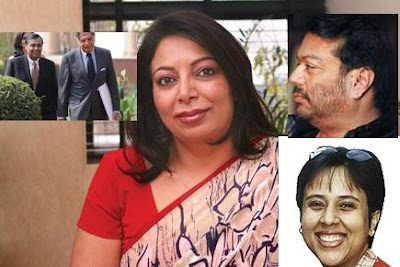
NDTV journalist Barkha Dutt and Hindustan Times columnist Vir Sanghvi are among those implicated by the tapes in the growing scandal. Initially, attention was focused on Ms. Dutt, who was accused of agreeing to pass on messages from Ms. Radia to the Congress party. Ms. Dutt denied that and defended herself on Twitter, in a statement and on television, and said that at most she had made an “error of judgment” in how she conversed with Ms. Radia.
The focus is now on on Mr. Sanghvi's role, according a Wall Street Journal report. In one of the tapes, Mr. Sanghvi sounded on one recording as if he was agreeing to slant his column on the feuding Ambani industrialist brothers according to Ms. Radia’s suggestions. Ms. Radia represents elder brother Mukesh Ambani, who controls Reliance Industries. Anil Ambani, the younger brother, controls the Reliance Anil Dhirubhai Ambani Group. Mr. Sanghvi tells Ms. Radia the piece is “dressed up as a plea to [Indian Prime Minister] Manmohan Singh so it won’t look like an inter-Ambani battle thing except to people in the know.” She responds: “Very nice.” In another conversation, between Ms. Radia and an employee, she asks for questions to be prepared for an interview between Mr. Sanghvi and Mukesh Ambani, saying that “he has agreed to ask whatever questions we suggest.”
In a court affidavit filed last week, the Indian government said it had begun tapping Ms Radia's phone after an allegation that she was spying for foreign intelligence.
Ms. Radia's telephone was tapped by the Indian government for 180 days during two separate stints in 2008 and 2009. Several hundreds of those call recordings have so far been leaked to Indian media outlets in the past few weeks. Some of these recordings have been posted on the Internet by India's Outlook and Open magazines.
Stung by the disclosures, Indian Prime Minister Manmohan Singh has asked cabinet secretary KM Chandrasekhar to investigate and report within a month. Singh said he "was aware of the nervousness in the corporate sector" over authorized phone-tapping. The Tata group chairman has taken legal action after his conversations with a lobbyist were leaked to media.
Here are some of the key revelations to date:
1. Billionaire businessman Mukesh Ambani is quoted as bragging that the ruling Congress Party is "Apni Dukan" (our shop), implying that he owns the ruling party.
2. Telecom minister Andimuthu Raja left an estimated $40 billion on the table by accepting bribes in exchange for lower bids from Indian and foreign bidders on 2G cellular spectrum auction, according to a New York Times report.
3. India's Highway Minister Kamal Nath is alleged to skim 15% on all the projects his ministry oversees.
There have long been allegations of corruption against Indian government ministers and politicians, but the tapes now confirm the extent of graft that was accidentally discovered by Indian authorities who were looking for evidence of Radia's possible involvement in spying for foreign nations.
There has long been a nexus of crime, corruption and politics in India. Of the 278 current Indian MPs for whom records are obtainable, 63 have criminal backgrounds. Of those, 11 have been charged with murder and two stand accused of dacoity (banditry). Other alleged misdemeanors range from fraud to kidnapping, according to data collected by National Election Watch, the campaign group that has put together the data.
Most Indian politicians have used their election wins to significantly enrich themselves, according to their own pre-election declarations of assets. For example, the comparison of assets of candidates who won in 2004 and sought re-elections in 2009 shows that the wealth of UP politicians has grown by 559%, over five times, in five years, second only to their Karnataka counterparts who registered a growth of 693% in the same period, according to a report..
Commenting on the scandal, Wharton's Professor Jitendra Singh says corruption in India is "heterogeneous and multifaceted," ranging from a simple bribe to systemic corruption, "where retrograde cultural norms get well-established in specific settings, such that a non-corrupt newcomer may well find it impossible to survive." Inferior cultural norms are the toughest to tackle, and those values could prove very difficult to unhinge, according to Singh. "In its abstract form, the gains in a transaction get disproportionately appropriated by actors in relation to their role in the creation of this value," he says. "This distorts incentives and, ultimately, values in a society and leads to inequitable distribution of income and wealth, and inefficient allocation of capital." He warns of "collective consequences such as the institutionalization of inferior cultural norms [for example, 'in order to succeed, you have to be dishonest, because everyone else is dishonest'] that may take generations, even centuries, to sort out meaningfully."
The telecom scandal may just be the tip of the iceberg. A broader and more serious independent inquiry is now necessary to find any evidence of widespread corruption as powerful Indian businessmen like Ambanis and Tatas use their power, influence and cash to garner resources or projects, whether mining rights, gas fields, land, infrastructure projects or the electromagnetic waves known as spectrum that carry cellphone service.
As to the role of the media, the US Supreme Court Justice Louis Brandeis once said that "sunlight is the best disnifectant". Transparency is not possible when the mass media join the effort to block sunlight, as has been the case in India's telecom scandal. Instead of playing their role as watchdogs in a democracy, many in the Indian media have chosen to collaborate with corrupt politicians and greedy businessmen to enrich themselves. The Indian media are guilty of manufacuring consent in a favor of the powerful few against the interests of the vast majority of India's population that is among the poorest and the most deprived in the world.
To protect the future of democracy, sustain economic growth and ensure that the benefits of growth are shared equitably by India's population, emergence of an honest, transparent and ethical media are absolutely essential. I hope the sane members of the Indian media will now find a way to clean up their ranks and begin a serious self-policing effort based on a new set of sound standards of professional ethics.
Related Links:
Haq's Musings
Manufacturing Consent in India
Challenges of Indian Democracy
Poor, Hungry and Illiterate India
Radia Tapes and Transcripts of India's 2G Scandal
The main source of these leaks are over 100 tapes of 5,000 recordings made by India's Enforcement Directorate and Income Tax authorities as part of their surveillance of Ms. Nira Radia. Radia lobbied government ministers and politicians on behalf of India's business elite, including the biggest business magnates Mukesh Ambani and Ratan Tata.

NDTV journalist Barkha Dutt and Hindustan Times columnist Vir Sanghvi are among those implicated by the tapes in the growing scandal. Initially, attention was focused on Ms. Dutt, who was accused of agreeing to pass on messages from Ms. Radia to the Congress party. Ms. Dutt denied that and defended herself on Twitter, in a statement and on television, and said that at most she had made an “error of judgment” in how she conversed with Ms. Radia.
The focus is now on on Mr. Sanghvi's role, according a Wall Street Journal report. In one of the tapes, Mr. Sanghvi sounded on one recording as if he was agreeing to slant his column on the feuding Ambani industrialist brothers according to Ms. Radia’s suggestions. Ms. Radia represents elder brother Mukesh Ambani, who controls Reliance Industries. Anil Ambani, the younger brother, controls the Reliance Anil Dhirubhai Ambani Group. Mr. Sanghvi tells Ms. Radia the piece is “dressed up as a plea to [Indian Prime Minister] Manmohan Singh so it won’t look like an inter-Ambani battle thing except to people in the know.” She responds: “Very nice.” In another conversation, between Ms. Radia and an employee, she asks for questions to be prepared for an interview between Mr. Sanghvi and Mukesh Ambani, saying that “he has agreed to ask whatever questions we suggest.”
In a court affidavit filed last week, the Indian government said it had begun tapping Ms Radia's phone after an allegation that she was spying for foreign intelligence.
Ms. Radia's telephone was tapped by the Indian government for 180 days during two separate stints in 2008 and 2009. Several hundreds of those call recordings have so far been leaked to Indian media outlets in the past few weeks. Some of these recordings have been posted on the Internet by India's Outlook and Open magazines.
Stung by the disclosures, Indian Prime Minister Manmohan Singh has asked cabinet secretary KM Chandrasekhar to investigate and report within a month. Singh said he "was aware of the nervousness in the corporate sector" over authorized phone-tapping. The Tata group chairman has taken legal action after his conversations with a lobbyist were leaked to media.
Here are some of the key revelations to date:
1. Billionaire businessman Mukesh Ambani is quoted as bragging that the ruling Congress Party is "Apni Dukan" (our shop), implying that he owns the ruling party.
2. Telecom minister Andimuthu Raja left an estimated $40 billion on the table by accepting bribes in exchange for lower bids from Indian and foreign bidders on 2G cellular spectrum auction, according to a New York Times report.
3. India's Highway Minister Kamal Nath is alleged to skim 15% on all the projects his ministry oversees.
There have long been allegations of corruption against Indian government ministers and politicians, but the tapes now confirm the extent of graft that was accidentally discovered by Indian authorities who were looking for evidence of Radia's possible involvement in spying for foreign nations.
There has long been a nexus of crime, corruption and politics in India. Of the 278 current Indian MPs for whom records are obtainable, 63 have criminal backgrounds. Of those, 11 have been charged with murder and two stand accused of dacoity (banditry). Other alleged misdemeanors range from fraud to kidnapping, according to data collected by National Election Watch, the campaign group that has put together the data.
Most Indian politicians have used their election wins to significantly enrich themselves, according to their own pre-election declarations of assets. For example, the comparison of assets of candidates who won in 2004 and sought re-elections in 2009 shows that the wealth of UP politicians has grown by 559%, over five times, in five years, second only to their Karnataka counterparts who registered a growth of 693% in the same period, according to a report..
Commenting on the scandal, Wharton's Professor Jitendra Singh says corruption in India is "heterogeneous and multifaceted," ranging from a simple bribe to systemic corruption, "where retrograde cultural norms get well-established in specific settings, such that a non-corrupt newcomer may well find it impossible to survive." Inferior cultural norms are the toughest to tackle, and those values could prove very difficult to unhinge, according to Singh. "In its abstract form, the gains in a transaction get disproportionately appropriated by actors in relation to their role in the creation of this value," he says. "This distorts incentives and, ultimately, values in a society and leads to inequitable distribution of income and wealth, and inefficient allocation of capital." He warns of "collective consequences such as the institutionalization of inferior cultural norms [for example, 'in order to succeed, you have to be dishonest, because everyone else is dishonest'] that may take generations, even centuries, to sort out meaningfully."
The telecom scandal may just be the tip of the iceberg. A broader and more serious independent inquiry is now necessary to find any evidence of widespread corruption as powerful Indian businessmen like Ambanis and Tatas use their power, influence and cash to garner resources or projects, whether mining rights, gas fields, land, infrastructure projects or the electromagnetic waves known as spectrum that carry cellphone service.
As to the role of the media, the US Supreme Court Justice Louis Brandeis once said that "sunlight is the best disnifectant". Transparency is not possible when the mass media join the effort to block sunlight, as has been the case in India's telecom scandal. Instead of playing their role as watchdogs in a democracy, many in the Indian media have chosen to collaborate with corrupt politicians and greedy businessmen to enrich themselves. The Indian media are guilty of manufacuring consent in a favor of the powerful few against the interests of the vast majority of India's population that is among the poorest and the most deprived in the world.
To protect the future of democracy, sustain economic growth and ensure that the benefits of growth are shared equitably by India's population, emergence of an honest, transparent and ethical media are absolutely essential. I hope the sane members of the Indian media will now find a way to clean up their ranks and begin a serious self-policing effort based on a new set of sound standards of professional ethics.
Related Links:
Haq's Musings
Manufacturing Consent in India
Challenges of Indian Democracy
Poor, Hungry and Illiterate India
Radia Tapes and Transcripts of India's 2G Scandal

Comments
The big, fat Indian wedding returned to the front pages of newspapers this week: reportedly a $55m gig with 20,000 guests, a Bell helicopter as dowry, a 100-dish menu, a dozen TV screens showing a video feed of the proceedings, and even a $5,000 tip for the groom's barber. The groom's father - a rich Congress party politician and real estate magnet, exemplifying the intersection of politics and new money in India - wryly remarked that the media reports of the wedding were speculative.
For the Congress party-led government whose credibility is battered by a tsunami of corruption scandals, the hugely ostentatious wedding by a party member should come as an embarrassment, many here feel. One minister is reported to have said recently that nearly 15% of India's grain and vegetables is wasted through "extravagant and luxurious functions". Party chief Sonia Gandhi has pleaded with her workers to be frugal and her MPs to fly economy class. The embattled PM, Manmohan Singh, had feebly exhorted businessmen to refrain from ostentatious displays of wealth because such "vulgarity insults the poor". But what he possibly forgets is that the poor in India are actually insulted every day by many of the men and women they vote into power.
The government is apparently working on a law to curb waste at extravagant weddings and functions. No law will be able to change soon a people and society that remain deeply hierarchical, feudal and class-conscious. At one end of the scale a hapless farmer may take ruinous loans from money-lenders to host a wedding beyond his means. At the other end a billionaire unabashedly builds the world's priciest home (more than $1bn) in Mumbai where half the people live in slums. All this is symptomatic of a society which thrives on perpetuating inequity. With near double-digit growth, there's going to be more money to throw around and flaunt. So don't expect any lame law to curb India's vulgar, overblown weddings any time soon.
The report by consultancy firm KMPG said that the problem had become so endemic that foreign investors were being deterred from the country.
It was compiled by questioning 100 top domestic and foreign businesses.
Its release comes as Prime Minister Manmohan Singh struggles to cope in the battle against corruption.
Earlier this month the head of the country's anti-corruption watchdog was forced to resign by the Supreme Court on the grounds that he himself faces corruption charges.
Over the last six months India has been hit by a series of corruption scandals including a multi-billion dollar telecoms scandal, alleged financial malpractices in connection with the Commonwealth Games and allegations that houses for war widows were diverted to civil servants.
Mega scams
"Today India is faced with a different kind of challenge," the report said.
"It is not about petty bribes (bakshish) any more, but scams to the tune of thousands of crores (billions of rupees) that highlight a political/industry nexus which, if not checked, could have a far reaching impact.
"Corruption poses a risk to India's projected 9% GDP growth and may result in a volatile political and economic environment."
Critics of the government say that recent scandals point to a pervasive culture of corruption in Mr Singh's administration - adding to the difficulties of a politician once seen as India's most honest.
The government denies the claims and has set up a parliamentary inquiry into corruption.
The BBC's Sanjoy Majumder in Delhi says that most Indians routinely pay bribes for a number of services such as getting a driver's licence or a passport.
But, our correspondent says, the KPMG survey makes clear that corruption is now no longer about such petty bribes but mega scams where billions of dollars are siphoned off by government and industry.
The worst-hit areas as identified by the report were real estate and construction - a priority for Delhi which plans to spend $1.5tn over the next decade to improve its over-burdened infrastructure.
The report said that the country's telecommunications industry was also badly affected.
Telecoms Minister Andimuthu Raja resigned in November, denying allegations that he had undersold billions of dollars worth of mobile phone licences. He is now under arrest.
However the KMPG report was not all gloomy. It said that despite the murky regulatory environment, business remained active in India with more than half of those surveyed saying they were unaffected by corruption.
More than 80% of respondents disagreed that corruption had reduced their ability to access domestic or foreign funds, while 55% disagreed that corruption had affected their business.
MANY Indians take justifiable pride in the rise of “India Inc”. Since winning independence from the licence and permit Raj 20 years ago, Indian companies have grown in size and scope, venturing into overseas markets and snapping up foreign companies. But even as Indians celebrate the rise of their country’s companies, they fret about the longer shadows those firms now cast. They worry that India’s corporate titans are too firmly entrenched, and too deeply ensconced in the corridors of power.
In the telephone conversations of a corporate lobbyist, tapped by the tax authorities and leaked to the media, Indians have heard ministries described as ATM machines and the ruling party referred to as “our shop”. They have read reports of companies wildly overcharging the government for the Commonwealth games and underpaying for mobile-telephone spectrum. The fear is that Indian capitalism is turning oligarchic.
Oligarchs begin as oligopolists: market power and political power tend to go hand-in-hand. Many people assume that 20 years of liberalisation has largely stripped India’s corporate establishment of its market muscle. But a 2009 paper* by Laura Alfaro of Harvard Business School and Anusha Chari of the University of North Carolina at Chapel Hill documented an economy still surprisingly dominated by incumbents. The authors drew on a database kept by the Centre for Monitoring the Indian Economy, which covers every firm that files financial statements.
As the economy opened up, the database recorded the birth of thousands of new, private firms. By 2005 it contained 8,864 firms under 20 years’ old, amounting to 56% of the total. But these firms’ clout did not match their numbers. They accounted for only 15% of corporate assets, 17% of sales and 13% of profits. About three-quarters of the economy was still in the hands of state firms and old, private firms born before 1985.
In a new paper**, Ashoka Mody of the IMF, Anusha Nath of Boston University and Michael Walton of Harvard echo this finding. Looking at companies listed on the Bombay Stock Exchange, they find that stand-alone, private firms increased their share of sales from 1989 to 2008, largely at the expense of state firms. But state firms hung on to a 37% share and India’s big family-owned conglomerates, known as business houses, actually increased theirs
So did our political elite and our news media learn from this experience? It sure doesn’t look like it.
The really striking thing, during the run-up to the war, was the illusion of consensus. To this day, pundits who got it wrong excuse themselves on the grounds that “everyone” thought that there was a solid case for war. Of course, they acknowledge, there were war opponents — but they were out of the mainstream.
The trouble with this argument is that it was and is circular: support for the war became part of the definition of what it meant to hold a mainstream opinion. Anyone who dissented, no matter how qualified, was ipso facto labeled as unworthy of consideration. This was true in political circles; it was equally true of much of the press, which effectively took sides and joined the war party.
CNN’s Howard Kurtz, who was at The Washington Post at the time, recently wrote about how this process worked, how skeptical reporting, no matter how solid, was discouraged and rejected. “Pieces questioning the evidence or rationale for war,” he wrote, “were frequently buried, minimized or spiked.”
Closely associated with this taking of sides was an exaggerated and inappropriate reverence for authority. Only people in positions of power were considered worthy of respect. Mr. Kurtz tells us, for example, that The Post killed a piece on war doubts by its own senior defense reporter on the grounds that it relied on retired military officials and outside experts — “in other words, those with sufficient independence to question the rationale for war.”
All in all, it was an object lesson in the dangers of groupthink, a demonstration of how important it is to listen to skeptical voices and separate reporting from advocacy. But as I said, it’s a lesson that doesn’t seem to have been learned. Consider, as evidence, the deficit obsession that has dominated our political scene for the past three years.
Now, I don’t want to push the analogy too far. Bad economic policy isn’t the moral equivalent of a war fought on false pretenses, and while the predictions of deficit scolds have been wrong time and again, there hasn’t been any development either as decisive or as shocking as the complete failure to find weapons of mass destruction. Best of all, these days dissenters don’t operate in the atmosphere of menace, the sense that raising doubts could have devastating personal and career consequences, that was so pervasive in 2002 and 2003. (Remember the hate campaign against the Dixie Chicks?)
But now as then we have the illusion of consensus, an illusion based on a process in which anyone questioning the preferred narrative is immediately marginalized, no matter how strong his or her credentials. And now as then the press often seems to have taken sides. It has been especially striking how often questionable assertions are reported as fact. How many times, for example, have you seen news articles simply asserting that the United States has a “debt crisis,” even though many economists would argue that it faces no such thing?
In fact, in some ways the line between news and opinion has been even more blurred on fiscal issues than it was in the march to war. As The Post’s Ezra Klein noted last month, it seems that “the rules of reportorial neutrality don’t apply when it comes to the deficit.”
What we should have learned from the Iraq debacle was that you should always be skeptical and that you should never rely on supposed authority. If you hear that “everyone” supports a policy, whether it’s a war of choice or fiscal austerity, you should ask whether “everyone” has been defined to exclude anyone expressing a different opinion. ...
http://www.nytimes.com/2013/03/18/opinion/krugman-marches-of-folly.html?_r=0
http://www.risingkashmir.com/news/army-threatened-me-for-kashmir-coverage-shekhar-gupta/ …
Noted Indian journalist, Shekhar Gupta Thursday said he would often receive threats from the Indian Army and other government establishments for covering Kashmir.
“We got a lot of flak for covering Kashmir,” he said speaking at the book release function of Aina Numa, a collection of writings of the former Member of Parliament and editor of ‘Aina’, late Shamim Ahmad Shamim.
Gupta, who remained the editor-in-chief of Indian Express for 19 years and also served as the vice chairman of the India Today Group for a while, was the chief guest on the occasion.
“When we broke the story of Pathribal fake encounter in Indian Express, and did a number of investigative follow up stories, I was getting phone calls from the Indian Army who would tell me, ‘What type of stories are you covering,’” he said.
Gupta, a recipient of Padma Bhushan award for his contribution to journalism, writes a weekly column ‘National Interest’ for India Today magazine and hosts an interview-based television show ‘Walk the Talk’ on NDTV news channel.
He said Kashmir was inextricably woven in the national security story and had been covered as a problem not as a place or people.
“National media sees it purely through the paradigm of that story – Line of Control, infiltration, gunfights, militants, and so on,” Gupta said. “This type of journalism has bedeviled the concept of Kashmir in India.”
Gupta, an author of Assam: A valley divided and India redefines its role, said it was unfortunate that journalists with very little knowledge of Kashmir were parachuted to the Valley to cover Kashmir.
“These people spend a week inside a hotel, do not even come to know about the day-to-day problems of the people like long hours of power curtailments, and return with stories of underlying danger of security increasing in Kashmir,” he said and accepted that Indian media had never been truthful with Kashmir coverage.
Gupta, who did his initial schooling from an RSS-run institution, said reporting anything truthful, embarrassing, or a setback was seen to be anti-national.
“But does it serve the national interest? We came to the conclusion that truth will never hurt the national interest,” he said. “We did a story when the GoC of the 15 Corps called DCs and SPs and told them to target people under the Public Safety Act and we did stories on fake surrender of militants, Srinagar sex-abuse scandal, and the killings of three persons allegedly by the DGP Kuldeep Khoda.”
Gupta, a keen Kashmir watcher, who has written extensively on Kashmir, said Kashmir does not need parachute journalists.
“Previously, calling an encounter a fake encounter was seen as a punishable act but it is no longer so as troops are now even punished in court martial proceedings,” he said. “There still are distortions but the coverage is much more open now.”
Gupta also criticized the Indian media for hyperbole while covering Nepal earthquake after praising Indian Army out of way during the coverage of Kashmir floods.
“We didn’t learn our lessons in Kashmir and we paid for it in Nepal,” he said.
Gupta said he had been laying a stress on reporters to report stories other than that of conflict from Kashmir.
“I tell them there is a state of Kashmir and the people there have their aspirations, they have their problems, there is a story on power cuts, shortage of jobs, how well Kashmiris are treated in different parts of India,” he said.
Gupta said Kashmir journalists working in India were serving as great ambassadors of Kashmir.
“My mother won’t believe Bangladesh had fallen until Mark Tully reported it and Rajiv Gandhi won’t believe his mother was dead till Mark Tully reported it,” he said asking Kashmiri journalists to be ambassadors of Kashmir like Mark Tully.
Gupta said there cannot be any better tribute to Shamim Ahmad Shamim than knowing that people of his profession from Kashmir were doing good.
The murders of journalists Rajdeo Ranjan in Bihar and Akhilesh Pratap Singh in Jharkhand within 24 hours of each other confirmed a 2015 international report that named India among the three most dangerous countries for media personnel.
Since 1992, 64 journalists have been killed in India with reporters exposing corruption the most hunted, says a compilation by the Committee to Protect Journalists.
Most of them died in smaller towns where graft is rampant and exposing it means earns the wrath of powerful politicians and industrialists. Earlier this year, a group backed by the Chhattisgarh government forced journalists Malini Subramaniam and some lawyers out of the Maoist-affected Bastar region. Activists also said the state administration was muzzling free speech after three journalists were arrested on allegedly flimsy charges.
The high death rate of journalists in the country is only lower than war-torn Iraq and Syria. India is the deadliest nation for reporters in Asia, more than Pakistan or Afghanistan.
All hail. The Economist
India’s press is more craven than Pakistan’s
Oct 22nd 2016 | DELHI | From the print edition
http://www.economist.com/news/asia/21709039-indias-press-more-craven-pakistans-all-hail
most Indians assume, their media are freer. When Cyril Almeida, a Pakistani journalist, revealed earlier this month that he had been banned from travelling abroad after writing a story that embarrassed Pakistan’s security forces, India’s tabloid press gloated.
The Schadenfreude proved short-lived. To general surprise, Mr Almeida’s colleagues rallied in noisy support. Pakistani newspapers, rights groups, journalists’ clubs and social media chorused outrage at his persecution. The pressure worked; the ban got lifted.
On the Indian side of the border, however, there has not been much critical examination of the government’s actions. Instead, Indian media have vied to beat war drums the loudest.
When an army spokesman, providing very few details, announced on September 29th that India had carried out a retaliatory “surgical strike” against alleged terrorist bases along the border, popular news channels declared it a spectacular triumph and an act of subtle statecraft. Some anchors took to describing India’s neighbour as “terror state Pakistan”. One station reconfigured its newsroom around a sandbox-style military diorama, complete with flashing lights and toy fighter planes. A parade of mustachioed experts explained how “our boys” would teach Pakistan a lesson it would never forget.
Such jingoism was predictable, given the fierce competition for ratings among India’s news groups. Disturbingly, however, the diehard nationalists have gone on the offensive against fellow Indians, too.
This month NDTV, a news channel with a reputation for sobriety, advertised an interview with Palaniappan Chidambaram, a former finance minister from the opposition Congress party. Mr Chidambaram was expected to say that previous governments had also hit back at Pakistan, but with less fanfare than the present one. Abruptly, however, NDTV cancelled the show. An executive sniffed that it was “not obliged to carry every shred of drivel” and would not “provide a platform for outrageous and wild accusations”.
Arnab Goswami, the anchor of a particularly raucous talk show, has declared that critics of the government should be jailed. Extreme nationalists in Mumbai, India’s commercial capital, have urged filmmakers to ban Pakistani actors. One party has threatened to vandalise cinemas that dare show a Bollywood romance, “Ae Dil Hai Mushkil”, due for release later this month, which features Fawad Khan, a Pakistani heartthrob. The film’s director, Karan Johar, has aired a statement declaring his patriotism, explaining that the film was shot before the current trouble and promising never again to work with talent from “the neighbouring country”. One commentator described his performance as akin to a hostage pleading for mercy.
Why, asks Mr Chidambaram, are the media toeing the government line so slavishly? Some answer that they have become ever more concentrated in the hands of big corporations, many of which carry heavy debts and so are wary of offending the party in power. Others ascribe the shrinking space for dissent to the unchecked rise of chauvinist Hindu-nationalist groups. Repressive colonial-era laws on sedition and libel also play a part.
http://www.dawn.com/news/1297065/pakistan-eyes-150m-after-direct-to-home-broadcast-licence-bidding
Pakistan is expected to attract direct investment of at least $150 million after the Nov 23 bidding for three direct-to-home (DTH) broadcast licences.
A top official of the Pakistan Electronic Media Regulatory Authority (Pemra) told journalists that 12 companies, including three foreign operators as part of local consortiums, had been shortlisted to bid for three DTH licences. The licences would be valid for 15 years.
Terming DTH a game-changer for the electronic media industry in Pakistan, the official said it would offer quality services and a wider range of choice to consumers and a lucrative revenue source to the economy’s managers. It would also end the monopoly of a few analogue cable operators.
It would not end the cable operators’ business, he said, but would compel them to invest in technology and their distribution systems.
Pakistan has close to 25 million electronic media subscribers and between three and five million consumers use Indian DTH illegally. Once the licensing process goes through, subscribers of Indian DTH would have to shift to the local network.
Foreign channels will get landing rights to come under the local regime through a regulatory process and launching of new local satellite channels will be allowed.
The official said that the current analogue distribution system offered a maximum of 80 channels while the DTH would increase the capacity to 250. Each local DTH licence holder is expected to have at least 500,000 subscribers.
A Chinese company is currently in the process of completing formalities to set up a factory for set-top boxes (STBs) for transmitting broadcasts to homes. The initial cost of an STB to consumer would be around Rs3,500 which could be recovered by DTH operators in instalments. Monthly subscription would be around Rs550.
“This will be the biggest investment in Pakistan’s electronic media history,” the official said. The conservative investment estimate of $150m was based on feasibility studies of shortlisted firms. It could go up to $250m after the three licence holders expand operations in the next two years. These estimates do not include bidding proceeds that would start with a base price of Rs200m for each licence.
The licence holders would employ 1,500 people directly and the move would open up indirect job opportunities for 15,000 people in the next two to three years as DTH penetration increases, he said.
Of the firms shortlisted, Startimes Communications Ltd would have 49 per cent shareholding from a Chinese operator, Parus Media and Broadcast Ltd will have 49 per cent stake from a Russian operator and Smart Sky Ltd (partially owned by PTCL’s foreign shareholders) would have a foreign shareholding. The official said that the law did not allow majority shareholdings to foreign firms, so 51 per cent stakes would have to be controlled by local partners.
Other shortlisted firms include Orient Electronics of Lahore, Mag Entertainment of Lahore, IQ Communication of Karachi and six firms, Skyflix, Sardar Builders, Nayatel, Mastro Media Distribution, Shahzad Sky Ltd and HB DTH, from Islamabad.
Information helps build nations. Fake news, propaganda and false history on the other hand helps create mobs. I’m thankful to the Ramon Magsaysay Foundation for giving me this opportunity to put my views to the other parts of the world…
I am not here alone. I have brought the entire world of Hindi journalism practised by Ganesh Shankar Vidyarthi and Peer Munis Mohammad.
We are living in testing times, as journalists and as common citizens. Our citizenship itself is on trial right now and make no mistake about it, we need to fight back. We need to rethink our duties and responsibilities as citizens. I believe that in today’s times when the attack on our citizenship is all-encompassing and the state’s surveillance apparatus is more overbearing than ever, the individuals or groups who are able to withstand this onslaught and emerge stronger from it, will be the ones who lay the foundation for a better citizenry and for that matter, maybe even better governments in the future.
Our world is filled with such determined citizens already who in spite of pervasive hatred and a manufactured information deficit, have chosen to fight back and bloom like the cactus flower does in the midst of a barren hopeless desert. Standing alone and surrounded by the ever stretching desert on all sides, the cactus doesn’t think about the meaning of its existence: it stands there to let you know that it’s possible.
Wherever the fertile plains of democracy are being subverted into deserts, the exercise of citizenship and the fight for the claim over – and right to – information have become perilous, but not impossible.
Citizenship effectively requires a free flow of verifiable information. The state today has established full control over the media and the corporations. The implication of this control over the media and in turn your information flow is that it limits and narrows the scope of your citizenship. In other words, the media controls diversity of the news stories, and specifies what interpretation of news events are acceptable. The media is now a part of the surveillance state. It isn’t the fourth estate anymore, but the first estate.
News channel debates take place within a vocabulary of exclusionary nationalism wherein they seek to replace the collective history and memory of the nation with that of the ruling party’s in their viewers’ minds. There are only two types of people in this news universe narrative: the anti-nationals and us. It’s the classic “us” and “them” technique. They tell us that the problem with anti-nationals is that they ask questions, disagree, and dissent. Disagreement is the atma – the spirit, soul, or essence – of democracy and citizenship. The democratic atma is under relentless attack every day. When citizenship is under threat or when its very meaning has been altered, then what happens to the nature of a citizen’s journalism? Both are citizens: those who claim to speak as the nation, and the victims of their derision.
Allegations of misconduct at one of India's largest tech companies have sent its stock plunging.
Infosys (INFY) shares dropped more than 16% in Mumbai on Tuesday after the company said it was investigating two whistleblower complaints detailing alleged unethical practices.
A member of Infosys' board received the complaints on September 30, chairman Nandan Nilekani said in a statement. The first complaint contains allegations of "disturbing unethical practices" while the second "largely deals with allegations relating to the CEO's international travel," he said. The company first disclosed the complaints on Monday.
The company is also aware of a letter written to US authorities under a whistleblower protection program, which refers to emails and voice recordings supporting the allegations, Nilekani said.
"Although we have not been provided any of the emails or voice recordings, we will ensure that the generalized allegations are investigated to the fullest extent," he added.
The complaints accuse the company's CEO of under-reporting costs in order to inflate profits and hiding "critical information" from auditors and the board, according to multiple Indian newspapers, which said they had obtained copies of the alleged complaints. CNN Business has not seen or independently verified the complaints, and an Infosys spokesperson declined to comment on the allegations beyond Nilekani's statement.
The CEO, Salil Parekh, and CFO, Nilanjan Roy, have both been recused from the matter, Nilekani said. The investigation will be conducted by Shardul Amarchand Mangaldas & Co., a prominent Indian law firm.
"These complaints are being dealt with in an objective manner," Nilekani said.
CNN Business has attempted to contact Parekh and Roy directly. The Infosys spokesperson said neither executive intended to comment at this time.
Infosys, headquartered in Bangalore, is one of India's largest outsourcing companies. It reported revenue of $11.8 billion in the last fiscal year and has nearly 230,000 employees worldwide, including thousands in the United States.
This is not the first time the company has been hit by controversy over its finances. Parekh's predecessor, Vishal Sikka, stepped down in 2017 after a public spat with some of its founders over executive pay and other issues.