Pakistan's Modern Infrastructure
As Pakistan struggles to bring a sense of stability and security amidst daily carnage, it is important to recognize that there is more to Pakistan than meets the eyes of a casual consumer of the images and reports by the world's media. For example, Pakistan is a developing country with functional bureaucracy, well-organized police force, democratic institutions and a powerful army. And Pakistan has more advanced infrastructure than its neighbors, including India. Among the modern infrastructure pieces in place in Pakistan are its motorway system, extensive road network, mobile telecommunications systems, airports, high-speed Internet system, extensive railroad network, gas pipeline etc. A British writer William Dalrymple who visited and compared India and Pakistan on their 60th anniversary described Pakistan as follows:
"On the ground, of course, the reality is different and first-time visitors to Pakistan are almost always surprised by the country's visible prosperity. There is far less poverty on show in Pakistan than in India, fewer beggars, and much less desperation. In many ways the infrastructure of Pakistan is much more advanced: there are better roads and airports, and more reliable electricity. Middle-class Pakistani houses are often bigger and better appointed than their equivalents in India. Moreover, the Pakistani economy is undergoing a construction and consumer boom similar to India's, with growth rates of 7%, and what is currently the fastest-rising stock market in Asia. You can see the effects everywhere: in new shopping centers and restaurant complexes, in the hoardings for the latest laptops and iPods, in the cranes and building sites, in the endless stores selling mobile phones: in 2003 the country had fewer than three million cellphone users; today there are almost 50 million."
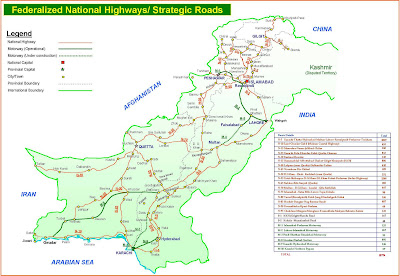
More recently, Alistair Scrutton filed a Reuters report about Pakistan's infrastructure, particularly its 367 Km long M2 motorway that connects Lahore with Islamabad:
"Indeed, for sheer spotlessness, efficiency and emptiness there is nothing like the M2 in the rest of South Asia.
It puts paid to what's on offer in Pakistan's traditional foe and emerging economic giant India, where village culture stubbornly refuses to cede to even the most modern motorways, making them battlegrounds of rickshaws, lorries and cows.
There are many things in Pakistan that don't get into the news. Daily life, for one. Pakistani hospitality to strangers, foreigners like myself included, is another. The M2 is another sign that all is not what it appears in Pakistan, that much lies hidden behind the bad news.

On a recent M2 trip, my driver whizzed along but kept his speedometer firmly placed on the speed limit. Here in this South Asian Alice's Wonderland, the special highway police are considered incorruptible. The motorway is so empty one wonders if it really cuts through one of the region's most populated regions.
"130, OK, but 131 is a fine," said the driver, Noshad Khan. "The police have cameras," he added, almost proudly. His hand waved around in the car, clenched in the form of a gun.
On one of my first trips to Pakistan. I arrived at the border having just negotiated a one-lane country road in India with cows, rickshaws and donkey-driven carts.
I toted my luggage over to the Pakistan side, and within a short time my Pakistani taxi purred along the tarmac. The driver proudly showed off his English and played U.S. rock on FM radio. The announcer even had an American accent. Pakistan, for a moment, receded, and my M2 trip began."

Here are another western tourist's impressions of M2 from nomadic-one.com:
A strange relief to get to drive 3 lane asphalt in such serene quietness! It was unreal, we had to pinch our arm if this was really happening. Is this Pakistan? We decided to spend the night at the 3rd big service area with restaurant, gas station, police and clean toilets. It was strange to see there was no trace of locals selling stuff on the curbs – something which is really normal in Pakistan. Probably these place are off limits to the small business men.
Going to India – something we have long looked out for. We’ve heard a lot about India from other travellers – good and bad experiences. One thing’s for sure – India must have a LOT of people, each and every traveller from India has mentioned this explicitly. With Pakistan and Nepal (1998) as context we’re curious and somewhat anxious how we will experience India. We’re not crowd maniacs and both appreciate a ‘bit of air’ between people. Anyhow India happened quicker than we expected – we left Islamabad on the 25th, the next day we already sat in the garden of Ms Bandari’s Guesthouse. The superb M2 motorway with overnight parking and the road to the Indian border was uneventful. We drove the canal bank road through Lahore a long drive on a straight road. But look carefully to find this road separated by a canal – it’s sign posted rather miniscule by “Wagah border”.

"The road to Amritsar was like wading upstream in extreme suicidal traffic – the independence day ceremony must be something special. It must be totally worth risking your life for this. Naturally we had our usual ‘end of the day – near dark – took the wrong turn in mega dense traffic’ exercise. Just to make our arrival in Amritsar a little bit more special. We arrived in the dark - asking directions many times. This way we came a few 100 meters closer to Ms Bandari’s guesthouse each time we asked. We nearly seen the golden temple by truck. Ain’t that a relaxed truck ride in the dark! Cool!
And yes, even with GPS coordinates of the place it’s still a nice puzzle to solve after a border crossing day like this."

According to BMI research, Pakistan has experienced a high level of activity in its infrastructure sector in 2008. This has mostly been focused on the power sector and the road network. In addition, construction of housing has been a top priority. However, the global downturn is hitting Pakistan hard, and the BMI's 2009 Annual Infrastructure Report for Pakistan is forecasting the construction industry to contract by 6.31% y-o-y in 2009. The power sector has been the major focus in Pakistan's infrastructure sector in 2008. Years of underinvestment in electricity generating and distributing infrastructure came to a head in 2008, when there was not enough supply to meet demand, further exacerbated by lack of rainfall almost knocking out Pakistan's large hydropower sector. It is currently estimated that there is a 3,300MW shortfall in capacity at peak hours; as a result, load shedding has been a common practice. In an attempt to combat the shortages, a US$30bn investment plan has been announced, which has seen the development of a number of projects. Construction started in 2008 on the 969MW Neelum-Jhelum power plant, which is being built by a consortium comprising Chinese Gezhouba Group Company and China Machinery Export Corporation. Construction of the Diamer Basha Dam, which will have a capacity of 4,500MW once completed, is expected to start in 2009. Within the transport sector, the roads have benefited from the majority of attention in 2008. This has been the result of the National Highways Authority's plans to invest US$5.36bn into the sector. The plans benefited from a US$900mn multi-tranche loan from the Asian Development Bank. The main project being pursued is the National Trade Corridor, envisaged as a main thoroughfare connecting the north of the country to the ports in the south; it is estimated to cost US$6.58bn. Construction of housing has been a major feature in 2008. Residential construction is being carried out under the prime minister's 'mega housing scheme' which involves the construction of one million low cost houses per year. Pakistan's economy has been hit hard by the global economic downturn and BMI's is forecasting real GDP growth of 2.5% y-o-y in 2009, down from 6.8% in 2007. In November 2008, the country received a US$7.6bn 23-month standby loan from the International Monetary Fund to "support the country's economic stabilization program". The move might help boost investor confidence in the short term; however, it may put off investors looking at long-term infrastructure investments.
The 2008 World Bank assessment says that Pakistan is one of the most water stressed countries in the world, and water resources are depleting rapidly. With its water infrastructure in poor condition, the report argues that Pakistan has to invest around Rs60 billion (US$1 billion) per year in reservoirs and related infrastructure over the next five years. In the energy sector, the country will face severe power shortages of around 6,000 megawatts by 2010. Similarly, inefficiencies in the transport sector cost the economy between 4-5 percent of GDP each year.
To overcome these constraints, the Government of Pakistan is tripling its annual infrastructure investment from an average of Rs150 billion (US$2.5 billion) to Rs440 billion (US$7.3 billion). However, the bank report points out that mega projects in the past have experienced frequent delays and cost overruns, illustrating a lack of capacity in the industry to plan, program, and execute large projects.
Many infrastructure projects in Pakistan, including power plants and motorways, are being built and financed on build-operate-transfer or BOT basis. Built on the BOT basis, the M2 motorway has already paid for itself and now generates revenue for Pakistan government.
Here's a video clip of British Writer William Dalrymple comparing India and Pakistan:
Here is a slide show of some of the infrastructure development projects underway in Pakistan:
Here is a video with pictures of Pakistan's extensive roads network:
Related Links:
Foreign Visitors to Pakistan Pleasantly Surprised
Digital Maps of Pakistan
Pakistan's daily carnage
Pakistan's Road Network
Life Goes On in Pakistan
Water Scarcity in Pakistan
Food, Clothing and Shelter in India, Pakistan
Urbanization in Pakistan Highest in South Asia
A Review of Global Road Accident Fatalities
Pakistan Leads South Asia in Clean Energy
Karachi Fashion Week
Is Pakistan Too Big to Fail?
Karachi Fashion Week Goes Bolder
More Pictures From Karachi Fashion Week 2009
Pakistan's Foreign Visitors Pleasantly Surprised
Start-ups Drive a Boom in Pakistan
Pakistan Conducting Research in Antarctica
Pakistan's Multi-billion Dollar IT Industry
Pakistan's Telecom Boom
Pakistan's Infrastructure Assessment by World Bank
ITU Internet Data
Eleven Days in Karachi
Pakistani Entrepreneurs in Silicon Valley
Musharraf's Economic Legacy
Infrastructure and Real Estate Development in Pakistan
Pakistan's International Rankings
Assessing Pakistan Army Capabilities
Pakistan is not Falling
Jinnah's Pakistan Booms Amidst Doom and Gloom
"On the ground, of course, the reality is different and first-time visitors to Pakistan are almost always surprised by the country's visible prosperity. There is far less poverty on show in Pakistan than in India, fewer beggars, and much less desperation. In many ways the infrastructure of Pakistan is much more advanced: there are better roads and airports, and more reliable electricity. Middle-class Pakistani houses are often bigger and better appointed than their equivalents in India. Moreover, the Pakistani economy is undergoing a construction and consumer boom similar to India's, with growth rates of 7%, and what is currently the fastest-rising stock market in Asia. You can see the effects everywhere: in new shopping centers and restaurant complexes, in the hoardings for the latest laptops and iPods, in the cranes and building sites, in the endless stores selling mobile phones: in 2003 the country had fewer than three million cellphone users; today there are almost 50 million."

More recently, Alistair Scrutton filed a Reuters report about Pakistan's infrastructure, particularly its 367 Km long M2 motorway that connects Lahore with Islamabad:
"Indeed, for sheer spotlessness, efficiency and emptiness there is nothing like the M2 in the rest of South Asia.
It puts paid to what's on offer in Pakistan's traditional foe and emerging economic giant India, where village culture stubbornly refuses to cede to even the most modern motorways, making them battlegrounds of rickshaws, lorries and cows.
There are many things in Pakistan that don't get into the news. Daily life, for one. Pakistani hospitality to strangers, foreigners like myself included, is another. The M2 is another sign that all is not what it appears in Pakistan, that much lies hidden behind the bad news.

On a recent M2 trip, my driver whizzed along but kept his speedometer firmly placed on the speed limit. Here in this South Asian Alice's Wonderland, the special highway police are considered incorruptible. The motorway is so empty one wonders if it really cuts through one of the region's most populated regions.
"130, OK, but 131 is a fine," said the driver, Noshad Khan. "The police have cameras," he added, almost proudly. His hand waved around in the car, clenched in the form of a gun.
On one of my first trips to Pakistan. I arrived at the border having just negotiated a one-lane country road in India with cows, rickshaws and donkey-driven carts.
I toted my luggage over to the Pakistan side, and within a short time my Pakistani taxi purred along the tarmac. The driver proudly showed off his English and played U.S. rock on FM radio. The announcer even had an American accent. Pakistan, for a moment, receded, and my M2 trip began."

Here are another western tourist's impressions of M2 from nomadic-one.com:
A strange relief to get to drive 3 lane asphalt in such serene quietness! It was unreal, we had to pinch our arm if this was really happening. Is this Pakistan? We decided to spend the night at the 3rd big service area with restaurant, gas station, police and clean toilets. It was strange to see there was no trace of locals selling stuff on the curbs – something which is really normal in Pakistan. Probably these place are off limits to the small business men.
Going to India – something we have long looked out for. We’ve heard a lot about India from other travellers – good and bad experiences. One thing’s for sure – India must have a LOT of people, each and every traveller from India has mentioned this explicitly. With Pakistan and Nepal (1998) as context we’re curious and somewhat anxious how we will experience India. We’re not crowd maniacs and both appreciate a ‘bit of air’ between people. Anyhow India happened quicker than we expected – we left Islamabad on the 25th, the next day we already sat in the garden of Ms Bandari’s Guesthouse. The superb M2 motorway with overnight parking and the road to the Indian border was uneventful. We drove the canal bank road through Lahore a long drive on a straight road. But look carefully to find this road separated by a canal – it’s sign posted rather miniscule by “Wagah border”.

"The road to Amritsar was like wading upstream in extreme suicidal traffic – the independence day ceremony must be something special. It must be totally worth risking your life for this. Naturally we had our usual ‘end of the day – near dark – took the wrong turn in mega dense traffic’ exercise. Just to make our arrival in Amritsar a little bit more special. We arrived in the dark - asking directions many times. This way we came a few 100 meters closer to Ms Bandari’s guesthouse each time we asked. We nearly seen the golden temple by truck. Ain’t that a relaxed truck ride in the dark! Cool!
And yes, even with GPS coordinates of the place it’s still a nice puzzle to solve after a border crossing day like this."
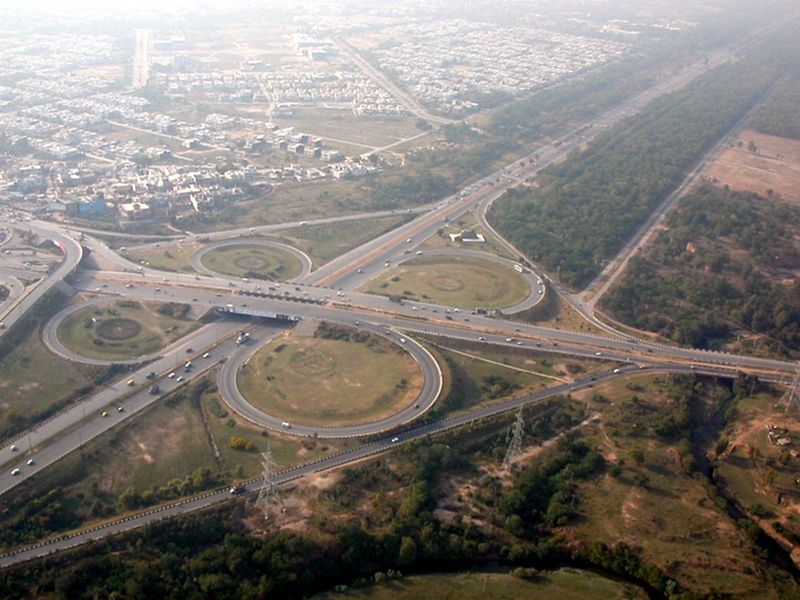
According to BMI research, Pakistan has experienced a high level of activity in its infrastructure sector in 2008. This has mostly been focused on the power sector and the road network. In addition, construction of housing has been a top priority. However, the global downturn is hitting Pakistan hard, and the BMI's 2009 Annual Infrastructure Report for Pakistan is forecasting the construction industry to contract by 6.31% y-o-y in 2009. The power sector has been the major focus in Pakistan's infrastructure sector in 2008. Years of underinvestment in electricity generating and distributing infrastructure came to a head in 2008, when there was not enough supply to meet demand, further exacerbated by lack of rainfall almost knocking out Pakistan's large hydropower sector. It is currently estimated that there is a 3,300MW shortfall in capacity at peak hours; as a result, load shedding has been a common practice. In an attempt to combat the shortages, a US$30bn investment plan has been announced, which has seen the development of a number of projects. Construction started in 2008 on the 969MW Neelum-Jhelum power plant, which is being built by a consortium comprising Chinese Gezhouba Group Company and China Machinery Export Corporation. Construction of the Diamer Basha Dam, which will have a capacity of 4,500MW once completed, is expected to start in 2009. Within the transport sector, the roads have benefited from the majority of attention in 2008. This has been the result of the National Highways Authority's plans to invest US$5.36bn into the sector. The plans benefited from a US$900mn multi-tranche loan from the Asian Development Bank. The main project being pursued is the National Trade Corridor, envisaged as a main thoroughfare connecting the north of the country to the ports in the south; it is estimated to cost US$6.58bn. Construction of housing has been a major feature in 2008. Residential construction is being carried out under the prime minister's 'mega housing scheme' which involves the construction of one million low cost houses per year. Pakistan's economy has been hit hard by the global economic downturn and BMI's is forecasting real GDP growth of 2.5% y-o-y in 2009, down from 6.8% in 2007. In November 2008, the country received a US$7.6bn 23-month standby loan from the International Monetary Fund to "support the country's economic stabilization program". The move might help boost investor confidence in the short term; however, it may put off investors looking at long-term infrastructure investments.
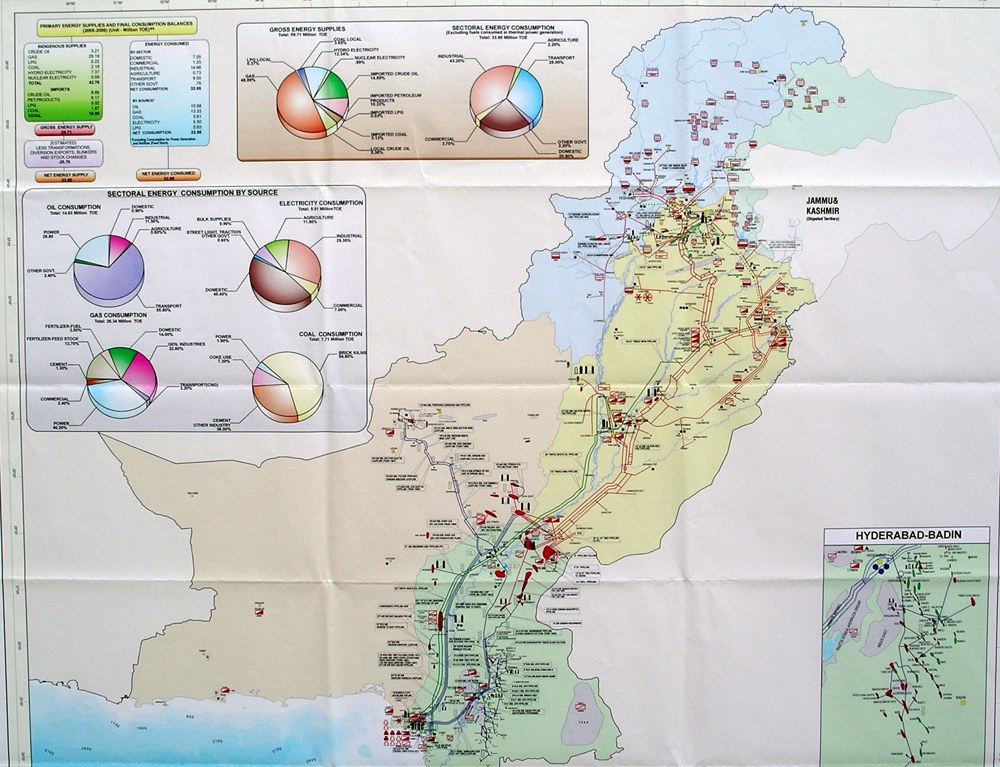 |
| Pakistan Energy Infrastructure (Source: PPECA) |
The 2008 World Bank assessment says that Pakistan is one of the most water stressed countries in the world, and water resources are depleting rapidly. With its water infrastructure in poor condition, the report argues that Pakistan has to invest around Rs60 billion (US$1 billion) per year in reservoirs and related infrastructure over the next five years. In the energy sector, the country will face severe power shortages of around 6,000 megawatts by 2010. Similarly, inefficiencies in the transport sector cost the economy between 4-5 percent of GDP each year.
To overcome these constraints, the Government of Pakistan is tripling its annual infrastructure investment from an average of Rs150 billion (US$2.5 billion) to Rs440 billion (US$7.3 billion). However, the bank report points out that mega projects in the past have experienced frequent delays and cost overruns, illustrating a lack of capacity in the industry to plan, program, and execute large projects.
Many infrastructure projects in Pakistan, including power plants and motorways, are being built and financed on build-operate-transfer or BOT basis. Built on the BOT basis, the M2 motorway has already paid for itself and now generates revenue for Pakistan government.
Here's a video clip of British Writer William Dalrymple comparing India and Pakistan:
Here is a slide show of some of the infrastructure development projects underway in Pakistan:
Here is a video with pictures of Pakistan's extensive roads network:
Related Links:
Foreign Visitors to Pakistan Pleasantly Surprised
Digital Maps of Pakistan
Pakistan's daily carnage
Pakistan's Road Network
Life Goes On in Pakistan
Water Scarcity in Pakistan
Food, Clothing and Shelter in India, Pakistan
Urbanization in Pakistan Highest in South Asia
A Review of Global Road Accident Fatalities
Pakistan Leads South Asia in Clean Energy
Karachi Fashion Week
Is Pakistan Too Big to Fail?
Karachi Fashion Week Goes Bolder
More Pictures From Karachi Fashion Week 2009
Pakistan's Foreign Visitors Pleasantly Surprised
Start-ups Drive a Boom in Pakistan
Pakistan Conducting Research in Antarctica
Pakistan's Multi-billion Dollar IT Industry
Pakistan's Telecom Boom
Pakistan's Infrastructure Assessment by World Bank
ITU Internet Data
Eleven Days in Karachi
Pakistani Entrepreneurs in Silicon Valley
Musharraf's Economic Legacy
Infrastructure and Real Estate Development in Pakistan
Pakistan's International Rankings
Assessing Pakistan Army Capabilities
Pakistan is not Falling
Jinnah's Pakistan Booms Amidst Doom and Gloom
Comments
Pakistan’s consumer electronics market, defined as the addressable market for computing devices, mobile handsets and AV products, is projected to be worth around US$1.6bn in 2010. Underlying demand will grow at a CAGR of about 7%, but spending will be restrained by a sizable grey market of smuggled or illegally assembled products.
The market’s considerable potential is currently depressed by a large grey market, poor IP protection, an unstable economic and security situation and weak distribution channels. Growth will be driven, however, by improved ICT infrastructure, and more credit availability. Reform of often high national and provincial taxes and tariffs on products ranging from computers to prepaid mobile cards would also boost the market.
Computer Computers accounted for around 18% of Pakistan’s consumer electronics spending in 2009. BMI forecasts Pakistan’s domestic market computer sales (including notebooks and accessories) of US$283mn in 2010, up from US$264mn in 2009. Computer hardware CAGR for the 2010- 2014 period will be around 7%. The abolition in September 2009 of a minimum sales tax on imported computers should boost the market.
AV AV devices accounted for around 40% of Pakistan’s consumer electronics spending in 2008. Pakistan’s domestic AV device market is projected at US$632mn in 2010. The market is expected to grow at a CAGR of 11% between 2010-2014, to a value of US$946mn in 2014. TV sets remain the core product in this category, but the growing availability of smuggled colour televisions is a market inhibitor.
Mobile Handsets Pakistan’s market handset sales are expected to grow at a CAGR of 1% to 18.8mn units in 2014, as mobile subscriber penetration reaches 91%. Revenue growth will be slower due to lower average selling prices (ASPs) of mobile handsets, with most handsets sold at a under US$40 price-point. Another issue is a declining growth rate of mobile subscriber penetration, which is now above 60%.
In the year 1996-97, Pakistan Railway had 10.45% share of passenger traffic and 5.17% of freight traffic, which has dropped to 9. 95% and 4. 72% respectively by the year 2006-07, according to Economic Survey of Pakistan.
Primarily on account of increasing preference for road transport by passengers as well as goods forwarders over rail transport and owing to a diversion of already scarce resources towards the expansion of the road network, the performance and condition of Pakistan Railways has declined and its share of inland traffic (if compared with the early 70s) has reduced from 41% to 10% for passenger and 73% to 4% for freight traffic.
The above qualitative and quantitative analysis reveals that Pakistan Railways has lost its significance and it is no more an attractive mode of transport. The railwaymen have to realise this fact and forget Railways has absolute benefits over road transport and that the Railways is the biggest mode of transport. It is a requirement today that rail transport is restricted to and enhanced on the corridors where long haul and mass scale traffic both for passengers and freights is available, and where there is sufficient revenue generation to bear the O&M (Operation & Maintenance) cost.
http://finance.kalpoint.com/economic-updates/exclusive-articles/railways-still-in-a-quagmire.html
----------
The government, in close collaboration with the World Bank, is preparing a detailed road map for revitalizing the cash starved Pakistan Railways that requires a multi-billion dollar injection over the medium to long term to ensure a complete turnaround, official documents available with The News disclosed on Sunday.
The government had constituted a Core Team, as specified by the Planning Commission, which was assigned to formulate a Pakistan Railways Issue Note (PRIN) based on a rapid governance analysis. According to the PRIN executive summary Pakistan Railways (PR) has been facing serious crisis since 2007-08 as its passenger traffic reduced by 16 percent and freight traffic (on a tonne-kilometer basis) by 70 percent. Revenues of PR has fallen by 6 percent while working expense increased by 80 percent with labor related costs and pensions being 120 percent of revenue in 2010-11.
Under the current organization structure and financial arrangement, the executive summary states, it would be very difficult for PR to even return to break-even on working expenses without radical surgery. In the absence of substantial reforms, PR will almost certainly suffer a continuing decline, slowly but steadily becoming almost irrelevant to the general economy of the country.
http://www.thenews.com.pk/TodaysPrintDetail.aspx?ID=10601&Cat=13
"The Eagles Nest is aptly named: it perches on top of a ridge amid rocky scree and jagged peaks. Behind us are 24000-feet snowcapped summits, soaring into the sky. Below, the valley where we have spent the past few days is recognizable by its row of cell phone towers and the Hunza River. I have been astonished that, remote as we are in Hunza, first-class cell phone and Internet connections are available 24/7. We are as close to civilization as the briefest click and as far away the loosest stone on that crumbling highway north or south."
http://books.google.com/books?id=_BtWtuLlDXoC&pg=PA44&lpg=PA44&dq=inquiry+based+learning+pakistan&source=bl&ots=6DRcWG5-r7&sig=7_vsfOS2Xet_zFFmqRmduY-hR24&hl=en&sa=X&ei=6rEHT93tEeqFiAKO_aWyCQ&sqi=2&ved=0CFEQ6AEwBQ#v=onepage&q=cell%20towers&f=false
The highway Mass is referring to is the world's highest called Karakoram Highway at an altitude of over 15000 feet. It's currently being repaired and expanded with Chinese help. Talking about it, she writes:
"I wonder what a wide, asphalt highway would do to this area--bring more tourists and trade and change forever the lives of the people in the distant villages hidden among the rocks, I imagine."
Cement is one of the most important industries of Pakistan. Limestone and gypsum are the main raw materials for manufacturing of cement and they are present in abundance in Pakistan along with good supply of Natural gas. This great potential makes the country capable of producing cement not only for local use but also for export as well. Pakistan cement industry has exporting cement to the neighbouring countries like U.A.E, Afghanistan, India, Iraq and Russia.
At present there are 22 cement plants are operating in Pakistan with the production of approximately 9.403 million tonnes. Out of these 22 cement plants, 17 are private and 5 are publicr. 11 new plants are also in planning stage and the capacity of these plants is estimated around 12.988 million tonnes. The industry has achieved a growth of 32% with the domestic demand increasing by around 24.95% and the exports by nearly 111.86% according to the financial year end June 30, 2007 ratings. Recently the country has been able to export to some of the African countries as well.
Cement industry is divided into two main regions; the northern and the southern region. Northern region is producing 35.18 million tonnes and southern region is producing 8.89 million tonnes of cement per year.
Per capita consumption of cement is an indicator of rate with which any country is developing. Unfortunately per capita consumption of cement in Pakistan is less if we compare it with other developing countries. It is about 131 kg per person annually; whereas world average is about 270 kg. This less consumption is due to the negligence given to the construction sector. However in last few years consumption of cement showed some rise due to increased commercial activities, infrastructural development and increasing demand of constructing houses.
Local demand for the year 2007-2008 was 20 million tonnes. Pakistan has started exporting cement few years back and has earned repute as a premium quality cement producer in the global market in this short period. Pakistan exported around 7.716 million tonnes of cement in 2007-2008 and earned a foreign exchange of 459 million dollars. There is surely a great potential of growth in this industry in Pakistan.
http://pakistan360degrees.contentcreatorz.com/cement-industry-of-pakistan/
PIA (PIAa.KA), like Pakistan, always seems to be on the brink of disaster. But now that seems closer than ever for the national flag carrier, once a source of pride for the country.
The airline is haemorrhaging hundreds of millions of dollars a year while being pummelled by competition from sleek Gulf giants like Emirates EMIRA.UL, Etihad and Qatar Airways.
A quarter of its 40 aircraft are grounded because the airline can't find enough money to buy spare parts. Flights are regularly cancelled and engineers say they are having to cannibalise some planes to keep others flying.
"The situation has worsened to the extent of rendering this airline almost financially unviable," said the State Bank of Pakistan in a report on the state of the economy.
In many ways the airline mirrors the way Pakistan -- a strategic U.S. ally often described as a failing state -- is run.
The same inefficiency, nepotism and corruption that critics say have prevented the government from tackling a Taliban insurgency, crippling power cuts, ethnic violence and widespread poverty also threaten to bring down the airline.
PIA lost 19.29 billion rupees in the first nine months of 2011, almost double the losses in the same period in 2010.
The airline, like the Pakistani economy, has relied on bailouts to stay in the air, and is negotiating with the state for another rescue package.
"Just like PIA has the potential to do well, Pakistan's economy does too. But both haven't because of mismanagement. In the end that is the story -- mismanagement," Salman Shah, a former Pakistani finance minister, told Reuters.
PIA officials were not available for comment on the challenges facing the airline despite repeated requests.
HUGE WORKFORCE WEIGHS DOWN AIRLINE
Over the years, critics say, governments have manipulated state corporations like PIA for political and financial gain, giving jobs to so many supporters that the size of the workforce has become unsustainable in the face of mounting losses.
"We don't have people in the right places in typical Pakistani fashion. It's about who you know not what you can do," said a PIA pilot, who like other employees asked not to be identified for fear of being fired.
Today, PIA has a staggering employee to aircraft ratio of more than 450, more than twice as much as some competitors. In the first nine months of 2011, employee expenses drained 16 percent of turnover.
"Politically motivated inductions have been the major cause of the significant increase in human resource burden in this organisation," said the central bank.
"It cannot be corrected without taking drastic steps for rightsizing and increasing operational efficiency."
That is unlikely in a country where political expediency and interests often undermine efforts to make everything from governments to corporations successful.
Frustrations with those realities are palpable at PIA.
http://www.reuters.com/article/2012/02/14/uk-pakistan-airline-idUSLNE81D02820120214
....When Indian journalists and members of a business delegation flying from Lahore to Karachi on board a PIA flight asked the flight attendant for a vegetarian meal, they were told that there was only non-vegetarian fare in the packet.
-----------
However, a smart attendant pointed out that while one of the sandwiches in the food packet was 'chicken', the other was 'cheese'. 'So you can have the cheese sandwich,' was his solution.
Of course, he overlooked the fact that two were part of the same dish and their proximity far too disturbing for the vegetarian mindset. Similarly, on the early morning PIA flight from Karachi to Islamabad the air hostesses were quite apologetic about not having any vegetarian breakfast on board.
While the world over, commercial airlines factor in dietary preferences, it appears PIA still has to move up the learning curve.
-------------
Pakistan deserves credit for building an excellent 8-lane expressway from Islamabad to its cultural capital Lahore.
With a permissible speed limit of 120 km an hour, cars cruise through the 370 km distance in four hours.
There is a 15 km stretch through the salt range where vehicles have to slow down as there is danger of disturbing the rocks due to vibrations.
Speed cameras placed along the expressway ensure that motorists do no exceed the maximum speed limit.
Interestingly, there are prominently displayed signs on the highway which warn drivers that there is a 'speed camera ahead' which tends to maintain discipline.
This is in sharp contrast to the approach of Delhi police, who believe in hiding behind bushes with their speed cameras to catch motorists unaware as though the main objective of the exercise is to make money instead of ensuring the safety of motorists.
The signage on the highway is up to the best global standards and boards at overbridges carry intelligent advice for motorists ranging from 'check your gauges frequently'; 'Retire the worn out tyres'; 'Drive slow in fog and rain.' A Lahore-based industrialist told Mail Today that he prefers to go to Islamabad by the motor way instead of catching the flight.
Read more: http://www.dailymail.co.uk/indiahome/indianews/article-2102861/Splendid-roadway-makes-sub-standard-airline-Pakistan.html
Singapore's International Container Terminal Services Inc (ICTS) said on Tuesday its subsidiary plans to acquire up to 55 percent of a Pakistan container cargo terminal operator.
ICTS's unit ICTSI Mauritius Ltd is intending to buy 35-55 percent of Pakistan International Container Terminal Ltd , whose terminal is located at the Karachi port, it said in a statement.
The company did not say how much it will pay for the acquisition, but noted that the Pakistan firm handled a total of 669,806 twenty-foot equivalent container units for the year ended June 30, 11 percent higher than the year before.
http://www.reuters.com/article/2012/03/06/icts-idUSL4E8E63HR20120306
National Highway Authority (NHA) is implementing 82 highway schemes at the cost of Rs 569 billion, while 14 new projects are in pipeline costing Rs 95 billion.
The participants of 11th Senior National Management Course visited NHA head office here on Wednesday where
NHA’s member (planning) Sabir Hasan while briefing about the functioning of the NHA to visiting faculty members of the 11th Senior National Management Course said 98 Toll Plazas have been approved on NHA, out of which 84 were operational.
NHA is striving hard for availability of National Trade Corridor (NTC), in the country. Practical advancement is being made for achieving North South economic corridor, providing linkages with Gwadar and up gradation of Karakoram Highway in particulars.
Under NTC programme highways, Motorways, Expressways are being constructed from ports to borders with the view to provide linkages for the Transit Trade. NTC will reduce 50 percent travelling time, decrease 10 percent transportation cost and reduce 70 percent road fatalities.
Rs 300 billion will be spent during the next 5 to 7 years for this gigantic programme. Toll Collection System is being established on modern lines, he added.
He said pragmatic steps have been taken to save asset of highways from bad effects of overloading. To this effect weigh stations have been set up at specific locations to check the overloaded vehicles. In order to ensure construction of durable roads state of the art and advanced technologies are being employed. NHA is attaching great importance to make journey safe and sound on its network, he added.
http://www.dailytimes.com.pk/default.asp?page=2012\05\08\story_8-5-2012_pg5_5
HUNZA - Prime Minister Raja Pervaiz Ashraf on Friday launched two landmark multi-million dollar strategic projects at the Karakorum Highway (KKH), aimed at restoring the historic road linkage with China that was severed due to the artificial Attabad Lake created as a result of landslides.The Prime Minister performed the ground-breaking of realignment of a 17-km long section of the Karakoram Highway (KKH). He also inaugurated the 510.42 million dollars upgradation of a 335 km long section of the road from Raikot to Khunjerab that has now been widened and meets international standards of construction.Prime Minister, who earlier had an aerial view of the Attabad lake, the upgraded road and the proposed road alignment site, said that the new roads were part of an effort of the government to provide the people of remote areas a fast and easy linkage with the rest of the country. He said that the road would not only ease travel, but also help provide all facilities of life. He said it would further deepen the strong ties between Pakistan and China. Raja said that road links were known to bring progress and prosperity to the areas they touch and hoped that a new era of development would usher in.He said that road links were a priority of the government and recalled his meeting with Chinese leaders during his recent visit to China where the KKH's upgradation and re-alignment were discussed. He appreciated and thanked the Chinese government for keeping its promise of despatching the required heavy machinery for completion of the project....
http://www.nation.com.pk/pakistan-news-newspaper-daily-english-online/national/29-Sep-2012/raja-launches-projects-to-restore-karakorum-highway
ISLAMABAD: Pakistan has signed eight new projects worth $2.24 billion with the World Bank while six projects of $69 million have been signed with Multi Donor Trust Fund (MDTF) during the last fiscal year.
Documents obtained by this correspondent showed that the Project of Tertiary Education worth $300 million, Social Safety Net TA Additional Financing of $150 million, Tarbela (Fourth Extension) worth $840 million, Punjab Irrigated Agriculture Productivity Project $250 million, Natural Gas Efficiency Project $200 million, Punjab Education Sector program worth $350 million, Sindh Skill Development of $21 million and Highway Rehabilitation Additional Financing project worth $130 million were signed between Pakistan and the World Bank during 2011-12.
The projects of Khyber-Pakhtunkhwa Emergency Road Recovery Project worth $8 million, Khyber-Pakhtunkhwa Fata Economic Revitalisation Project $20 million, KP Fata Governance Support Project of $6 million, Fata Rural Livelihood and Community Infrastructure worth $12 million, Fata Urban Centre Project of $7 million and the project of Revitalizing Health Services in Khyber-Pakhtunkhwa worth $16 million are the projects signed by Pakistan with MDTF.
Documents also showed that the Asian Development Bank’s (ADB) active portfolio in Pakistan comprised $3.3 billion in loans for 23 ongoing projects: $143 million in grants and $9.37 million in technical assistance as of June 30 this year. In terms of lending modality, the Multi tranche financing Facility accounted for 49 percent of the portfolio and project leans at 41 percent while disbursement achieved during FY 2011-2012 amounted to $429.4 million.
One of the key pillars of reform in the power sector of Pakistan is to enhance power generation, replacement of inefficient plants and improve the transmission and distribution system. In this regard, ADB has committed a financing facility of $2.9 billion over medium-term.
Documents also showed that the ADB organised 55 capacity-building initiatives for 2011-12 for Pakistan in areas of irrigation, energy, transport, environmental safeguards, gender statistics, poverty reduction, regulatory practices, financial inclusion approaches, sustainable and millennium development goals, taxation, public sector management, planning, budgeting and evaluation, foreign direct investment, procurement, project processing and regional integration.
http://www.brecorder.com/top-news/1-front-top-news/84391-pakistan-wb-sign-eight-new-projects-worth-224bn-.html
Karachi: Sept02: KMC Administrator Muhammad Hussain Syed has said that the construction work of flyovers at Shahrah-e-Pakistan and S.M Taufeeq Road will be started this week and will be completed within the estimated time which is 6 months. He said this during an inspection visit at the construction place of four flyovers at Shahrah-e-Pakistan where he was accompanied by Director General Technical Services Altaf G. Memon, Sr. Director Mass Transit Rasheed Mughal, Sr. Director Transport & Communication Muhammad Ather, Project Directors Syed Muhammad Taha, Abdul Rehman Shaikh, Noor-ul-Haq Shaikh and other high officials. He said that planning for construction of four flyovers at Shahrah-e-Pakistan was already made and offices of concerned contractors have been setup whereas traffic diversion plan was also made final. He said that construction work of four flyovers will be started at the same time with least effect on traffic and no inconvenience for people whereas service road will be widened after removing encroachments. Administrator Karachi Muhammad Hussain Syed was informed by Project Director Syed Muhammad Taha that construction of flyover at Water pump will cost 383.37 million rupees and flyover at Aisha Manzil will cost 378.20 million rupees and the length of flyover at Water pump will be 140 meter long with 3 lanes for each side of traffic which will consist of 11.80 meter width whereas the length of flyover at Aisha Manzil will be 590 meter long for both sides. Project Director of S.M Taufeeq Road Dakhana, Abdul Rehman Shaikh informed that the construction of flyovers at this road will cost 385.5 million rupees and the length of the flyover will be 497 meter long whereas two tracks with 11.80 meter length will be made whereas 5 spans, 78 piles and girders will be made. Administrator Karachi on this occasion directed engineers and contractors to take special care of quality and time during construction of flyovers. He said that the construction of these flyovers will maintain traffic flow on this road and provide transportation facilities to the citizens.
http://kmc.gov.pk.sv2.premiumwebserver.com/News/NewsDetail.aspx?id=898
KARACHI, Pakistan—At the brand-new Nue Multiplex here, chauffeured cars drop families at the door. Excited squeals of children reverberate from the games arcade. Hollywood and Bollywood movies play on five screens.
"We wanted to have something of international standard," said Tariq Baig, executive director of the $100 million multiplex that opened in August, replete with a Canadian sound system, Danish carpeting, and chairs and screens imported from the U.K. "We didn't go for anything local."
Nue is part of a wave of Western-style cinemas that are opening across Pakistan, aiming to serve the entertainment-starved middle classes in a country where movie houses were traditionally dilapidated, seedy, and shunned by families.
The blossoming of Western cinema in Pakistan is something of a phenomenon, taking place even as Islamist militants—who view all cinema as sinful— increasingly target the country's moviegoers.
There are just 104 movie screens in all of Pakistan, a country of 180 million people. Still, that is a jump from 20 screens in 2005, according to various distributors and cinema owners. There are another 100 screens under construction, they say.
Pakistan's cinema renaissance began in 2006, when the then military dictator, Pervez Musharraf, loosened a law dating back to the 1965 war between India and Pakistan that banned the import of Bollywood films. Though imports of Indian movies are still restricted, Mr. Musharraf's ruling allowed them to be granted a "No Objection Certificate" by the government in special cases. The ordinance also created a loophole in the law that allowed Indian films to be imported via another country.
"Everyone wants to go to the cinema," says Nadia Jamil, a popular TV and film actress based in Lahore. "It's the Indian films that have created the market that everyone wants to rush to."
----------
Cinema construction has been on a tear over the past few years in a number of developing countries where growing middle classes are flocking to theaters. China last year added 5,077 new film screens, boosting its total to 18,200, according to the official Xinhua news agency.
---------
Peshawar's cinemas are a far cry from the multiplexes of Lahore, Islamabad and Karachi. The only defense against the intense summer heat are ancient fans. In the winter patrons come with their own blankets. The audiences are exclusively male, and many of the theaters show porn, crudely dubbed into Pashto, the local language. Audiences are small and profits are slim. Tickets cost around 50 rupees (50 cents), depending on how popular the film is.
Habib ur Rehman, the manager of the Picture House cinema, the first theater to be attacked by the Taliban, said in conservative Peshawar being in the cinema business isn't something you boast about. He said the modern multiplexes springing up in other parts of the country would never come to the city. "They will not succeed here. The people don't like Hindi and English films. They want Musarrat Shaheen, " he said, referring to a famous Pashto actress.
Despite the Taliban threats, Rehan Shah, who works at the Shama Cinema, the second Peshawar theater attacked, said people are eager for these cinemas to reopen.
"People are already asking, 'Why are you not open? We want entertainment,' " he said.
http://online.wsj.com/news/articles/SB10001424052702303546204579439371307729670
ISLAMABAD: South Asia should spend as much as $2.5 trillion on infrastructure by 2020 to bring its power grids, roads and water supplies up to the standard required to serve its growing population, said a World Bank report on Wednesday.
“If South Asia hopes to meet its development goals and not risk slowing down — or even halting — growth, poverty alleviation and shared prosperity… it is essential to make closing its huge infrastructure gap a priority,” the report said in probably the first analysis of the region’s infrastructure needs.
The report, entitled “Reducing poverty by closing South Asia’s infrastructure gap”, says that “infrastructure deficiencies in South Asia are enormous, and a mix of investment in infrastructure stock and implementing supportive reforms will enable the region to close its infrastructure gap”.
Pakistan should invest $165 billion over ten years in improving infrastructure in transport, electricity, water and sanitation, solid waste, telecom and irrigation sectors, according to the report.
For the required investment in electricity sector of up to $96bn, Pakistan should generate funds through government-private sector partnership, the report said.
The average share of Pakistan in the total infrastructural investment in South Asia is only 12 per cent compared to 79 per cent by India, the report says.
http://www.dawn.com/news/1097656/s-asia-should-spend-more-to-serve-its-growing-population-report
As a resident of Baramulla, I should have been able to make it to Muzaffarabad, the capital on the other side, within five hours by road, had the governments of India and Pakistan allowed our three-member delegation to travel on the much-vaunted cross LoC bus.
However, the walls between the two sides built over 60 years forced me to travel via Delhi-Lahore-Islamabad — the journey thus took me almost three days.
Nevertheless, this longer route was interesting in itself. The 180-km Islamabad-Muzaffarabad road reminded me of the winding Srinagar-Jammu highway, while the mountainscape and the gushing waters of the Jhelum resembled Patnitop and the waters of the Chenab.
-------
Muzaffarabad, with a population of just over 6,00,000, looks cleaner than Srinagar (PoK has 10 districts with an estimated population over three million in 2009). Even during my previous visit in 2004, I found that the stories of “under development in PoK,” fed to us on this side, are off the mark. This time, I noticed road connectivity and power supply to houses even on the upper reaches of a hill. In contrast, many villages in Jammu and Kashmir even today are without basic facilities. Neither does Muzaffarabad seem to be lagging behind in education and health compared to the Indian side of Jammu and Kashmir though progress is more in tune with Pakistani literacy rates. In the past few years the development in these two sectors has been rapid. The literacy rate in PoK has touched 65 per cent which is higher than for any other area in Pakistan. In conversations, both the young and old in Muzaffarabad say that Pakistan has “never discriminated” against the region.
http://www.thehindu.com/opinion/op-ed/the-other-kashmir/article2101764.ece
Correspondents say animals straying into Indian airports over the years have led to serious safety concerns. In June 2008, close to 100 flights were disrupted on a single day after a family of monitor lizards crawled out onto the Delhi airport runway, forcing its closure for an hour.
On other occasions, reports said jackals, antelopes, peacocks, porcupines, snakes, monkeys, foxes and dogs have strayed onto runways.
http://www.bbc.com/news/world-asia-india-29947409
“Work on different sections of the Peshawar, Karachi motorway should be completed by 2017,” the premier said, while chairing a meeting to review the progress of projects under the China, Pakistan Economic Corridor (CPEC) project.
During the meeting, PM Nawaz directed authorities to expedite work on the projects under the CPEC to materialise the dream of a prosperous Pakistan.
“Energy projects under CPEC should be completed on fast-track,” the premier said.
Read: CPEC to be completed at all costs: Army chief
“Railway stations from Peshawar to Karachi should be upgraded and maximum facilities should be provided to the passengers,” he added.
PM Nawaz also upheld that the Gwadar International Airport should be completed in the shortest possible time.
Earlier this week, Army chief General Raheel Sharif visited Panjgur area of Balochistan and vowed to torpedo the campaign run by the country’s enemies against the CPEC and help get the project off the ground.
Read: Eastern CPEC route unfeasible: report
Emphasising the importance of the CPEC, the army chief said construction of these roads would link Gwadar port with the rest of the country at Chaman and the Indus Highway.
http://tribune.com.pk/story/927215/peshawar-karachi-motorway-to-be-completed-by-2017-pm/
http://tribune.com.pk/story/958632/pakistan-the-worlds-best-kept-secret/ …
I have been an extensive traveller, a true backpacker, having visited numerous countries on all continents. Pakistan had never figured in my calculus until I developed friendships with two Pakistanis; one gentleman from Lahore and the other from Karachi. These two shared a dormitory with me during my studies at the National University of Singapore (NUS). I found these individuals to be poles apart from the general depiction of Pakistanis that the media regularly portrays. What I had always gleaned from the media was that Pakistan was a country mired in terrorism and religious extremism, and was a highly unsafe place, especially for foreigners. Stories about how women were treated in the country were just as dismal. In stark contrast to these images, my Pakistani friends exuded warmth and wit; they were generous, well-meaning and easy to relate to. My curiosity about their country often led me to lengthy discussions with them. Their advice to me was that the only way to truly understand Pakistan was by paying it a visit. As my Lahore-based friend returned to Pakistan upon his graduation from NUS, I thought of grabbing a chance to visit the country. His response was very encouraging. My biggest problem, however, was my mother, who when learning of my plan, screamed and proclaimed me to be crazy. I cannot blame her, as her only knowledge about the country was through the media, which is solely interested in displays of violence and misogyny, thus missing 99.9 per cent of the Pakistan story.
However, as I had made up my mind to visit Pakistan, nothing was going to stop me. Since I desired to visit the Northern Areas as well, my friend from Lahore not only lined up a visit for me, he also took a break from his office to give me company. My journey from Singapore to Lahore (via Bangkok) felt strange, or rather unique, as I was the only foreigner on the flight. The gentleman sitting next to me was a doctor from Lahore. His amazement as to why I had chosen Pakistan as my holiday destination unhinged me for a moment. Later I understood that this was genuine curiosity rather than a voicing of concern regarding my security.
I was received at the airport by my friend. While driving to his home, I saw alleys of trees and greenery, clean streets and orderly traffic — quite unlike how I imagined Lahore to be. The next day, I woke up to a beautiful sunny morning and went around the city: to the historic fort and the Badshahi Mosque. I was wearing the traditional shalwar kurta that my friend’s father had kindly gifted to me. Contrary to my expectations, nobody on the street gave me strange ‘look-there’s-a-foreigner’ looks. The evening was spent sitting on the rooftop of a restaurant on food street, listening to live instrumental music against the backdrop of the splendidly-lit Badshahi mosque, presenting an awe-inspiring spectacle. The desi cuisine was delicious and the spices were toned down at my request. The decor and architecture of the street were indescribably beautiful. I visited shopping areas, busy malls, high-end restaurants and roadside dhabas. There was not a moment, which gave me the feeling that I was at a dangerous or a conservative place. People were open, cheerful and absolutely normal while they went about their daily lives.
The bus ride from Lahore to Islamabad on the motorway was an experience in itself. Passengers were offered complimentary high-speed WiFi internet, sandwiches, juices and headphones, should they want to listen to music or watch a film. While in Islamabad, a visit to a local coffee shop was an eye-opener. I could see petite girls, walking in re-assuredly, hanging out with their friends late into the night, giggling and chatting. My stereotypes as to how women in Pakistan lived were now gradually fading away; more so when I saw so many of them all alone and independent, trekking the woods of the Astor Valley.
The Lahore Ring Road is much like the Delhi Ring Road, only much wider and with lesser traffic. It merges into the Lahore-Islamabad motorway which is even bigger and better. The drive to Nankana Sahib was pretty smooth through the town of Sheikhupura and the only roadblock we hit was on the outskirts of the town which was in a state of lockdown due to the rush of Indian devotees. Massive police presence could be seen and street after street was cordoned off with cement road blocks and razor wires to prevent access to the Gurdwara. -
See more at: http://indianexpress.com/article/blogs/a-surreal-drive-through-pakistan-discussing-modi-bihar-and-patiala/
http://www.khaleejtimes.com/nation/general/uae--pakistani-friendship-road-opens-in-pakistans-tribal-areas
The UAE- Pakistani Friendship Road, with length of 72 km and width of 9 metres, is one of the biggest development projects in the tribal region, and links south and north of Waziristan regions.
AdTech Ad
The UAE- Pakistani Friendship Road, funded by the Abu Dhabi Fund for Development at cost of US$60.6 million, has been inaugurated in the Federally Administered Tribal Areas (FATA) in Pakistan.
The move follows the directives of President His Highness Shaikh Khalifa bin Zayed Al Nahyan, and His Highness Shaikh Mohammed bin Zayed Al Nahyan, Crown Prince of Abu Dhabi and Deputy Supreme Commander of the UAE Armed Forces, and follow up by His Highness Shaikh Mansour bin Zayed Al Nahyan, Deputy Prime Minister and Minister of Presidential Affairs, to provide the humanitarian and development aid to the Islamic Republic of Pakistan.
The UAE- Pakistani Friendship Road, with length of 72 km and width of 9 metres, is one of the biggest development projects in the tribal region, and links south and north of Waziristan regions. The project opened by General Raheel Sharif, Chief of Staff of the Pakistan Army, in the presence of, Abdullah Khalifa Al Ghafli, Director of the UAE Project to Assist Pakistan (PAP), members of the project, senior Pakistani army officers, senior local government officials of the tribal areas, and tribal dignitaries.
During the inauguration ceremony, the audience thanked the UAE President for his kind gesture. General Sharif extended his thanks to Shaikh Khalifa for continuous support, citing the UAE- Pakistani Friendship Road, deemed one of the development projects in Pakistan. He delivered the message of gratitude on the behalf of inhabitants of the tribal areas to the UAE leadership.
For his part, Al Ghafli stressed that the bilateral relations between the UAE and the Islamic Republic of Pakistan have a unique and special character demonstrated through the fraternal spirit, appreciation, mutual respect and shared vision between the leaders and peoples of the two countries.
He pointed out that the opening of "this vital road is nothing but the product of a long history of love, togetherness and cohesion between the leaders and peoples of the two friendly countries."
Al Ghafli said that the directives of the political leadership of the UAE have leveraged the success of the project and translated it into a reality. He appreciated the kind gestures of the UAE President and the Crown Prince of Abu Dhabi, which focussed on helping the poor and needy in Pakistan.
He also praised the support and continuous follow-up enjoyed by the PAP by His Highness Shaikh Mansour bin Zayed Al Nahyan, Deputy Prime Minister and Minister of Presidential Affairs. He stressed that the support and follow-up by Shaikh Mansour was a catalyst for the successful implementation of 416 development projects in Pakistan.
Al Ghafli referred to the success of partnership, cooperation and coordination with the Abu Dhabi Fund for Development, which has been keen to contribute to several development projects in the areas of roads, bridges, health, education being implemented by the UAE Project to Assist Pakistan.
A number of beneficiaries told Emirates News Agency (WAM) that they were appreciative about the UAE leadership's stance to offer all forms of assistance in time of their need. While welcoming the opening of the road which would facilitate transport in the tribal region, the beneficiaries noted that the naming of the project, the UAE- Pakistani Friendship Road, "reflects intimacy in the relationship between the peoples of the UAE and Pakistan."
Re-carpeting and renovation work of Islamabad-Lahore Motorway (M2), scheduled to be completed by December this year, would be completed by much ahead of time by the end of next month.
Talking to APP on Thursday, an official source said that the work is in full swing and it would be completed by May or June.
The total cost of the project is Rs30.935 billion, which includes renovation of toll plazas weigh stations workshops, as well and the total length of the M2 being recarpeted is 714kms. An official of the National Highway Authority (NHA) said the expenditures incurred on re-carpeting of the M2 were made from the revenue generated through toll tax; therefore, no expenditure is made from other development heads of the NHA.
Renovation and overlay work on the M2 had started in January last year by MORE (FWO) the build operate transfer (BOT) concessionaire of the project.
M2 was handed over to FWO on December 15, 2014 for operation and maintenance for the next 20 years.
Signing ceremony of the BOT agreement between the NHA and the Frontier Works Organization (FWO) for redesigning and beautification of Lahore-Islamabad Motorway (M2) was held in April 2014. He said that the overlaying fencing beautification of the road would make travel along it all the more a wonderful experience.
The government is not seeking any loans from abroad for the construction of the road, he said.
On the contrary, the FWO would pay an amount of Rs206 billion to the government of Pakistan over the agreement period, besides looking after the road.
https://www.thenews.com.pk/print/114349-Renovation-of-M2-to-be-completed-by-May#
https://www.app.com.pk/bot-becoming-popular-mode-of-road-construction-in-pakistan-2/
ISLAMABAD, Jan 14 (APP): National Highway Authority (NHA) has been focusing on Build-Operate-Transfer (BOT) projects to involve private sector in highway building projects as the present government wants to upgrade road infrastructure in the next five to seven years.
The government wants to double the road density till 2025 and this mammoth development goal can only be achieved with the support of private sector, an official of National Highway Authority ( NHA ) told APP on Saturday . He said that public private partnership is becoming an essential component of NHA development strategy.The objectives set by NHA,he said, include development,off-budget financing, efficiency, investment, sustainability and revenues generation.
Re-carpeting and renovation work of Islamabad-Lahore Motorway (M2) completed recently is one of the big achievements of NHA on BOT basis, he added.
The total cost of the project was Rs30.935 billion, which includes renovation of toll plazas, weigh stations workshops, as well and the total recarpetted and renovated length is 714kms.
Renovation and overlay work on the M-2 had started in January 2015 by MORE (FWO), the build operate transfer (BOT) concessionaire of the project.M-2 was handed over to FWO on December 15, 2014 for operation and maintenance for the next 20 years.
He said another major under-construction BOT project of NHA was 136 km Karachi-Hyderabad Motorway (M-9) which connects Karachi to Hyderabad and would cost about Rs. 24 Billion. The project work started on March 16,2015 and will be completed by December 2017. Its 80 km portion would be opened for traffic within a week time.
Among the upcoming BOT projects, he said construction work of 296 km Hyderabad-Sukkur Motorway is likely to start soon . The project would be executed on BOT basis and its estimated cost is over Rs 160 billion.
The motorway project starting from Sukkur will touch Khairpur, Nowshehro Feroze, Nawab Shah, Mitiari, Hala and Jamshoro and terminate at Hyderabad.
About 90-kilometre Sialkot-Lahore Motorway would cost Rs 56 billion and will be built on BOT basis and it would be completed in three years. The proposed motorway project would help link remote areas with big cities and reduce the distance between Sialkot and Lahore.
Starting from Sahowala-Sambrial,the motorway will end at Kala Shah Kaku via Daska, Gujranwala and Kamonki.
Moreover the NHA plans to undertake the up gradation and dualization of Multan-Muzaffargarh-D.G. Khan Section of Multan-Qilla Saifullah Highway (N-70) on BOT basis.
The NHA invited bids for undertaking upgradation and dualization
of the section and a Concession Agreement has been finalized, the official informed.
The Concession Agreement has been signed, and the construction work shall be commenced after achievement of Financial Close by the Concessionaire. He said that the project construction period will be 24 months from achievement of financial close.
The existing 20 km of Tarnol-Taxila section of Grand Trunk Road (N-5) would be improved and widened to provide a fast track facility of international standard is among the BOT Projects at Procurement Stage. Scope of work also includes a flyover at Tarnol railway crossing. Concession agreement is at negotiation stage.
About 111-kilometre four-lane Pindi Bhattian-Faisalabad Motorway (M-3) and Faisalabad-Gojra Section of Faisalabad-Multan Motorway (M-4) would be converted into a 6 lane facility and overlay on existing 4-lanes would also be done.Land and 6-lane structures are of the project are already available.
Yet another upcoming BOT project is 32 km existing 2-lane Tarnol-Fatehjang section of Rawalpindi-Kohat Highway which would be converted into a 4- lane, divided highway and the project is at preparation stage.
https://tribune.com.pk/story/1394404/pakistan-set-1b-infrastructure-bank/
Finance Minister Ishaq Dar has announced that the government will set up Pakistan Infrastructure Bank with a paid-up capital of $1 billion, which will give financing to private investors for development projects.
Pakistan government and the International Monetary Fund (IMF) would have 20% shares each in the bank and the rest would be held by global organisations such as the International Finance Corporation, he said.
AJK plans tourism corridor along CPEC
He was speaking at a briefing held for the Pakistani media towards the end of his visit to Washington DC during which he attended spring meetings of the IMF and the World Bank.
Dar also revealed that the government would soon be launching Pakistan Development Fund (PDF) and its shares worth Rs100 billion would be offered to Pakistani diaspora in order to channelise their remittances effectively.
Later, these shares will be listed on the Pakistan Stock Exchange. “After the success of Sukuk (Islamic bonds), the PDF will be another attractive investment for overseas Pakistanis,” he remarked.
Giving a detailed round-up on the plenary sessions with the IMF and World Bank, the minister said there was positive sentiment about the tremendous economic rebound experienced by Pakistan over the last four years.
“Pakistan was on the verge of bankruptcy in 2014 and today it is likely to achieve approximately 5% growth during the current financial year,” he said. “Both IMF and World Bank are on the same page with the Pakistani government in these projections.”
Promotion of it: Work on innovation centres begins
Global credit rating agencies have upgraded the rating of Pakistan from negative to stable and from stable to positive in the last four years to an extent that the country is likely to be included in G-20 countries by 2030.
https://www.ft.com/content/a00a3312-5913-11e8-806a-808d194ffb75
On paper, India’s transport infrastructure is on a par with China’s. Yet anyone who has travelled to both countries can tell you there remains a vast gap between them.
India’s road and rail networks are only slightly shorter than China’s. But far more of the latter’s roads are multi-lane paved highways, compared with single-lane dirt tracks, and China’s bullet trains outclass India’s lumbering locomotives on virtually every metric.
The comparison between the world’s two most populous countries and their approach to building and maintaining cities and infrastructure is irresistible, especially since China has outpaced India so comprehensively over the past few decades. While the countries’ economies were roughly the same size as recently as 1980, China’s gross domestic product is now four and a half times the size of India’s.
In India, even politically important projects such as the “golden quadrilateral” highway network connecting the country’s four major metropolitan centres of Delhi, Mumbai, Chennai and Kolkata have been hampered by chronic delays and obstacles.
In 1999, Prime Minister Atal Bihari Vajpayee broke ground on the road project, which had a projected completion date of 2006. But the highways were not opened to traffic until 2012 and to this day upgrades and extensions remain bogged down by legal challenges, funding shortfalls and the inability to acquire land.
By contrast, China is already halfway through a three-decade, $300bn expansion of its motorway system that will connect all Chinese cities with a population of more than 200,000 people.
The scale of the country’s road-building frenzy is matched by the creation of hundreds of new cities and the world’s longest high-speed rail network. All of this construction is reflected in the incredible scale of Chinese cement production. China accounts for about 60 per cent of total global cement production and in just five years from 2012 China produced nearly three times as much cement as the US did in the entire 20th century.
India is on track to build 100 new cities of its own and add roughly 300m people to its population by 2050. Yet although it is now the second-largest producer of cement in the world, India’s annual output is only about a 10th of China’s.
@ 2018 Results index If the Belt and Road Initiative has a blind spot, it is surely to be found in south Asia. The region is home to one country that can’t get enough of the project (Pakistan), and another (India) that wants nothing to do with it. Does this matter? Well, yes and no. On the plus side, Pakistan, which is chronically short of friends and capital, shows no sign of falling out of love with a project that continues to shower it with financial largesse. The list of Chinese-funded and Chinese-built infrastructure projects is long and impressive. Take the $2.9 billion, 400-kilometre stretch of the M5 Motorway funded by China Development Bank (CDB) and built by China State Construction Engineering. When the motorway is completed later this year, the cities of Karachi and Lahore will finally be linked, by a project that was first drawn up as long ago as the 1990s. CDB is the financial driving force behind many of the big local BRI deals. In December 2017, the policy bank was a key player in a 10-year, $700 million syndicated term loan raised for the finance ministry, a deal that included partial guarantees from the World Bank. It is funding an $883 million coal-fired power plant at Port Qasim. And in April, CDB shelled out $1 billion to a government that, not for the first time, faces a looming financing crisis. Pakistan’s foreign exchange reserves dipped below the $10 billion mark this July, for the first time since 2014. China is unlikely to turn off the spigot, even though the position of prime minister, vacated after the arrest of Nawaz Sharif in July, has been filled by Imran Khan, the former cricketer who campaigned hard against alleged corruption in local China-backed construction projects. Yet Beijing is clearly keen to keep Khan on-side: days after his election, it handed Pakistan another $2 billion, bolstering the perception that however bad its finances get, China will not turn its back on the south Asian state. That should come as no surprise. Beijing plans to spend up to $57 billion by 2030 on a profusion of new domestic infrastructure projects – ports, airports, highways, power plants, transmission lines, solar parks – which are all part of the so-called China-Pakistan Economic Corridor (CPEC). Both can see clearly what they get out of this transactional alliance: for China, a reliable overland route to the Indian Ocean that bypasses the Malacca Strait, and for Pakistan, the infrastructure it always wanted and needed, but couldn’t afford. And so we turn to India, which has, to say the least, a different relationship with its giant neighbour. It was a founding member of the Asian Infrastructure Investment Bank in 2014, and is the second-largest contributor after the People’s Republic, funding the China-led multilateral to the tune of $8.4 billion. It is also a founding member of another multilateral, the Shanghai-headquartered New Development Bank, which is chaired by KV Kamath, the former chairman of Indian IT firm Infosys. Yet India adamantly refuses to be considered a belt-and-road nation. Rafiqul Islam At a meeting of the Shanghai Cooperation Organization in June, India was the only member state that did not tacitly endorse the BRI programme. New Delhi resents the mere existence of the CPEC project with Pakistan, and fears being outflanked in its own backyard by Beijing, which is funding a series of massive infrastructure projects in states that border India, or are historically aligned with it. The question arises: does India need to be part of the BRI project?
Full article: https://www.euromoney.com/article/b19zv4qt994gg1/china-strengthens-its-grip-on-south-asia?copyrightInfo=true
Visit http://www.euromoney.com/reprints for additional distribution rights. For more articles like this, follow us @euromoney on Twitter.
The China Pakistan Economic Corridor (CPEC)-funded Multan-Sukkur motorway is likely to be opened for traffic by August this year as work on the project is in progress according to the set schedule, a senior official of National Highway Authority said on Thursday.
“At present, 83 per cent of the total work has been completed, out of which 392-kilometer-long roadbed and culvert passage, as well as other structures, already been completed,” the official added while talking to APP.
He said up till now, all the bridges have been completed, while asphalt pavement works are advancing at full speed, whereas building construction and ancillary works are also being implemented actively.
The Multan-Sukkur Motorway is part of the Peshawar-Karachi Motorway, which is also known as the eastern route of CPEC. “This route starts from Karachi via Hyderabad, Sukkur, Multan, Islamabad, Lahore and other cities, and ends in Peshawar with a total length of 1,152 kilometers,” he added.
Sukkur-Multan motorway has a design speed of 120km per hour, and it is a two-way six-lane road with a contractual value of $2.889 billion (excluding $180 million tax exemption).
The Export-Import Bank of China provided loan support while China State Construction Company Limited (CSCEC) is responsible for construction on Engineering Procurement Construction (EPC) basis.
With a contract period of 36 months (including design period of four months), the project officially started on August 5, 2016.
Meanwhile, the official said Lahore-Abdul Hakeem section of M-3 would be opened for traffic by February 15. He said that all physical work of this section had already been completed but due to some technical issues, such as delay in approval for deployment of motorway police on the section, the motorway could not be opened yet.
Similarly, the official informed that the Gojra-Shorkot section of Faisalabad-Multan motorway had also be nearly completed and it would be opened for traffic by next month.
Zafar Hayat, Project Director for Shorkot-Dinpur section of M-4, told APP that work on the 34km section has been completed and it would also be opened for traffic by next month.
He said this section is being built at a cost of Rs11,220 million and the project is funded by Asian Development Bank (ADB).
“Work on the 31km Dinpur-Khanewal section is in progress and would be completed soon,” he added.
https://www.urdupoint.com/en/pakistan/sialkot-lahore-motorway-to-be-completed-in-cu-662541.html
Deputy Commissioner Dr Syed Bilal Haider on Friday said that the Sialkot-Lahore Motorway project would be completed till the end of 2019.
He said that Rs 43.85 billion would be spent on the project of 91.2Km long motorway which will reduce travelling time between Sialkot to Lahore.
He added that it would be a four-lane motorway with seven inter-changes at Kala Shah Kaku, Muridkey, Narowal, Gujranwala, Pasrur, Daska and Sambrial.
Earlier, a meeting of officials of the National Highway Authority (NHA) and the Frontier Works Organization (FWO) was held at the DC's Office here to review construction of the project while DC Dr Syed Bilal Haider presided over the meeting.
The NHA and FWO officials told the meeting that construction work on Sialkot-Lahore Motorway's four different sections, namely Kala Shah Kaku to Muridkey Sction (21Km), Muridkey to Narowal Section (25Km), Narowal to Pasrur Section (20Km) and Pasrur to Sambrial Section (20Km) was briskly under way.
The construction of the 392-km Sukkur-Multan Motorway under the China-Pakistan Economic Corridor (CPEC) has been completed after the National Highway Authority (NHA) on Tuesday presented a substantial completion certification to the constructor China State Construction Engineering Corporation (CSCEC).
The motorway, which is known as M5 in Pakistan and the largest transportation infrastructure project under CPEC, is a part of the country's Peshawar-Karachi Motorway and was completed two weeks ahead of contract due date. The M5 was designed for speeds of up to 120 kmh with a total investment around 2.89 billion U.S. dollars.
NHA M5 General Manager Muhammad Naseem Arif said during a ceremony held in Multan that the motorway is very impressive in terms of its quality and construction process, adding that the authority closely worked with the CSCEC and overcame a number of difficulties so that they could complete the great project within three years.
Li Ganchun, chief of the M5 project from the CSCEC, appreciated the security provided by the Pakistani side, saying that the M5 will help Pakistan connect its north and south, improve the country's transportation situation and facilitate social economic development in the region along the motorway.
According to the CSCEC, the M5 project had created some 29,000 jobs for the locals during the construction. The Chinese constructor also built schools, roads, bridges, wells and water channel for the locals to make their lives more convenient.
The motorway is expected to open to traffic in August.
https://karandaaz.com.pk/wp-content/uploads/2018/11/Bankability-of-the-Transport-Sector-2-1.pdf
Executive Summary:
1. The Transport, Logistics and Communications (TLC) sector is estimated to have contributed 13.3% of GDP in 2016-17. Of this, more than 62% was contributed by the road transport sector. In 2014-15 the sector employed 3.1 million people.
2. Most traffic intensive routes are a) Karachi to Peshawar via Hyderabad-Multan-Faisalabad-Rawalpindi; b) Sukkur to Quetta; c) Karachi to Quetta via the RCD Highway; and d) N-5 National Highway segment of Multan-Lahore-Gujranwala-Rawalpindi.
3. Passengers and freight are the primary segments of road transport sector. The fastest growing freight segment is the delivery vans at 7.5% annually, while for the passenger segment it is motor cabs and taxis at 5.9% annually.
4. Road transport grew at an average rate of 6.2% annually between 1991 and 2016, faster than the average GDP growth rate 4.4% during this period. China-Pakistan Economic Corridor (CPEC) is expected to accelerate transport sect or growth with construction of roads and other transport infrastructure.
5. Freight transport sector is highly lucrative with profit margins ranging from 21% for large trucks to 43% for rickshaws. Passenger transport sector is even more lucrative with 30% profit margin for wagons to 50% for luxury buses.
https://www.businesswire.com/news/home/20160921005655/en/Pakistan-Logistics-Industry-to-2020---30.77-Billion-Outlook-and-Growth-Opportunities---Research-and-Markets
Pakistan Vision 2025 seeks to enhance the national transportation infrastructure by establishing an efficient and integrated transportation and logistics system. Establishing industrial parks and developing SEZs along the China-Pakistan Economic Corridor (CPEC) will strengthen the transportation network and logistics infrastructure. Road freight transportation contributed over 90% of the goods transported by land.
Rail freight is likely to gain share due to modernization and expansion. High priority is given to road network development. Private sector participation in logistics infrastructure development is likely to gain momentum, and transportation and warehousing are likely to lead logistics industry growth during 2016-2020.
The potential opportunities in the logistics industry in Pakistan, is estimated at approximately US $ 30.77 billion in 2015. Key targets set in the national development initiatives for the transportation sector include reduction in transportation costs, effective connectivity between rural areas and urban centres, inter-provincial high-speed connectivity. Also high priority is given for the development of integrated road/rail networks between economic hubs (including air, sea and dry ports) and high capacity transportation corridors connecting with major regional trading partners.
Up-gradation of all major airports to trans-shipment hubs, development of cargo villages, modernization of rail transport, E-commerce, CPEC related investments in industrial centres and Special Economic Zones (SEZs) will serve as primary macro drivers for logistics sector growth. CPEC related projects intend to upgrade and modernize road transport and related logistics infrastructure such as logistics park and establishment of cargo villages at major airports. Hence, high priority is given for road network development; private sector participation in logistics infrastructure development is likely to gain momentum.
Storage and Warehousing demand from CPEC related industrial corridors are likely to derive increased storage and warehousing requirements including cold chain logistics, establishment of Cargo Villages Ports will facilitate goods traffic to central Asian countries and evolve as a major transhipment hub in the region.
https://propakistani.pk/2019/07/24/pakistan-ranks-among-the-worst-in-logistic-performance-index/
India is at 35th position while Sri Lanka stands at 92nd place in the list. Regional countries including Thailand, Vietnam, Indonesia, Malaysia, and the Philippines are far ahead of Pakistan, according to a report published by the State Bank of Pakistan.
Where’s CPEC?
Luckily, Pakistan’s performance on the infrastructure component of the LPI is likely to improve, particularly in the wake of CPEC-related development of roads, railways, and the Gwadar port. In addition, CPEC is also expected to boost the prospects of the shipping industry, and forward-thinking investors are reportedly keen to explore such opportunities.
Why Logistics Sector Holds Great Value?
A more concerted policy focus is required to tackle the shortcomings reflected in other LPI components. These can be viewed as a subset of the ease of doing business, and may thus be added to the agenda items that the country is looking to address in order to attract more FDI and boost exports.
The efficient logistics lie at the heart of competitiveness, both at the firm and country level. They enable firms to connect with domestic and international markets and affect a country’s prospects of integration within global value chains.
Logistics impact trade, job creation, and economic development. Given its importance, there is a need to track logistics performance and take corrective action as needed.
The Criteria
To this end, the World Bank’s LPI serves as a benchmarking tool that scores and ranks logistics performance. The index can be further categorized into 6 distinct components, namely:
International shipments: The ease of arranging competitively priced international shipments
Logistics competence: The competence and quality of logistics services
Infrastructure: The quality of trade and transport-related infrastructure (for example, ports, roads, railroads, information technology)
Customs: The efficiency of customs and border management
Timeliness: The frequency with which shipments reach consignees within the scheduled or the expected delivery time
Tracking and tracing: The ability to track and trace consignments
World Bank’s aggregated LPI 2012-2018 provides a composite, weighted score and ranking based on four surveys, which minimizes random variations across individual surveys and facilitates comparison across 167 countries.
Moreover, the six components reveal that Pakistan’s weaknesses are broad-based. In four out of six components, Pakistan’s ranking ranges between 100 and 112. In fact, the country ranks last on the ‘Tracking and tracing’ component compared to selected South Asian countries.
Roads, Provincial / District Roads and Farm to Market Roads as well as urban roads.
The entire road network has a length of more than 260,000 km with present road
density of 0.32 km per sq. km.
The urban roads are linked with district and provincial road which terminate at National
Highways hence form a complete highway network for inter and intra country
movement. Road transport presently dominates Pakistan’s transport system carries
about 90% passenger traffic and 95% of freight traffic. Pakistan’s National Highways
are differentiated in terms of North South and East West Corridors providing connectivity to the
population, divided into two parts by River Indus which flows through the center of country
https://www.piarc.org/ressources/documents/1217,Pakistan-Profile.pdf
https://www.parco.com.pk/our-business/transportation/pipeline-network/
PARCO’s cross-country network of pipelines, including those of its subsidiary – PAPCO, starts from Karachi and goes up to Machhike near Lahore, covering over 2000 kilometres. These pipelines have played a major contribution in protecting the environment of our country and reducing congestion on the roads by substituting thousands of tank lorries. As this silent river of fluid energy flowing underground, much of the noise, fatalities and pollution on the surface, thefts and contamination of the product have become a thing of the past.
KARACHI-MAHMOODKOT (KMK) PIPELINE
The 870-km Karachi-Mahmoodkot (KMK) Pipeline, commissioned in 1981, transports crude from Karachi to Mahmoodkot near Multan for its Mid Country Refinery. Its initial annual pumping capacity of 2.9 million tons has been upgraded and KMK is now capable of pumping up to 6 million tons per year.
MAHMOODKOT- FAISALABAD–MACHHIKE (MFM) PIPELINE
PARCO commissioned 362-km Mahmoodkot- Faisalabad–Machhike (MFM) Pipeline, in 1997 to transport refined products like diesel and kerosene to Faisalabad and Machhike near Lahore. MFM has designed pumping capacity of approximately 3.7 million tons per year.
WHITE OIL PIPELINE
The US$ 480 million, White Oil Pipeline is the mega infrastructure project owned by Pak Arab Pipeline Company Limited (PAPCO). After conversion of PARCO’s existing pipeline network for Crude Oil transportation, the White Oil Pipeline (WOP) is catering to transport diesel to the central regions of Pakistan; which account for almost 60% of the total Petroleum consumption in the country.
For the implementation of the 786 km White Oil Pipeline Project (WOPP) from Karachi to Mahmoodkot, a joint venture company, Pak-Arab Pipeline Company Ltd. (PAPCO) was created. PARCO holds a 51% majority share in PAPCO while Shell, PSO and TOTAL PARCO Marketing Limited hold 26%, 12% and 11% shares in equity respectively. The 26” dia White Oil Pipeline is designed for a capacity of 12 million tons per year, starting with 5 million tons in the initial years.
KORANGI-PORT QASIM LINK (KPLP) PIPELINE
The 22-km Korangi-Port Qasim Link (KPLP) Pipeline was laid by PAPCO, linking PARCO’s Korangi station with PAPCO’s Port Qasim station was commissioned in 2006. This tactical link has connected both the Karachi ports (Keamari & Port Qasim) with PARCO & PAPCO pipeline systems, providing flexibility in pipeline operations to receive crude as well as product from either port.
PARCO’s Pipeline System includes a network of highly sophisticated Telecommunication facilities and a comprehensive Supervisory Control And Data Acquisition (SCADA) System.
PARCO’s pipeline network is a critical and efficient life support system for the Central and Northern areas of the country. In addition to its strategic nature, it is contributing to the national exchequer not only through payment of attractive dividends, taxes and import duties but also by delivering major savings in freight expenses.
distribution of natural gas.
https://www.adb.org/sites/default/files/linked-documents/48307-001-ssa.pdf
Its natural gas pipeline system is about 145,633 kilometers (km) long,
of which 134,489 km are distribution pipelines and 11,144 km are high-pressure transmission
lines (footnote 5). Transmission and distribution of natural gas in the northern and central
regions of Pakistan is undertaken by Sui Northern Gas Pipelines Limited (SNGPL)6 while
Sui Southern Gas Company Limited (SSGC) covers the southern region of Pakistan where the
project is located (footnote 6).
https://twitter.com/haqsmusings/status/1427433907608199175?s=20
Different emergency numbers will be merged into one hotline
Islamabad: The Pakistan government is set to launch an all-in-one emergency helpline 911 to swiftly respond to call for help across the country.
Different emergency numbers will be merged into one hotline called Pakistan Emergency Helpline (PEHEL). The idea is to launch a service similar to the 911 helpline in the United States.
The project is being implemented by the National Telecommunication Corporation (NTC) and the Digital Pakistan initiative of the IT ministry. NTC, which is responsible for providing secure and reliable telecommunication services to government organizations, is spearheading the initiative to help the citizens in distress. The software applications are being developed by NTC and the National Information Technology Board (NITB).
The dedicated emergency response number can be dialled to avail different services including police, ambulance, and other rescue and support so that the citizens will not have to go through different helplines during emergencies.
The decision was taken in the wake of the horrific rape incident at Lahore-Sialkot Motorway in September 2020 in which the victim failed to get any help through the motorway helpline. The incident prompted Prime Minister Imran Khan to launch a dedicated hotline to prevent such crimes and offer citizens immediate help during the emergency situation.
Khan had asked the PM Delivery Unit (PMDU) to complete work on the emergency helpline by December 2020. However, the launch of the pilot project in Islamabad is expected to take another two months. The testing of the service has been completed. The operations would initially begin at Safe City Islamabad.
The PEHEL 911 service would offer a “unified and one-window access to all emergency services” in Pakistan, according to IT Minister Syed Aminul Haq. The IT ministry will provide technical support and infrastructure and the interior ministry will ensure the smooth....
https://pakobserver.net/79pc-motorways-and-68pc-highways-completed-under-cpec/
As many as 79% work on motorways and 68% on highways have been completed on eastern and western routes of China-Pakistan Economic Corridor (CPEC), according to Gwadar Pro.Both the Western and Eastern alignments will connect Khunjerab Pass to Gwadar.
The common alignment for all the three eastern, western and central routes including 790 km road from Khunjerab to Burhan and 193 km road from Hoshab to Gwadar has been completed already.
Burhan will be at the intersection of the Eastern and Western Alignment.
According to the officials in the Ministry of Communication, the distance of the Eastern route starting from Islamabad to Karachi is 1,419 km, out of which 79% work on motorways has been completed whereas 21% is left which is 306 km Sukkur Hyderabad motorway.This is the only patch left in the eastern route of CPEC. Sukkur Hyderabad motorway is expected to be complete in the next 30 months. The company which won the tender has already been allowed to start its construction.
On the other hand, the western route of CPEC starts from Islamabad to D. I Khan, then D. I Khan to Quetta, and from Quetta to Gwadar. Excluding the common alignment, the total length of this route is 1,714 km. Out of which 68% has been completed while 32% is under construction.
The Islamabad to D I khan motorway has been completed recently. The very important link of the western route of CPEC is D.I khan to Zoub and Quetta which is 540 km patch.
https://www.incpak.com/info/motorways-in-pakistan/
1. M1 Motorway
The M1 Motorway (also known as the Peshawar to Islamabad Motorway) was built in the year 2007, while many of the interchanges were added to the project in later years. The M1 Motorway is 155KM long and it has six lanes.
2. M2 Motorway
The M2 Motorway was the first one ever built in Pakistan connecting the country’s capital Islamabad to Lahore, which is the Provincial Capital of Punjab. The M2 is a six-lane and 367KM long Motorway.
3. M3 Motorway
The M3 Motorway was completed in 2019. It is a six-lane Motorway spanning the length of 230KM from Lahore to Abdul Hakeem.
4. M4 Motorway
The construction for this Motorway began in 2009 and completed in 2019. The M4 Motorway has four to six lanes throughout the length of 309KM from Pindi Bhattian to Multan.
5. M5 Motorway
The Multan to Sukkur Motorway (formally known as M5 Motorway) was built in 2019. It is 392KM long and has six lanes.
6. M6 Motorway
The Sukkur to Hyderabad Motorway (M6) is currently under construction and not yet operational. The M6 Motorway will have six lanes over a length of 306KM.
7. M7 Motorway
The M7 Motorway is going to follow the route of Dadu to Hub and cover an area of 270KM. The project is still pending and construction is yet to begin.
8. M8 Motorway
The M8 Motorway (formally known as M8 Motorway) is the longest one in Pakistan at 892KM from Ratodero to Gwadar. The Motorway is partially operational and the remaining road is currently under construction.
9. M9 Motorway
The M9 Motorway (Hyderabad to Karachi) is a 136KM long six-lane Motorway which has been operational since 1028. The Motorway is more commonly as Super Highway.
10. M10 Motorway
This M10 Motorway is also known as the Karachi Northern Bypass and covers a distance of 57KM. The two lane Motorway was built in 2007 and there are currently plans to expand it to four-lanes.
11. M11 Motorway
The Lahore to Sialkot or M9 Motorway was built in 2020 and covers a distance of 103KM with four lanes.
12. M12 Motorway
The M12 Motorway (also known as Sialkot to Kharian Motorway) is currently under construction and expected to be completed by 2023. This is going to be a four lane Motorway.
13. M13 Motorway
The M12 Motorway is a planned project from Kharian to Rawalpindi. It is cover a distance of 117KM and have four lanes. The construction is expected to start somewhere around 2023.
14. M14 Motorway
The M14 Motorway (also known as Islamabad to Dera Ismail Khan Motorway) was built in 2021 and covers an area of 285KM. This is a six-lane Motorway which is also called Hakla-Yarik Highway.
15. M15 Motorway
The M15 Motorway is also known as the Hazara Motorway and covers a distance of 180KM from Hasan Abdal to Thakot. The Motorway will have six, four, or two planes depending on different points throughout the road.
16. M16 Motorway
The Swabi to Chakdara Motorway (known as M16 Motorway) was built in 2020 and covers an area of 160KM. It is a four lane Motorway, which is also known as Swat Motorway
https://www.lexology.com/library/detail.aspx?g=3df8a24e-6658-405c-ad66-d45e8874bf82
As of 2020, the federal government and all four provincial governments have passed PPP-specific legislation, formalising and enabling the regime, including by creating independent statutory bodies to facilitate, support and promote PPPs. At the federal level, the Public Private Partnership Authority (the PPP Authority) was set up in 2017 under the Public Private Partnership Authority Act, No. VIII of 2017 (the 2017 PPP Act). The PPP Authority replaced the Infrastructure Project Development Facility (IPDF), formed by the federal government in 2006 to facilitate PPPs. The 2017 PPP Act was subsequently amended through the Public Private Partnership Authority (Amendment) Act, 2021 (the 2021 Amendment Act), to create a more facilitative PPP regulatory framework and make it more amenable to private investment in development projects.
Traditionally, PPPs in Pakistan have been particularly common in the energy, power generation and transportation sectors. In fiscal year 2019–2020, 17 infrastructure projects involving private investment reached financial closure.2 The power sector made up the largest investment share with a total investment amount of US$5 billion.3 In recent years, though, the government has expressed a commitment to using PPPs in many more sectors including aviation, technology, healthcare, tourism and others. In late 2019, the Prime Minister approved a development plan, expected to run from fiscal years 2020 to 2023, termed the Public Sector Development Programme Plus (PSDP+) initiative, firmly orienting the government towards PPPs across sectors.4
In addition to the federal initiative, each of the four provinces – Sindh, Punjab, Balochistan and Khyber Pakhtunkhwa – has its own specific roster of projects and policies to promote PPPs. In accordance with the Constitution, PPPs in the areas enumerated in the Federal Legislative List fall within the domain of the federal government, while other areas generally fall under the domain of the provinces. This chapter focuses on the federal regime as exemplary of other models, but where relevant, also references the provincial regimes.
The year in review
According to information available on the PPP Authority's official website, at the federal level, 47 PPP projects are in the pipeline across sectors out of the 105 PSDP+ portfolio federal projects.5 Additionally, the PPP Authority lists a number of 'early harvest' projects that it is assisting with, including:
the construction of the Sukkur Hyderabad Motorway (expected cost around US$1.2 billion);
the construction of the Sialkot Kharian Motorway (expected cost around US$225 million);
the construction of a teaching and research hospital;
the construction of an innovations ecosystem (science and technology park);
the conversion of a guesthouse located in Lahore (the provincial capital of Punjab province) into a hotel;
the creation of a mass transit facility in a major city, the Karachi Circular Railway; and
the modernisation of the current Karachi–Pipri Rail Track.6
Previous projects finalised by the IPDF include:
the overlay and modernisation of the Lahore Islamabad Motorway (investment of US$460 million), which has been in operation since 2016;
the construction of the Lahore Sialkot Motorway (investment of US$438 million), which is in operation now;
the conversion of an existing four-lane super highway into a six-lane Karachi Hyderabad highway (investment of US$430 million), which has been in operation since 2017; and
the construction of the Habibabad Flyover (investment of US$8 million), which has been in operation since 2014.7
https://openknowledge.worldbank.org/handle/10986/12391
This final report is the fifth deliverable for the World Bank funded project 'operational design for the project development fund and for the viability gap fund'. Taking into account feedback and further consideration of issues rose in the previous Reports, it aims to: provide high level recommendations on the overall Public Private Partnership (PPP) framework in Pakistan, recognizing international best practice but also taking into account the specific Pakistan context and the challenges faced their-in; provide the analysis of the project pipeline for PPP projects in Pakistan, on the basis of consultations undertaken in Islamabad in May 2009; and design possible structures for the Project Development Fund (PDF) and for the Viability Gap Fund (VGF), that is informed by the current local enabling environment for PPPs, including the institutional capabilities and the existing pipeline of PPP projects. This final report incorporates feedback from the World Bank and the Government of Pakistan on each of the above-listed issues, which were set out and discussed in details in previous reports.
https://www.pakistantoday.com.pk/2022/07/05/nha-gears-up-to-link-cpec-m-14-with-pak-afghan-border/
ISLAMABAD: The federal government has decided to connect Ghulam Khan in North Waziristan with Motorway 14 (M-14), a project of the western alignment route of China-Pakistan Economic Corridor (CPEC) via a 184km-long Motorway.
According to Gwadar Pro on Tuesday, the National Highway Authority (NHA) on Monday issued a request for proposal (RFP) of consultancy services for the Feasibility Study and Detailed Design for the Construction of the Motorway from Ghulam Khan to Esa Khel Interchange (184km approx).
The project will be financed by the Federal Government through PSDP 2022-23 through separate head/allocation.
In this regard, a pre-proposal conference on the project will be held on July 19, 2022, at NHA headquarters in Islamabad while procurement will be carried out by adopting the “Single Stage Two Envelops” procedure.
The proposals complete in all respects in accordance with the instructions provided in the RFP document in sealed envelopes, which should reach on or before August 10, 2022.
Esa Khel Interchange is located over M-14 in Mianwali district of Punjab, which is in proximity to the Lakki Marwat district of Khyber Pakhtunkhwa (KP). Between Mianwali and Ghulam Khan falls Bannu district of KP. After Torkham and Chaman, Ghulam Khan is the third most important crossing between Pakistan and Afghanistan.
Afghanistan has already started benefiting from Gwadar Port and the country received the first consignment of bulk cargo from the United Arab Emirates in July 2020. Ghulam Khan crossing, at the Pak-Afghan border point, is the shortest route connecting CPEC’s western route with Afghanistan, Central Asian States and beyond.
https://newsroom.mastercard.com/mea/press-releases/mastercard-partners-with-pakistans-one-network-to-digitize-road-toll-payments/
Islamabad, Pakistan; 08 November 2021 – Mastercard has signed a strategic partnership with the Pakistani intelligent transport systems provider, One Network, to digitize the country’s road toll payments network. The announcement was signed at the Pakistan Pavilion at Expo 2020 Dubai, where Mastercard is the Official Payment Technology Partner, in the presence of Frontier Works Organization, Pakistan’s biggest toll collection entity.
The partnership will see Mastercard integrate its digital payment gateway infrastructure into One Network’s newly launched Apple and Android smartphone app, allowing motorway commuters to top-up their M-Tag cards in advance from anywhere using their mobile devices. The newly developed app will also enable motorists to review their travel history and check their balance in real-time.
Every year, over three hundred million vehicles travel and pay Toll Tax on Pakistan’s motorways. M-Tag uses RFID technology (radio-frequency identification) to automatically and digitally deduct credit from commuters’ prepaid M-Tag accounts as they pass through RFID-enabled toll lanes. With the integration of Mastercard’s digital mobility payment solutions, commuters can add credit whenever and wherever is most convenient to them through the new application without interrupting their journeys.
https://propakistani.pk/2022/11/08/government-approves-m6-hyderabad-sukkur-motorway/
The government has greenlit the construction of Hyderabad-Sukkur Motorway M-6 under the China-Pakistan Economic Corridor (CPEC) project.
According to the details, the completion period for this project is 30 months. It will include 15 interchanges, one major bridge over the Indus River, 82 bridges over canals, 19 overpass bridges, 6 flyovers, and 10 service areas.
CPEC officials told the media that this project will provide employment opportunities to the local people and will also support the country’s economy.
A recent update revealed that the National Highways & Motorway Police (NH&MP) has significantly reduced the speed limit on certain sections of motorways across Pakistan.
According to details, the NH&MP has reduced the speed limit in order to reduce accidents on motorways. The sections with a revised speed limit are as follows:
Lahore-Islamabad Motorway (M2) – Thokar Niaz Baig to Ravi Toll Plaza
Pindi Bhattian-Multan Motorway (M4) – Pindi Bhattian to Multan
Lahore-Sialkot Motorway (M11) – Lahore to Sambrial
Hakla–Yarik Motorway (M14) – Hakla to Dera-Ismail Khan
These sections of the motorway are either surrounded by population or have a bumpy road section. Also, with the winter season fast approaching, the visibility on motorways is compromised due to fog.
This precautionary step from NHMP is to discourage overspeeding under such circumstances and protect them from a potential tragedy.
https://www.adb.org/sites/default/files/publication/850111/carec-energy-outlook-2030.pdf
Electricity Generation
Pakistan’s electricity sector has a total installed capacity of 34.5 GW, with thermal generation dominating
the power mix, having a share of 66% (National Transmission and Despatch Company 2020). Gas-fired
plants are the main source of power, having an installed capacity of almost 9.3 GW, while oil-fired power
plants have 6.5 GW installed capacity and coal-fired plants have 4.6 GW. Since the regulatory framework
allowed independent power producers to develop generation projects, multiple new thermal power
plants were constructed. As the country’s oil and natural gas reserves are diminishing, further growth in
alternative energy sources is needed.
Historically, hydropower was one of the main sources of electricity generation in Pakistan. The total
hydropower resource potential is estimated at 60 GW (Faizi 2020). However, with the expansion of
thermal power, its share in electricity has declined significantly and currently holds a 29% share of total
installed capacity. The country has 30 hydropower plants in operation, with a total installed capacity
of 9.9 GW, including 17 categorized as major hydropower and 13 as small hydropower units operating
mainly as a run-of-river units. The three main projects are Tarbela Dam (4.8 GW installed capacity),
Ghazi–Barotha (1.4 GW), and Mangla Dam (1.1 GW). Tarbela and Mangla dams, commissioned in the
1970s, are considered the main contributors to hydropower generation. To enhance the quality and
reliability of supply, Mangla Dam is planned for refurbishment, and Tarbela Dam for extension.
Pakistan’s first nuclear power plant, Karachi Nuclear Power Plant (KANUPP), began operations in 1970,
with a capacity of 100 megawatts (MW). Since then, nuclear power generation has experienced active
growth, and current capacity is 2.5 GW. Cross-country cooperation is a cornerstone of Pakistan’s strategy
to reach its goal of 8,800 MW of nuclear installed capacity by 2030. Currently, one new reactor of
1,100 MW is being built.
The country’s renewable energy potential has been realized to only a limited extent. The theoretical
potential of total wind energy is estimated at 340 GW, with the southern wind corridors being the most
auspicious—the Gharo–Keti Bandar wind corridor has over 50 GW of potential alone. However, only
around 1.1 GW of wind energy capacity is currently in operation. Likewise, solar power has tremendous
potential—as high as 2,900 GW, only about 0.4 GW of which is installed as of 2021. Although projects such
as the Quaid-e-Azam Solar Park (0.4 GW capacity) were successfully implemented, the lack of political
commitment, land availability, and the lower performance of outdated PV plants installed earlier are among
the reasons for limited development of renewable energy. Additional potential solutions include offshore
wind, floating solar PV in existing hydropower reservoirs, and wind farms near hydropower plants with
integration into existing grid infrastructure.
Power generation during fiscal year 2020 reached 121,691 GWh: 32% by hydroelectric plants, 57% by
thermal plants, 8% by nuclear plants, and 3% by renewable energy power plants.
Transmission and Distribution
Pakistan’s power T&D system is suffering from significant energy losses and disruptions. In 2020, 19.8%
of energy was lost during its transmission, distribution, and delivery to end consumers. Among the
10 distribution companies, losses vary greatly from 9% to 39% (NEPRA 2020). On average, the country
experienced 81 interruptions (system average interruption frequency index) lasting nearly 5,300 minutes
(system average interruption duration index) in 2020. The poor performance can be attributed to a
variety of factors, including poor technical conditions, insufficient collection rate of accounts receivable,
and issues with circular debt present in the country.
Pakistan had 7,470 kilometers (km) of 500 kilovolts (kV) and 11,281 km of 220 kV T&D lines in 2020.
https://www.adb.org/sites/default/files/publication/850111/carec-energy-outlook-2030.pdf
Transmission and Distribution
Pakistan’s power T&D system is suffering from significant energy losses and disruptions. In 2020, 19.8%
of energy was lost during its transmission, distribution, and delivery to end consumers. Among the
10 distribution companies, losses vary greatly from 9% to 39% (NEPRA 2020). On average, the country
experienced 81 interruptions (system average interruption frequency index) lasting nearly 5,300 minutes
(system average interruption duration index) in 2020. The poor performance can be attributed to a
variety of factors, including poor technical conditions, insufficient collection rate of accounts receivable,
and issues with circular debt present in the country.
Pakistan had 7,470 kilometers (km) of 500 kilovolts (kV) and 11,281 km of 220 kV T&D lines in 2020.
Distribution companies are responsible for T&D activities below 132 kV. Importantly, only 74% of Pakistan’s
population is connected to the power grid. With high electricity losses and frequent outages, Pakistan is
planning to introduce advanced grid management infrastructure and metering. Advanced conductors and
other smart grid upgrades could help reduce T&D losses.
There are two operators in Pakistan’s natural gas T&D system: Sui Northern Gas Pipelines Limited
(SNGPL), covering the central and northern regions of the country; and Sui Southern Gas Company
Limited (SSGCL), covering the southern regions. Total grid losses accounted for nearly 17% by SSGCL and
11% by SNGPL in 2020. According to estimates, average leakage rate is 4.9 leaks per km for SSGCL, and
2.2 leaks per km for SNGPL (for comparison, this value equals 0.2 in Germany and 0.4 in Massachusetts, on
average). The gas pipeline systems require a major overhaul and modernization to increase the efficiency
of transportation and to reduce leakages.