Pakistan Starts UAV Production Line
At a ceremony held at the Pakistan Aeronautical Complex (PAC), Kamra, last Thursday, Air Marshal Farhat Hussain Khan, the chairman of the PAC board, announced the launch of Falco UAV production in Pakistan in collaboration with Selex Galileo of Italy. Speaking on the occasion, the Air Marshal said the UAV co-production facility was a major step towards the long-term goal of self-reliance in military aviation industry.
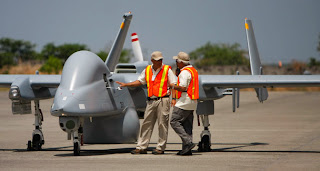
In the opinion of this blogger, it is expected that most Pakistanis will take pride in the nation's indigenous capacity to build and eventually use armed drones to put down the insurgent groups such as the Tehrik-e-Taliban Pakistan (TTP) who have unleashed a reign of terror in Pakistani towns and cities. Most such attacks cause large numbers of innocent civilian casualties and powerful, palpable anger against the responsible groups.
Many Pakistanis will also see the development and manufacturing of UAVs positively in the context of Pakistan's competition with archrival India's UAV effort backed by the Israelis. But there are some elements in Pakistan who are irrevocably opposed to any military action by US or Pakistan against the Taliban or Al Qaeda and their allies. They will loudly oppose the the development, manufacture and use of drones against any internal insurgency, just as they have opposed the US drones attacking targets in Pakistan's FATA region. Fortunately, support for such groups on both the left and the right is rapidly declining, especially after the reported killing of Baitullah Mehsud who was seen as public enemy #1 by the vast majority of Pakistanis.
While it is absolutely desirable for Pakistan to replicate US Predator capabilities and become self-reliant to avoid the political backlash when US predator strikes claim innocent Pakistani civilian lives, I doubt if it'll happen any time soon. While Washington has offered the UCAV (Unmanned Combat Aerial Vehicles) technology to its allies in Europe, it has been reluctant to make it available to Pakistan. Meanwhile, the Indians are likely to get the US armed drone know-how through the Israelis.
The growing interest by Pakistani military and also foreign companies and governments has helped spawn several private Pakistani UAV companies specializing in air-frames, launch and propulsion, flight control, tele-command and control systems, signal intelligence, training simulators, etc. In addition to Integrated Dynamics, other private companies involved in UAV development and manufacturing include, East-West Infinity, Satuma and Global Industrial Defense Solutions.
Pakistan UAV1
Flamingo - Satuma Pakistan
Pakistan UAV 2
Mukhbar- Satuma Pakistan
Pakistan UAV Uqaab
Uqaab - Air Weapons Complex
I think the current generation of Pakistani drones, including the Italian designed Falco, are not at all comparable to the larger US drones armed with powerful Hellfire missiles and sophisticated targeting technology which still results in serious errors. Regardless of the sophistication of drones, such errors can only be reduced by improving the accuracy and reliability of the human intelligence on the ground in FATA.
Here's a recent report by Farhan Bokhari of Jane's Defense Weekly on Falco production launch in Pakistan:
The Pakistan Aeronautical Complex (PAC), Pakistan's chief aircraft manufacturing facility, has formally launched plans to part-produce the Falco unmanned aerial vehicle (UAV), a system already acquired by the Pakistan Air Force (PAF) from Italian company Selex Galileo. The project, unveiled on 20 August, will result in some of the Falco's parts being manufactured domestically to reduce reliance on Italian imports.
The new programme marks an important step towards achieving an indigenous UAV capability - something seen as increasingly important to the PAF as it expands its role in the country's war against militants across North West Frontier Province (NWFP). Air Chief Marshal Rao Qamar Suleman, the chief of staff of the PAF, told Jane's earlier in August about the PAF's growing role in supporting anti-terrorism operations. UAVs are understood to be central to these efforts. Earlier this year, the Pakistani military successfully blocked an advance by Taliban militants in and around the northern Swat valley, with the PAF "carrying out several strikes on Taliban strongholds" following UAV surveillance, according to a senior Pakistani security official.
The PAC chairman Air Marshal Farhat Hussain Khan said at the project's opening ceremony that continued use of the Falco "would greatly enhance the PAF's operational capability". Western defence officials in Islamabad told Jane's that Pakistan would eventually seek another armed UAV or work with Selex Galileo to develop a weaponised version of the Falco. "Today, the Falco UAV is principally for [reconnaissance] and intel-gathering purposes," said one official. "But I am sure the Pakistanis will eventually try to go for UAVs armed with missiles."
The launch of the Falco project precedes the PAC's roll-out, expected later this year, of the first locally built JF-17 fighter, an aircraft jointly developed by the PAC and China's Chengdu Aircraft Corporation (CAC). The PAF plans to acquire at least 250 JF-17s to form the backbone of its fighter fleet. "The Falco UAV and the JF-17 both fit into the same philosophy, which is to reduce reliance wherever possible on imports," said the Western official. "Over time, Pakistan seems to be getting into handling more and more sophisticated technology."
Falco UAV Finds Pakistan A Most Suitable Environment
The Pakistan Air force has initiated the start of the Falco UAV Co-Production Project. The project was inaugurated at Pakistan Aeronautical Complex (PAC) Kamra last Thursday, with Air Marshal Farhat Hussain Khan, Chairman, PAC Board, was the featured guest at the occasion. Falco is an advanced tactical Unmanned Aerial Vehicle (UAV) designed by Selex Galileo, Italy, and will be co-produced by Pakistan Aeronautical Complex, Kamra. The Falco UAV will address the present and future surveillance and reconnaissance needs of the Pakistan Air Force. Speaking on the occasion, Air Marshal Farhat Hussain said the addition of UAV co-production facility would be a major step towards the long-term goal of self reliance in military aviation industry. He lauded the efforts of engineers and technicians of Pakistan Aeronautical Complex who had worked diligently for the last two years to establish the facility. He further stated that Falco UAV will greatly enhance the PAF operational capability. Earlier, Managing Director Aircraft Manufacturing Factory, Air Vice Marshal Aminullah Khan and Managing Director F6 RF, Air Commodore Nadeem Aslam, presented an appraisal of the project activities. The induction of this technology has opened a new dimension in the field of aviation manufacturing at PAC and would be used for other requirements of aviation industry. The roll-out of the first co-produced Falco UAV from Pakistan Aeronautical Complex should occur in the near future.
Here is a vide clip about Pakistani drones:
Related Links:
Asian Defense
Pakistan's Defense Production Going High Tech
Flying High in Korangi: Pakistani Drones
Growing India-Israel Defense Collaboration
Pakistan Military Business and Industrial Revolution
Jane's Defense Industry Briefing on Pakistan
India-Pakistan Military Balance
Pakistan's Arms Industry
India's Israeli Supported UAV Plans
Pakistan Defense Production
Dinar Standard
Washington Offers Predators to Germany, Italy
Demolishing India's War Myths about Pakistan
Chuck Yeager on Pakistan Air Force

In the opinion of this blogger, it is expected that most Pakistanis will take pride in the nation's indigenous capacity to build and eventually use armed drones to put down the insurgent groups such as the Tehrik-e-Taliban Pakistan (TTP) who have unleashed a reign of terror in Pakistani towns and cities. Most such attacks cause large numbers of innocent civilian casualties and powerful, palpable anger against the responsible groups.
Many Pakistanis will also see the development and manufacturing of UAVs positively in the context of Pakistan's competition with archrival India's UAV effort backed by the Israelis. But there are some elements in Pakistan who are irrevocably opposed to any military action by US or Pakistan against the Taliban or Al Qaeda and their allies. They will loudly oppose the the development, manufacture and use of drones against any internal insurgency, just as they have opposed the US drones attacking targets in Pakistan's FATA region. Fortunately, support for such groups on both the left and the right is rapidly declining, especially after the reported killing of Baitullah Mehsud who was seen as public enemy #1 by the vast majority of Pakistanis.
While it is absolutely desirable for Pakistan to replicate US Predator capabilities and become self-reliant to avoid the political backlash when US predator strikes claim innocent Pakistani civilian lives, I doubt if it'll happen any time soon. While Washington has offered the UCAV (Unmanned Combat Aerial Vehicles) technology to its allies in Europe, it has been reluctant to make it available to Pakistan. Meanwhile, the Indians are likely to get the US armed drone know-how through the Israelis.
The growing interest by Pakistani military and also foreign companies and governments has helped spawn several private Pakistani UAV companies specializing in air-frames, launch and propulsion, flight control, tele-command and control systems, signal intelligence, training simulators, etc. In addition to Integrated Dynamics, other private companies involved in UAV development and manufacturing include, East-West Infinity, Satuma and Global Industrial Defense Solutions.
Pakistan UAV1
Flamingo - Satuma Pakistan
Pakistan UAV 2
Mukhbar- Satuma Pakistan
Pakistan UAV Uqaab
Uqaab - Air Weapons Complex
I think the current generation of Pakistani drones, including the Italian designed Falco, are not at all comparable to the larger US drones armed with powerful Hellfire missiles and sophisticated targeting technology which still results in serious errors. Regardless of the sophistication of drones, such errors can only be reduced by improving the accuracy and reliability of the human intelligence on the ground in FATA.
Here's a recent report by Farhan Bokhari of Jane's Defense Weekly on Falco production launch in Pakistan:
The Pakistan Aeronautical Complex (PAC), Pakistan's chief aircraft manufacturing facility, has formally launched plans to part-produce the Falco unmanned aerial vehicle (UAV), a system already acquired by the Pakistan Air Force (PAF) from Italian company Selex Galileo. The project, unveiled on 20 August, will result in some of the Falco's parts being manufactured domestically to reduce reliance on Italian imports.
The new programme marks an important step towards achieving an indigenous UAV capability - something seen as increasingly important to the PAF as it expands its role in the country's war against militants across North West Frontier Province (NWFP). Air Chief Marshal Rao Qamar Suleman, the chief of staff of the PAF, told Jane's earlier in August about the PAF's growing role in supporting anti-terrorism operations. UAVs are understood to be central to these efforts. Earlier this year, the Pakistani military successfully blocked an advance by Taliban militants in and around the northern Swat valley, with the PAF "carrying out several strikes on Taliban strongholds" following UAV surveillance, according to a senior Pakistani security official.
The PAC chairman Air Marshal Farhat Hussain Khan said at the project's opening ceremony that continued use of the Falco "would greatly enhance the PAF's operational capability". Western defence officials in Islamabad told Jane's that Pakistan would eventually seek another armed UAV or work with Selex Galileo to develop a weaponised version of the Falco. "Today, the Falco UAV is principally for [reconnaissance] and intel-gathering purposes," said one official. "But I am sure the Pakistanis will eventually try to go for UAVs armed with missiles."
The launch of the Falco project precedes the PAC's roll-out, expected later this year, of the first locally built JF-17 fighter, an aircraft jointly developed by the PAC and China's Chengdu Aircraft Corporation (CAC). The PAF plans to acquire at least 250 JF-17s to form the backbone of its fighter fleet. "The Falco UAV and the JF-17 both fit into the same philosophy, which is to reduce reliance wherever possible on imports," said the Western official. "Over time, Pakistan seems to be getting into handling more and more sophisticated technology."
Falco UAV Finds Pakistan A Most Suitable Environment
The Pakistan Air force has initiated the start of the Falco UAV Co-Production Project. The project was inaugurated at Pakistan Aeronautical Complex (PAC) Kamra last Thursday, with Air Marshal Farhat Hussain Khan, Chairman, PAC Board, was the featured guest at the occasion. Falco is an advanced tactical Unmanned Aerial Vehicle (UAV) designed by Selex Galileo, Italy, and will be co-produced by Pakistan Aeronautical Complex, Kamra. The Falco UAV will address the present and future surveillance and reconnaissance needs of the Pakistan Air Force. Speaking on the occasion, Air Marshal Farhat Hussain said the addition of UAV co-production facility would be a major step towards the long-term goal of self reliance in military aviation industry. He lauded the efforts of engineers and technicians of Pakistan Aeronautical Complex who had worked diligently for the last two years to establish the facility. He further stated that Falco UAV will greatly enhance the PAF operational capability. Earlier, Managing Director Aircraft Manufacturing Factory, Air Vice Marshal Aminullah Khan and Managing Director F6 RF, Air Commodore Nadeem Aslam, presented an appraisal of the project activities. The induction of this technology has opened a new dimension in the field of aviation manufacturing at PAC and would be used for other requirements of aviation industry. The roll-out of the first co-produced Falco UAV from Pakistan Aeronautical Complex should occur in the near future.
Here is a vide clip about Pakistani drones:
Related Links:
Asian Defense
Pakistan's Defense Production Going High Tech
Flying High in Korangi: Pakistani Drones
Growing India-Israel Defense Collaboration
Pakistan Military Business and Industrial Revolution
Jane's Defense Industry Briefing on Pakistan
India-Pakistan Military Balance
Pakistan's Arms Industry
India's Israeli Supported UAV Plans
Pakistan Defense Production
Dinar Standard
Washington Offers Predators to Germany, Italy
Demolishing India's War Myths about Pakistan
Chuck Yeager on Pakistan Air Force

Comments
NEW DELHI: Defence ministry has approved another major induction of spy drones or UAVs (unmanned aerial vehicles) for armed forces, with
surveillance and intelligence-gathering missions becoming critical on the western and eastern fronts as well as along the huge coastline. Army, for instance, is going in for two more “troops” (6-8 birds each) of advanced Heron UAVs from Israel for
Rs 1,118 crore after getting the nod from the Defence Acquisitions Council headed by defence minister A K Antony.
The 1.13-million strong force has also projected a requirement of seven “troops” of the Rustom drones being developed by Defence Research and Development Organisation and Aeronautical Development Establishment in a Rs 1,000 crore project with Israeli help.
As a MALE (medium-altitude, long-endurance) drone, Rustom will be capable of operating for 24 hours, with a 300-km range and a 10,000-metre maximum altitude. Army, of course, is already inducting the indigenous Nishant and Lakshya UAVs.
Similarly, Navy’s case for two more Israeli UAVs at a cost of Rs 386 crore has also been approved, in addition to the ongoing Rs 1,163 crore joint project between Israel Aerospace Industries (IAI) and DRDO for NRUAVs (naval rotary UAVs).
Navy is already using its UAV fleet of eight Searcher-II and four Herons for maritime surveillance up to 200 nautical miles. “To be operated from warship decks, the NRUAVs will further extend the surveillance out at sea,” said an official.
Moreover, as reported earlier, Army also wants to induct a “large number” of man-portable “mini” and “micro” UAVs for short-range surveillance and NBC (nuclear, biological, chemical) detection in the battlefield.
With Army planning to induct these miniature spy drones right down to the battalion-level by 2017, it’s keen they also be capable of carrying explosives for “hard kill” of “light targets”.
Apart from regular infantry units, Para (Special Forces) battalions will also get these “stealthy” drones for covert missions beyond enemy lines and counter-terrorism operations. The armed forces had gone in for a major infusion of Israeli UAVs after the 1999 Kargil conflict and the 2002 Operation Parakram in the wake of Parliament terror attack.
At present, they have over 100 UAVs, primarily Israeli ones like Searcher-II and Heron, as also some “killer drones” designed to detect and destroy enemy radars by functioning like cruise missiles. While the aim in the 11th Plan (2007-2012) period is to also induct armed drones like the American ‘Predators’, which are being successfully used to take on Taliban in Af-Pak region with their ‘Hellfire’ missiles, the eventual objective is to have full-fledged UCAVs (unmanned combat aerial vehicles). The plan, as of now, is to further boost the snooping capabilities of armed forces as well as fully-integrate UAVs with weapon platforms for delivering precision-guided munitions.
KARACHI, July 19 (Bernama) -- A Pakistani navy pilotless drone crashed near an oil refinery after hitting a bird in the country's largest city of Karachi on Tuesday,the navy said.
A spokesman said that there were no casualties and that the drone had been on a surveillance flight when a bird accidentally flew into the aircraft and it came down in the Karachi suburbs.
The aircraft burst into flames after hitting the ground but the flames were extinguished after a short while, reported China's Xinhua news agency on Tuesday.
It was the third aircraft crash in Karachi in eight months.
Pakistan is developing its own drone technology for surveillance and reconnaissance missions because the United States, which is running a bombing campaign with drones in the country's northwest, refuses to give Pakistan the technology.
Two companies in Islamabad, Satuma and East West Infiniti, make drones for the Pakistani military. It is not known if the crashed drone belonged to either company.
China's Xinhua news agency, citing local press reports, that the aircraft crashed in the highly sensitive area where three major oil storages are located.
Rescue teams were sent to the area to check if anyone was hurt on the ground, police said, adding that the fire fighters rescue team were called to control the blaze after some time, police said.
The police sources earlier said they were investigating if it was an act of terrorism as it crashed in the sensitive no-fly zone due to big oil storages.
http://www.bernama.com.my/bernama/v5/newsindex.php?id=602244
1. Airframe and low-observable design: While this is by no means the most important piece of information that can be gleaned from this drone, being in possession of a confirmed LO platform does allow someone to analyze it completely and replicate it. As far as the physical elements of design which contribute to stealth go, Iran should be able to get 100% of that information simply by observing, measuring and modeling this aircraft.
2. Materials: Reverse engineering many materials is entirely possible by studying their chemical composition. For example, RAM coatings....
3. Propulsion: There are two elements here; first, the engine itself, and second the techniques used to reduce the engine’s heat/sound signature. Let me tackle the first one here. I don’t know how advanced the power plant in the RQ-170 is, but reverse engineering a complex jet engine may not be possible in a short timeframe....
4. Techniques used for signature reduction: The RQ-170 design will likely employ numerous techniques to reduce the heat (IR) signature emanating from the engine or other active sources in the aircraft. It would also likely use techniques to reduce audio signature. Iran can definitely get a lot of value by studying the design, materials used and techniques employed to achieve this signature reduction. The Iranians have their own stealth project, the “Sofre Mahi”. This analysis could help them advance that stealth fighter development effort.
5. The actual audio signature of the RQ-170: This speaks more to detecting the presence of aircraft like the RQ-170 in future. For example, does the engine of the ’170 give off a particular “whine”, i.e. does it have a distinct audio signature? Depending on whether this is a high frequency, it could be possible to deploy audio sensors particularly tuned to listen for this pitch as a means for detection.
6. The all-aspect radar signature of the RQ-170: No design is perfect. There may be certain aspects which produce a higher signature than others. Now that Iran can study the full response profile of an RQ-170, it may learn more about how to detect these aircraft in future using radar configurations.
7. The cameras: This would be a huge asset for the Iranians in two ways. First, they will now know the exact capabilities of this surveillance platform in terms of resolution, light spectrum performance and numerous other aspects. This means they could plan on how to evade such surveillance. ....
8. The transceivers: There will be numerous transceivers on board and each of these will give the Iranians lots of information that can be used to develop cyber warfare capabilities to neutralize US drones, and also the means to eavesdrop on US communications. For example, the satellite transponder will tell the Iranians exactly which frequencies are used by US drones for sat link-up. Could the Iranians deploy balloon-based transmitters that “jam” or “spoof” these frequencies and deploy these over their own country, thus making it difficult for these drones to have a clean sat linkup? ...
9. The algorithms: This is a tough one. One line of thought says that it would be impossible to extract any “code” from this platform. Perhaps. But another line of thinking says that the processors and controllers employed in military projects are not much different to those available commercially. Yes, they have much higher tolerances and quality standards, but a lot of the basic technology is the same. ...
10. Encryption: This would apply both to the radio/satellite transceiver links as well as to any data or code stored on the RQ-170s own systems. ......
http://www.techlahore.com/2011/12/10/what-can-iran-learn-from-the-us-rq-170-stealth-drone/
Reports of Pakistan working on producing its own drones began to surface in 2009. The most highly touted model is called the “Burraq”, named for a mythical winged creature that is said to have carried the Prophet Muhammed.
Masood said the military is working hard on it, but there’s still no guarantee it will be flying anytime soon.
“I think they are on a high priority. There is no doubt about it, they are on a high priority. But even if a weapons system is on a high priority because of the complexity and the advanced nature of its technology it may take some time before it is mastered and its full utilization is made.”
In fact, Pakistan already has a long history of designing and producing drones, many of them created by a man named Raja Sabri Khan.
His near obsession with unmanned aircraft started at a young age. Khan found himself compelled to do whatever it took to fund his research.
“I augmented my nonexistent earnings by teaching physics and doing fashion photography so these helped Pakistan’s first drones to be created,” Khan said.
His clear preference for model aircraft over fashion models carried Khan to the top of his industry. In fact, he said he’s sold his unarmed drones to a company he does not want to name in the United States.
Khan said the drones flying in American airspace are being used for law enforcement, security and even search and rescue.
But he is adamantly opposed to arming drones because of the risk that innocent people will be harmed.
Still, Khan expects Pakistan’s political and military leaders will push ahead, seeing a missile firing drone as nothing more than the latest airborne weapon of war.
“I feel bombing civilians is unfair,” he said. “It’s something that cannot be condoned. But at the same time, a drone is nothing more than an aircraft without a pilot [on board]. And if you use it to fight a war, I think political considerations far outweigh the idealistic side of the issue.”
There is another potential side effect of Pakistan’s determination to manufacture its own drone fleet. Talat Masood said China has become a key partner in the development of the Burraq drone.
Masood said the US, which has cooperated with the Pakistani military on joint projects and training for years, should be paying attention.
“So you can see how lasting those bonds are. And any country which has a defense relationship which is strong and binding, then the relationship also becomes very lasting,” he said.
http://www.theworld.org/2012/04/pakistan-building-its-own-drones/
A Practical UCAV for Pakistan
The attempt forward will be to propose a solution in the form of a UCAV for the PAF. We will first focus on some basic parameters that need to be fulfilled. The focus will then shift to defining a specific solution that meets those requirements in a most balanced manner.
We identify the following characteristics as imperative for the discussed UCAV solution:
1. Unmanned Platform
2. Simple construction and achievable technology
3. Simplified single-engine buildable in Pakistan
4. Relatively Low Cost
5. Economy and asymmetry in sensor load
6. Using parts bin of existing aircraft and from industry partners
7. Designed for high altitude, high speed f-pole BVR combat
8. Structure can operate in and sustain high G-forces
9. Artificial Intelligence
10. Network centric
11. Swarm & Group Tactics
12. Low Observable
13. Combat Air Patrol efficiency
14. Interceptor suitability
------------------
In the Grande Strategic view, PAF can use large numbers of J-UCAVs as a cheap and ideal counter for IAF and any other air force that seeks to undermine Pakistani airspace. They could form a picket line that are the first to deal with enemies and are reinforced with manned fighters where necessary. Such J-UCAVs would require very low maintenance, near zero training costs and may be cheap enough to not worry about being put outside hardened shelters, a valued commodity for PAF. Armed with 2 BVRs and 2 WVRs, J-UCAVs could prove to become the foot soldier of the skies, lightly armed and yet overwhelming in their numbers.
In Conclusion
UCAVs are an emerging technology that has the potential to revolutionize air warfare. While the 5th generation of combat planes is today the pinnacle of military aviation, UCAVs present paradigms that can supplement if not supplant manned fighters of the 4th and 5th generations. People who discuss a potential 6th generation inevitably mention unmanned aircraft as a likely salient. Unlike the 5th generation of aircraft that are extremely expensive and complex to build and maintain UCAVs provide the potential of finding an equivalent solution with significant reduction in complexity and cost.
The PAF has until now not considered UCAVs in the air-to-air role. With the systematic addition of net-centric warfare with platforms such as Erieye, ZDK03, ground radars, future planned communication satellite and the necessary middleware for a superior C4I, Pakistan has managed to transform the battle environment to one were UCAVS can multiply the effectiveness and flexibility of the entire air defense system.
While nations struggle to keep their 4th generation aircraft operational and can barely dream about 5th generation solutions, UCAVs provide an interesting paradigm shift that cannot be ignored by those entrusted with the defense of their nations and peoples. For some like Pakistan, UCAVs may be the only realistic way to counter a large number of PAKFAs and possibly other 5th generation planes sitting across the border in belligerent India, whose stalwarts dream about “cold starts” and “surgical strikes”, and are only kept at bay by the strength of arms and the courage of the Pakistani soldier; whether on land, in the depths of the seas, or up high over the towering mountains and skies above.
http://www.asian-defence.net/2010/12/ucavs-future-of-air-warfare-for-paf.html
This country's defense industry is building what companies hope will be a domestic fleet of aerial drones that can take over the U.S.'s role in attacking militant strongholds.
The U.S.'s persistent use of armed drones to kill militants in remote parts of Pakistan has created a public backlash that has damaged the relationship between the two nations.
--
But Pakistan isn't altogether against drones. The nation's leaders want to have more control over where and how they are used, and are encouraging local drone makers to build up the country's budding arsenal.
"The future era is toward unmanned operations," said Sawd Rehman, deputy director of Rawalpindi, Pakistan-based Xpert Engineering, which builds aerial drones. "The policy of self-reliance is always priority No. 1 of every nation."
---
Instead, Xpert and a small number of other companies are working to develop the country's own fleet of unmanned aerial vehicles—a force they hope will one day supplant the American drones that dominate the country's border with Afghanistan.
"We have tried our best asking the United States to transfer this technology to us so we can fight our own war instead of somebody from abroad coming and doing it," said Maj. Gen. Tahir Ashraf Khan, director general of Pakistan's Defense Export Promotion Organization. "Those efforts did not meet with success, so we decided to venture into this field ourselves—and we have gone pretty far ahead."
Pakistan's military already uses a small but growing number of unarmed drones, some of them manufactured at home, to monitor the borders, coast and mountain ranges that serve as sanctuaries for some of the world's most wanted militant leaders, including the Taliban and its allied Haqqani Network.
---
Without advanced satellite technology, the Pakistanis are incapable of developing armed drones by themselves now. It will take years, if not decades, for Pakistan to develop a fleet of armed drones to rival America's Predator and Reaper models, many analysts and people in the industry say.
---
To expand its capabilities, Pakistan is looking for help from China, which has marketed its own version of armed drones to developing countries.
"Pakistan can also benefit from China in defense collaboration, offsetting the undeclared technological apartheid," Pakistan Prime Minister Raja Pervez Ashraf said at a recent arms expo in Karachi, in apparent reference to U.S. reluctance to share its technology with Pakistan.
GIDS produces one of Pakistan's newest and most advanced drones, a medium-range vehicle called the Shahpar that can fly for about seven hours—a fraction of the 40 hours a Predator can spend in the sky.
To supplement its nascent drone industry, Pakistan has been working with Italy's Selex Galileo SpA to produce a medium-range Falco drone with limited capabilities that the Pakistani military has been using for surveillance since at least 2009, when the government staged operations against militants based in Swat Valley in northeastern Pakistan.
While Pakistan has looked to other countries to advance its drone capabilities, one Pakistani company said it has exported a small number of drones to a private company in the U.S.
Raja Sabri Khan, chief executive of Integrated Dynamics, a Karachi-based drone manufacturer, said he thought the U.S.'s use of armed drones has given the industry a bad name. He aims to help rehabilitate the perception of drones by promoting their peaceful uses, such as the ability to locate flood victims for rescue. "Drones can be used for saving lives, for security," he said. "I'm absolutely against drones for armed purposes."
online.wsj.com/article/SB10001424127887324712504578133483559620340.html
ISLAMABAD: Robotics as a discipline of science and technology is being taught at the graduate and post-graduate levels by more than 60 universities of Engineering Science and Technology in Pakistan, official sources told Daily Times here on Saturday.
The research and development (R&D) in advanced fields of Robotics and Artificial Intelligence has also been undertaken by some of laboratories established in the R&D institutes and universities in Pakistan. The official in the Ministry of Science and Technology claimed that there is a technical group engaged in development of automation of industrial processes at the National Institute of Electronics (NIE), Islamabad. The group has developed Programmable Logic Controllers (PLCs), which are used in automatic industrial controls.
The Centre for Intelligent Machines and Robotics (IMR) at the COMSATS Institute of Information Technology has a Research Group, which is undertaking research related to robotics, computer vision and machine learning. The IMR Research Group is conducting basic and applied research in robotics technologies relevant to industrial and societal tasks; the robotics technology in Pakistan has the potential role in boosting the productivity and competitiveness. The researchers at CIIT are working for projects on visual guided robotic systems for use in surgery, navigation control, mapping and geometric representation of environmental parameters.
National Engineering Robotics Contest (NERC) is an inter universities robotics competition held annually since 2005 at the NUST. The contest is organised by HEC, the Science, Technology, Engineering and Mathematics (STEM) Careers Project with more than 60 Pakistani universities participating in the event, and aims to train individuals for engineering services in Pakistan, and cash prizes are awarded to the winners.
NERC 2011 held at the College of Electrical and Mechanical Engineering (EME), Rawalpindi from June 28 to July 2. Many universities like FAST, GIKI, LUMS, CASE and UET Lahore participated in the event, where students were encouraged to design, develop and programme their respective robots.
R&D projects on Tele-Surgical Training Robot and Simulators and Development of Intelligent Robotic Wheelchairs are being undertaken by NUST funded by ICT R&D Fund.
International workshops and seminars for knowledge sharing and events at national level for talent hunt among youth in the fields of robotics have been organised regularly at NUST. Specialisation in robotics is a popular choice for students going abroad to study under various scholarships schemes for research and PhD. This field offers job opportunities, and robotics engineers can apply their mastery in diverse fields like modern warfare, surgery, nano-technology and space-exploration.
The official claimed that developing a robot comes with the goal of finding a solution to the problem. Along with the technical know-how, interest in research is essential. This field has promising opportunities, with no boundaries and will continue to grow with the advancement of science and technology in the near future.
http://www.dailytimes.com.pk/default.asp?page=2013\02\10\story_10-2-2013_pg5_12
Rawalpindi:The 1st International two days Conference on Robotics and Artificial Intelligence was organized at NUST, College of Electrical and Mechanical Engineering.The conference held under flagship of IEEE and National University of Sciences and Technology (NUST) on Monday.
ICRAI is the first of its series, and this conference will be held biennially. This conference covers latest and emerging trends in the fields of robotics and artificial intelligence including Intelligent Mechatronics and Robotics, Haptics, Tele and Medical robotics, Unmanned Vehicles, Prosthetics, Micro and Nano robotics, Artificial Intelligence, Neuro and Fuzzy control, Human Machine Interface and Automation.
Maj Gen. Obaid Bin Zakria, commandant college of E&ME welcomed all participants and guests at the opening ceremony. He highlighted the importance of research conferences around the world and said that this is how knowledge integrates into development of great ideas.
He appreciated the efforts put in by the Department of Mechatronics Engineering for arranging such an event. He said that NUST College of E&ME has been a home to novel, state of the art projects and the research work being done here is no less than the work done internationally. Our students are technically sound, very talented and extremely competent and the work presented in this conference is a proof of that.
Dr. Mahmood Anwar Khan, the Conference Chair informed that more than 110 research papers had been submitted to the conference and after a thorough review, 20 were accepted for oral presentation and 13 for poster. He also mentioned that the conference was graced by four International key note speakers from USA, UK and Korea.
Dr. Francisco Sepulveda from University of Essex, UK gave an interesting keynote talk on Brain Computer Interface Systems . At the end of his talk, he praised the level of research being done in Pakistan.
Dr. Lynn E Parker from University of Tennessee, USA said in her recorded message that The conduct of such an event in Pakistan shows the research maturity of the academic institutions . She further assured to attend the conference next time.
Dr. Younus Javed, Dean NUST College of E&ME emphasized that such events and meetings give a chance to form collaborative projects and research groups.
Dr. Javaid Iqbal, Head of Mechatronics Engineering Department appreciated the turnout at the conference and said that the aim of conference is to have collaboration of national and international researchers from a wide range of academic and professional backgrounds to bridge the gap.
At the end of the ceremony, the Chief Guest Dr. Javaid R. Laghari, chairman Higher Education Commission (HEC) gave souvenirs to the foreign keynote speakers.
In his address, the Chief Guest congratulated NUST College of E&ME for arranging 1st International Conference on Robotics and Artificial Intelligence in Pakistan.
He mentioned that conferences like this are not only a platform for great minds to meet but also a venue for research collaboration. He said that everyone should make the most of this opportunity and socialize and discuss latest topics of research.
He also mentioned that this conference was the first of its kind and expected it to grow over the years into one of the prestigious conferences in the field of Robotics and Artificial Intelligence .
A large number of participants from many Universities, colleges and research organizations of the country have benefited from this well focused and target oriented conference.
http://pakistan.onepakistan.com.pk/news/city/141930-1st-international-conference-on-robotics-and-artificial-intelligence-icrai-2012-held.html
The armed forces announced on Monday that they had inducted the very first fleet of unmanned aerial vehicles (UAV) in the Army and the Air Force.
According to a release from the Inter-services Public Relations (ISPR) announced that the first fleet of strategic drones, ‘Burraq’ and ‘Shahpar’, had been inducted into the forces. Both of the drones were produced indigenously.
The military described the induction as a “landmark and historic event,” where a “very effective force multiplier has been added to the inventory of the armed forces.”
“In the future these UAVs could also be gainfully employed in various socio-economic development projects, as well,” it added, hinting at the possibility of using drones in non-combat settings and for civilian use.
The induction ceremony was attended by Chief of Army Staff General Ashfaq Parvez Kayani, Chief of the Air Staff Air Chief Marshal Tahir Rafique Butt, Director General Strategic Plans Division Lieutenant General (Retd) Khalid Ahmed Kidwai, and senior officers from armed forces, scientists and engineers.
General Kayani, while appreciating the work of NESCOM scientists and engineers, highlighted that induction of indigenously developed surveillance capable UAVs in Pakistan Armed Forces is a force multiplier, and will substantially enhance their target acquisition capabilities in real time.
http://tribune.com.pk/story/636833/army-air-force-induct-first-fleet-of-indigenously-developed-drones/
Pakistan’s military unveiled two domestically produced drones Monday, even as the country is facing growing protests over U.S. drone strikes on Pakistani soil.
After years of preparation, the Strategically Unmanned Aerial Vehicles were formally announced by Gen. Ashfaq Kayani, chief of Pakistan’s military. The drones, called Burraq and Shahpar, will not be armed and are to be used only for surveillance, military officials said.
The development of the drones, thought to have a range of about 75 miles, represents a milestone for the country’s military and scientists, Pakistani and Western analysts said.
“It is a landmark and a historic event, wherein a very effective force multiplier has been added to the inventory of the armed forces,” the Pakistani military said in a statement.
For years, Pakistan’s military has seen up-close the effectiveness of the U.S. drone campaign, which has included hundreds of strikes within the country’s borders. When the United States began using armed drones after the Sept. 11, 2001, terrorist attacks, then-Pakistani President Pervez Musharraf asked President George W. Bush to supply drone technology to his country.
The United States declined, setting in motion Pakistan’s homegrown effort to develop the technology.
Pakistan’s military first revealed its drone technology at a trade show last year, but Monday’s formal unveiling coincides with an ongoing farewell tour by Kayani, who is retiring after two terms as army chief.
Brig. Muhammad Saad, a former senior officer in the Pakistani military familiar with the subject, said the country already had less-sophisticated drones for intelligence gathering, with a range of about six miles. The newer models, he said, will prove useful for the “collecting of more operational intelligence” that could help guide helicopter gunships and fighter jets to specific targets.
“This is a great achievement, and the drones can be used instead of surveillance jets and fighter jets that would be costlier” to fly, Saad said.
Saad and other observers said Pakistan is still years away from being able to develop armed drones. Still, Monday’s announcement is likely to unnerve Pakistan’s neighbors, including India and Afghanistan.
Peter W. Singer, a security analyst at the Brookings Institution, said most surveillance drones can be armed, though they will lack the precision of U.S.-developed models.
“Almost any unmanned system can be armed in a crude style, such as dropping a bomb or even turning it into an equivalent of a cruise missile that you fly into the target,” said Singer, adding that the announcement will probably add to growing fears about proliferation of drone technology.
The Pakistani military’s announcement comes as the country is facing growing discontent in some parts over recent U.S. drone strikes, including an attack this month that killed the leader of the Pakistani Taliban....
http://www.washingtonpost.com/world/asia_pacific/pakistan-unveils-its-own-military-drones-as-protests-continue-against-us-attacks/2013/11/25/fae691cc-5607-11e3-bdbf-097ab2a3dc2b_story.html
https://eurasiantimes.com/pakistan-displays-indias-mig-21-bisons-tail-shot-down-by-paf-f-16/
By
Ashish Dangwal
November 17, 2022
The tail section of a MiG-21 of the Indian Air Force is on display at IDEAS-22 that was shot down on February 27, 2019, during Operation Swift Retort, by a Pakistani F-16. New Delhi and Islamabad made different statements about the event’s occurrence at the time.
-----
Meanwhile, the J-17C’s informative photos, one of which also shows the cockpit, are being presented at the event. A video module of the aircraft is also showcased at PAF Pavilion during IDEAS 2022.
Pakistan’s JF-17C, also known as Block 3, is the latest version of the J-17 aircraft. The Chengdu Aircraft Corporation (CAC) of China and the Pakistan Aeronautical Complex (PAC) collaborated to develop the medium-sized multi-role JF-17 ‘Thunder’ fighter aircraft for the Pakistan Air Force.
The service has received more than 100 Thunder jets since 2007.
The JF-17 C model is thought to have taken to the skies for the first time in December 2019. The PL-10E, which China describes as its most advanced air-to-air missile, was also spotted being carried by the JF-17 Block 3 in 2021.
The JF-17C has notable upgraded capabilities, such as Missile Approach Warning Systems (MAWS), Wide Angle Smart HUD, more Chin Hardpoints, and an integrated EW suite.
Another photograph that has gained popularity on the internet is thought to be the finest image of a PAF JF-17C – dubbed Block 3 – so far.
The DEPO organizes IDEAS every two years. Since its beginning in 2000, IDEAS has established itself as a worldwide staging ground for defense manufacturers, business owners, R&D professionals, finance experts, and top-level officials.
However, in terms of space, reservations, exhibitors, and delegates from domestic and international countries, this year’s event has reportedly eclipsed all records.
The defense expo was inaugurated by Pakistan’s Foreign Minister Bilawal Bhutto-Zardari at the city’s expo center in Karachi. IDEAS 2022 officially started on November 15 and will last through November 18.
In his remarks at the occasion, FM Bhutto-Zardari discussed the current coalition government’s difficulties while noting that it succeeded despite the economic downturn. About 300 exhibitors are showing off their latest products from 32 nations.
This exhibition is attended by about 500 national and international delegates, including high-level delegations from friendly nations.
Prime Minister Shehbaz Sharif tweeted that the nation’s defense industry is meeting the demands of the technological era, and he emphasized that IDEAS had grown into a significant platform in the global defense market.
He stated that this year’s event’s ‘Arms for Peace’ theme represented Pakistan’s commitment to peace and stability. Sharif added that IDEAS had developed into a platform that showcased Pakistan’s expanding impact in the global defense market.
“Good to see that our defense sector is catering to demands of the tech era,” he added.
Meanwhile, the Pakistan Air Force is presenting its aerospace, avionics, cyberspace, and other related technologies at its pavilion. The National Aerospace Science and Technology Park (NASTP) is the PAF pavilion’s biggest attraction.
It is a Pakistan Air Force project to promote industry-academia linkage to provide an ecosystem of critical elements required to nurture design, research, development, and innovation in the aviation, space, and cyber sectors.
---
Speaking at the event, the Air Chief stated that the Pakistan Air Force (PAF) is dedicated to creating advanced technologies in the nation to deliver the most cutting-edge, efficient, and impenetrable aerial defense.