Auto Industry in China, India and Pakistan
Tata Motors is set to launch its low-cost Nano minicar Monday, March 23, according to media reports from India. With a starting price of about $1,945, which doesn't include dealer markup and other charges that consumers will pay, the Nano will be one of the world's cheapest cars. This product launch comes at a time when the auto industry is facing a severe downturn, attributed to the worldwide consumer credit crunch amidst a serious global financial crisis.
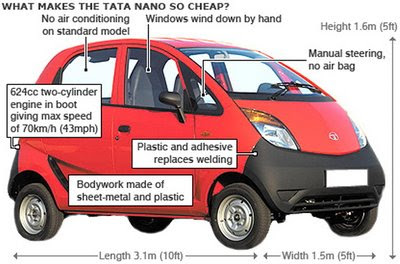
Like other auto makers around the world, Tata Motors is also contending with declining demand, both for its bread-and-butter commercial vehicles in India and its luxury brands, Jaguar and Land Rover. The company reported its first quarterly net loss in seven years in the October-December 2008 quarter, and saw its debt rating cut by ratings firms. More immediately, Tata Motors faces a June deadline to repay $2 billion in loans related to its Jaguar-Land Rover acquisition from Ford Motor Co. last year, according to the Wall Street Journal.
The automobile industry in India—the tenth largest in the world with an annual output of 2 million units last year—is expected to become one of the major global automotive industries in the future. A number of domestic companies produce automobiles in India and the growing presence of multinational investment, too, has led to an increase in overall growth. Following the economic reforms of 1991 the Indian automotive industry has demonstrated sustained growth as a result of increased competitiveness and reduced restrictions. The monthly sales of passenger cars in India exceed 100,000 units, according to a related Wikipedia entry.
In comparison with the rest of the world, the Chinese market for automobiles appears to be relatively robust. Monthly auto sales in China surpassed those in the U.S. for the first time in January, but automakers and industry watchers say the news may tell us more about the troubles in the U.S. than about China's growing car market, says a report published in San Francisco Chronicle.
Data released in February by the China Association of Automobile Manufacturers shows 735,000 new cars were sold in China last month, down 14.4 percent from the record of 860,000 set in January 2008. U.S. sales, meanwhile, fell 37 percent to 656,976 vehicles — a 26-year low.
In Pakistan, Engineering Development Board (EDB) is attempting to increase the GDP contribution of the automotive sector to 5.6%, boost car production capacity to half a million units as well as attract an investment of US$ 3 billion and reach an auto export target of US$ 650 million.
In addition to the growing defense industry, auto industry can become a driving force for the much needed manufacturing industrial base in Pakistan to create significant employment opportunities for its large population. Last year, the auto sector contributed US$ 3.6 billion, only about 2% of the GDP, to the national economy, and employed about 192,000 people.
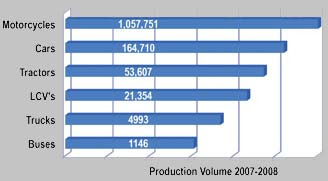
Pakistan's auto parts manufacturing is a billion US dollars a year industry. Sixty percent of its output goes to the motor cycle industry, 22% is for cars, and the rest is consumed by trucks, buses & tractors.
After a significant growth spurt in 2002-2006, the auto sector is feeling the pain of economic slow-down in Pakistan. The industry is continuing in a slump which began in the previous financial year and according to Business Monitor International's recently published Pakistan Automotives Report, the industry’s performance this year will get worse. In FY08, which ended in June 2008, total vehicle sales fell by 6.2%. The downturn carried over into FY09, with sales for the first half of the year (July to December 2008) down by 48% year-on-year to 52,927 units for cars and light commercial vehicles (LCVs), while compared with November, sales for December were down 55%. These results support BMI’s forecast for a drop in sales of cars and LCVs to around 112,000 units in FY09. BMI expects the total auto market in Pakistan to contract by over 32%, with the worst damage done in the car and bus segments, which is forecast to fall by 45% each. Pakistan’s Economic Co-ordination Committee (ECC) is to consider a tax cut of 10% for domestic car manufacturers, which has been proposed by the Ministry of Industries and Production. However, the plan is not without its opposition, as the Federal Board of Revenue is reportedly against supporting individual sectors as this would prompt other industries to seek help. Moreover, with just five carmakers producing locally, the automotive industry is relatively small. On the other hand, the industry is also largely self-sufficient as the majority of its output is sold within Pakistan; this reduces the country’s reliance on imports and raises issues such as the protection of local jobs and the industry’s contribution to the overall economy.
Among the automakers, Indus Motors and Pakistan Suzuki reported positive earnings: The two leading car assemblers PSMC and INDUS posted positive earnings for 2008. PSMC reported operating losses of Rs 399 million. However, increase in other income by 77 percent offset their losses helping PSMC post positive earnings of Rs 26 million, according to Daily Times. Honda posted a loss after tax of Rs 190 million for the period July-December 2008 after a decline in net sales by 5 percent and a massive surge in operating expenses over the corresponding period last year.
The poor state of the industry is reflected in BMI’s Business Environment Rating for the automotive industry in Asia Pacific, where Pakistan is in last place on a score of 42.4 out of a possible 100. The market is held back by low production growth potential and an average rating for sales growth. However, as a signatory to the Trade Related Intellectual Property Rights Agreement (TRIPS) under the auspices of the World Trade Organization (WTO), the country’s regulatory environment scores well. A number of free trade agreements also contribute to this criterion, although forming FTAs with non-Asian countries would improve this rating further. Despite low marks for bureaucracy and corruption, the market does score well for its long-term economic risk and policy continuity.
With just a handful of manufacturers, Pakistan’s competitive landscape remains narrow. Japanese car manufacturers control most of the country’s passenger car production and sales. Figures for FY08 show that Suzuki-brand models represented 62% of total Pakistani passenger car production and 51.7% of sales. Toyota is gaining, however, with Corolla becoming the country’s best-selling model in the first half of FY09.
According to Daily Times, as many as 60,000 workers and staffers in Pakistan's auto sector have lost their jobs from July, 2008 to January, 2009 due to falling demand for cars. More jobs cuts are feared with continuing weakness in demand.
Given strong underlying growth dynamics in South Asia, the negative feedback effects of the global financial crisis are expected to be temporary. A relatively rapid rebound is expected in 2010, with a projected revival of GDP growth to 7.2 per cent. The long term prospects for the auto industry in the continent of Asia appear to be quite favorable. As the current financial crisis ebbs, there will be significant pent-up demand for automobiles in Asia, including India, Pakistan and China, that will drive the growth in auto industry.
Related Links:
Pakistan Automobiles Report 2009
Auto Pakistan Expo 2009
Automobile Technology in Pakistan
A Review of Global Road Accident Fatalities
Pakistan Automotive Report
China Surpasses US in Auto Sales
Auto Industry in India
India's Global Shopping Spree

Like other auto makers around the world, Tata Motors is also contending with declining demand, both for its bread-and-butter commercial vehicles in India and its luxury brands, Jaguar and Land Rover. The company reported its first quarterly net loss in seven years in the October-December 2008 quarter, and saw its debt rating cut by ratings firms. More immediately, Tata Motors faces a June deadline to repay $2 billion in loans related to its Jaguar-Land Rover acquisition from Ford Motor Co. last year, according to the Wall Street Journal.
The automobile industry in India—the tenth largest in the world with an annual output of 2 million units last year—is expected to become one of the major global automotive industries in the future. A number of domestic companies produce automobiles in India and the growing presence of multinational investment, too, has led to an increase in overall growth. Following the economic reforms of 1991 the Indian automotive industry has demonstrated sustained growth as a result of increased competitiveness and reduced restrictions. The monthly sales of passenger cars in India exceed 100,000 units, according to a related Wikipedia entry.
In comparison with the rest of the world, the Chinese market for automobiles appears to be relatively robust. Monthly auto sales in China surpassed those in the U.S. for the first time in January, but automakers and industry watchers say the news may tell us more about the troubles in the U.S. than about China's growing car market, says a report published in San Francisco Chronicle.
Data released in February by the China Association of Automobile Manufacturers shows 735,000 new cars were sold in China last month, down 14.4 percent from the record of 860,000 set in January 2008. U.S. sales, meanwhile, fell 37 percent to 656,976 vehicles — a 26-year low.
In Pakistan, Engineering Development Board (EDB) is attempting to increase the GDP contribution of the automotive sector to 5.6%, boost car production capacity to half a million units as well as attract an investment of US$ 3 billion and reach an auto export target of US$ 650 million.
In addition to the growing defense industry, auto industry can become a driving force for the much needed manufacturing industrial base in Pakistan to create significant employment opportunities for its large population. Last year, the auto sector contributed US$ 3.6 billion, only about 2% of the GDP, to the national economy, and employed about 192,000 people.
Pakistan's auto parts manufacturing is a billion US dollars a year industry. Sixty percent of its output goes to the motor cycle industry, 22% is for cars, and the rest is consumed by trucks, buses & tractors.

After a significant growth spurt in 2002-2006, the auto sector is feeling the pain of economic slow-down in Pakistan. The industry is continuing in a slump which began in the previous financial year and according to Business Monitor International's recently published Pakistan Automotives Report, the industry’s performance this year will get worse. In FY08, which ended in June 2008, total vehicle sales fell by 6.2%. The downturn carried over into FY09, with sales for the first half of the year (July to December 2008) down by 48% year-on-year to 52,927 units for cars and light commercial vehicles (LCVs), while compared with November, sales for December were down 55%. These results support BMI’s forecast for a drop in sales of cars and LCVs to around 112,000 units in FY09. BMI expects the total auto market in Pakistan to contract by over 32%, with the worst damage done in the car and bus segments, which is forecast to fall by 45% each. Pakistan’s Economic Co-ordination Committee (ECC) is to consider a tax cut of 10% for domestic car manufacturers, which has been proposed by the Ministry of Industries and Production. However, the plan is not without its opposition, as the Federal Board of Revenue is reportedly against supporting individual sectors as this would prompt other industries to seek help. Moreover, with just five carmakers producing locally, the automotive industry is relatively small. On the other hand, the industry is also largely self-sufficient as the majority of its output is sold within Pakistan; this reduces the country’s reliance on imports and raises issues such as the protection of local jobs and the industry’s contribution to the overall economy.
 |
| Pakistan Tractor Sales. Source: Trading Economics |
Among the automakers, Indus Motors and Pakistan Suzuki reported positive earnings: The two leading car assemblers PSMC and INDUS posted positive earnings for 2008. PSMC reported operating losses of Rs 399 million. However, increase in other income by 77 percent offset their losses helping PSMC post positive earnings of Rs 26 million, according to Daily Times. Honda posted a loss after tax of Rs 190 million for the period July-December 2008 after a decline in net sales by 5 percent and a massive surge in operating expenses over the corresponding period last year.
The poor state of the industry is reflected in BMI’s Business Environment Rating for the automotive industry in Asia Pacific, where Pakistan is in last place on a score of 42.4 out of a possible 100. The market is held back by low production growth potential and an average rating for sales growth. However, as a signatory to the Trade Related Intellectual Property Rights Agreement (TRIPS) under the auspices of the World Trade Organization (WTO), the country’s regulatory environment scores well. A number of free trade agreements also contribute to this criterion, although forming FTAs with non-Asian countries would improve this rating further. Despite low marks for bureaucracy and corruption, the market does score well for its long-term economic risk and policy continuity.
With just a handful of manufacturers, Pakistan’s competitive landscape remains narrow. Japanese car manufacturers control most of the country’s passenger car production and sales. Figures for FY08 show that Suzuki-brand models represented 62% of total Pakistani passenger car production and 51.7% of sales. Toyota is gaining, however, with Corolla becoming the country’s best-selling model in the first half of FY09.
According to Daily Times, as many as 60,000 workers and staffers in Pakistan's auto sector have lost their jobs from July, 2008 to January, 2009 due to falling demand for cars. More jobs cuts are feared with continuing weakness in demand.
Given strong underlying growth dynamics in South Asia, the negative feedback effects of the global financial crisis are expected to be temporary. A relatively rapid rebound is expected in 2010, with a projected revival of GDP growth to 7.2 per cent. The long term prospects for the auto industry in the continent of Asia appear to be quite favorable. As the current financial crisis ebbs, there will be significant pent-up demand for automobiles in Asia, including India, Pakistan and China, that will drive the growth in auto industry.
Related Links:
Pakistan Automobiles Report 2009
Auto Pakistan Expo 2009
Automobile Technology in Pakistan
A Review of Global Road Accident Fatalities
Pakistan Automotive Report
China Surpasses US in Auto Sales
Auto Industry in India
India's Global Shopping Spree
Comments
Kindly note: The comments section is having problems so you may not be able to comment right now but it will available in a few days. We are also planning to get Live Cricket in our website within this week.
Dear friend, if you have any suggestions or information or news which you think has been ignored by the mainstream media, kindly let us know. We will try to implement that in our website.
Kindly go through the entire website. Who knows, it might just have the right kind of stuff that you are looking for. If you like this website, can you please recommend it to at least 5 of your friends. Your little help would help us in a big way.
Thank you,
The Future Mantra
Please support my new blog.
thank you,
automotive website
Suzuki auto parts
Total auto sales in Pakistan in 1H-FY2010 increased by 16.37% to 61,021 units from ... The auto industry was operating at 37% of its installed capacity of 273 thousand units per annum in FY2009 and it is expected that 20% YoY growth ... units in FY2009. Market players Honda Atlas, Pak Suzuki, Indus Motors, Mitsubishi, Dewan ...
Sales of Tata Motors' Nano, the world's cheapest car, plunged by 85% in November compared with a year earlier, the Indian carmaker has said.
It blamed the slump on the difficulty potential customers had in accessing loans to buy the car.
However, analysts pointed out that a series of fires in the Nano, as well as price rises, had also affected sales.
Tata said its total sales across all models in November were 54,622, a rise of 1% on a year earlier.
The carmaker also said that sales of its Jaguar Land Rover-branded models "continued their upward trend".
Fire hazard
However, the company said it had sold just 509 Nanos during November.
During the month, Tata offered free safety upgrades for the model, which went on sale last year.
This came after owners of the hatchback reported about half a dozen fires since April last year. There were no injuries.
The Nano was introduced to India in April 2009 and there are now about 70,000 of them on the country's roads.
The basic Nano costs about 100,000 rupees ($2,205; £1,414).
Of the 11.4 million natural-gas vehicles currently in use world-wide, most can be found in the developing world, according the International Association for Natural Gas Vehicles, an industry body. Pakistan led with way with 2.3 million as of December 2009, while Iran, Argentina, Brazil and India together accounted for six million more. In China, the number has more than doubled since 2007 to around half a million.
There is a network of 1500 CNG stations in Pakistan to fuel the 2.3 million CNG vehicles.
Not only is Pakistan self-sufficient in building cng kits for domestic use, it is also exporting these kits.
Here's a Tribuneindia report from 2008 titled "India lags behind Pak" in gas infrastructure:
New Delhi, May 5
India is way behind Pakistan in terms of its gas pipeline network, with the neighbouring country’s network stretching around 56,400 km against its 10,500 km, connecting only 20 cities compared to Pakistan’s 1,050, industry body Assocham said.
Pakistan’s pipeline density, at present is 1044 km/mmscmd (million metric standard cubic meter per day) per day compared to 116 km/mmscmd of India, Assocham said in its paper on gas sector ‘A Comparison between India and Pakistan’.
The neighbouring country has created a 31,000 km distribution network to serve its domestic and commercial consumers in large locations, against the 11,000 km network that have so far been build in India to serve the needs of its consumers in limited pockets, the report said.
While Pakistan has nearly 1,600 CNG stations, India has 380. The gas throughput in Pakistan is 38 mmscmd per day as against 8.5 mmscmd gas in India.
The number of gas customers and vehicles running on CNG in Pakistan is about 19 lakh and 15.6 lakh respectively, while in India the number is 5.50 lakh and 4.60 lakh.
“The gas availability in Pakistan is undoubtedly quite large, compared to India but given the imports of gas and even its domestic availability in India, its pipeline network is extremely poor and the main reason attributed for the low and limited pipeline network in India is because this sector has been thoroughly regulated which has now been opened for competition,” Assocham president Venugopal Dhoot said.
The paper added that since the pipeline network in India does not reach out to most of the potential demand centres, a number of industrial projects, which would ideally run on gas, have to depend on much more costlier and more polluting alternative fuels.
Hyundai Motor India ,one of the country’s largest car manufacturer recorded a 17.6% rise over 22,252 units sold in December 2009. Hyundai Motor expexts the market to continue to grow in 2011 although the rate of growth may come down.
Mahindra & Mahindra vehicles segment also registered a growth of 28%, having sold 15,601 units in December 2010, as against 12,212 units during December 2009.Tata Motors vehicle business recorded 28% rise in its total domestic sales in December 2010 at 19,977 units as against 15,661 units in December 2009. Tata Nano sales also touched 5,784 units last month, about 60% higher over December 2009 .Ford India December sales were up 172%, with more than 60,000 units of Figa sold in India since its launch in March 2010.
Final data for 2010 (calendar year) passenger car sales within Pakistan show that a total of 134,757 passenger car units were sold from January-December 2010 period, and passenger car production was 130,625 in total for the calendar year.
Looking at trends at the halfway stage of FY10/11 (July to end June), total vehicle production was 106,810 units, an increase of 9.2% y-o-y on the 97,788 units produced over the same period in FY09/10. This is made up of 62,952 units passenger car production, 1,432 units truck production, 242 units bus production, 504 units jeep production, 8,961 units pick-up production and 32,719 units farm tractor production.
Total vehicle sales for H1FY09/10 were 102,469 units, an increase of 6.2% y-o-y on the 96,440 vehicles sold over the first half of FY09/10. This is made up of 59,646 passenger cars sold, 1,384 trucks, 243 buses, 381 jeeps, 8,072 pick-ups and 32,743 farm tractors.
All of which bodes well for the evolution of Pakistan’s auto sector over the current fiscal year. Our current forecasts are for total FY10/11 production to reach 221,583 units, with sales to reach 224,160 units. Considering the strong start to this fiscal year, there could be some upside risk to these forecasts. However, with car prices continuing to rise and continuing weak economic backdrop in the country, we refrain from making any changes to our forecasts this quarter. Moreover, a recent extension of the age of imported new cars allowed into Pakistan could also hit new car sales (see Page 6 for further information). Considering this mixed outlook for new car sales therefore, we shall await further data from the third quarter of FY10/11 before deciding if any further changes need to be made to our forecasts.
Certainly, the start of FY10/11 saw new car sales fall by 31.6% month on month (m-o-m), to 9,796 units in July, as customers felt the impact of an increase in General Sales Tax (GST) and with heavy flooding causing displacement of people and severe disruption to business across the country. However, this poor monthly performance did not mark the start of a negative trend, with the remaining five months of the calendar year all showing positive growth.
This upwards sales trend came as a surprise to most industry analysts, who had expected a combination of a weak rupee and falling income and demand from flood-affected areas to have sent car sales lower. It may be, however, that with the Pakistan rupee and consumer demand both set to remain weak into 2011, customers chose to buy new cars early in the current fiscal year, for fear that they will continue to increase in price over the coming months. Certainly, local media have speculated that this is what car dealerships have been doing, buying cars in at current prices to hedge against future likely price rises. Increase in imported used cars to meet demand
In January 2011 the Pakistan cabinet passed legislation extending the age limit on imported used cars from three years to five years as it tries to open up car ownership to poorer Pakistanis. The move follows the release of a report by the country’s Economic Coordination Committee which stated that the current import regime of about 30,000-40,000 cars a year was proving insufficient to meet growing demand for private vehicles.
Car sales in Pakistan increased 26 percent to 38,065 units in the quarter ended Sept. 30 from a year earlier, the Pakistan Automotive Manufacturers Association said Oct. 10. Indus sold 12,820 cars in the period, rising from 11,792 a year earlier, according to the association.
-------------
Oct. 25 (Bloomberg) -- Indus Motor Co., Toyota Motor Corp.’s affiliate in Pakistan, posted a 62 percent gain in first-quarter profit as rising incomes boosted sales.
Net income climbed to 937.5 million rupees ($11 million), or 11.93 rupees a share, in the three months ended Sept. 30, from 577 million rupees, or 7.35 rupees, a year earlier, the Karachi-based company said in a filing today. Sales gained 20 percent to 17.1 billion rupees.
Sales of the Cuore, Corolla, and Hilux models assembled by Indus increased more than 9 percent during the three months, according to Shahbaz Ashraf, an analyst at Arif Habib Ltd. Remittances to Pakistan gained 25 percent to $3.3 billion in the period, the nation’s central bank said Oct. 10.
“Rising remittances and farm incomes helped pushed sales for the company,” Ashraf, who has a “buy” recommendation on the stock, said by telephone from Karachi before the company’s announcement.
Indus, Pakistan’s second-largest carmaker, didn’t provide reasons for the profit increase in its filing.
Shares of Indus climbed 2.5 percent to 199 rupees as of 1:24 p.m. on the Karachi Stock Exchange, paring the stock’s decline this year to 21 percent.
Higher crop prices boosted farmers’ incomes in Pakistan by 342 billion rupees in the 12 months through June 30, more than the annual gain of 329 billion rupees in the preceding eight years, according to an economic survey published by the Ministry of Finance.
http://www.businessweek.com/news/2011-10-25/pakistan-s-indus-posts-62-profit-gain-as-sales-rise.html
Karachi - To effectively cope with domestic market of over 1.5 million units and after successful launch of their products in global markets, the local motorcycle producers are now planning a further investment of $100-150 million in their existing units.
The motorcycle industry analysts have pointed out that despite numerous hiccups faced by the economy in recent years, growth in motorcycle production has been robust at 15 per cent. “A decade back, the total motorcycle production in Pakistan was around 100,000 units, now the largest player alone is rolling out half a million units while total production of two wheelers has crossed 1.5 million. They said that the encouraging aspect in this regard is that industry is on the path to sustained growth. The local demand for motorcycles is likely to exceed 2 million units within a year or two,” they added.
“The global response to our quality motorcycles indicate a sustained and healthy growth in exports as well” they opined, adding that in fact, the industry experts are seeing themselves as the largest exporters in the engineering sector. A sustained growth is only possible due to regular investment and up-gradation of technology in the motorcycle industry. “The growth we see in motorcycle production would not have been possible without investment”, they added.
In this regard, Fahad Iqbal CEO, HKF Engineering, makers of Ravi motorcycles said that the industry now has to fulfill the growing demand in both domestic and global markets and for this, it needs to invest over $100 million in the next couple of years to keep abreast with market needs and demands. He said that all the motorbike producers having production of 50,000 units or above are now planning to expand their capacities to cope up with the market demands.
“There are almost a dozen players that have achieved this production level” he said, adding that even if each of them invests $10-15 million, the total investment would cross $150 million. These units have been regularly making investments to increase their market share but now they have reached a level where they have to invest in high-tech parts to ensure that instead of having 90 per cent local components, Pakistani bikes are produced by 100 per cent local parts, he added.
Market analysts urged that in such an encouraging situation, the government should refrain from taking steps that might jeopardise this investment. He said that an investment of $150 million by local players without any government concession is better than vying for similar investment over a period of 10 years from a foreign company. The current players, from Italy, China and Japan, are also in various stages of developing new models in the 100-150 cc range with the latest technology, he said. However, he added, they were not offered any relief even on imports of the environmentally friendly Euro 2 components, which have already been introduced in local bike production.
“Capacities exist in the country in areas like sheet metal parts and there is a huge investment need in areas such as die casting for parts like crank cases and crank covers, electronic parts such as CDI units, engine parts like ACG, clutch, pistons, shock absorbers (cushions), plastic parts such as emblems” said Arshad Awan CEO General Engineering and added that even capacity enhancement and thus investment will be needed in low-tech parts like head lights, tail lights etc.
http://www.pakistantoday.com.pk/2011/08/bike-manufacturers-plan-heavy-investment/
NEW DELHI – Several auto makers in India have decided to increase their vehicle prices in January due to rising raw material costs and a fall in the local currency’s value, which has made imports of parts more expensive.
The local units of Hyundai Motor Co., General Motors Co., Ford Motor Co. and Toyota Motor Corp. will increase vehicle prices on Jan. 1. Suzuki Motor Corp’s unit already increased prices of its diesel models last month.
The Indian rupee is the worst-performing Asian currency this year, with the U.S. dollar rising nearly 16% against the local unit. Auto makers, especially the local units of foreign companies, import large amounts of parts and the rupee’s weakness has driven up their costs.
They have also been hit by higher prices of key raw materials such as steel and aluminum.
Raising vehicle prices could further damp demand for vehicles, which has remained weak since June due to rising fuel costs and higher interest rates on loans.
Hyundai Motor India Ltd.’s director of sales and marketing, Arvind Saxena, said factors such as inflation and the rupee’s depreciation have “compelled us to look at a price increase.”
The company will increase the prices of all its vehicles by 1.5%-2.0%.
Maruti Suzuki India Ltd. raised prices of the diesel variants of four models by up to 10,000 rupees ($195), and it will consider a similar increase for gasoline-powered vehicles after December as an appreciation in the Japanese yen has made parts imports expensive, India’s largest car maker said on Dec. 1.
The company expects its operating profit margin to shrink 1.0 percentage point during October-March due to the currency effect.
Ford India will raise prices of all vehicles by up to 3%, while General Motors India will increase prices of most models by 1%-2%.
P. Balendran, vice president for corporate affairs at GM India, said it will increase the price of the diesel variant of its Beat small car by 15,000 rupees as it is currently being sold at introductory rates.
Toyota Kirloskar Motor Pvt. Ltd. also said it will lift prices by up to 3%.
Honda Siel Cars India Ltd., however, said it isn’t considering raising prices right now. “Our immediate priority is to make sufficient cars to meet demand,” said Jnaneswar Sen, senior vice president of marketing and sales.
The company has been forced to cut production due to a shortage of parts from Thailand following heavy floods there.
A Tata Motors Ltd. spokesman refused to comment, while executives at Mahindra & Mahindra Ltd. couldn’t be contacted.
http://blogs.wsj.com/drivers-seat/2011/12/07/car-prices-to-rise-in-india/
TOKYO (Kyodo) -- Local companies in Bangladesh are aggressively diversifying into heavy machinery industries, offering a new window of opportunity for Japanese manufacturers in a promising Asian market with a population of some 160 million.
Topping the list of such firms is the Dhaka-based home electronics maker Walton High-Tech Industries Ltd., which is planning automobile production. The company, which started production in 2006 as the first domestic electronics manufacturer, said it hopes to begin making cars at its new plant next year.
Walton executives say they want to put three or four passenger car models on the market in the near future, possibly by tying up with some Japanese companies and gaining their technical support.
Walton is among the local companies rapidly expanding and growing into major exporters in Bangladesh, where the textile business has been the main industry and imported products have commanded large shares of the domestic market.
While grabbing a large market share in the domestic home appliance market with its low-priced products, Walton has expanded into motorcycle production.
Bangladesh has been seeing annual economic growth of around 6 percent in recent years and its government is seeking development of industrial clusters by setting up special economic zones.
Hoping to beat foreign rivals in establishing a presence in the promising market, a Japanese economic delegation led by the government-backed Japan External Trade Organization, known as JETRO, visited Bangladesh in February. Officials from about 40 Japanese companies including electronics and auto parts makers took part in the program, reflecting Japanese firms' growing interest in the country's cheap labor and economic growth.
Fast Retailing Co., which operates Uniqlo casual clothing stores in Japan and in some major cities abroad, is among the Japanese companies already operating in Bangladesh.
Some of the officials who visited the country cited concerns about lagging infrastructure development, but voiced hope for business potentials arising from gaining a foothold before more companies from around the world come into the market.
The head of JETRO's office in Bangladesh said the number of Japanese companies contacting the trade-promoting organization for information and advice about the Bangladesh market has doubled since around 2006.
Other rapidly growing industries in the country include shipbuilding. Propelled by technologies and business know-how brought by Bangladeshi-born engineers with overseas working experience, Western Marine Shipyard has been winning a series of orders from Europe and elsewhere for small vessels.
http://mdn.mainichi.jp/mdnnews/business/news/20120310p2g00m0bu043000c.html
The Adviser to Prime Minister on Industries Muhammad Basharat Raja said that talks were held with delegations of Korean Company and General Motors (GM) to motivate them to invest in Pakistan and he hopes for positive results.
Raja told the National Assembly that the government is considering giving more incentives for investment in car manufacturing in the country. He added that presently one hundred and fifty thousand cars are being manufactured in the country and fifty thousand are being imported annually which are not sufficient to meet requirements.
General Motors, the world’s largest automaker based on sales has brands like of Cadillac, Chevrolet, GMC, Opel and Vauxhall under its belt. In Pakistan, General Motors markets its products through Nexus Automotive Limited, the exclusive importer and progressive manufacturer of the automaker’s products in the country. Nexus started manufacturing Chevrolet Joy in Pakistan in December 2005 whereas other GM products sourced from the global GM network are also planned for introduction to the local market. Nexus uses idle capacity at the Ghandhara Nissan Limited plant at Port Qasim to assemble Chevrolets, under the GM contract assembly agreement.
The project estimated value is $15 million and GM-Chevrolet has provided full support to ensure that the local components and the car assembled here meet GM quality standards and customer expectations.
Auto sales in fiscal 2012 stood at 157,325 units according to the data released by the Pakistan Automotive Manufacturers Association. In terms of car sales, Pak Suzuki Motor Company is leading with 95,142 units followed by Indus Motor Company and Atlas Honda.
http://tribune.com.pk/story/408082/exploring-avenues-pakistan-seeks-to-attract-general-motors/
Pakistan motorcycle industry sector is vibrant, flourishing and exemplary, as it achieved 95 percent localisation through latest technology transfer, billions of rupees investment and hundreds of thousands of skilled workers.
The sector progressed tremendously so far due to consistent policy of the government, while it gave protection to local investors to expand its businesses locally as well as globally.
The sector is apparently standing on its feet as it is not only able to meet the local demand but also capable of exporting various models to various countries, resulting in becoming a strong foreign exchange earning arm of the country.
Motorcycle production in Pakistan has increased in past 12 years. It has increased from a mere 100,000 units at the start of the century to around 2.0 million this fiscal. No other industrial sector has shown high and sustained growth during the past one decade. In fact Pakistan has emerged as global leader in production of 70cc motorcycles. He said that now even new 125cc bikes are also being exported.
However the proposed abrupt change in policy has badly shaken the confidence of investors and local manufacturers, following Board of Investment (BoI) ill-conceived initiatives to incentivise a Japanese bike maker to re-enter the Pakistani market at zero rate.
The plan to allow a new investor to import all motorcycle parts at zero duty will be negation of the previous policies and will encourage all original equipment manufacturers (OEMs) to bypass vendors and parts made locally, a representative of OEM said. The U-turn of policies will be worrisome and against the interest of the country and future industrialisation, he added.
Pakistan needs foreign investment! However, the country should not be so desperate in attracting investment by catering to unit specific investment proposals so as to destroy its most vibrant sectors where existing domestic and foreign are already investing. Such a case is that of the motorcycle industry.
The projection of this bike maker as a new investor conveniently ignores the fact that the same brand was being produced and marketed for decades in Pakistan and was forced to wind up on failure to compete with either other brands especially the Chinese bikes. Industry experts are dismayed at the constant pursuance to grant special status to this OEM on its re-launch and even more so by insisting that a supposed, and highly misleading, $150 million investment figure will be made.
The local industry, based on the projection of increase in demand, has already embarked on capacity enhancement plans and by the end of current fiscal year will have invested around $100 million out of which a size able amount is already invested while plans for rest are already submitted.
The proposal given to the government reflects that the OEM’s investment is hardly a couple of million dollars in the initial years. The remainder is merely a commitment to reinvest the tax so saved in the form of exemptions granted, when all other motorcycle manufacturers have readily agreed to pay high duty on the import of parts that are not being produced in Pakistan.
Another surprising aspect in this regard is the government wants to allow the Japanese manufacturer to import parts from anywhere but most probably from China. The claim that the new investment would bring new technology is an eyewash as the existing players have all introduced latest Euro 2 engines into the market without any special incentive.
Current players are even willing to import hybrid and EFI based engine without special incentives.
http://www.dailytimes.com.pk/default.asp?page=2012\07\17\story_17-7-2012_pg5_12
KARACHI: Pakistan will be amongst top 5 countries producing and exporting high quality motorcycles in next few years, T Oyama senior Managing Director Honda Motor Company Japan said at the launch of new model ‘Pridor’.
With the hard work of associates, Atlas Honda today stands at the turning point from where the sales and production will touch the ever highest in the history of the country, he said.
It is encouraging after investing $35 million this year, Atlas Honda has increased its motorcycle production capacity to 750,000 vehicles annually keeping in mind the growing local demand, one of the largest motorcycle markets in the world and export potential to regional countries, he said. The leading motorcycle manufacturer is currently conducting a study for an expansion to 1 million units’ production capacity, which is estimated to cost around an additional $50 million. He said the seed of relationship sown by Atlas Group Pakistan’s Yusuf Shirazi and Suichiro of Honda Japan is today the oldest joint venture of Honda Motor Company anywhere in the world i.e Atlas Honda Ltd.
By launching yet another state of the art model Pridor, surpassing all available technologies in the country, Atlas Honda has also proven its commitment to Pakistan’s market, he said.
http://www.dailytimes.com.pk/default.asp?page=2012\11\04\story_4-11-2012_pg5_8
Lahore - The domestic Motorcycle Industry has registered a remarkable recovery during the four months ending July 2011 as it has started taking its roots in international markets and exported around 10,500 units to different countries during the four months. The sources at industry said that after a steep drop in exports of around 135 percent from a peak of $3.5 million in 2009-10, the high-quality and low-priced locally produced bikes have effectively checked imports. They commended the industry efforts as the exports have picked up appreciably during April-July 2011 to 10,500 units.
They confirmed that during the said period, the industry has exported in excess of 2,500 units per month which is against an average export of around 1,200 units per month last year. If the trend continues, Pakistan will easily be able to double its motorcycle exports this year.
Motorcycle exports stood at $786,310 and surged to $3.5 million in the next year on the strength of $50 per unit Research and Development facility provided by the Government of Pakistan. The facility was withdrawn in 2010-11 after which the exports nosedived by 135 percent to $1.34 million, they said.
“The decline in exports would have been much higher but the prudent marketing strategy adopted by large motorcycle players controlled it”, said Mr. Fahad Iqbal CEO, HKF Engineering, makers of Ravi motorcycles. He said that the exports of motorcycles averaged over 2,500 units during the last four months which is a good sign for the industry. This, he added, is double the monthly export of 1,200 units in 2009-10 when record exports were witnessed. He said that the trend is expected to continue and Pakistan will easily be able to double its motorcycle exports this year.
Last year exports experienced a steep decline after a major policy shift by the Government when the Research & Development (R&D) facility was withdrawn from the motorcycle industry. The experts from the industry said that this massive recovery by motorcycle exports is testament to the resilience of this sector. The progress this sector has made over the last ten years or so is a proof that Pakistani entrepreneurs can compete with the best in the world if consistent policies are in place. Exports from Pakistan are textile dependent for the most part. Motorcycle industry provides a viable option as the next emerging export from Pakistan. “The industry is aiming to export half a million units annually by the year 2016” one expert said. “In export markets success builds on itself, especially, in motorcycles where establishment of an after sale service network and that of a secondary market creates the ground for a successful brand. Growth in sales will multiply as brands get established”, he said.
Experts pleaded that the current policy regarding motorcycles should not be disturbed as with its huge forward and backward linkages, the motorcycle industry moves the wheel of the economy. High employment creation and technology transfers make it an ideal sector for a country like Pakistan.
Growth in this sector means that upstream businesses such as part making in industries like steel, rubber, electronics and plastics etc. also get a boost. Investment comes in and jobs are created in all these industries. Similarly, this industry pushes up investment and creates additional jobs in downstream avenues like motorcycle dealerships for new and old bikes, repair and maintenance workshops and spare-parts businesses. The multiplier effect of this industry is huge.
http://www.pakistantoday.com.pk/2011/09/13/news/profit/pakistan-aims-to-double-motorcycle-exports-by-next-year/
Huge potential exists between Pakistan and Japan to further strengthen economic ties as Pakistan offers a big market for investment in different sectors and hoped that the Japanese companies would tap that potential.
These remarks were made by Mr.Hiroshi Oe, Ambassador of Japan to Pakistan while addressing business community at Islamabad Chamber of Commerce & Industry (ICCI). He said that major reasons that keep Japanese companies away from investing in Pakistan are security and energy supply.
The Ambassador said that he has been trying to provide Japanese companies with opportunities to clear their perception gap and turn their eyes to the opportunities that Pakistan possesses. He said that Key areas of trade and investment between Pakistan and Japan could be textile, surgical equipments, furniture and automobile industry. He said that many big Japanese auto-industries investors are seriously planning to shift their units to Pakistan from Thailand due to heavy floods.
In his welcome address, Zafar Bakhtawari, President ICCI said that Japan is third biggest and one of the trillion dollar economies of the world and is an important trading partner of Pakistan as well as a major donor. ...
http://www.nation.com.pk/pakistan-news-newspaper-daily-english-online/islamabad/18-Dec-2012/japanese-auto-industry-investors-shifting-focus-to-pakistan-hiroshi-oe
In support of his claim, he said average cost of a Pakistani car (excluding taxes) is Rs750,000. An average Pakistani car uses 60% of local components and the value of such components is around Rs450,000. This is the amount that the parts makers lost on each imported car, he said.
Most people believe that locally assembled cars are much more expensive than vehicles manufactured in other countries, but this is a wrong perception, the industry representatives said while giving a comparison between prices of Pakistani cars and those manufactured in regional countries.
Pakistani cars are cheaper than most cars manufactured in India, Allawala claimed, adding 1,800cc Toyota Corolla is being sold in India for $16,334 (retail price excluding taxes) while the price of the same car in Pakistan is $13,253, lower by $3,081.
Including taxes, the retail price of Toyota Corolla in India is $26,744 while in Pakistan it is $19,781, a difference of $6,963.
Similarly, the retail price of 1,800cc Honda Civic in India he said was $19,216 (excluding all taxes) while the same car is being sold for $15,214 in Pakistan, a difference of $4,002, he said.
After including all taxes, the difference in prices of Honda Civic in Pakistan and India is $7,403. In India, Civic is being sold for $30,455 while it is available at $23,052 in Pakistan.
The automakers and vendors have underlined the need for revision in the import duty slabs, saying the old duty structures are favouring car importers.
In response to a question, PAMA Director General Abdul Waheed cautioned the consumers, who are opting for imported used cars, saying they were making a wrong decision.
“The buyers of used cars may spend less initially, but eventually they pay much more in terms of expensive maintenance and low resale value compared to a new car,” he said.
http://tribune.com.pk/story/478485/auto-assemblers-say-cannot-sustain-liberal-import-policy/
Islamabad—Pakistan Post will provide motorcycles to its postmen to ensure timely delivery of mails and important parcels. In this regard a Memorandum of Understating (MoU) has signed between Pakistan Post and Bank of Khyber (BK).
Through the scheme, the employees of the Post have an option to choose each and any brand of motorcycle available in market as per their choice. Director General, Pakistan Post, Syed Ghulam Panjtan Rizvi said that the organization has earlier provided motorcycles to its staff officials to ensure provision of quality services and it will provide more motorcycles to its postmen”, he said.
http://pakobserver.net/detailnews.asp?id=192703
Yamaha Motors will invest US$150 million in auto sector of Pakistan to produce two-wheelers in the country.
This was stated by Sumioks, Senior Executive Officer of Yamaha Motors Pakistan (YMPK) while addressing a press conference in Islamabad on Thursday.
He said that the company would start production of motorcycles with engine capacity of 100cc and above from 2015.
“We have already submitted the application for registration to Securities and Exchange Commission of Pakistan (SECP) and 18 months after getting approved from the SECP, the company would start its production,” Sumioks added.
He said that initially YMPK will produce 40,000 units, which will be gradually increased and after five years the production would reach 400,000 units per year.
He said that the company would have its own factory and office of 50 acres at Bin Qasim Industrial Park Karachi.
“We will have high ration of localisation in manufacturing starting from 25 per cent since the first day of commercial production up to 85 per cent in five years,” he added.
He said the investment will help in boosting economic activity, increasing foreign direct investment, creating job opportunities, developing human resources and broadening the base of parts supplier industry.
He said the investment will create nearly 2000 job opportunities directly and 25,000 indirectly.
He said the motorcycles will be fuel efficient and would have new technology with Euro-II & Euro-III compliance, which were are not yet manufactured in Pakistan.
On the occasion, Feroz Shah, honorary councilor of Board of Investment (BoI) in Japan said that after producing motorcycles, Pakistan would be able to export them.
“The annual production of motorcycle is around 1.8m in Pakistan but almost all domestic models, so export is negligible.
“This plant will bring opportunity not only for the export motorcycles but vendors will also be able to export their parts as well,” he added.
http://dawn.com/2013/02/28/yamaha-to-invest-150m-in-pakistan-auto-sector/
Pakistan is likely to enter into lucrative export market of bulletproof cars as the company manufacturing bullet-proof cars has received export inquiries from Indonesia.Managing Director Toyota Central Motors (TCM) Salim Godil on the eve of 8th Toyota Dream Car Contest at TCM said his manufacturing plant in Karachi was already in full production and converting around 25 cars a month. He said, “If Pakistan enters into export arena of bullet-proofing it may prove to be the most lucrative export sector as bullet proofing cost is ranging from Rs 4 million to Rs 12.8 million depending upon the models and shapes of the vehicles”. He said majority of the customers were interested in bullet-proofing of their 4X4 vehicles which usually costs Rs 4 million while cars like Mercedes cost up to Rs 12.8 million. Pakistan has fully capable in converting vehicles into bulletproof as the best and number one bullet-proofing company in the world has given franchise to him.
TCM has also exhibited a locally bulletproof 4X4 vehicle on the occasion, which was also shown to the media. He said at present his manufacturing unit has limited production capacity and if the government formulates a policy to encourage this industry, export of bulletproof cars might fetch huge foreign exchange to the national exchequer.
He said production of locally assembled cars has dropped at a significant level as government has allowed import of secondhand cars. He demanded of the government to impose restrictions on import of secondhand vehicles in order to rescue local automobile industry. He said hybrid cars’ future in Pakistan was yet to be clear as only a limited number of such vehicles have been imported since the government announced to encourage these cars. He said unless and until hybrid cars get economical, they might not become popular in Pakistan.
Taimur Soori of Indus Valley School of Art and chief of the jury announced the names of the winners of the nationwide contest. A number of schools from Karachi and upcountry participated in the contest. The winners of the contest would be sent to Japan for global contest to be held there.
http://www.dailytimes.com.pk/business/13-Mar-2014/pakistan-likely-to-enter-into-export-of-bulletproof-cars
Only 3% of Pakistani households (vs 6% in India) own a car but 43% (vs 47% of Indians) respondents own motorcycles.
If you’ve ever witnessed traffic in Ho Chi Minh City, it’s clear that motorcycles and scooters dominate transportation there. While less common than cars and bicycles, these relatively inexpensive two-wheelers are especially popular in South and Southeast Asia. More than eight-in-ten in Thailand, Vietnam, Indonesia and Malaysia own a scooter. And the next tier of motorcycle owners are all in Asia: China at 60%, India at 47% and Pakistan at 43%.
http://www.pewresearch.org/fact-tank/2015/04/16/car-bike-or-motorcycle-depends-on-where-you-live/
The factory has been established with an initial investment of Rs5.3 billion and its current production capacity is 40,000 units per year. It has hired 200 employees in the first phase.
In its initial phase, the company has introduced the “YBR125” model, a 125cc engine motorcycle, with a network of 140 dealerships in different parts of the country. Equipped with new technology, industry analysts say the initial price of YBR125 (Rs129,400) is competitive enough for its rival models in the market. Pak Suzuki’s GS150 is available in Rs128,500 while Atlas Honda’s CG125 and CG125 Deluxe is available in Rs102,900 and Rs124,000, respectively.
Japanese Ambassador to Pakistan Hiroshi Inomata said that the presence of the top leadership of Pakistan in the inauguration ceremony signifies the importance of the investment Yamaha has brought into Pakistan.
“We appreciate the efforts of the government of Pakistan in bringing FDI in the country. We believe this is a win-win situation for both Japan and Pakistan,” Inomata added.
Board of Investment Chairman Dr Miftah Ismail said the middle class of Pakistan was growing at a rapid pace. From the current level of 70 million, it will touch 100 million by 2025, making Pakistan one of the top six countries with the largest middle class in the world, he added.
The launch of new Toyota Corolla brought a big relief to its assembler, pushing up the company’s sales to 51,398 units from 29,087 and also making a positive impact in overall sales figures, Pakistan Automotive Manufacturers Association (PAMA) said on Friday.
Another uplift in overall sales came from Punjab government’s taxi scheme that helped sales of Suzuki Bolan rise to 23,582 units from 14,088, and that of Suzuki Ravi to 22,815 from 12,419.
Even increase in car prices by the manufacturers did not dampen buyers’ enthusiasm. Moreover, a decline in interest rates to seven per cent from 10pc by the State Bank of Pakistan (SBP) in the last one year also pushed up sales by at least 10pc on cars being sold under bank financing.
Launched in March 2014, Suzuki Wagon R compensated the 32pc sales loss in Swift. Wagon R’s sales more than tripled to 5,246 units in FY15 from 1,621 a year ago, while Swift sales dropped to 3,490 from 5,128.
Facing stiff competition with thriving used-car imports of small engine power, Suzuki Mehran sales slightly inched up to 29,886 from 29,509 units, while Cultus sales fell to 13,837 from 14,682.
The just-ended fiscal year proved a bit difficult for Honda Civic in the wake of Toyota Corolla’s launch, as its sales dropped to 7,806 units from 9,933 in FY14.
Pak Suzuki Motor Company Limited (PSMCL) did not officially announce halt in Liana production despite the fact that no car was rolled out during FY15. However, sales from old stocks stood at 23 units in 2014-15 compared to 161 a year earlier. Only 72 Lianas were produced each in October and December 2013.
Hyundai Santro also faced the same fate as only 82 and 128 units were produced in January and February 2014, respectively, while no car was assembled in the 2014-15. Its sales from some old stocks were 50 units in FY15 compared to 152 in FY14.
Muhammad Tahir Saeed of Topline Securities told Dawn that local car assemblers registered “an excellent” year-on-year growth of 31pc during FY15 versus just 1pc growth in FY14 and a compound annual growth rate (CAGR) of 5.3pc during the last five years (FY11-15).
http://www.pakistantoday.com.pk/2015/07/11/business/car-sales-cross-150000-mark/
Pakistan's car market has been dominated by Japanese automakers for decades, but a mini-economic revival looks set to attract new players from Europe and Korea into the mix.
Despite heavy taxation on imported vehicles, enthusiasm for owning a car in Pakistan has remained undented -- thanks in part to underdeveloped public transport in the country's sprawling cities, but also the social status it brings.
Toyota, Suzuki and Honda car assembly plants already work around the clock in Karachi to satisfy demand but still customers have to wait for about 4 months to get delivery
Pakistan local car assemblers have started the new fiscal year with a positive growth of around 129 percent year on year (YoY), according to the data released by Pakistan Automotive Manufacturers Association (PAMA).
During July 2015, the local vehicle sales including LCVs, Vans and Jeeps stood at 15,909 units. It is important to note that in July 2014, sales dropped abnormally due to increase in advance motor vehicle tax and imposition of advance income tax on transfer of motor vehicles in Federal Budget FY15, said Muhammad Tahir Saeed, an analyst at Topline Research.
“Furthermore, anticipated new ‘Corolla’ model and less working hours due to Ramadan were other factors contributing to the historical low sales in last July,” he added.
Overall healthy growth in auto sector is indicative of increase in per capita income, improved farmer economics and overall recovery of the economy. Car financing is also picking up gradually, currently estimated at 30 percent versus 5.0 percent few years ago. To recall, car sales in Pakistan grew at a 5-year (FY11-15) CAGR of 5.3 percent to 179,953 units while volumes surged by 31 percent in FY15 on the back of a new model of Toyota Corolla, Taxi Scheme of Punjab government and an increase in car financing due to 42-year low interest rates in the country.
“We forecast car sales to grow at 13 percent in FY16 to reach at 203,653 units,” the analyst added.
Among individual companies, Pak Suzuki Motors (PSMC) sales increased by 119 percent YoY to 9,464 units in Jul 2015 primarily due to Punjab government’s Taxi Scheme. Volumes declined by three percent on Month-on-Month (MoM) basis due to extended Eid holidays.
Indus Motors Company (IMC) sold around 4,259 units in Jul 2015 compared to 1,106 units in the same month last year. It is pertinent to note that customers were waiting for the new model of Toyota Corolla in the same month last year which was the main reason for such an abnormally low base. On MoM basis, INDU sales decreased by 22 percent from 5,458 units it sold in Jun 2015.
Saeed attributed this decline to less working hours during Ramadan and extended Eid holidays. Just to highlight, Toyota’s new Corolla model is sold out for next 3-4 months, according to the sources in the industry.
HCAR sold 2,181 units in Jul 2015 compared to 1,505 units in the same month last year. On MoM basis, HCAR sales decreased by 12 percent in Jul 2015 from 2,488 units in Jun 2015.
It is important to note that HCAR is consistently posting sales growth despite the new model of Toyota Corolla launched by its competitor Indus Motors. This indicates that overall market size of Pakistan automobile sector is growing.
Millat Tractors (MTL) and Al Ghazi (AGTL) sales have been affected due to the floods.
MTL sold 743 units in July 2015 compared to 1,703 units in the same month last year. On Month-on-Month basis, MTL sales decreased by 71 percent in July 2015 from 2,556 units in June 2015.
AGTL sold 820 units in Jul 2015 compared to 1,056 units in the same month last year. On Month-on-Month basis, AGTL sales decreased by 40 percent in Jul 2015 from 1,375 units in Jun 2015.
KARACHI, Pakistan -- This country's auto industry has seen sharp increases in production and sales lately, following a long period of doldrums since their previous peak in 2007. This shows that the sector is well ahead of other industries in taking advantage of the country's burgeoning economic recovery. But Japanese automakers operating here continue to face tough challenges, including chronically unstable power and gas supplies, a shortage of skilled workers, and the negative impact of the tax system on their sales.
In April, Japanese motorcycle manufacturer Yamaha Motor resumed assembling motorcycles in Pakistan for the first time in seven years at its new factory in the Bin Qasim industrial park in the outskirts of Karachi, Pakistan's commercial hub. The new assembly line is turning out Yamaha's new YBR125 sport bike, equipped with higher-end features, such as an electric starter and cast wheels. The YBR125, a top-of-the-line model from Yamaha, costs approximately 129,000 rupees ($1,238), roughly double the average price for the 70cc models that are the most popular in Pakistan. The company expects the model's first year shipments to reach 30,000 units. Yasushi Ito, managing director of Yamaha Motor Pakistan, said the company aims to produce up to 400,000 units annually by 2020.
Hirofumi Nagao, managing director of Pak Suzuki Motor, a Pakistani subsidiary of Japanese automaker Suzuki Motor -- which holds a 54% share of the domestic automobile market -- said: "The Pakistani rupee is holding steady, inflation has calmed down and auto loan rates have dropped to 11% per annum after climbing to around 20%. If loan rates fall below 10%, it will help boost sales significantly."
Output at Pak Suzuki is likely to surpass 130,000 units and reach an all-time high this year, thanks in part to "special demand" from the Punjab state government, which has ordered from Pak Suzuki 50,000 cabs under its taxi scheme to boost employment in the province.
Indus Motor, a joint venture between the Habib group, one of the leading business groups in Pakistan, and Toyota Motor, registered sales of over 57,000 units in fiscal 2014, up 70% from the previous year, thanks to brisk sales of a new Corolla model.
Smartphones with internet connectivity are deployed to solve some of the inherent problems related to the conventional auto trade. For example, buying a used car from a dealer meant several visits to find the right car or sifting through hundreds of newspaper classifieds, with limited information and no pictures. With online portals, people can sift through tens of thousands of cars listed for sale across Pakistan, look at pictures and then decide which ones they want to investigate further.
Similarly, sellers faced challenges with the traditional system because they either had to leave their car at the dealer’s for a long period of time or sell it to the dealer instantly at a price lower than the market value. With online services, they can now list their cars and wait until they find a buyer willing to offer the right price.
Plenty of auto related services such as classifieds, car brokerage, dealerships and sales are quickly moving online to websites such as Apni Gari, Carmudi, OLX, PakWheels, Sasti Gari and countless others.
According to World Bank data, there are three million cars on the road in Pakistan today. This number is increasing rapidly as more than 170,000 new cars are sold every year and about 35,000 to 40,000 cars are imported every year as well. Yet these numbers pale in comparison to other developing countries, given that the car ownership per capita in Pakistan is very low.
There is already a trade of about 750,000 used cars taking place every year in Pakistan and more than 50% of this used car inventory has already come online through auto buying/selling portals. Given that trade is moving online, used car dealerships have realised the power of the internet and according to the All Pakistan Motor Dealers Association (APDMA), 4,500 dealerships in Pakistan are putting all of their inventory online on auto sites and other mediums like their own websites, social media, etc.
Not only has the car trade moved online, so has the research part, whereby people decide what to buy. Rather than relying on an auto expert, a relative or a friend, anyone can go online, find out the pros and cons of the different makes and decide what to buy. In a study conducted by Nielsen, Pakistanis spend about three weeks deciding on what their next car will be and the majority of this time is spent online thanks to the abundance of information.
Services such as car financing and maintenance have also moved online. With over 10 banks offering car financing, the internet is an excellent means for people to compare rates and terms and conditions. In terms of maintenance, services such as AutoGenie allow people to book an appointment with an experienced mechanic who will come to their home and make the necessary repairs. Similarly, Insta Lube, a service launched by Total this April, enables people to call a helpline to have their automobile’s oil changed at their home.
While all the above feels like disruption in the traditional way of doing things, in my view we are only just getting started in Pakistan and all the businesses that are disrupting today will be disrupted in turn unless they innovate. In more mature markets like the US, used car sales are even more disrupted and are almost like buying diapers on Amazon.
---
So imagine being driven around in driverless cars owned by Uber! Disrupt or be disrupted!
http://aurora.dawn.com/news/1141310
Two wheeler manufacturer Honda has announced plans to double the production capacity of its existing motorcycle plant at Sheikhupura in Pakistan, the company informed in a statement.
From current 6,00,000 units, the company will increase the capacity to 1.2 million units during the next three years to accommodate the expected expansion of the motorcycle market in Pakistan.
Honda is also planning to invest approximately $ 50 million in this three-year capacity expansion, which also will add approximately 1,800 new associates.
After this expansion, Honda's overall annual production capacity will be increased to 1.35 million units.
For this capacity expansion, Honda will first add another production line to the Sheikhupura Plant with the plan to begin production on this new line in October 2016. It then will further expand the overall capacity in stages.
Honda is currently producing motorcycles at two plants - the Karachi plant in the southern part of the country and the Sheikhupura plant in the northeastern part of the country, with annual production capacity of 1,50,000 units and 6,00,000 units, respectively.
The Sheikhupura plant manufactures Honda CD70, CD Dream, Pridor, CG125, CG Dream and Deluxe.
After the announcement by the Korean and French auto giants to invest in Pakistan’s auto sector, the major incumbent Japanese player Pak Suzuki Motors has unveiled a plan to invest $460 million to set up a second assembly plant in the country.
Pak Suzuki Motors Managing Director Hirofumi Nagao called on the Finance Minister Ishaq Dar on Thursday and discussed his company’s plan of future investment in Pakistan.
The MD said that his company was ready to invest $460 million in Pakistan to set up a second plant. After completion of formalities, the new project would be completed within a period of two years and may start production by the end of 2018, he informed.
The minister asked the Pak Suzuki Motors MD to submit a complete plan with all the details to process the request in accordance with prescribed codal formalities and procedures. He said the government was committed to providing a level playing field to all the prospective investors.
The government has implemented a new auto policy from this fiscal year that provided tax incentives up to three years for the new players in the sector. The incentives were not offered to the existing three Japanese players. However they were provided incentives for modernization and expansion.
Japanese auto giants are demanding the similar policy incentives for making new investment in the country. The government may provide similar incentives to Japanese auto makers if they make investment in setting up new plants, an informed source said.
A week back a big Pakistani conglomerate announced that they planned to assemble autos in the country with the help of Korean auto giant Kia Motors. While a delegation of French company Renault formally informed the Finance minister in Paris that they planned to set up an auto manufacturing plant in Pakistan.
The minister said Pakistan has been projected by JETRO as the second best place for investment in the world. He said that the turnaround of Pakistan’s economy, macroeconomic stability, improvement of energy and security situation in the country has provided a conducive atmosphere to foreign direct investment.
He said that a number of new entrants have shown keen interest to invest in automobile manufacturing sector as well. The meeting was attended by senior officials of the Ministry of Finance and the members of the delegation of Pak-Suzuki.
https://tribune.com.pk/story/1343197/pakistan-auto-show-2017-auto-part-manufacturers-gear-exhibition/
Pakistan’s auto part manufacturers are bullish on future growth of the industry due to growing sales of locally-assembled vehicles and planned investments of new companies.
“A record number of foreign exhibitors are going to participate in the Pakistan Auto Show (PAPS) 2017,” Pakistan Association of Automotive Parts and Accessories Manufacturers (Paapam) Chairman Mashood Ali Khan told reporters at a local hotel on Wednesday.
Pakistan, Thailand: PAAPAM expresses concern over inclusion of auto sector in FTA
Paapam officials expect over 65 international exhibitors in PAPS 2017, being held from March 3-5 at the Expo Centre, Karachi. Relative improvement in security, macroeconomic stability and the announcement of the new auto policy in 2016 has created an ideal condition for global car manufacturers to invest in Pakistan.
Current conditions are particularly beneficial for the local auto part making industry, which is expected to provide auto parts to new automobile entrants that need their partnership to produce economical cars in Pakistan.
“New auto players like Kia and Hyundai are setting up their plants in Pakistan and this is a huge opportunity for us,” former Paapam Chairman Aamir Allawala commented.
“Last year, only six international exhibitors participated in the event, but this time the response is overwhelming. We are pleased to entertain a large complement of dignitaries from across the globe,” added Khan.
This time a total of 85 local exhibitors, 17 sponsors, six universities and 17 support organisations are going to take part in the show. This comes to a total of 192 exhibitors this year, as against 104 last year. In PAPS 2013, a total 15,000 visitors and 100 exhibitors were part of the show while in 2014 the number of visitors was 25,000 and there were 150 exhibitors. In 2015, the visitors increased to 30,000 and exhibitors were 200.
Government officials, local and international buyers and manufacturers, machinery manufacturers, raw material providers and service providers are expected to visit the show.
International visitors from Afghanistan, Bangladesh, China, Japan, the Netherlands, Sri Lanka, the UAE, the UK and African countries have attended the past events, but this year visitors from other countries as well are expected in this show, Paapam Senior Vice Chairman Saeed Iqbal Ahmed Khan said.
“We would like to strengthen our international relationships, which have been developed after years of hard work. Export orientation will be the key to introducing new and upgraded technology,” he said.
Paapam Vice Chairman Syed Mansoor Abbas commented that an additional important objective is to strengthen relationships with OEMs and strive to increase localisation content.
https://www.thenews.com.pk/print/195925-Indus-Motor-Company-unveils-Rs4bln-investment-plan-to-expand-production
Indus Motor Company Limited (IMC), a country’s leading automaker, on Saturday unveiled four billion rupees investment plan to expand its annual production capacity by 200,000 units in a bid to capitalise on the growing consumer demand.
Currently, IMC holds an annual production capacity of 54,800 units, which are sold under the brand name of Toyota. The planned capacity enhancement would bring the production to 75,000 vehicles a year.
“Pakistan’s auto industry future looks very promising,” IMC Chief Executive Officer Ali Asghar Jamali told media at its third auto workshop.
“I am hopeful that Pakistan will be producing 500,000 cars per year by 2022,” Jamali said.
The demand for local as well as used cars has exponentially been growing for the last three years due to overall improvement in the macroeconomic activities.
Despite being a world’s biggest densely-populated country, Pakistan has, however, not seen rapid motorisation. The country has only 16 cars per 1,000 people. By 2020 the ratio is likely to reach 20 cars per 1,000.
Industry experts are expecting a fast growth in car sales due to growing and young middle-class in the country.
The experts said the country is the third largest growing economy in emerging market and it could benefit from the ongoing $57 billion worth of China-Pak Economic Corridor (CPEC) projects.
IMC recorded five percent drop in sales during the July-February period of 2016/17, but in light commercial vehicle -- vans and jeeps – sales of Toyota Fortuner increased to 568 during the period from 368 units in the corresponding period.
Analyst Sohaib Subzwari at Taurus Securities Limited attributed the fall in sales to “strong demand for Honda Civic and operational issues restricting production.”
Subzwari, however, said the growing construction and road network development activities on account of CPEC would contribute to growth in volumes of heavy and light commercial vehicles.
In July-February, IMC emerged as the second leading player by number of sold vehicles. Pak Suzuki was the first, while Honda was the third.
The government recently announced auto policy 2016-21 containing a number of incentives for Greenfield and Brownfield projects in the country’s Japanese-dominated auto market.
IMC started its operation as a joint venture of House of Habib of Pakistan, Toyota Motor Corporation and Toyota Tsusho Corporation of Japan in 1989.
Analysts said auto industry generally feels comfortable about the new auto policy, which they say has provided a solid road map to the investors to plan investment for a long period.
On premium (own money) and black marketing, Jamali said the government should impose Rs100,000 as a levy per car if the first owner sells it within six months of the purchase. “This will eliminate the middleman and investors who create artificial shortage of cars in the market,” he added.
Car manufacturers said import of used cars poses the biggest threat to the local industry’s survival.
“We purchase local parts of Rs150 million on every working day, which becomes Rs40 billion per year,” said IMC executive.
Pakistan imports more than 46,500 used cars in a year, around 15 percent of the total car sales of 283,000 units in 2016.
Aamir Allawalla, ex-chairman of Pakistan Association of Automotive Parts and Accessories Manufacturers (Paapam) said import of five-year old used vehicles dented the industry as it led to shutdown of several plants.
“New variants to be introduced by local players in the next years would, however, give a tough competition to the imported cars,” Allawalla said.
He said local industry wants long-term auto policies to get return on their investment and in order to avert ‘sudden shocks’. A huge investment in the sector has been planned, he added.
ISLAMABAD, Pakistan – Volkswagen has made significant progress in talks to establish manufacturing operations in this South Asian port city of Karachi, a top government official says.
“Volkswagen Commercial Vehicles is in final talks with Premier Systems, the authorized importer of Audi vehicles in the country, to set up a manufacturing/assembly plant for its Amarok and T6 models and Volkswagen,” Tariq Ejaz Chaudhary, CEO of Pakistan’s Engineering Development Board, confirms to WardsAuto.
A senior official at Premier Systems adds VW is considering establishing production of Audi luxury vehicles in the country.
“Volkswagen Commercial intends to use the same plant Audi intends to build for the assembly of its own vehicles in Karachi,” the official says, adding VW plans to open about 40 dealerships across Pakistan to accommodate rising demand for its Amarok pickup and T6 vans.
The possible launch of the three vehicles in Pakistan’s market of 190 million people follows forecasted demand arising from the China-Pakistan Economic Corridor program of development projects backed by the Chinese government. A VW manufacturing presence also would be among the latest results of the business-friendly policies pursued by Prime Minister Nawaz Sharif.
The Amarok is a direct competitor to Toyota’s HiLux Revo and the T6 is a multipassenger van.
Wilhlem Kramer, a spokesperson for Volkswagen Commercial Vehicles, says no firm decisions have yet been made about an investment in Pakistan, saying only, “A global corporation such as Volkswagen continuously explores market potential – including in South Asia.”
Federal Commerce Minister Khurram Dastgir Khan confirms to WardsAuto that VW “is in talks with government of Pakistan to launch its passenger/commercial plants in Pakistan,” although he doesn’t comment on the status of the negotiations.
Another possible motive for VW to enter Pakistan is the scheduled July launch of refineries able to produce high-quality diesel fuel.
-----------
Other automakers considering production in Pakistan include Hyundai, which may form a joint venture with textiles manufacturer Nishat Mills; Kia, which may partner with Lucky Cement, one of the country’s largest cement makers; and Renault, which is in talks with India’s Ghandhara Nissan Motors to use its Karachi plant for car assembly.
Last month, after over two decades in India, Detroit giant General Motors (GM) called it quits. The company will stop selling cars in India and focus only on exports from its factory in Talegaon in Pune. GM will shut down its plant in Halol in Gujarat. It has been struggling in India, selling 25,823 cars in 2016-17, giving it a market share of under 1%. Its dealers and customers are still reeling under the shock.
In a market that at last count had over 17 carmakers, and in which the top four control over 75%, a legitimate question to ask is: who next after GM? It’s also pertinent considering that all is not well at many of the bit players — in India as well as at the global headquarters.
Look under the hood at Volkswagen India. It has been hit by a flight of senior honchos at the sales division. The head of sales, national head of corporate sales and south sales manager have reportedly quit.
More exits are said to be in the offing. The world’s largest carmaker that sold over 10 million cars as a group in 2016 is struggling in India. Under the mother VW brand, the Indian outpost sold 50,042 cars in 2016-17, yielding 1.6% in market share. “India is indeed one of the toughest markets,” says Andreas Lauermann, managing director, Volkswagen India. But he has reason not to give up. “If you can crack it, you can practically access many more such markets around the world. We know that the I ..
Read more at:
http://economictimes.indiatimes.com/articleshow/58978980.cms?utm_source=contentofinterest&utm_medium=text&utm_campaign=cppst
https://tribune.com.pk/story/1407581/local-auto-sales-stay-buoyant-volumes-rise-14/
Local automobile sales, including light commercial vehicles (LCVs) and jeeps, in the first 10 months (Jul-Apr) of the current fiscal year totalled 176,937 units, up 14% compared to 154,949 units (excluding Punjab taxi scheme sales of 29,150 units) in the same period of previous year, according to data released by the Pakistan Automotive Manufacturers Association (Pama).
Auto industry seeks tax relief at retail stage
“Car sales remained robust and are expected to touch 270,000 units (including 60,000 imported cars) by the end of fiscal year in June 2017,” Topline Securities commented on Thursday.
https://www.thenews.com.pk/print/216089-Government-asks-auto-investors-to-conclude-committed-investments
The government on Wednesday asked four investors, which was given approval to invest around $3 billion in setting up auto assembling plants in the country, to furnish all the necessary documents in order to finalise the agreements by next week.
In June, ministry of industries and production allowed United Motors Private Limited, Kia-Lucky Motors Pakistan Limited, Regal Automobiles Industries Ltd, and Nishat Group to set up units for assembly and manufacturing of vehicles under the Greenfield investment category.
A senior official at BoI told The News that the four companies would likely to bring in investment of around three billion dollars, “which will help in breaking the existing cartel of three Japanese car assemblers and bringing down prices and create job opportunities.”
A statement said Khizar Hayat Gondal, secretary ministry of industries and production and Azhar Ali Chaudhry, secretary Board of Investment held a meeting on Wednesday with the four awardees of Greenfield status under the Auto Development Policy (ADP) 2016-21 as a follow-up of the meeting held on June 6.
The investors were urged to meet the necessary codal requirements under the policy as early as possible. They were asked to prepare their agreements to be effected pursuant to the award of ‘Greenfield status’ without any loss of time.
All concerned assured that these agreements would be finalised over the next week. Most of them expressed the resolve to present all necessary documentation by the 20th of this month, according to the statement.
Secretary ministry said companies awarded with Greenfield investment would be required to separately enter into agreements with the ministry of industries and production to ensure compliance with ADP 2016-21, relevant statutory regulatory orders and various timelines for completion of the projects for availing incentives under this policy.
The meeting asked the Engineering Development Board (EDB) to examine and put up these cases for approval as and when complete documentation is received.
Next monthly meeting with investors will be convened in the ministry of industries and production in the 2nd week of August 2017.
EDB will issue manufacturing certificate and list of importable components to new investors after verifying that their manufacturing facilities are adequate to produce roadworthy vehicles. The investors appreciated efforts of the ministry and the board for being pro-active in finalising investment proposals in record time.
Applicants for award of Greenfield status also participated during the meeting and showed their level of preparedness. The applicants are Habib Rafiq (Pvt.) Ltd., Khalid Mushtaq Motors (Pvt) Ltd., Pak-China Motors (Pvt) Limited, Foton JW Auto Park (Pvt) Ltd, Cavalier Automotive Corporation (Pvt) Ltd.
Similarly, production and sales in May 2017 were 90,800 and 93,060 units while in August 2017 it was 95,200 and 91,599 units.
United Auto Motorcycle also made new records as its production and sales surged to 35,555 and 36,084 in August 2017 in comparison to its previous record in November 2016 of 32,773 units.
In July-Aug 2016-17 the sales by UAM were 49,464 while this year during same period UAM sales increased to 67,023 units.
Moreover, statistics by Pakistan Automotive Manufacturers Association confirmed that Road Prince Bike Assembler also made record production of 23,650 units in Aug 2017 compared to its last record of 19,508 units in October 2016.
Other than this sale of Honda Civic/City, Suzuki Swift and Toyota surged from 5,295, 689 and 8,250 units during July-August 2016 to 7,766, 722 and 8,657 units this August 2017. Sales of Suzuki Cultus and Suzuki WagonR climbed up from 2,190 and 2,352 units to 3,670 and 4,137 units. Similarly, Suzuki Mehran and Suzuki Bolan sales increased from 5,676 and 2,865 units to 6,826 and 3,224 this August 2017. Trucks, Jeeps, Vans, Tractors sales also showed a considerable rise from the previous year.
CPEC played a significant role in high sales of trucks and other vehicles.
https://www.researchsnipers.com/bike-makers-break-previous-production-sales-records-pakistan/
Pakistan's National Logistics Cell has signed a MoU with Daimler AG to assemble Mercedes-Benz Trucks in the country. With the upcoming China-Pakistan Economic Corridor (CPEC) and a new network that links Pakistan's seaports in Gwadar and Karachi with Northern Pakistan, this new plant will boost Commercial Vehicle sales in Pakistan.
German Automaker, Daimler AG has signed a memorandum of understanding (MoU) with The National Logistics Cell (NLC), Pakistan to set up a manufacturing unit of Mercedes‐Benz trucks in Pakistan. In a statement released by NLC, the company confirms that Daimler AG will locally assemble Mercedes-Benz Trucks in Pakistan and marks a major shift in the logistics and transportation industry’s preference towards European manufacturers.
News report further confirms that Major General Mushtaq Faisal, the director general, and Zia Ahmed, Chief Executive Officer of Pak NLC Motors signed the MoU on behalf of NLC. On behalf of Mercedes-Benz Trucks, Klaus Fischinger, head of the executive committee, and Dr Ralf Forcher, head of sales, were present to sign the MoU.
Major General Faisal further said that this is a historic moment for Pakistan’s commercial vehicle industry. A report on Tribune further quotes him saying “The local assembly of Mercedes‐Benz trucks would prove as a strategic opportunity that would leverage the modernisation of Pakistan’s logistics industry,” said the official. Pakistan government has promised to give more incentives in its Auto Development Policy 2016-21 and these locally-assembled Mercedes-Benz trucks would be sold at competitive prices.
This is also a huge move for Pakistan with the China-Pakistan Economic Corridor (CPEC) coming up, Daimler seems to have invested at the right time to make the most of Pakistan's logistics movement to China.
In an IANS report, Dr Ralf Forcher, head of sales at Mercedes‐Benz Special Trucks was quoted saying "Pakistan’s infrastructure and construction sectors have registered significant growth in recent years, giving a boost to the logistics industry that, in turn, means increased demand for commercial vehicles."
The demand for Commercial vehicles in Pakistan is set to go up with CPEC and a new network that links Pakistan's seaports in Gwadar and Karachi with Northern Pakistan.
https://profit.pakistantoday.com.pk/2018/06/11/mous-agreements-galore-for-assembling-electric-cars-in-pakistan/
KARACHI: Rahmat Group has signed at least 14 memorandum of understanding (MoU) and technical collaboration agreements last month with different Chinese companies to establish Electrical Complex at Nooriabad.
This complex has been planned to establish assembly-cum-progressive manufacturing plants for electric/ battery operated vehicles under joint venture and technical collaboration agreements with the Chinese manufacturers. Roll out will begin with electric buses. Eventually, the group plans an entry into electric two-wheelers as well. Plants with two well-known companies of China would be set up at the complex, reports a national daily.
Rahmat Group’s chief operating officer Shaukat Qureishi said on Saturday that the group has already acquired 25 acres of land at Nooriabad. The group is filing the application and proposals with the Board of Investment and ministry of Industries after the Eid, based on all the joint venture agreements signed by respective manufacturers from China.
As soon as the approval is granted, a crash plan has been made to come up with the models within 4-6 months, while the production lines will be set up on a fast track, said Qureshi.
“All arrangements have been firmed up with the partners concerning plants, machinery, and equipment,” he said, adding immediate production would be under SKD followed by CKD as per the localisation program of Auto Policy 2016-2021. However, for introduction, immediate imports of the desired units would be conducted within the 3-4 months.
A MoU has been signed with two different Chinese companies for the local production of electric cars (small cars) with different capacities while another memorandum has been signed with another Chinese firm to assemble electric vans/pickup/loaders.
The group also plans to make electric lithium-based high-tech batteries with two famous Chinese companies for use in buses and cars as well as motorcycles on options.
Giving some examples, Shaukat said some the of MoUs and technical collaboration agreements signed with Chinese companies are Shangdong Leiteng Electric Power Technology Co, Jiangzi Technical Vehicles Manufacturing Co Ltd, Jiangsu Fuan Technologies, Louyang Xinguang Lithium Science and Technology Co Ltd, Zhehang Shangi Tianying Vehicle Industries, Yangzhou Daojue New Energy Development Co Ltd, Haohong Motors, Weifang Shandong Electric Power Technology Co Ltd, Shanghai Shenlong Bus Co Ltd, Wuxi Shengbao Electric Vehicle Co Ltd and Base Ningbo Foreign Trade Co Ltd.
The government has recently relaxed duties of electric vehicles in the last budget which is not enough. In order to save foreign exchange from purchase of fuel, a crash programme ought to be launched by the government to promote e-vehicles, with zero customs duty and sales tax.
As India overtook China to become the world’s fastest-growing major economy, its buoyant car market was a conspicuous sign of its momentum.
Driven by growing urban disposable income, the car sector enjoyed robust growth as sales surged, with global giants such as Hyundai vying for market share with dominant incumbent Maruti Suzuki.
Its rapid expansion between 2015 and the first half of last year prompted predictions that India would soon overtake Japan and Germany to become the world’s third-biggest motor market.
But figures released this week showed a sudden reversal of that upbeat narrative. Last month, passenger vehicle sales were 17.7 per cent lower than a year before, according to the Society of Indian Automobile Manufacturers.
The pain was severe across all vehicle categories, which are closely watched as economic indicators. “Two-wheeler” sales, an important sign of rural economic health, fell by 16 per cent, while commercial vehicle sales declined 6 per cent.
For some foreign carmakers, the Indian market has been a tough nut to crack despite the success of Hyundai, Honda and Toyota, which have built up a significant presence in the country. Some big western groups have struggled to compete in the market, where Maruti Suzuki last year held a share of 51 per cent.
General Motors stopped sales in India in 2017 as part of a retreat from its less successful national ventures, and media speculation has been swirling about Ford ceding control of its Indian operation to local peer Mahindra & Mahindra.
The latest data add to concerns about flagging economic momentum in India, reflecting weak job growth and the impact of a squeeze in the credit market.
Unfortunately for Narendra Modi, prime minister, these worries have arisen in the middle of a general election where he has presented the government as an architect of growth.
“It reflects a broader lack of confidence in the economy — the entire consumption sector is slowing down,” said Prabodh Agrawal, chief financial officer at IIFL, a financial institution. “Liquidity is tight and confidence is low.”
Industry observers now fear that the car sector has become one of the most prominent victims of a debt market crunch that began last September, when defaults by infrastructure and finance group IL&FS triggered sharp outflows from mutual funds.
That drained money from the commercial paper market, a major source of funding for the nonbank financial companies that had driven the growth of loans as they took market share from the ailing state-controlled banks. The so-called NBFCs were particularly active in areas such as vehicle loans and lending to small businesses.
“In smaller towns and cities, NBFCs really control the [vehicle financing] game,” said Puneet Gupta, a car analyst at IHS Markit.
The motor industry had already been flagging after a strong first half of 2018, but sentiment darkened more seriously as the credit squeeze fed through.
“For everyone I speak to in the market, November was a turning point — there was a ripple effect from the NBFC crisis,” said Anant Goenka, managing director of Ceat, the country’s biggest tyre producer.
The tighter credit market has been reflected in India’s economic growth figures: gross domestic product grew at 6.6 per cent in the last quarter of 2018, the slowest pace for five quarters.\
https://www.reuters.com/business/autos-transportation/exclusive-great-wall-motor-shift-some-india-investment-brazil-after-approval-2021-08-11/
In 2020, Great Wall unveiled plans to invest $1 bln in India
Part of the $1 bln being re-allocated to Brazil -sources
Firm close to buying plant in Brazil amid global push -sources
Great Wall committed to India but cautious over delays -sources
NEW DELHI/BEIJING, Aug 11 (Reuters) - Great Wall Motor (601633.SS) has decided to re-allocate to Brazil a portion of its $1-billion investment in India, as the Chinese automaker has been unnerved by a year-long delay in winning government approvals, three sources told Reuters.
The re-allocation, which could range up to $300 million, comes as the sources said the maker of popular sport-utility vehicles (SUVs) and pick-ups was close to acquiring a former Daimler (DAIGn.DE) plant in Brazil to build cars.
Great Wall has also tasked James Yang, its India president since last year, with the responsibility of assisting with operations in the Latin American nation, said the sources, who have direct knowledge of the matter.
"Brazil is almost a done deal and it did not make sense to keep the funds blocked for India," said one of the sources, explaining the rationale for the change of focus.
Great Wall's move is a fallout of India's decision in April 2020 to more closely scrutinise investments from China, the sources said, as part of a crackdown that followed a border clash between the two Asian giants.
Just two months before, amid the fanfare of India's biennial car show, Great Wall had said it would invest $1 billion to build cars there, by buying a former General Motors (GM) (GM.N) factory, as well as making batteries and car parts.
Two of the sources said the re-allocated funds, budgeted by Great Wall for India since 2020, would mainly have been used to buy GM's factory, a cost that sources had earlier put at about $300 million.
Great Wall declined to comment. The Indian government did not immediately reply to an email seeking comment.
The step highlights growing nervousness and impatience among Chinese investors, who have seen roughly 150 investment proposals worth more than $2 billion held up by India's slow approvals process, according to industry estimates.
The delays are forcing Great Wall, which was expected to begin selling its India-made Haval brand of SUVs in the country this year, to look at taking a more measured approach.
It may even consider entering the market with a fully-built imported vehicle before starting domestic production, one of the sources said.
"When approvals in India come through, Great Wall will be ready with the money, but it may not be a straight decision anymore," said the source.
Report ad
"The company will judge the situation before moving forward. What if future approvals get stuck?"
Earlier this year, India had been set to clear about 45 of the investment proposals from China, mainly in manufacturing, but it was not immediately clear how many had been approved. read more
Indian officials say the situation cannot return to business as usual until de-escalation at the border is complete, however. read more
The Chinese automaker will also wait for ties between the two nations to improve and for the COVID-19 pandemic to ease in India before speeding up its plans for the market, said a second source.
Great Wall still wants to make cars in India and is now building its supply chain, the source added.
The firm saw India as a key market when it kicked off its global expansion, envisioning its plant in the subcontinent to be its biggest outside China.
Great Wall now makes cars in Russia and Thailand, where it acquired a plant at the time it announced its India plans.
As a result, the small car market has been shrinking as two-wheeler customers shelve or delay plans to upgrade to a four-wheeled drive
https://www.business-standard.com/article/companies/india-to-take-191-yrs-to-reach-chinese-car-penetration-levels-r-c-bhargava-122122000775_1.html
Maruti Suzuki India Chairman R C Bhargava on Monday at a media interaction said that even with the number of cars per 1,000 population projected to grow by three to five per year, India would still take 40 years to draw level with China.
In the past five years, car penetration on average grew by a mere one per 1,000 population, especially with the closure of plants and disruption of sales during the pandemic.
The key drivers for the car industry’s sluggish growth — and consequently penetration — are twofold: high taxation and higher cost of regulatory compliance, especially for small cars.
Bhargava pointed out that currently, the penetration ratio in India is 30 cars per 1,000 population, as opposed to China’s 221 cars per 1,000 population.
“Based on this calculation, we will take around 40 years,” he said.
The message clear: the Indian car market is not growing as fast as it ought to.
He said the low penetration is reflected in a torpid passenger car market.
“In the first decade of this century (2000-2010), the passenger car market grew at around 10-12 per cent per annum. In the next 12 years, the average growth was a mere 3-4 per cent.”
Unlike other developed countries like Germany that build their manufacturing prowess on the strength of their automotive (auto) industry, India, he said, continues to be dismissive of cars as a product of luxury.
“Government policies are such that they treat cars as luxury products that need to be heavily taxed,” he lamented, adding, “Car affordability is not at all related to income.”
“Taxation on cars in Japan is 10 per cent; in Europe, 19 per cent. Apart from the goods and services tax (GST), cess, state taxes, and a one-time road tax, the tax incidence in India is anywhere from 40 per cent to as high as 60 per cent for premium sport utility vehicles. It’s a call the government has to take,” he said.
At present, four-wheelers are taxed at 28 per cent GST, with additional cess ranging between 1 per cent and 22 per cent, depending upon the type of vehicle.
Cars imported as completely-built units attract Customs duty ranging between 60 per cent and 100 per cent, depending upon engine size and cost, insurance and freight value being less or above $40,000.
He said the cost of regulatory compliance (implementing Bharat Stage VI norms, for instance), especially on smaller and cheaper cars, has been going up. While the cost of doing so is similar for both versions, the impact as a percentage of cost is far higher on a smaller car.
As a result, the small car market has been shrinking as two-wheeler customers shelve or delay plans to upgrade to a four-wheeled drive.
For instance, the market share of a Rs 5 lakh and below car has fallen from 25.8 per cent in 2018-19 to a meagre 10.3 per cent in 2021-22. In the same period, the market for cars of Rs 7 lakh and below fell from 60 per cent to 43 per cent.
Bhargava also took a contrarian view on India’s decision to go in for free trade agreements (FTAs) with different countries — a move strongly resisted by many auto companies that feared the absence of tariff barriers opening the floodgates to imported vehicles entering the country.
At the break of dawn, thousands of workers walk out from dusty and congested maze-like alleys to work at nearby factories in Manesar, one of India’s leading automobile hubs, about 50km (31 miles) south of the capital.
In India, the automobile industry employs around 3.7 million people and contributes 7.1 percent to the gross domestic product (GDP). Just in Manesar and the next-door city of Gurugram, both in Haryana state, approximately 80,000 workers are employed in different automobile units of Hero MotoCorp, Maruti Suzuki, Yamaha, and other global companies.
Waiting restlessly outside a government dispensary for his turn, Manish Kumar, 20, a worker at one such factory in Manesar, quickly covers his bandaged hand with a piece of cloth as a group of workers walk past him. In February, Manish lost two fingers when a power press machine, used in the manufacturing of car windows, came crashing down on his hand.
“I came to Manesar like thousands of other workers to support my family and for a better future. But little did I know, instead, this place would make me dependent on someone for the rest of my life,” Manish told Al Jazeera.
“The incident is fresh in my mind and I get traumatised when someone asks me what happened to your hand, and that’s why I try to hide it most of the time,” he said.
Before the outbreak of the COVID-19 pandemic, Manish worked as a casual labour in his central Indian state, Madhya Pradesh. To meet his daily ends and support his ailing parents, he boarded a bus to Manesar, like hundreds of others from his village, in search of a better job opportunity. Soon at the recommendation of a friend, he landed a job that would earn him 13,500 rupees ($163) per month in a small factory manufacturing parts for auto major Maruti Suzuki.
“The factory owners don’t care about our safety; their main agenda is production should not stop at any cost … The machine I was working on malfunctioned for a week, and still I was made to work on it instead of getting it repaired. The machine crushed my two fingers due to their negligence, turning them into powder.”
“It has been over a month, and still, I don’t know whether I will ever be able to work again,” said Manish while struggling to clear drops of sweat dripping from his face. He said he is yet to receive any compensation for his injury.
Like Manish, thousands of others have been injured while working in this sector in India. “Crushed”, a report published by Safe in India Foundation (SII) revealed that, on average, 20 workers lose their hands and/or fingers daily while working in automobile factories spread in the Manesar and Gurgaon areas. Around 65 percent of injured workers are under the age of 30.
The automobile manufacturing sector in India recorded 3,882 incidents of injuries including 1,050 deaths in 2020, according to data from the Directorate General Factory Advice Service and Labour Institutes (DGFASLI). That year, the state of Haryana reported 50-60 nonfatal accidents, it said. However, SII says that figure is far from reality as each year it helps at least 4,000 workers suffering from a range of injuries in the state’s auto sector.